Claude Code Growth Myth Shattered? Large Number of Users Are Canceling Subscriptions

marsbitPublicado a 2026-08-20Actualizado a 2026-08-20

Resumen

The myth of Claude Code's meteoric growth appears to be shattering, with a surge of users reportedly canceling subscriptions. Data from TickerTrends indicates a dramatic slowdown: after explosive ARR growth from $25B in February 2026 to over $140B by June, its monthly growth rate has plummeted to just 5.2% by August, signaling a potential shift to traditional software's slower growth pace. A key driver of user dissatisfaction is the recent global rollout of an "invisible text watermark" on all Claude-generated content, including code, which developers fear could compromise their intellectual property and create legal risks. Other complaints include restrictive usage quotas and inconsistent performance of the new Fable 5 model. As Claude Code stumbles, its rival OpenAI Codex is capitalizing, showing a 20.8% growth rate in the same period—four times higher—and attracting disgruntled Claude users. Competitors like Cursor are also offering incentives to switch. The article argues that despite Claude's technical prowess, missteps in product strategy and user experience are eroding its early advantages. The market is entering a more sober phase, moving beyond the hype of "AI self-evolution" to focus on practical, reliable tools. The piece concludes by warning Anthropic that arrogance risks alienating its core user base.

The growth myth of Claude Code is shattered!

"Anthropic is done for, there's a massive wave of users frantically canceling subscriptions right now."

A developer's post on X sparked heated discussion in the community.
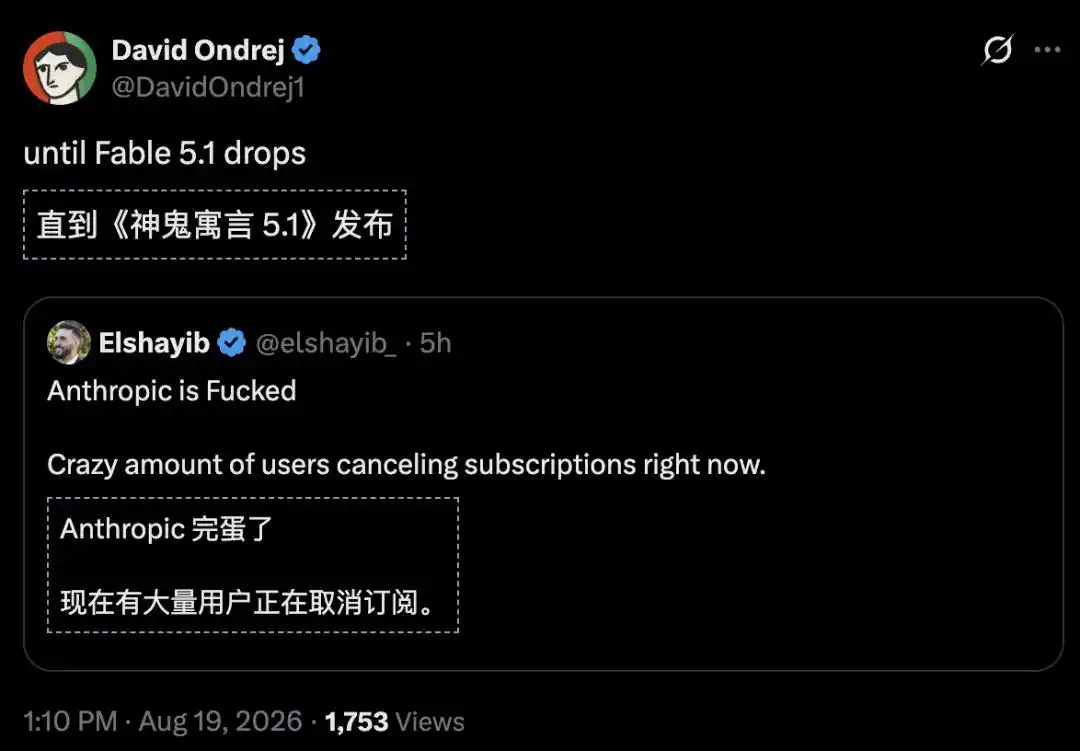
Latest data shows the early explosive growth phase of Claude Code has officially ended.

Now, new user growth is in the single digits, while old users are defecting in droves.

Many loyal CC users have already switched to its old rival, OpenAI's Codex.

ARR Growth Rate Plummets to 5.2%, the Frenzied Dash Halts

Today, the well-known data tracking platform TickerTrends released a new report, data shows—

Claude Code's growth engine has clearly "stalled."
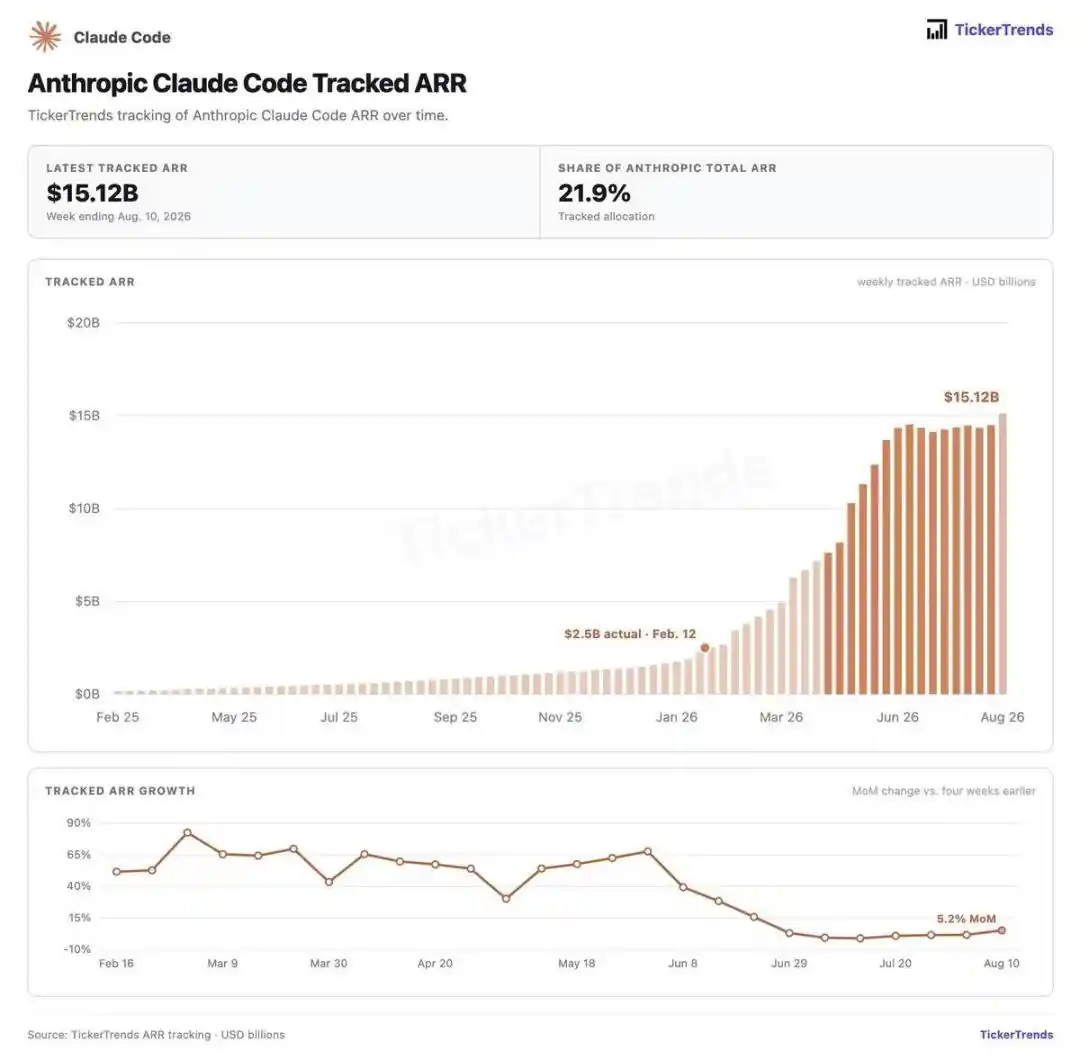
Once, Claude Code had a breathtaking growth curve.

Claude Code's ARR was around $2.5 billion on February 12, 2026; it skyrocketed to $6.3 billion by the end of March; broke through $10.3 billion by the end of April; and by June, that number had exceeded $14 billion.

Nearly a sixfold increase in just a few months!

This is not only a miracle in AI history but a myth in the entire history of the software industry. Investors were ecstatic, and the entire tech world gasped in amazement.

But Claude Code's myth ended in August 2026.

As of August 10th, Claude Code's tracked ARR stalled at $15.12 billion.

At first glance, a $15 billion plate is still massive (accounting for 21.9% of Anthropic's total tracked ARR), but if you look at the month-over-month growth rate, this number has plummeted to 5.2%!

What does 5.2% mean? For an AI unicorn at the forefront of the hype, this number indicates it has prematurely entered the low-growth period of "traditional software."

Data doesn't lie, especially for SaaS and AI subscription products. ARR is the lifeline.

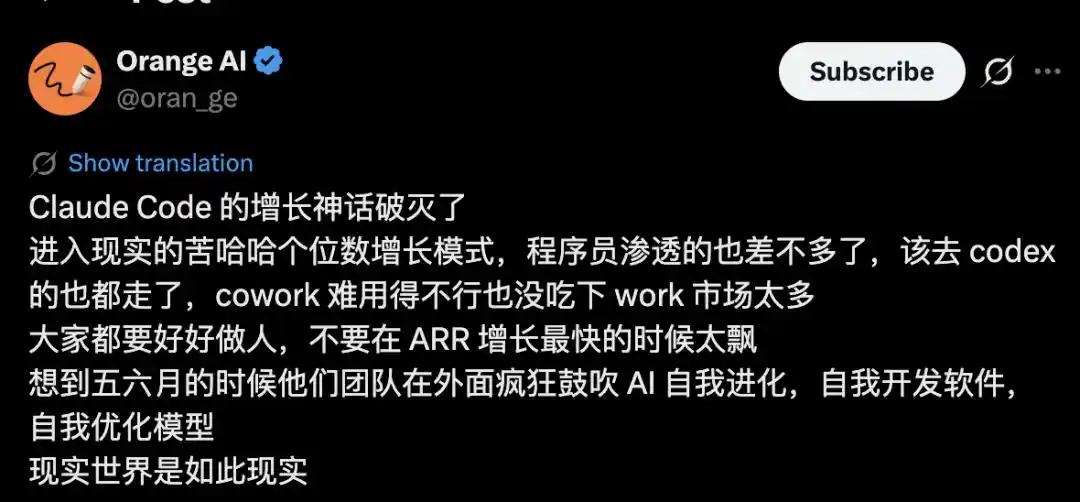
As tech commentator Orange AI pointed out:

The growth myth of Claude Code is shattered.

Entering the harsh reality of single-digit growth mode, programmer penetration is almost done, those who were going to Codex have left, and Cowork is too difficult to use and hasn't captured much of the work market.
Why has growth stalled?

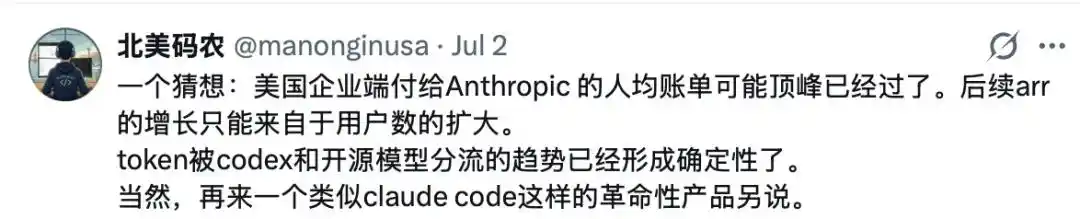
First, penetration among the programmer community is nearing its ceiling.

Globally, the number of core developers willing to pay for advanced AI coding tools is ultimately limited. Those who were going to buy have bought it. Where will the new growth come from?

Second, the Cowork feature, on which Anthropic had placed high hopes to change white-collar workflows, has suffered a resounding failure.

User feedback is almost universal: Cowork is terribly difficult to use, completely failing to bite into the massive Work market as expected.

The product capability didn't keep up with the ambition. The attempt to break into new markets failed, naturally leading to competition within the existing market.
Invisible Watermark Incites Public Outrage, Large-Scale "Cancel Wave" Erupts

Slowing growth is only an internal worry. A more fatal external threat is the "cancel wave" spreading across social networks.

The direct trigger for this subscription cancellation crisis is a new feature rolled out globally in early August 2026—"Invisible Text Watermarking."

It's reported that Anthropic took this step to comply with increasingly stringent EU regulations. However, this move infuriated users.

This watermark silently embeds itself into all text and code generated or processed by Claude, completely enraging programmers and writers.

For many premium users paying around $100 monthly for Claude Pro/Max subscriptions, AI is just an auxiliary tool.

They might put their core code into Claude to find bugs, or toss tens of thousands of words of confidential documents in for light polishing.

Now, anything touched by Claude gets permanently stamped with the "AI-generated" mark on these original works born from human effort.

In interviews with foreign media, several users who angrily canceled expressed their fury: "This pollutes our work!"
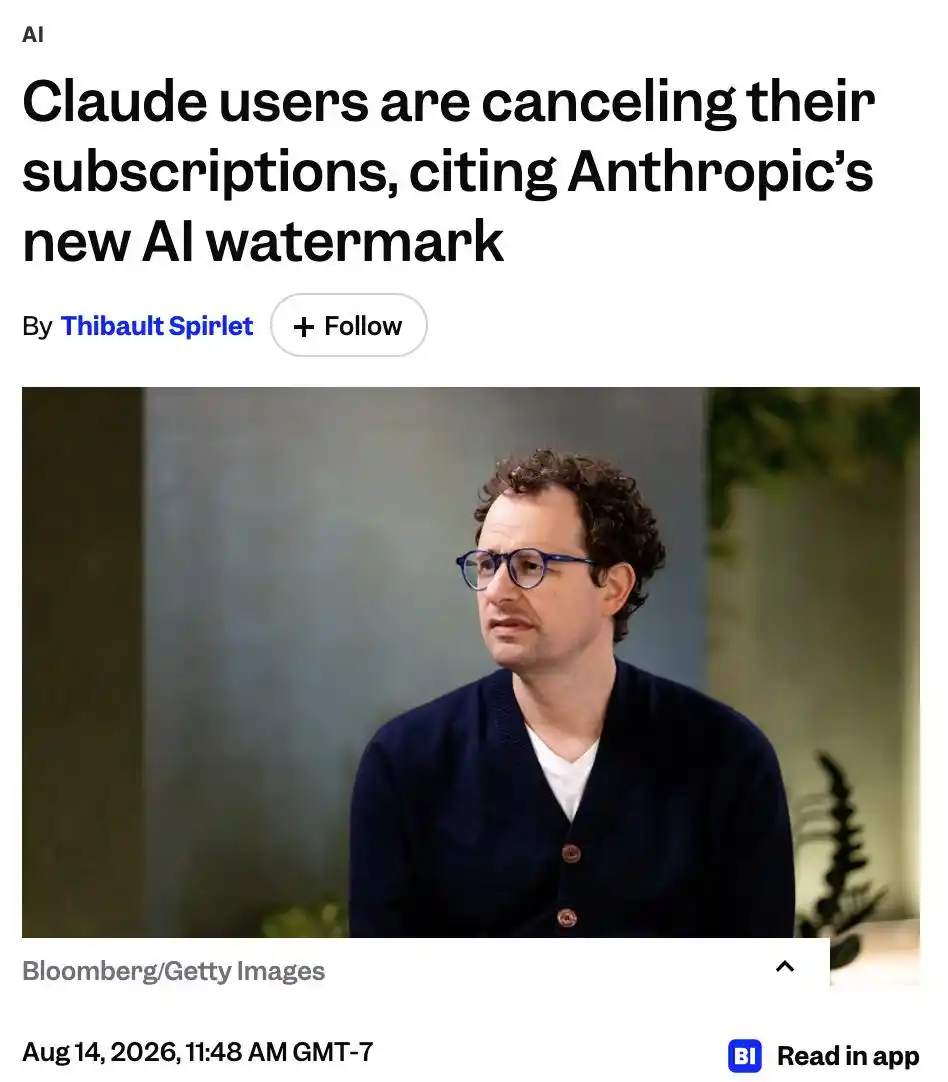
Once code is secretly watermarked, indie developers face huge trouble—they work hard to deliver to clients, only to potentially face lawsuits and breach of contract penalties.

Programmers at big companies are even more panicked. If the company's core codebase gets "contaminated" by AI watermarks, and compliance audits find out, their career prospects could be ruined.

And the watermark is just the trigger.

The subsequent official moves piled on the negative effects, thoroughly grinding everyone's patience into the ground.

For instance, the miserly token limits.

Unlike OpenAI's Thibault, who frequently resets limits, Anthropic, after being heavily criticized, reluctantly increased the weekly token limit by 50% (and only until the end of August).

But for heavy users who rely on it daily, this isn't even enough to fill the gaps! The pain of being rate-limited in the middle of coding, who understands?

Additionally, there's the Schrödinger-like model experience.

The previously hyped-up god-tier model Fable 5, after its June launch, kept causing problems.

When writing complex business logic code, its performance is like a lottery—sometimes divine, sometimes idiotic, making it impossible to fully trust.

Since it's expensive, heavily overpriced, and aggressively milking users, it's no surprise users are revolting.

OpenAI Codex's Frenzied Counterattack

Just as Claude Code is mired in trouble and losing users in droves, its arch-nemesis—OpenAI Codex—is feasting.
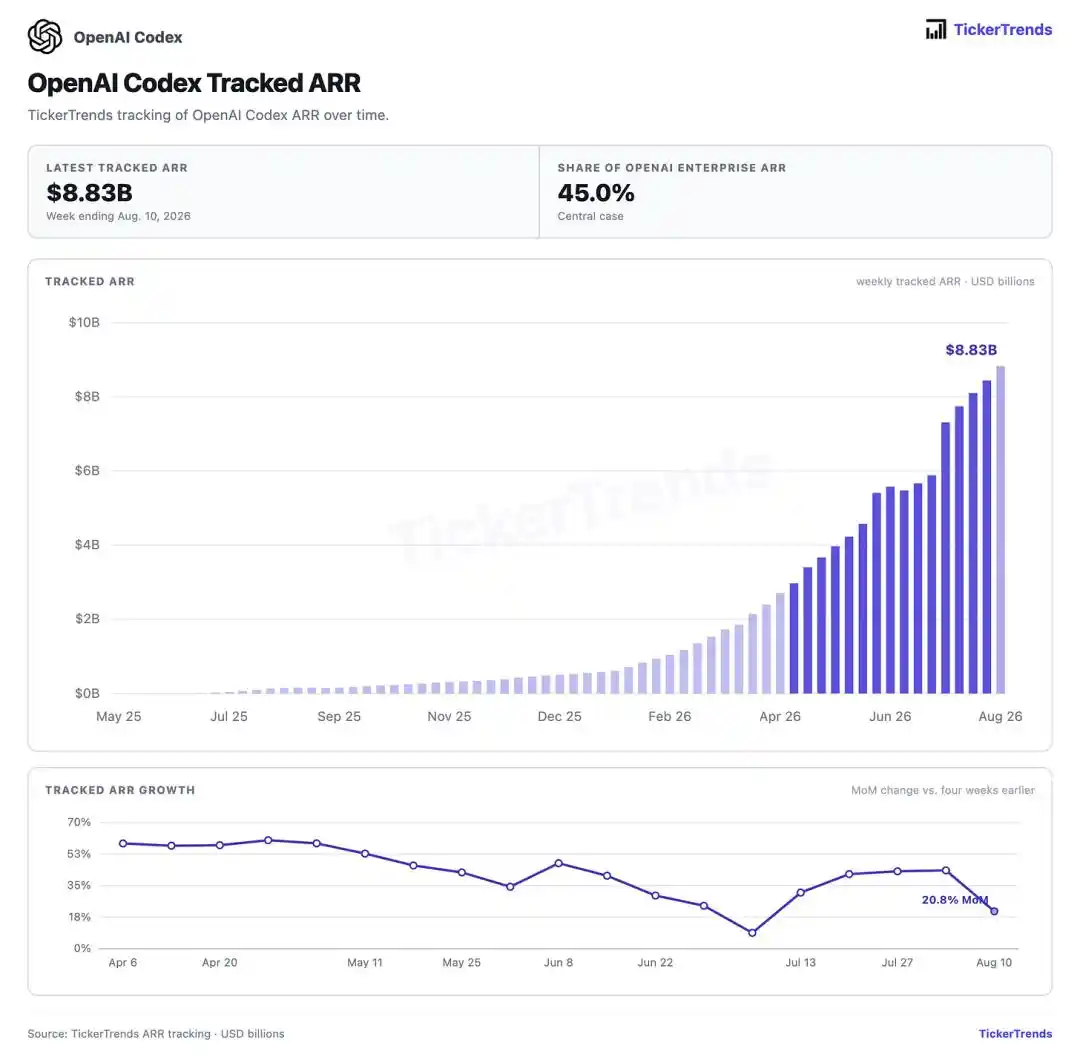
Comparative data from TickerTrends paints a picture of "fire and ice."

In the most recent four weeks ending August 10th, OpenAI Codex's month-over-month growth rate reached a staggering 20.8%, a full four times that of Claude Code (5.2%)!
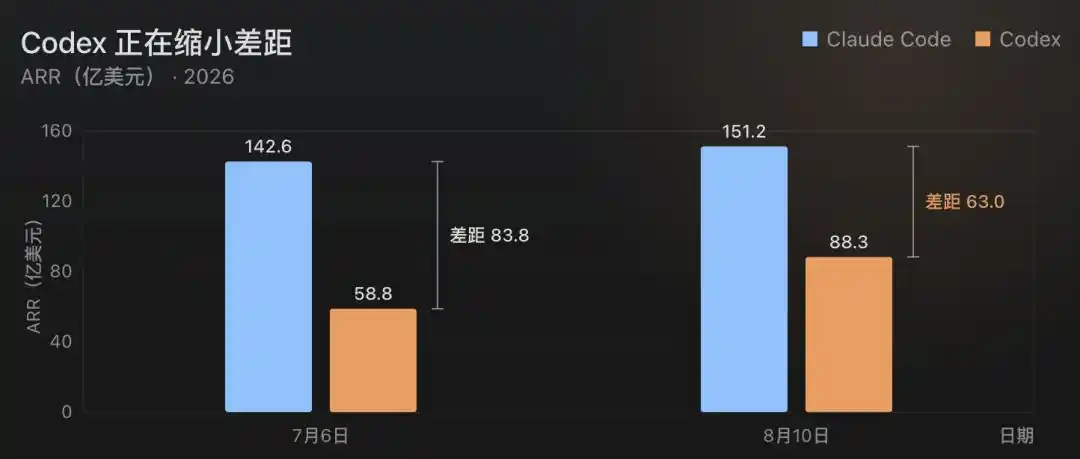
Why is Codex so strong? The answer is simple: it has absorbed a large number of "refugees" from Claude.

On platform X, numerous developers stated that due to the watermark and token limits, they have canceled their Claude subscriptions and fully switched to Codex.

Codex has looser limits, more seamless IDE integration, no disgusting invisible watermarks, and the backing of OpenAI's powerful enterprise sales network (Codex currently accounts for about 45% of OpenAI's enterprise ARR).

As one comment said: "Those who were going to Codex have left." Users are voting with their feet.

Even Cursor, recently acquired by SpaceX, has started a subsidy war, offering a $200 premium subscription directly for a "Claude cancellation screenshot."
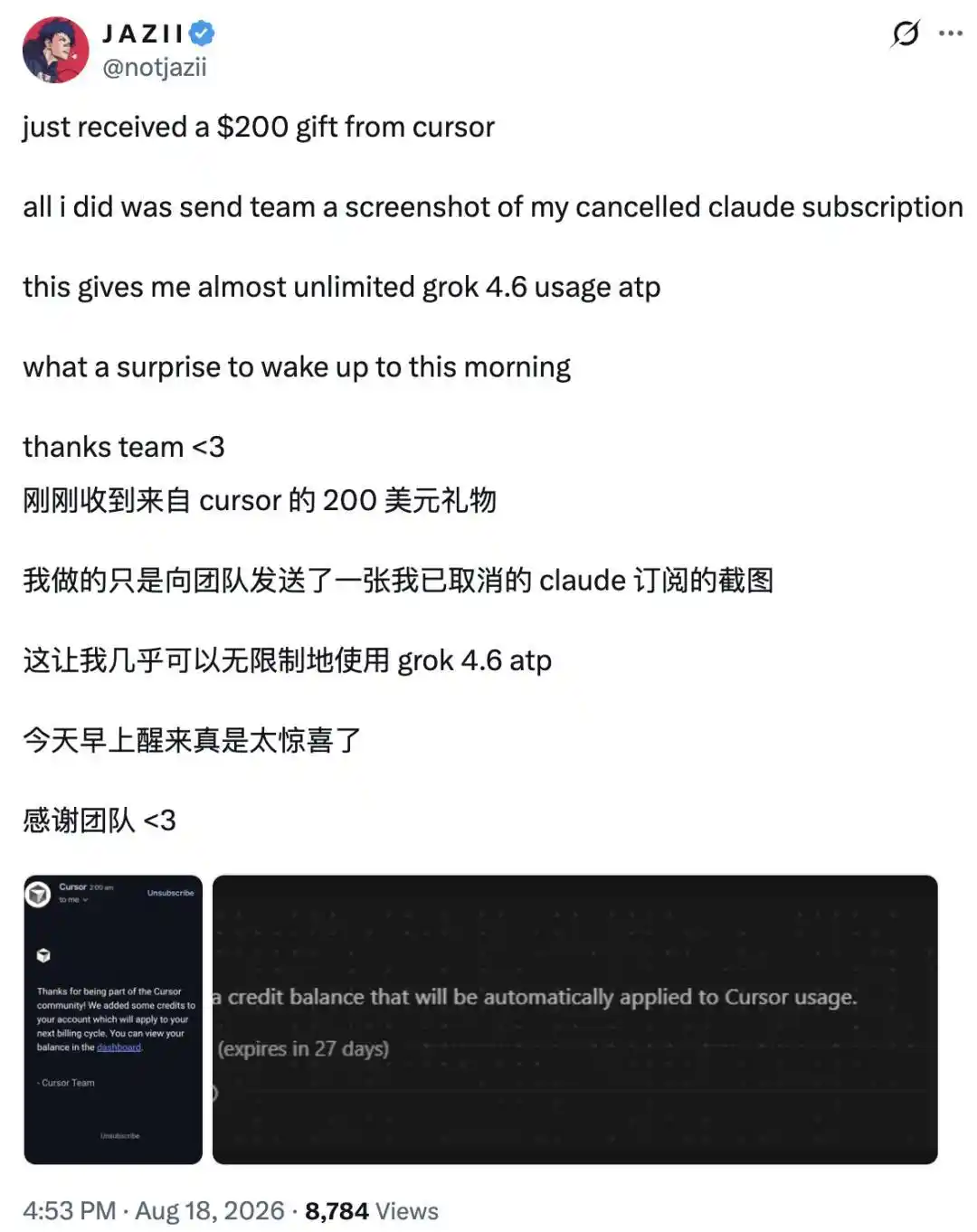

The moat Claude Code built early on with its ultra-long context and impressive zero-shot coding capabilities is being slowly filled in by OpenAI and Cursor with better product experiences and ecosystems.

The Market Enters a Cooling-Off Period, Waking from the "AI Self-Evolution" Dream

Looking back to May and June of this year, how triumphant Anthropic was then.

The Fable 5 model had just been released, team members were touting the new narrative everywhere: "AI has already gained the ability to develop software on its own." "The role of human programmers will be redefined."

At the peak of its ARR surge, all of Silicon Valley was immersed in a frenzy of "AGI is about to arrive, we are building gods."

This narrative is extremely sexy and also extremely easy to make those involved feel "high."

However, just two months later, reality harshly slapped this boastful narrative.

When the tide recedes, companies face the cold, hard business reality—

Corporate budgets are finite; compute is finite; workers' demands are quite humble (they just want the tool to be useful, not cause trouble, and have enough tokens).

What users truly care about is: "Can you stop putting watermarks in my code? Can you raise the hourly message limit a bit? Can you design your Cowork feature to be usable by humans?"

This is precisely the common dilemma facing all AI super-unicorns now.

CC's technical foundation is undoubtedly top-tier, but in product operations, commercialization strategy (like forcefully pushing watermarks), and understanding user psychology (like pricing and limits), it acts like an arrogant novice, leading to backlash.

What truly pushed the discussion to a poignant point is the critique at the capital and narrative level.

Some bluntly stated: Anthropic's roughly $2 trillion IPO valuation is absurd, even higher than SpaceX's.

Yet the reality is, it doesn't own any hardware, has no real moat, and the prospects aren't bright. Serious companies like SpaceX, whose intelligence is nearing and will soon surpass these models, will also see their revenue catch up.

As for the IPO, more people will see it as a tool to quickly offload shares and achieve a graceful exit.

Now, the market has moved from the blind rush period into a cooling-off period.

The days of feasting on hype and early-mover advantages are over.

Although Anthropic still holds a trump card—Fable 5.1—if it continues with the watermark, will users accept it?

One final piece of advice for Anthropic: Please be decent and stay humble.

Don't get too arrogant during growth, because your patrons can overturn the table and leave at any moment.

References:

https://blog.tickertrends.io/p/claude-code-vs-openai-codex-arrhttps://techcrunch.com/2026/08/17/anthropics-annualized-revenue-surges-to-65b/https://x.com/oran_ge/status/2090040293383082085

This article is from the WeChat public account "New Zhiyuan", author: Aeneas David

Criptos en tendencia

Preguntas relacionadas

QWhat is the main reason behind the recent surge in subscription cancellations for Claude Code?

AThe main reason is the controversial introduction of an 'invisible text watermark' on all text and code generated or processed by Claude, which users fear will taint their original work and lead to potential legal or compliance issues.

QAccording to the data from TickerTrends, how much did Claude Code's ARR growth rate drop to by August 10th?

AClaude Code's ARR growth rate plummeted to 5.2% by August 10th.

QWhich competing AI coding tool is reportedly gaining a significant number of users from Claude Code?

AOpenAI's Codex is gaining a significant number of users from Claude Code, with its recent four-week growth rate reaching 20.8%, four times that of Claude Code.

QWhat was the ambitious new narrative promoted by Anthropic's team during the peak of Claude Code's growth?

AThe team promoted a narrative that AI had achieved 'self-developing software capabilities' and that the role of human programmers would be redefined.

QWhat incentive did Cursor, recently acquired by SpaceX, offer to attract Claude Code subscribers?

ACursor offered a $200 premium subscription to users who provided screenshots proving they had cancelled their Claude subscription.

Lecturas Relacionadas

BTC Sees Largest Single-Day Short Liquidation in History: Overnight $1.1 Billion Short Positions Evaporate, But Calling a Bull Return is Premature

Bitcoin experienced its largest single-day short liquidation in history, with approximately $1.191 billion in short positions being forcibly closed within 24 hours as the price surged nearly 7% to approach $70,000. This event, occurring on the evening of August 19, resulted in total liquidations of about $1.345 billion across the network. The massive short squeeze was attributed to a combination of catalysts: a White House meeting between former President Trump and crypto industry executives fueling regulatory optimism, and a more substantial signal from the U.S. Treasury doubling its liquidity support for long-term bond repurchases, hinting at looser macro liquidity for risk assets. Data showed strong institutional buying, with U.S. spot Bitcoin ETFs seeing significant inflows. The liquidation process itself created a feedback loop, accelerating the price rise as forced buy-backs pushed prices higher. This event surpassed the previous record for BTC perpetual short liquidations set during the volatile "5.19" period in 2021. While such extreme short liquidations have historically signaled a potential medium-term bottom formation, analysts caution that the market often undergoes weeks of consolidation and "cooling off" afterward. Current sentiment remains mixed, with the Fear & Greed Index still in "Fear" territory, and the key test for the rally being whether it can sustain momentum to challenge higher resistance levels like $75,000. The article concludes by warning against immediate "bull market is back" assumptions, emphasizing that history provides context but not guaranteed outcomes.

marsbitHace 12 min(s)

BTC Sees Largest Single-Day Short Liquidation in History: Overnight $1.1 Billion Short Positions Evaporate, But Calling a Bull Return is Premature

marsbitHace 12 min(s)

Websea Global RWA Summit Successfully Held: Focusing on New Opportunities in China-Kazakhstan Digital Economy, Releasing Signals of Cross-border Collaboration

Websea Global RWA Summit Successfully Held: Focusing on China-Kazakhstan Digital Economy Opportunities, Releasing Signals for Cross-Border Synergy When traditional industries seek new channels for globalization and digital technologies reshape capital, assets, and collaboration methods, an industrial dialogue connecting China, Kazakhstan, and global markets took place in Almaty. On August 18, 2026, the "2026 Global RWA Real-World Asset Tokenization Enterprise Globalization Resource Matching & China-Kazakhstan Industrial Investment Conference," co-hosted by Websea, concluded successfully in Almaty, Kazakhstan. Centered on RWA digitization, cross-border industrial synergy, and investment promotion, the summit gathered industry representatives, investors, digital economy practitioners, creators, and media from China and Kazakhstan to explore the future of a digital economy community. The event shifted focus from mere "project showcases" to fostering deeper "industrial synergy." It featured project roadshows and panel discussions on topics like "Mining Future·Digital Empowerment," "Real Estate Renewal·Urban Evolution," "Green Energy·RWA Opportunities," and "The Globalization Logic of Real Economy." Mr. Yerbol Kharbayev, Chairman of the Kazakhstan Association of Special Economic Zones, emphasized that RWA's significance lies not only in technology but in enhancing asset transparency, collaboration efficiency, and cross-border connectivity through digitization. The discussions highlighted a move towards a deeper "Digital Economy Community" between China and Kazakhstan. Key points included the need for an open, transparent, and stable business environment to attract long-term investment and the crucial role of synergy between governments, enterprises, platforms, and communities. The summit facilitated strategic cooperation signings and targeted B2G/B2B matching, providing a direct channel for Chinese enterprises exploring the Central Asian market. As an invited digital asset platform, Websea participated in brand presentations and the launch of initiatives like a Creator Alliance and a Web3 MCN agency. Herbert Sim, Global CMO of Websea, stated that platform development is fundamentally rooted in user trust and real experience. He expressed gratitude for user and partner trust, underscoring Websea's commitment to asset security, transaction experience, risk awareness, and user rights protection. Websea aims to contribute to the global digital economy through optimized services and open collaboration. The summit also launched the Web3 Beauty Alliance - Central Asia Chapter, a China-Kazakhstan Quality Creator Alliance, and Web3 MCN agencies, expanding the dialogue beyond industry and capital to include technology, content, community, and brand building. The event concluded by signaling that the future of the digital economy will be co-created by a broad range of participants. It requires institutional and infrastructural support, long-term commitment from enterprises, and the sustained trust of users, partners, and communities. With the summit's conclusion, a new chapter in China-Kazakhstan industrial synergy and digital economy cooperation has begun. Websea will use this as a starting point to continue exploring a secure, open, and sustainable digital future alongside global users and partners.

marsbitHace 21 min(s)

Websea Global RWA Summit Successfully Held: Focusing on New Opportunities in China-Kazakhstan Digital Economy, Releasing Signals of Cross-border Collaboration

marsbitHace 21 min(s)

Russia's Banking Bleed and the Crypto Hunt: Citizens Have Withdrawn 24 Billion Euros from Banks This Year; Bill Limiting Total Crypto Purchases Set to Take Effect

**Title: Russia's Banking System Bleeds Cash as Citizens Turn to Crypto, But New Law Imposes Strict Limits** **Summary:** Russia is witnessing a significant outflow of cash from its banking system, with citizens withdrawing approximately €24.4 billion in the first seven months of 2026. This trend accelerated in July, marking the highest monthly increase for the year. Major banks like Gazprombank and Sberbank have reported substantial deposit losses. Simultaneously, cryptocurrency transaction volumes have surged, with an estimated daily trading volume of around $650 million. Officials note that annual crypto transactions exceed 10 trillion rubles, largely occurring outside regulated channels. Citizens are increasingly using crypto as a tool to hedge against currency depreciation and financial uncertainty. In response, President Putin signed the "Digital Currency and Digital Rights Law," with key provisions taking effect on September 1, 2026. This law severely restricts access for ordinary citizens. Non-qualified retail investors will be limited to purchasing only about $3,600 worth of cryptocurrency (initially Bitcoin, Ethereum, and USDT) per year through any single licensed intermediary. Qualified investors and businesses face no such limits for cross-border settlements. Official explanations for the cash exodus cite technical factors like tax changes and digital payment disruptions. However, analysts and media point to deeper public concerns over potential asset freezes, economic instability related to the war, and a lack of trust in the financial system. Notably, September 1 also marks the public launch of the Digital Ruble, Russia's central bank digital currency (CBDC). This creates a dual dynamic: tightening control over decentralized crypto assets while introducing a state-controlled digital currency for payments. For ordinary Russians, traditional banking is losing appeal, crypto access is being capped, and the new Digital Ruble offers a third, fully state-managed pathway.

marsbitHace 45 min(s)

Russia's Banking Bleed and the Crypto Hunt: Citizens Have Withdrawn 24 Billion Euros from Banks This Year; Bill Limiting Total Crypto Purchases Set to Take Effect

marsbitHace 45 min(s)

Household & Personal Care Giant Quietly Becomes the Champion in 'Chip Cleaning'

Kao, the renowned Japanese consumer goods giant known for laundry detergent and facial cleansers, has quietly become a leader in the semiconductor precision cleaning agent market, as revealed in its recent financial report. The company's chemical business, which includes semiconductor precision cleaning agents, achieved net sales of 2472 billion yen (approx. RMB 104.4 billion) in the first half of fiscal 2026, growing 9.4% year-on-year and becoming its fastest-growing segment. Notably, Kao holds about a 60% market share in cleaning agents for package substrates and is also a leader in specific chemicals for NAND flash manufacturing processes. Its products have entered the supply chains of major chipmakers like TSMC, Samsung, and Kioxia. Kao's journey into semiconductors began with its core expertise in surface science, developed from its origins in soap and detergent manufacturing. The 1987 Montreal Protocol, which phased out ozone-depleting solvents like Freon, created a demand for alternative cleaning solutions. Leveraging its deep knowledge of surfactants and purification, Kao launched its "CLEANTHROUGH" aqueous cleaning agent in 1991, entering the precision cleaning market. Over the past three decades, Kao has expanded its product line to cover both front-end (wafer fabrication) and back-end (packaging) semiconductor processes. Its "precision interface control technology" addresses key challenges like particle removal, photoresist stripping, and cleaning complex structures in advanced packaging without damaging delicate materials. Beyond cleaning, Kao's portfolio extends to adjacent processes like dry film photoresist stripping. A key to Kao's success is its customer-centric business model. The company operates "Fine Cleaning Centers" in Japan and Taiwan, where it collaborates directly with clients on process development. This deep integration, coupled with the high cost and risk of switching validated materials in semiconductor production, creates strong customer loyalty. As the AI boom drives demand for complex chip packaging like CoWoS, which requires more numerous and difficult cleaning steps, Kao is strategically positioned. The company plans to defend its back-end dominance while expanding into DRAM and logic semiconductor markets. Kao's story mirrors that of other Japanese firms like Ajinomoto (ABF film) and TOTO (electrostatic chucks), which leveraged deep-rooted core technologies from seemingly unrelated industries to achieve leadership in critical, niche segments of the semiconductor supply chain.

marsbitHace 46 min(s)

Household & Personal Care Giant Quietly Becomes the Champion in 'Chip Cleaning'

marsbitHace 46 min(s)

Trading

Spot

Artículos destacados

Qué es DOGE M

Doge Matrix ($doge m): La Nueva Raza de Criptomonedas Impulsadas por la Comunidad Introducción En el paisaje en constante evolución de las criptomonedas, nuevos proyectos emergen constantemente, cada uno con el objetivo de captar el interés de inversores y entusiastas por igual. Uno de los últimos en entrar en este dominio es Doge Matrix, representado por el símbolo de ticker $doge m. Este proyecto ha atraído atención gracias a sus raíces en la popular cultura de memes que rodea a Dogecoin, estableciendo su lugar dentro del espacio web3. Este artículo tiene como objetivo proporcionar un análisis integral de Doge Matrix, cubriendo su visión general, creador, inversores, funcionalidad, cronología y aspectos notables. ¿Qué es Doge Matrix ($doge m)? Doge Matrix es un proyecto de criptomoneda impulsado por la comunidad que aparentemente se basa en el atractivo generalizado de Dogecoin, una moneda digital conocida por su mascota Shiba Inu y sus orígenes en memes. Si bien los objetivos generales de Doge Matrix no están ampliamente definidos, se caracteriza por un compromiso con la participación y el apoyo de la comunidad. A diferencia de las criptomonedas tradicionales que a menudo enfatizan la utilidad o el valor intrínseco a través de tecnologías subyacentes, Doge Matrix se posiciona dentro de un espacio que abraza el fenómeno cultural de las criptomonedas, apelando particularmente a aquellos que resuenan con la ética de los activos basados en memes. Aprovechando las fortalezas de la comunidad de Dogecoin, Doge Matrix opera como parte de un ecosistema más amplio, invitando a la participación y el compromiso de usuarios que comparten un interés en la criptomoneda y el paisaje digital. ¿Quién es el Creador de Doge Matrix ($doge m)? La identidad del creador de Doge Matrix sigue siendo desconocida. Esta falta de transparencia no es un acontecimiento poco común en el espacio de las criptomonedas, donde algunos proyectos se lanzan sin revelar las identidades de sus fundadores. La ausencia de información sobre el equipo fundador puede generar preguntas entre los posibles inversores sobre la responsabilidad y dirección del proyecto. ¿Quiénes son los Inversores de Doge Matrix ($doge m)? Hasta el momento, no hay información disponible públicamente que detalle los inversores o fundaciones de inversión que respaldan a Doge Matrix. El proyecto parece depender principalmente del apoyo de la comunidad en lugar de inversiones institucionales. Este modelo se alinea con la naturaleza impulsada por la comunidad de la iniciativa, fomentando un entorno donde la dirección del proyecto es moldeada por sus participantes en lugar de ser dictada por unos pocos patrocinadores financieros seleccionados. ¿Cómo Funciona Doge Matrix ($doge m)? Los detalles sobre los mecanismos operativos de Doge Matrix son algo vagos, reflejando una tendencia más amplia de proyectos en el espacio de las monedas meme donde las funcionalidades innovadoras no siempre están claramente articuladas. No obstante, Doge Matrix parece estar diseñado para aprovechar el ecosistema existente de criptomonedas alentar la participación de los usuarios mientras se conecta con las referencias culturales familiares asociadas a Dogecoin. Sus características potencialmente únicas derivan de las interacciones comunitarias en lugar de avances tecnológicos, enfatizando experiencias compartidas y colaboración entre los poseedores de tokens. Si bien las innovaciones exactas no se han delineado explícitamente, el proyecto parece crear un espacio donde los miembros de la comunidad pueden interactuar, compartir ideas y propulsar el potencial del proyecto hacia adelante. Cronología de Doge Matrix ($doge m) Reflexionar sobre la cronología del proyecto revela eventos notables que han definido su trayectoria hasta ahora: 25 de noviembre de 2024: Doge Matrix alcanzó su valor máximo histórico, marcando un hito significativo en su historia temprana. 1 de enero de 2025: Por el contrario, Doge Matrix alcanzó su valor mínimo histórico, ilustrando la volatilidad a menudo asociada con las criptomonedas, especialmente en las primeras etapas del ciclo de vida de un proyecto. En curso: El proyecto continúa siendo activamente negociado y respaldado por su comunidad, aunque aún no se han divulgado hitos u objetivos futuros específicos. Puntos Clave Sobre Doge Matrix ($doge m) Enfoque Comunitario En el corazón de Doge Matrix hay un compromiso con la participación de la comunidad. El proyecto prospera sobre la premisa de colaboración y objetivos compartidos entre sus miembros, enfatizando la importancia del esfuerzo colectivo. A diferencia de los proyectos centralizados que a menudo tienen una estructura de liderazgo definida, Doge Matrix actualmente muestra un enfoque más fluido hacia la gobernanza, donde la voz de cada miembro de la comunidad importa. Volatilidad El mercado de criptomonedas es notorio por su volatilidad, y Doge Matrix no es una excepción. Su historial de precios refleja fluctuaciones significativas entre valores altos y bajos, lo cual es típico de muchas nuevas criptomonedas, pero subraya los riesgos asociados con la inversión en tokens emergentes. Falta de Información Detallada Una de las características más llamativas de Doge Matrix es la escasez de información detallada sobre sus fundamentos tecnológicos y mecanismos operativos. Esta ambigüedad requiere que los posibles inversores realicen una diligencia debida exhaustiva antes de involucrarse con el proyecto. Conclusión En resumen, Doge Matrix ($doge m) ilustra una nueva ola de proyectos de criptomonedas que se apoyan en gran medida en la participación de la comunidad y la relevancia cultural. Si bien carece de ciertos detalles, como liderazgo claro, objetivos definidos y funcionalidad detallada, el proyecto ha logrado generar interés dentro de la comunidad cripto, aprovechando el atractivo establecido de la cultura de memes. Al igual que con cualquier inversión en el espacio de las criptomonedas, comprender los riesgos inherentes y realizar una investigación exhaustiva es esencial para los participantes potenciales. Doge Matrix se erige como un recordatorio de la naturaleza dinámica y, a veces, impredecible de la industria cripto, marcada por una evolución constante y entusiasmo por iniciativas impulsadas por la comunidad.

543 Vistas totalesPublicado en 2025.02.03Actualizado en 2025.02.03

Qué es DOGE M

Qué es $M

Entendiendo Mantis ($M): Una Nueva Era en la Interoperabilidad entre Cadenas En el paisaje en constante evolución de Web3 y las criptomonedas, nuevos proyectos se esfuerzan por ofrecer soluciones innovadoras destinadas a mejorar la experiencia del usuario y expandir las posibilidades funcionales dentro del ecosistema financiero descentralizado. Uno de estos proyectos que está ganando atención es Mantis ($M), un protocolo pionero fundado en los principios de interoperabilidad entre cadenas y liquidaciones basadas en intenciones. Este artículo profundiza en los aspectos esenciales de Mantis, incluyendo su funcionalidad central, creadores, respaldo de inversión, características innovadoras y hitos críticos. ¿Qué es Mantis ($M)? Mantis se describe como un protocolo de liquidación de intenciones multi-dominio que simplifica las interacciones entre cadenas, permitiendo a los usuarios ejecutar transacciones financieras complejas a través de varias plataformas de blockchain sin problemas. El protocolo opera a través de tres capas principales: Expresión de Intenciones: Los usuarios pueden articular sus objetivos de transacción utilizando un lenguaje natural facilitado por el DISE LLM, un modelo de lenguaje de IA avanzado. Por ejemplo, un usuario podría expresar el deseo de intercambiar Ethereum (ETH) por Solana (SOL) con una tolerancia de deslizamiento específica del 1%. Ejecución: Esta capa emplea una red de solucionadores que compiten para cumplir con las intenciones de los usuarios. Las transacciones se ejecutan utilizando mecanismos como Coincidencia de Deseos (CoWs) y Subastas de Flujo de Órdenes (OFAs), que aseguran que las demandas de los usuarios se satisfagan de manera óptima. Liquidación: Aprovechando el protocolo de Comunicación Inter-Blockchain (IBC), Mantis permite transacciones atómicas entre cadenas, permitiendo a los usuarios operar a través de varias cadenas soportadas, incluyendo Ethereum, Solana y Cosmos. Mantis está diseñado para introducir generación de rendimiento nativa para activos inactivos, utilizando pruebas criptográficas para mantener la integridad de las transacciones a lo largo de todo el proceso. Creadores y Equipo de Desarrollo Mantis fue concebido por la Composable Foundation, una organización impulsada por la investigación notable por su énfasis en soluciones de interoperabilidad de blockchain. Esta fundación colabora con instituciones académicas de renombre, incluyendo la Universidad de Harvard y la Universidad de Lisboa, contribuyendo a extensos esfuerzos de investigación y desarrollo que informan la arquitectura y funcionalidad de Mantis. El compromiso de la Composable Foundation de fomentar la innovación en el espacio de blockchain posiciona a Mantis como una solución robusta para la creciente demanda de interoperabilidad entre múltiples redes de blockchain. Inversores y Respaldo Si bien los detalles específicos sobre inversores individuales no se han divulgado públicamente, Mantis disfruta de un respaldo sustancial de varias entidades, incluyendo: Subvenciones del ecosistema de cadenas habilitadas por IBC, que apoyan el crecimiento del protocolo y su integración dentro de ecosistemas de finanzas descentralizadas. Asociaciones estratégicas con proveedores de infraestructura que mejoran las capacidades de la red de Mantis y sus estrategias de implementación. Financiamiento a través del tesoro de la Composable Foundation, asegurando un apoyo financiero sostenido para el desarrollo continuo y los costos operativos. Estos esfuerzos colaborativos reflejan un consenso entre las partes interesadas sobre la importancia de mejorar la funcionalidad entre cadenas y la utilidad potencial de las innovaciones infraestructurales de Mantis. Innovaciones Clave Mantis se distingue por varias innovaciones pioneras que mejoran su funcionalidad y utilidad: Intenciones Agnósticas a la Cadena: Los usuarios pueden iniciar transacciones desde cualquier cadena soportada mientras liquidan en otra. Esta flexibilidad empodera a los usuarios, impulsando una mayor interacción entre diferentes plataformas. Interfaz Potenciada por IA: La integración del DISE LLM permite a los usuarios realizar operaciones complejas de DeFi utilizando lenguaje natural, simplificando así las interacciones y haciendo que la tecnología blockchain sea accesible a un público más amplio. Captura de MEV Inter-Dominio: Mantis crea un mercado interno para el valor máximo extraíble (MEV) a través de competencias entre solucionadores. Este enfoque innovador permite una mayor eficiencia y extracción de valor en transacciones complejas. Capa de Liquidación Modular: El protocolo soporta varios métodos de verificación, incluyendo pruebas de conocimiento cero y rollups optimistas, proporcionando un marco versátil que puede adaptarse a las tecnologías de blockchain emergentes. Línea de Tiempo Histórica El desarrollo de Mantis está marcado por varios hitos críticos que trazan su trayectoria y crecimiento: | Año | Hito | |————|———————————————————————–| | 2022 | Desarrollo del concepto inicial dentro de la división de investigación de la Composable Foundation. | | Q3 2024 | Lanzamiento de la testnet con capacidades de puenteo entre Solana y Ethereum. | | Q1 2025 | Evento de Generación de Token (TGE) anticipado junto con el lanzamiento de la mainnet. | | Q2 2025 | Integración esperada del DISE LLM y expansión de las capacidades entre cadenas. | | 2025 H2 | Soporte planeado para más de 15 cadenas a través de futuras actualizaciones de IBC. | Esta línea de tiempo describe la evolución de Mantis, desde discusiones conceptuales hasta la implementación activa y fases de crecimiento futuro. Estrategia de Crecimiento del Ecosistema La estrategia de Mantis para el crecimiento del ecosistema incluye varias iniciativas diseñadas para fomentar la participación de los usuarios y el compromiso de los desarrolladores: Sistema de Créditos: Los usuarios pueden ganar créditos del protocolo al proporcionar liquidez y participar en programas de referidos. Estos créditos son canjeables por incentivos en el futuro, fomentando una comunidad de usuarios robusta. Kit de Desarrollo de Software Modular (SDK): Este conjunto de herramientas empodera a los desarrolladores para crear aplicaciones basadas en modelos impulsados por intenciones utilizando la infraestructura de Mantis, promoviendo así la innovación dentro de su ecosistema. Modelo de Gobernanza: A medida que el protocolo madura, los poseedores de tokens $M tendrán voz en la gobernanza del protocolo, permitiéndoles votar sobre actualizaciones y cambios propuestos, mejorando así el compromiso de la comunidad y la descentralización. Mantis representa un avance significativo en el ámbito de la arquitectura entre cadenas. Al integrar sin problemas algoritmos avanzados de IA con un marco de liquidación robusto, Mantis busca abordar los problemas de fragmentación dentro de los ecosistemas multi-cadena. Su enfoque innovador prioriza la mejora de la experiencia del usuario mientras se adhiere a los principios fundamentales de descentralización y seguridad, estableciendo un nuevo estándar para la futura interoperabilidad de las tecnologías blockchain. A medida que Mantis continúa su camino de crecimiento e implementación, promete ser un proyecto a seguir de cerca en el competitivo paisaje de Web3 y las finanzas descentralizadas. Con su enfoque en cruzar fronteras y elevar la participación del usuario, Mantis está preparado para ser una parte integral de los futuros desarrollos en el espacio de las criptomonedas.

157 Vistas totalesPublicado en 2025.03.18Actualizado en 2025.03.18

Qué es $M

Cómo comprar M

¡Bienvenido a HTX.com! Hemos hecho que comprar MemeCore (M) sea simple y conveniente. Sigue nuestra guía paso a paso para iniciar tu viaje de criptos.Paso 1: crea tu cuenta HTXUtiliza tu correo electrónico o número de teléfono para registrarte y obtener una cuenta gratuita en HTX. Experimenta un proceso de registro sin complicaciones y desbloquea todas las funciones.Obtener mi cuentaPaso 2: ve a Comprar cripto y elige tu método de pagoTarjeta de crédito/débito: usa tu Visa o Mastercard para comprar MemeCore (M) al instante.Saldo: utiliza fondos del saldo de tu cuenta HTX para tradear sin problemas.Terceros: hemos agregado métodos de pago populares como Google Pay y Apple Pay para mejorar la comodidad.P2P: tradear directamente con otros usuarios en HTX.Over-the-Counter (OTC): ofrecemos servicios personalizados y tipos de cambio competitivos para los traders.Paso 3: guarda tu MemeCore (M)Después de comprar tu MemeCore (M), guárdalo en tu cuenta HTX. Alternativamente, puedes enviarlo a otro lugar mediante transferencia blockchain o utilizarlo para tradear otras criptomonedas.Paso 4: tradear MemeCore (M)Tradear fácilmente con MemeCore (M) en HTX's mercado spot. Simplemente accede a tu cuenta, selecciona tu par de trading, ejecuta tus trades y monitorea en tiempo real. Ofrecemos una experiencia fácil de usar tanto para principiantes como para traders experimentados.

993 Vistas totalesPublicado en 2025.07.02Actualizado en 2026.06.02

Cómo comprar M

Discusiones

Bienvenido a la comunidad de HTX. Aquí puedes mantenerte informado sobre los últimos desarrollos de la plataforma y acceder a análisis profesionales del mercado. A continuación se presentan las opiniones de los usuarios sobre el precio de M (M).

活动图片