Claude Bill Skyrockets by 5 Billion, Surges 60-Fold Overnight—Can Your Token Budget Keep Up?

marsbitPublicado a 2026-06-01Actualizado a 2026-06-01

Resumen

An enterprise reportedly ran up a staggering $500 million bill on Anthropic's Claude AI in just one month due to a simple oversight: failing to set usage limits for employee accounts. This incident highlights a growing trend of runaway AI costs. Other examples include a Google Cloud user hit with an unexpected $18,000 bill from API key abuse, and an OpenAI internal experiment that consumed 603 billion tokens, costing $1.3 million in 30 days. Major AI providers like OpenAI and GitHub are shifting from flat monthly fees to granular, usage-based pricing (per input/output/cached token), causing shock for some users whose costs skyrocketed by orders of magnitude. The root causes extend beyond pricing. The rise of autonomous AI agents executing long, complex tasks has drastically increased token consumption. Furthermore, misaligned incentives, like internal "leaderboards" ranking employees by AI usage, can encourage wasteful "tokenmaxxing"—using powerful models for trivial tasks just to inflate metrics. This has sparked a new industry focused on cost optimization. Solutions include providing AI with better context (reducing redundant searches) and intelligent model routing (matching tasks to the most cost-effective model). Research indicates token consumption for agentic tasks can vary wildly (up to 30x for the same job) without guaranteeing better results, and models often underestimate their own costs. As AI expenses begin to rival or even surpass human labor costs for some t...

A $500 Million Bill in Just 1 Month!

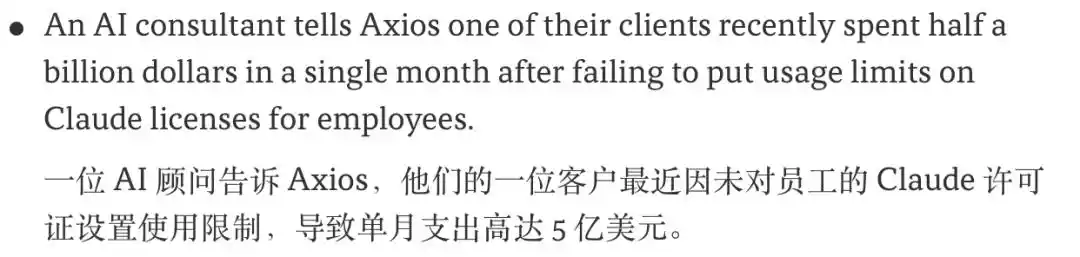
Recently, a shocking blunder erupted in the tech world. According to Axios, a company actually managed to rack up a $500 million bill on Claude in just one month!

The reason is laughable: management forgot to set usage limits when granting employees access to Claude accounts.
In fact, this isn't the only case of AI bills exploding.

In April, a Google Cloud user, whose publicly accessible API key was misused, received a bill for $18,000 overnight, despite having only a $7 budget set.

The unlucky user, Jesse Davies, is an Australian AI consultant and founder of Agentic Labs. He had set up two safeguards for his Google Cloud account: a A$10 (about $7) budget alert and a hard spending cap of $1,400.

As reported by Tom's Hardware, attackers discovered a Cloud Run service he had deployed months earlier from AI Studio, sending over 60,000 requests. Both safeguards failed: there was a delay in billing calculations, and by the time the system reacted, the amount had skyrocketed to $18,000.

In mid-May, Peter Steinberger, founder of the open-source project OpenClaw, posted a screenshot on X: a $1.3 million OpenAI API bill for 30 days.
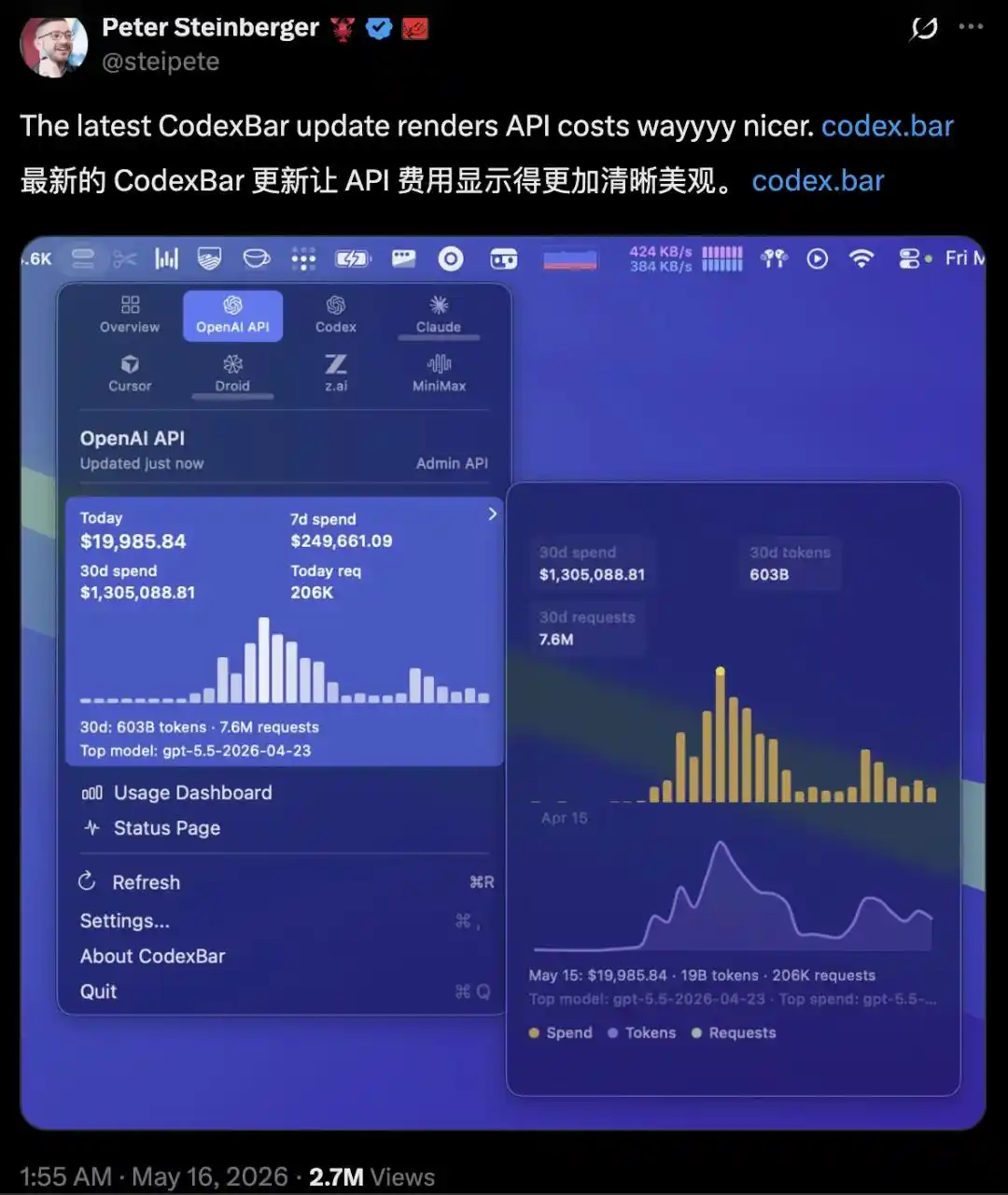
His team has only three people, but they orchestrated 100 Codex agents running in parallel: burning through 603 billion Tokens and making 7.6 million requests in 30 days. Fortunately, he didn't have to foot this $1.3 million bill himself.

Steinberger joined OpenAI this past February, and this $1.3 million was treated as an internal experiment:

to test the absolute limits of AI programming when token cost is not a consideration. He added that this was the result of Codex's "Fast Mode" (higher-tier billing); turning it off reduced the cost to about $300,000.

Even earlier, Uber's CTO Praveen Neppalli Naga had admitted to The Information that the company had exhausted its annual Claude Code budget by April, and their COO also publicly stated that AI costs were becoming increasingly "hard to justify."

$500 million, $1.3 million, $18,000—though these figures differ by orders of magnitude, they point to the same reality:

In the age of agents, any one of these—a compromised key, an army of agents running 24/7, or an account with forgotten limits—can blow up your token bill overnight.

Why Do AI Bills Explode?

The answer lies mainly in the shift in billing methods.

Starting April this year, OpenAI began transitioning from monthly flat fees to usage-based billing by Token.

On April 2, Codex billing shifted from per-message estimates to alignment with actual Token usage: Input, Cached Input, and Output Tokens are billed separately. On April 23, this rule was extended to all Enterprise, Edu, Health, and Gov plans: the invisible discount within the monthly fee was removed.

GitHub followed closely, just announcing: all Copilot plans will switch to usage-based billing effective June 1, 2026. The old premium request logic is scrapped, replaced with AI credits, settled based on actual consumption of Input, Output, and Cached Tokens against each model's API rate.

GitHub officially explained the reason for this change:

Currently, a quick chat question and a multi-hour autonomous coding task cost the user the same amount. GitHub has been subsidizing the heavy users, but this model is no longer sustainable.

Before the rise of AI agents, the costs of chat and completions were similar, and monthly fees could cover them.

After agents rose, a single task could run for hours and modify entire codebases, creating a cost difference of orders of magnitude between heavy and light users. The flat monthly fee model collapses in the face of such disparity.

The news sparked an uproar on Reddit and X.

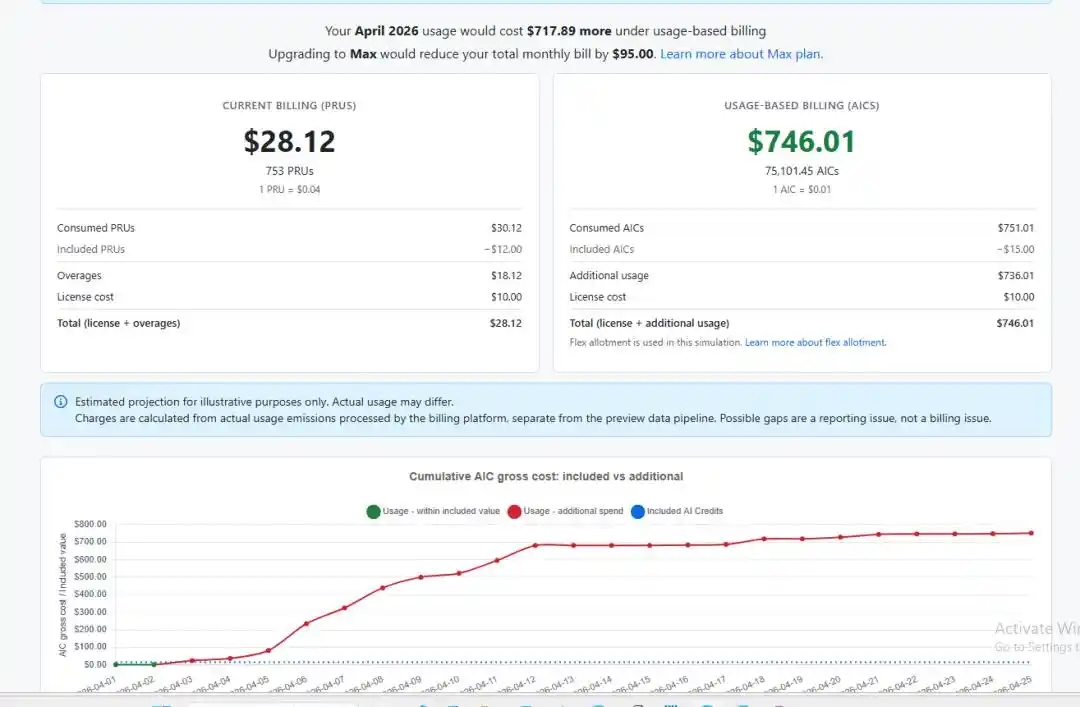
A developer with the ID JBusu shared a screenshot of their bill, bluntly calling the new pricing "a joke." Their previous monthly cost of $28.12 would become $746.01 under the new system. They've decided to cancel, "At this price, I could rent a cloud server myself and it would be cheaper."

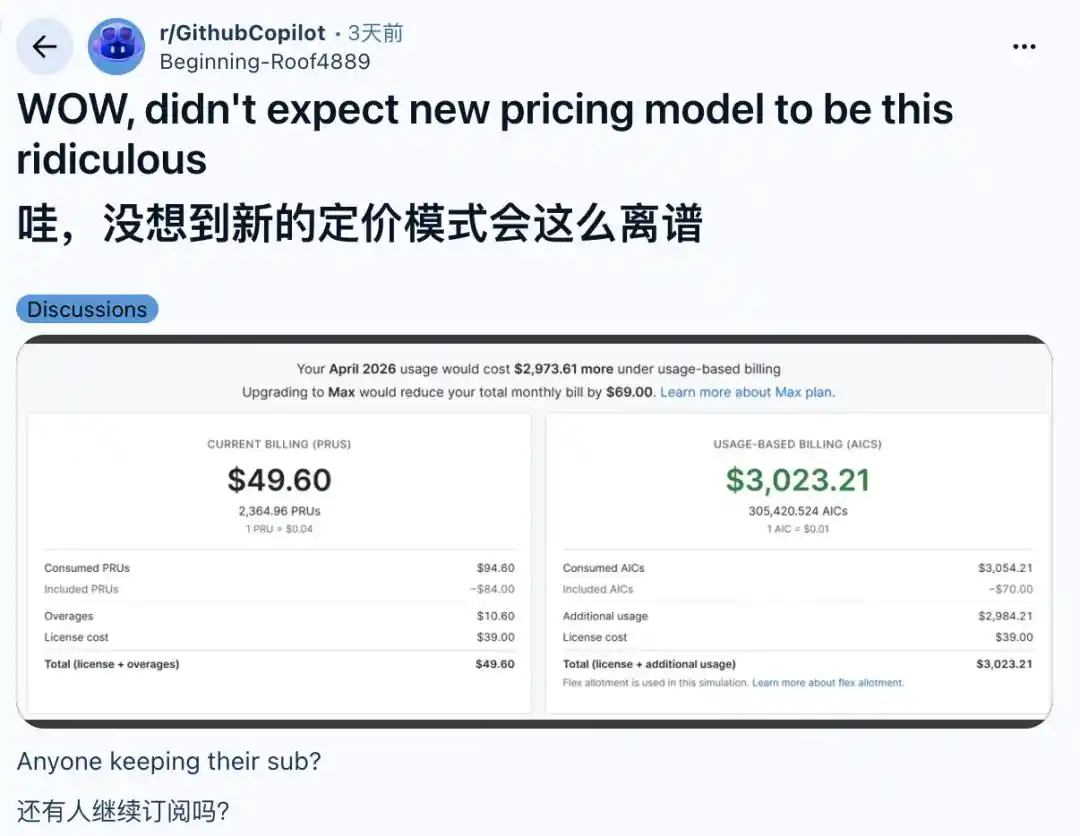
Another user shared an even more extreme screenshot, showing costs soaring from $50 to $3,000. They said they never expected pricing to be this outrageous, "Is anyone still subscribing?"
However, some veteran Copilot users countered: these extreme bills are likely burned by "vibe-coders" who aren't mindful of token usage and may not represent normal use.

One veteran user commented: "I use it all day long and rarely exceed limits by month-end. It's hard to believe this is due to differences in task complexity." Another was more direct: "It's people wanting fully automated YOLO-mode development, letting AI run wild. Culling this waste is actually good for everyone else."

One thing is clear: GitHub hasn't abolished monthly fees; the base subscription price remains unchanged. What has changed is that extra usage, agent tasks, and calls to more expensive models now fall under usage-based billing.

The hardest hit are those heavy agent users who rely on Copilot for long-chain tasks.

The Leaderboard Gamed by Its Own Users

The collapse of flat fees is partly due to platforms changing their billing rules, and partly because AI users themselves are burning through tokens.

In May, Business Insider reported that Amazon took down an internal AI usage leaderboard called KiroRank.

The report cited insiders saying the leaderboard quietly encouraged a strange work style: some employees, to climb the ranks, would burn tokens on tasks that didn't solve actual problems, purely for ranking.
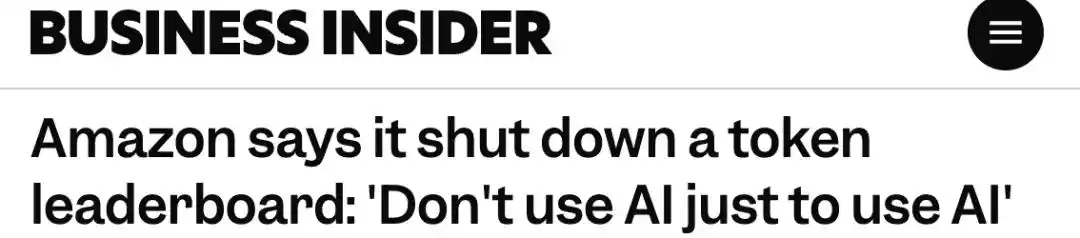
After the story broke, Amazon SVP Dave Treadwell directly addressed all employees: "Don't use AI for the sake of using AI. Use it to solve customer problems, business problems, to innovate."

Though absurd, this is hardly surprising. When "burning tokens" gets you on a leaderboard, employees will naturally burn tokens.

Silicon Valley has coined a term for this phenomenon: Tokenmaxxing—treating consumption volume as productivity.

Axios's report also mentioned CTOs discovering employees using cutting-edge AI models to check the weather or write routine emails—trivial tasks that, when run on the most expensive frontier models, can silently send bills soaring.

KiroRank wasn't part of Amazon's official evaluation system but an informal tool built by employees. Yet it clearly exposes a classic management principle: when KPIs are set wrong, people will use the cleverest ways to game the system.

Equating "how much was used" with "how well it was done"—this is the systemic root of this wave of AI waste.

Those Who Count Tokens Are Already Making Money

On the flip side of token bill anxiety, some are quietly turning it into a business.

First approach: Feed the AI with context.

Glean is actually Arvind Jain's own company. It builds an enterprise AI work assistant: unifying knowledge scattered across a company, giving employees' AI direct context so they don't have to dig around. The AI takes fewer detours, naturally burning fewer tokens.

This mechanism helped Glean's annual revenue triple in 15 months, crossing $300 million, with clients including Databricks, Reddit, and Samsung.

Second approach: Delegate tasks to the right model.

This is what model routing startup Factory AI does: automatically routing each task to the most suitable model, cheap ones for simple tasks, top-tier for complex ones. Arvind also noted: Do routing right, and you can save 10x.

Both paths lead to the same destination: Let AI work, but don't let it burn money indiscriminately.

Academic research is also laying the groundwork for this shift.
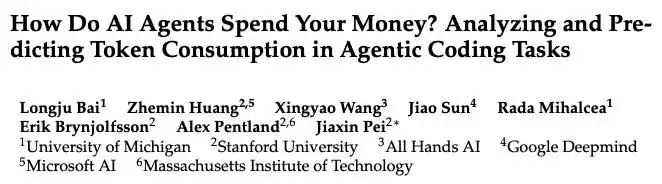
https://arxiv.org/pdf/2604.22750

An arXiv paper from April 2026 systematically broke down how agent coding tasks actually burn money for the first time.

Conclusion One: Token consumption for agent tasks can be thousands of times higher than ordinary code reasoning or code chat, with Input Tokens being the main cost driver.

Conclusion Two: Running the same task multiple times can result in a 30x difference in Token consumption.

Conclusion Three: Higher Token consumption does not necessarily lead to higher accuracy. Accuracy often peaks at medium cost—burning more beyond that spends money without yielding better results.

The paper also found that even frontier models can't reliably predict their own token consumption, generally underestimating the real cost.

You think spending more gets more done. In reality, money is spent, the work isn't necessarily better, and the budget is still unpredictable.

When AI Bills Start Rivaling Labor Costs

"This is the first time in my memory that technology costs are starting to be on par with human costs."

On May 29, Glean CEO Arvind Jain said this in an interview with CNBC's Deirdre Bosa.
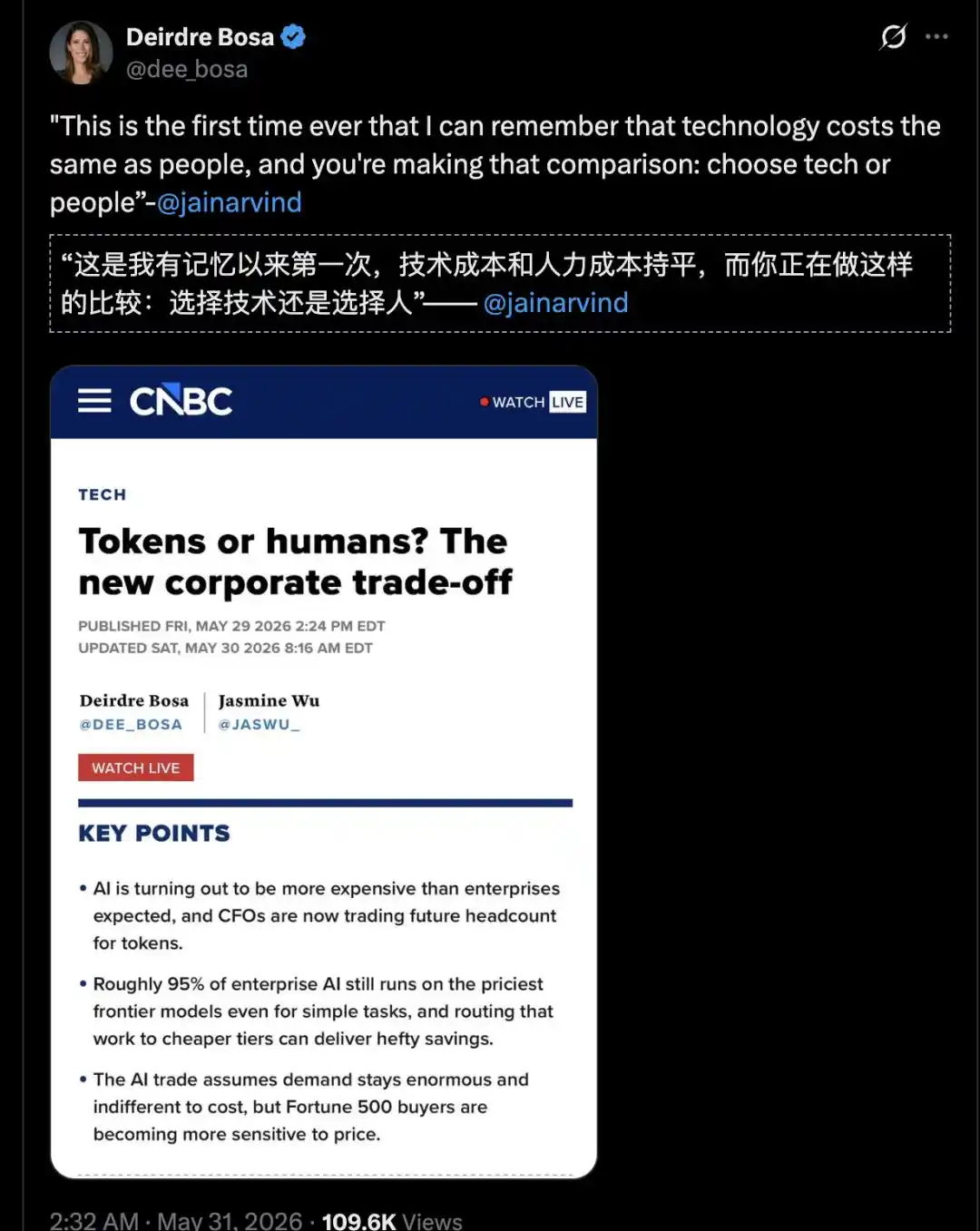
Observations from Nvidia's Vice President of Applied Deep Learning, Bryan Catanzaro, corroborate this.

He mentioned in an Axios interview that for his team, compute costs far exceed employee salaries.

Similar trends are emerging across multiple companies: from enterprise AI player Glean, to AI compute seller Nvidia, to AI user Uber—all are re-evaluating this equation.

In Arvind's view, historically, technology was just a small slice of overall corporate costs. But now, AI costs are catching up to payrolls. Many companies' annual AI budgets are often burned through in just one or two months.

Over the past year, AI usage rate was a worshipped metric: more usage meant being advanced, burning tokens meant embracing the future. Now, many companies are reflecting on that simple question: What exactly did all those burned tokens buy?

The window of free or flat-rate unlimited usage is precisely closing at this moment.

Going forward, the question facing all developers is this: How to budget meticulously and maximize the value of every single Token.

Undoubtedly, the true winners of the future will be those who learn to count tokens first.

References:

https://x.com/dee_bosa/status/2060791500049613306%20

https://www.cnbc.com/2026/05/29/-tokens-or-humans-the-new-corporate-trade-off.html%20

https://www.axios.com/2026/05/28/ai-spending-roi-enterprise-costs%20

https://www.businessinsider.com/amazon-ai-leaderboard-tokenmaxxing-2026-5

This article is from the WeChat public account "AI Era Insights", author: ASI启示录

Preguntas relacionadas

QWhat is the main reason behind the dramatic increase in AI usage costs as discussed in the article?

AThe primary reason is the shift from flat-rate monthly subscription models to consumption-based pricing (charging per Token used). This change, implemented by companies like OpenAI and GitHub, means that intensive AI agent tasks, which can consume orders of magnitude more tokens than simple chats or completions, now incur significantly higher costs.

QWhat incident involving a leaked API key led to a massive unexpected bill, and how much was it?

AAn Australian AI consultant named Jesse Davies had a Google Cloud API key exposed from a public service. Attackers used it to make over 60,000 requests, resulting in a bill of $18,000, despite him having set a budget alert and a hard spending limit.

QWhat does the term 'Token maxxing' refer to in the context of corporate AI use?

A'Token maxxing' refers to the practice of employees excessively consuming AI tokens, not to solve real problems, but to climb internal usage leaderboards (like Amazon's KiroRank) or meet misguided productivity KPIs that equate high token usage with good performance.

QWhat was the key finding of the April 2026 arXiv paper regarding AI agent coding tasks and cost?

AThe key finding was that AI agent tasks can consume up to a thousand times more tokens than standard code reasoning/dialogue, primarily due to input tokens. Crucially, higher token consumption does not necessarily lead to higher accuracy, with performance often plateauing at a medium cost level.

QAccording to the article, what are the two main business approaches emerging to help manage and reduce AI token costs?

A1. Providing context to AI: Companies like Glean build systems that give AI assistants direct access to relevant company knowledge, reducing the need for lengthy searches and context-building, thus saving tokens. 2. Model routing: Startups like Factory AI automatically route tasks to the most cost-appropriate AI model (e.g., simple tasks to cheaper models, complex ones to top-tier models), potentially saving up to 10x in costs.

Lecturas Relacionadas

Anthropic's IPO Launch: Commercial Miracle or Valuation Bubble?

Anthropic has confidentially filed for an IPO, led by Morgan Stanley and Goldman Sachs, potentially going public by October. Following its latest $650 billion funding round, its pre-IPO valuation stands at $965 billion, with projections reaching up to $2 trillion at listing, which would make it the highest-valued private company ever. The article, written by Fu Sheng, addresses skepticism that this represents an AI bubble akin to the 2000 dot-com crash. It argues the current situation differs fundamentally. Unlike the internet bubble era, which relied on speculative narratives with little revenue, Anthropic's valuation is backed by unprecedented, measurable financial performance. Key data points include: * **Revenue Growth:** ARR skyrocketed from $10 billion in early 2025 to $470 billion by May 2026, targeting $100 billion by year-end—a growth curve unmatched in business history. * **Profitability:** It achieved operating profitability in Q2 2026 with an estimated $5.6 billion profit. * **Efficiency:** With ~3,000 employees and ~$470 billion ARR, its revenue per employee exceeds $10 million. Products like Claude Code, launched less than a year ago, already generate $25 billion in annualized revenue. * **Enterprise Adoption:** It boasts a strong enterprise client base, with 8 of the Fortune 10 and over 1,000 large firms spending over $1 million annually on Claude. The valuation is framed using a traditional SaaS model (e.g., a 10x Price-to-Sales multiple on $100 billion revenue). The author contends the core question for analysts has shifted from "How big could this be?" to "How much is it earning and will earn next quarter?" The discussion extends beyond Anthropic to a broader paradigm shift: the transition from a "carbon-based" to a "silicon-based" economy. Companies are increasingly prioritizing investment in compute and AI capabilities over human resources, as these directly scale productivity and competitive advantage. Anthropic's IPO is thus positioned not just as a corporate milestone, but as a price anchor for this new economic era.

链捕手Hace 1 hora(s)

Anthropic's IPO Launch: Commercial Miracle or Valuation Bubble?

链捕手Hace 1 hora(s)

Near Returns to the AI Stage: Transformation into a Public Chain Due to 'Payroll Difficulties,' Agent and Privacy Emerge as New Growth Narratives

NEAR Returns to AI Origins: From Payroll Struggles to Blockchain, Now Focusing on AI Agents and Privacy NEAR Protocol's journey began not with grand blockchain ambitions, but from a practical hurdle: its AI startup founders, including Transformer paper co-author Illia Polosukhin, couldn't efficiently pay international developers in 2017. This led them to pivot and build a high-performance, scalable blockchain. After years navigating various crypto narratives like sharding and cross-chain interoperability, NEAR is now leveraging its AI roots to re-enter the AI arena. A key driver is its "NEAR Intents" layer, which abstracts complex cross-chain transactions. Users simply state their goal (e.g., swap BTC for ETH), and a solver network finds the optimal route. This system has processed over $20B in cross-chain volume, generating significant fee revenue. A major growth area is private transactions via "Confidential Intents/Swaps," which hide trade details until settlement to protect against MEV and front-running. Remarkably, private swaps recently accounted for over 40% of NEAR's transaction volume, highlighting strong demand but also potential regulatory scrutiny. With its AI-founder pedigree, NEAR is positioning itself at the intersection of blockchain, AI agents, and privacy, aiming to become infrastructure for the emerging agent economy while navigating the challenges of its rapid adoption.

marsbitHace 4 hora(s)

Near Returns to the AI Stage: Transformation into a Public Chain Due to 'Payroll Difficulties,' Agent and Privacy Emerge as New Growth Narratives

marsbitHace 4 hora(s)

From Ethereum to AI's 'CROPS': What Exactly is This Set of 'Slow Variables' That Vitalik Repeatedly Emphasizes?

In recent discussions, Vitalik Buterin has frequently emphasized the concept of "CROPS," a framework defining core values for Ethereum's development. CROPS stands for Censorship Resistance, Capture Resistance, Open Source, Privacy, and Security. Initially outlined in the Ethereum Foundation's "EF Mandate," it represents a commitment to user sovereignty, ensuring that the network resists external control, remains open, protects privacy, and prioritizes security. The relevance of CROPS extends beyond Ethereum's foundational principles, becoming crucial in the context of AI integration. As AI agents begin handling wallet operations and automated transactions, the risk increases that users may cede control over their digital assets, privacy, and intentions to centralized AI service providers. A "CROPS AI" would therefore emphasize local execution where possible, privacy-preserving remote model calls (e.g., using zero-knowledge proofs), and transparent, verifiable processes to maintain user agency. Vitalik highlights a significant convergence between "CROPS Ethereum access layer" and "CROPS AI." Both address the same fundamental challenge: how users can access powerful services—be it blockchain data via RPCs or AI models—without exposing sensitive information or relinquishing ultimate control. This intersection points toward a future digital entry point that is more private, secure, and user-controlled. Ultimately, CROPS is not merely an abstract ideal but a practical guidepost. It steers development—from protocol resilience and wallet design to AI agent safety—towards a future where users retain self-sovereignty even as digital systems grow more complex and powerful. In an era of accelerating AI adoption, these "slow variables" of censorship resistance, openness, privacy, and security may define Ethereum's enduring value.

marsbitHace 4 hora(s)

From Ethereum to AI's 'CROPS': What Exactly is This Set of 'Slow Variables' That Vitalik Repeatedly Emphasizes?

marsbitHace 4 hora(s)

Trading

Spot
Futuros

Artículos destacados

Cómo comprar BILL

¡Bienvenido a HTX.com! Hemos hecho que comprar Billions Network (BILL) sea simple y conveniente. Sigue nuestra guía paso a paso para iniciar tu viaje de criptos.Paso 1: crea tu cuenta HTXUtiliza tu correo electrónico o número de teléfono para registrarte y obtener una cuenta gratuita en HTX. Experimenta un proceso de registro sin complicaciones y desbloquea todas las funciones.Obtener mi cuentaPaso 2: ve a Comprar cripto y elige tu método de pagoTarjeta de crédito/débito: usa tu Visa o Mastercard para comprar Billions Network (BILL) al instante.Saldo: utiliza fondos del saldo de tu cuenta HTX para tradear sin problemas.Terceros: hemos agregado métodos de pago populares como Google Pay y Apple Pay para mejorar la comodidad.P2P: tradear directamente con otros usuarios en HTX.Over-the-Counter (OTC): ofrecemos servicios personalizados y tipos de cambio competitivos para los traders.Paso 3: guarda tu Billions Network (BILL)Después de comprar tu Billions Network (BILL), guárdalo en tu cuenta HTX. Alternativamente, puedes enviarlo a otro lugar mediante transferencia blockchain o utilizarlo para tradear otras criptomonedas.Paso 4: tradear Billions Network (BILL)Tradear fácilmente con Billions Network (BILL) en HTX's mercado spot. Simplemente accede a tu cuenta, selecciona tu par de trading, ejecuta tus trades y monitorea en tiempo real. Ofrecemos una experiencia fácil de usar tanto para principiantes como para traders experimentados.

233 Vistas totalesPublicado en 2026.05.07Actualizado en 2026.06.02

Cómo comprar BILL

Discusiones

Bienvenido a la comunidad de HTX. Aquí puedes mantenerte informado sobre los últimos desarrollos de la plataforma y acceder a análisis profesionales del mercado. A continuación se presentan las opiniones de los usuarios sobre el precio de BILL (BILL).

活动图片













