Clarity Act Outlook: No Yield, No Payment

marsbitPublicado a 2026-05-19Actualizado a 2026-05-19

Resumen

"Clear Act Outlook: No Yield, No Payment" analyzes the evolving U.S. regulatory landscape for stablecoins, focusing on the interplay between the proposed "Clarity Act" and the existing "Genius Act." The article argues that the Genius Act successfully fostered "payment stablecoins" by permitting tokenized assets like U.S. Treasuries as reserves. This created a structured market where stablecoin issuers (like USDC) must hold these reserves, often purchased as Tokenized Money Market Funds (TMMFs) from giants like BlackRock. These TMMFs are primarily B2B products, ensuring user-facing stablecoins remain non-interest-bearing and used primarily for payments. The upcoming Clarity Act is seen as the next phase, aiming to restrict passive yield on stablecoins. Its goal is to dismantle the arbitrage advantage of offshore stablecoins like USDT by redirecting Treasury demand towards compliant, U.S.-sanctioned TMMFs. For on-chain and compliant offshore dollars, this creates new pressure: they must spur adoption and utility to generate yield, as simple Treasury staking may be restricted. This indirectly promotes dollar circulation and sustained Treasury purchases. Ultimately, the analysis posits that U.S. regulation seeks to create a new dollar distribution model. By separating payment function from yield generation and anchoring both to U.S. debt instruments, it aims to embed the dollar and Treasury demand into the global crypto economy, managing yields through sanctioned intermediarie...

Author: Zuo Ye

The Clarity Act is progressing smoothly, with multiple benefits expected mid-year for stablecoins, tokenization, and DeFi development. However, prohibiting passive yield on stablecoins will also cast some uncertainty over the on-chain outlook.

This is not unwarranted anxiety. From ETFs, DAT, to Wall Street's attempts at RWA, the battle for crypto pricing power continues. Compliance often means accepting established frameworks, snuffing out grassroots innovation in the name of stability.

ETFs sacrifice BTCFi, DAT creates systemic crises, RWA rejects existing public chains.

On the surface, the Clarity Act compresses the arbitrage space for offshore dollar stablecoins like $USDT. But in reality, by separating and recombining payment and yield, the US is experimenting with a new model for dollar circulation beyond gold, oil, and credit.

The story of payment stablecoins is basically over; the chapter of yield-bearing stablecoins is about to begin.

Surround on Three Sides, Payment Stablecoins

Setting my heart on money learning pleasure more than Thee.

There has always been a question: How exactly does the Genius Act facilitate the "payment stablecoin" narrative to become reality?

As Wall Street giants lay the groundwork for tokenization on the eve of the Clarity Act's passage, this confusion intensifies. Yes, you heard right—they are laying the groundwork for tokenization business to enable stablecoin yield.

  • On May 8th, besides BUILD, BlackRock plans to launch two new TMMFs (Tokenized Money Market Funds): BSTBL and BRSRV.
  • On May 13th, besides MONY, JPMorgan Chase launched a second TMMF, JLTXX.

Moreover, BlackRock explicitly stated that the new products aim to meet the growing needs of stablecoin issuers, while JPMorgan also emphasized compliance with relevant qualification requirements of the Genius Act.

Examining the text closely, the Genius Act indeed adds provisions for tokenization, allowing tokenized forms of US Treasuries and dollars to serve as stablecoin reserve assets.

This doesn't explain the relationship between stablecoins, tokenization, and payment. We need to explore further.

Under the Genius Act, stablecoin issuance licenses are allocated to the OCC's federal charter bank mechanism. Such banks cannot take deposits, require full reserves, and must not encroach on commercial bank lending business.

In this scenario, policy creates market demand. Stablecoin issuers either build their own reserves—like USDT and USDC frantically buying US Treasuries, surpassing many sovereign nations—or directly purchase RWA assets like TMMFs. This is crucial for stablecoins like USDS/sUSDS that rely on profit-sharing to attract users.

  1. It avoids the complex process of subscribing to and redeeming US Treasuries.
  2. On-chain profit-sharing and real-time yield generation better align with user habits.

According to data from @ElectricCapital, 98% of BlackRock's BUIDL shares were subscribed to by various yield-bearing stablecoin issuers.

And, most ingeniously, retail investors cannot directly purchase tokenized products. Policy shapes the market structure; this is the secret of how the Genius Act creates "payment stablecoins."

An act cannot solely rely on coercive power to make market participants comply; otherwise, USDT wouldn't have remained underground for so many years. Only by following market trends can it achieve significant results with minimal effort.
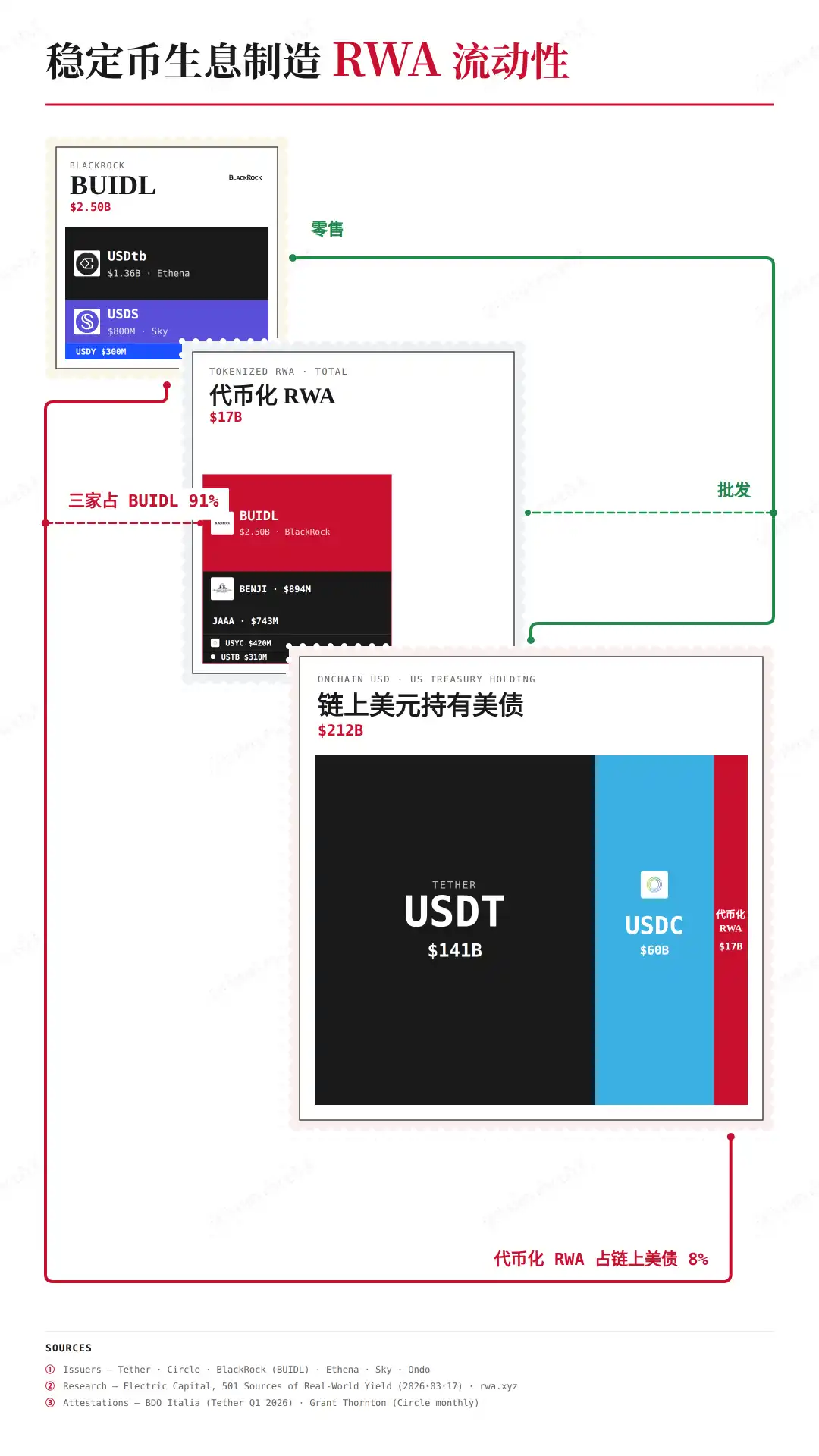
Caption: TMMF Supporting Payment Stablecoins

Data Source: @ElectricCapital

BlackRock's tokenized products, while circulating on-chain, cannot be purchased "permissionlessly" and still require compliance with KYC, accredited investor checks, etc., essentially targeting B2B sales.

You cannot monitor decentralized individual transactions, just as the US government cannot monitor the circulation of physical dollar cash. However, monitoring a few giants is much simpler.

By recognizing tokenized assets, the US cleverly constructs a feasible framework among stablecoin issuers, Wall Street giants, and regulators. The stablecoins users receive can only be used for payment because they cannot generate yield.

A single Genius Act binds stablecoins and tokenization together. This also answers the earlier confusion: it makes stablecoins the retail endpoint layer for US Treasuries.

The previous dollar relied on the commercial banking credit mechanism; the future dollar will rely on the intermediary role of tokenization companies.

Arbitrage Space, Yield-Bearing Stablecoins

Caring for worldly things more than God.

If the Genius Act's recognition of tokenization created payment stablecoins, then the Clarity Act's restrictions on tokenization guide the development of yield-bearing stablecoins.

The importance of yield-bearing lies not in the banking sector's fear of deposit outflows—JPMorgan has difficulty opening accounts, Coinbase has difficulty making money.

Consider this: Under the Clarity Act, if users choose to stake for yield, ideally, the stablecoin issuer's interest can only come from US Treasury products.

But this raises new questions. Issuers of on-chain stablecoins like Sky/Ethena, in a sense, don't need an OCC bank license first. Therefore, new arrangements are needed for yield, especially DeFi yield.

Excessive regulatory costs are the essential reason for Congress's "lenient" arrangements for DeFi development. Beyond that, the dollar needs stablecoins as a distribution channel.
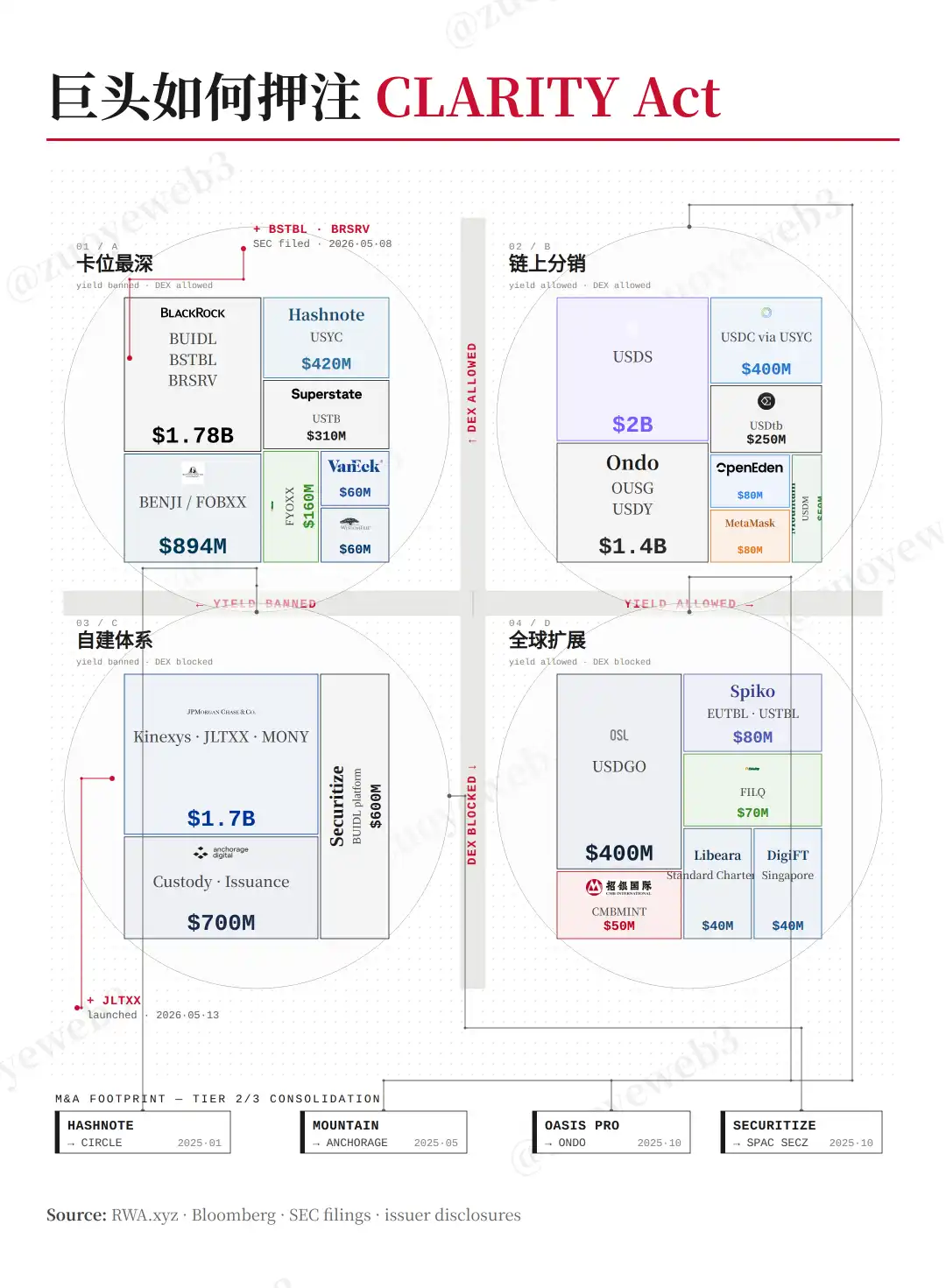
Caption: Giants Rushing into the Clarity Act

Image Source: @zuoyeweb3

This distribution is divided into two major categories: first, the B2B customer acquisition path among giants; second, on-chain and cross-regional C2C arbitrage issuance.

Among giants, the bet is on the strictness of the "ban on passive yield," which also changes the intermediary role. If DeFi is also restricted, consortium chain models may revive; if relatively relaxed, deeper cooperation with on-chain stablecoins is possible.

Furthermore, the giants' intermediary model is hard to bypass. Ondo and others choose to serve as the retail distribution layer for giants, while OSL and others choose the overseas compliant dollar stablecoin track.

Extending further, Sky's inclusion of diversified "RWAs" in USDS reserves is essentially leveraged arbitrage, quietly switching from full reserves to fractional reserves.

A mainstream demand emerging next: How to increase stablecoin yields based on US Treasuries? This requires more complex financial engineering designs, which is where various DeFi yield strategies come into play.

It can be seen that the yield mechanism targets offshore dollar stablecoins like $USDT, aiming to replace their position as Treasury buyers with BlackRock's TMMFs.

For on-chain dollars and compliant offshore dollars, new arbitrage spaces will emerge. They cannot stably earn scaled US Treasury yields and must continuously promote utilization growth, indirectly promoting dollar circulation and stable Treasury purchases.

In this process of tightening and loosening, users will be incentivized to use stablecoins because holding them leads to devaluation. The interest generated from usage flows back into the US financial system because the underlying asset is US Treasuries.

This is the true purpose of the Clarity Act: to create individual demand for the dollar on a global scale. Stablecoin issuance requires US Treasuries, stablecoin yield requires US Treasuries, ultimately completing the cycle.

Conclusion

To transcend the limitations of sovereign states, one must rely on rigid demand like payment.

But to promote the adoption of stablecoins, one must rely on direct mechanisms like yield.

The focus of both the Genius Act and the Clarity Act lies in the intertwining of stablecoins and yield. Because DeFi and cross-regional arbitrage cannot be fully controlled, Wall Street is needed as an intermediary to manage yields. This also gives us reassurance: Regardless of whether the Clarity Act passes on schedule, arbitrage mechanisms never sleep.

Preguntas relacionadas

QWhat is the main purpose of the 'Clarity Act' and the 'Genius Act' as discussed in the article regarding stablecoins?

AThe main purpose of these acts, particularly the 'Clarity Act', is to regulate stablecoins by separating their payment function from interest-bearing capabilities. This is designed to make U.S. dollar stablecoins a retail layer for U.S. Treasuries, creating a global demand loop where stablecoin issuance and usage ultimately cycle back to support the U.S. financial system and Treasury purchases.

QAccording to the article, how do Wall Street giants like BlackRock and JPMorgan Chase fit into the new regulatory framework for stablecoins?

AWall Street giants are positioning themselves as intermediaries by launching tokenized money market funds (TMMFs), like BlackRock's BSTBL/BRSRV and JPMorgan's JLTXX. These TMMFs serve as compliant, KYC-gated reserve assets for stablecoin issuers, replacing their direct purchases of U.S. Treasuries. This creates a controlled B2B market structure that aligns with the regulatory goals of the 'Genius Act'.

QWhat is the significance of prohibiting passive yield on payment stablecoins under the 'Clarity Act'?

AProhibiting passive yield on payment stablecoins aims to force users to spend or utilize the stablecoins for transactions rather than holding them as savings. Any interest generated must come from underlying U.S. Treasury products, channeling profits back to the U.S. financial system. This policy targets offshore stablecoins like USDT, aiming to replace their role as Treasury buyers with compliant products like Wall Street's TMMFs.

QWhat new arbitrage opportunities might emerge for on-chain and offshore compliant dollar stablecoins under the proposed regulations?

ANew arbitrage opportunities will arise as these stablecoins cannot earn scalable yields from U.S. Treasuries directly. To remain competitive, they must innovate by increasing their utilization rates and developing complex financial engineering strategies within DeFi to generate higher returns. This indirectly promotes greater dollar circulation and stable demand for U.S. Treasuries.

QHow does the article view the role of DeFi in relation to the upcoming 'Clarity Act' regulations?

AThe article suggests that due to high regulatory costs, Congress may provide a relatively 'lenient' arrangement for DeFi development. DeFi's role will be crucial in designing complex yield strategies that go beyond simple U.S. Treasury backing, helping compliant stablecoins generate competitive returns. However, if regulations strictly limit DeFi's passive yield mechanisms, it could lead to a revival of consortium chain models as an alternative.

Lecturas Relacionadas

Senior Trader's Confession: How to Trade Market's False Expectations?

Veteran trader's case study: trading the market's "wrong expectations". This trade centered on a textbook "expectation error" after a weak CPI report. While the market initially priced in broad monetary easing (sending Nasdaq to 30,060), the crucial 30-year real yield hit a 20-year high. This signaled a fractured transmission mechanism: short-term rates eased, but long-term funding costs (vital for tech valuations) refused to fall. The trader executed five short positions on the Nasdaq (NQ) as it fell from 30,060 to 28,768. The core methodology: don't just trade the data, but analyze the market's implied causal chain and identify where it breaks. In this case, the chain was: Weak CPI → Policy Easing → Lower Long-Term Funding Costs → NQ Valuation Expansion. The break occurred between policy easing and long-term rates. The "veto variable" – long-term real yields – refused to confirm the bullish narrative. Trades were structured around "fast variables" (price) temporarily repairing while "slow variables" (funding conditions) remained broken. The article outlines a repeatable framework: 1) Map the market's implied causal chain. 2) Identify the veto variable. 3) Observe if it rejects the narrative. 4) Enter when price still follows the old script. 5) Choose the cleanest asset expression (e.g., short NQ, not broad S&P). 6) Define both invalidation and fulfillment exit conditions. The key insight: Alpha often comes not from an information edge, but from a "reaction function edge" – recognizing when the market is applying an outdated causal logic to new data. The critical question: What causal chain is the market's first reaction relying on, and is that chain still valid today?

marsbitHace 22 min(s)

Senior Trader's Confession: How to Trade Market's False Expectations?

marsbitHace 22 min(s)

Opinion: The Hedging Relationship Between U.S. Treasuries and Stocks Has Broken Down, and BTC, as a Risk Asset, Is Under Dual Pressure

For the past 20 years, U.S. investors relied on a free insurance policy: when stocks fell, bonds rose, cushioning portfolio losses. This reliable inverse correlation underpinned entire financial strategies. However, this mechanism broke down around 2020 and has not recovered. Currently, the two-month rolling correlation between the S&P 500 and 10-year Treasury yields is at -0.69, its lowest level since 1996, indicating stocks and bonds are moving in sync to an unprecedented degree, eliminating the traditional portfolio shock absorber. The失效 of this hedge is not simply due to lost confidence in U.S. debt. The key driver is the shift from growth-dominated to inflation-dominated market narratives. When growth fears prevail, stocks and bonds move inversely. Since 2022, persistent inflation volatility has been the dominant factor, causing both asset classes to suffer simultaneously from higher inflation expectations. Investors now seek safety without duration risk, favoring cash, dollars, and short-term Treasuries while selling long-duration bonds. Record U.S. deficits, rising net interest payments, and waning foreign demand (e.g., from Japan) are pressuring long-term yields, with the 30-year yield surpassing 5%. This environment places Bitcoin, as a risk asset on the far end of the risk curve, under dual pressure. Higher risk-free rates increase the opportunity cost of holding non-yielding assets like Bitcoin, while falling equities reduce overall risk appetite. Bitcoin's performance has become highly sensitive to macro conditions such as real yields, dollar strength, and financial conditions. While its long-term thesis as a fixed-supply asset outside the sovereign credit system is strengthened by these fiscal trends, the same conditions hurt it in the short term. The return of bonds as a effective hedge requires inflation volatility to subside, growth risks to retake dominance, and the Fed to have room to ease policy. Until then, Bitcoin trades in a market where the deepest asset class no longer absorbs shocks, removing the safety floor for all risk assets, especially those that pay nothing to wait.

marsbitHace 22 min(s)

Opinion: The Hedging Relationship Between U.S. Treasuries and Stocks Has Broken Down, and BTC, as a Risk Asset, Is Under Dual Pressure

marsbitHace 22 min(s)

Funding Weekly | Crypto.com Secures $400M Investment, CeFi and Stablecoin Sectors Continue to Attract Capital

Crypto Weekly Investment Recap: Funds Converge on CeFi, Stablecoins, and AI Last week's crypto and AI investment landscape saw significant capital concentration, with a few large deals dominating. **Crypto/Web3 Highlights (July 13-19):** Total investment exceeded **$812 million** across 17 deals. Key trends: * **Centralized Finance (CeFi) & Stablecoins** remained a major magnet, led by **Crypto.com**'s massive **$400 million** raise from Citadel Securities, valuing the exchange at $20B. * **Infrastructure & Tools** saw 7 deals, including **Cyclops** ($20M for stablecoin payments) and **ADI Chain** ($50M for stablecoin settlement infrastructure). * **DeFi** had 2 deals, such as AI-native DEX **Quote Trade** ($4M). * Other notable raises: API broker **Alpaca** ($135M), cross-border platform **Flex** ($70M), treasury firm **ORANGE JUICE** ($40M), and prediction market **Pascal** ($9M). * **Acquisitions:** Keyrock bought BlockFills' trading unit, SBI Holdings acquired Singapore exchange Coinhako, and MoonPay bought startup Glide. **AI & Robotics Highlights:** Investment momentum in AI remained very strong. * Nvidia-backed AI cloud service **Fireworks** raised a massive **$1.5 billion** at a $17.5B valuation. * In robotics, **Walden Robotics** (spun out from Toyota) secured **$300 million**, and Chinese humanoid firm ****逐际动力** **(Climax Dynamics) raised nearly **$200 million** in a Pre-IPO round. * Other significant AI raises included Indian programming platform **Emergent** ($130M) and drone company **Brinc** ($125M), backed by Sam Altman. Overall, the trend shows capital flowing heavily into established crypto financial services, stablecoin infrastructure, and large-scale AI/robotics commercialization.

marsbitHace 1 hora(s)

Funding Weekly | Crypto.com Secures $400M Investment, CeFi and Stablecoin Sectors Continue to Attract Capital

marsbitHace 1 hora(s)

The Gentlest Bear Market? BTC Bears Exit, ARK and Bitwise Collectively Bullish

**Title: The Mildest Bear Market? BTC Shorts Exit, ARK and Bitwise Collectively Bullish** Bitcoin continues to consolidate around $75,000 while Ethereum struggles near $1,900. Market data shows $116 million in liquidations over 24 hours, with $62.7 million from short positions, and the Fear & Greed Index remains at 35 (Fear). According to Polymarket, there's a 33% probability BTC falls below $50,000 this year. ARK Invest's Q2 2026 Bitcoin report notes technical weakness but identifies potential bottoming signals, including a record high in long-term holder supply, suggesting selling exhaustion. Bitwise's Juan Leon calls this the "structurally mildest bear market" on record, with a ~50% drawdown from highs, less severe than past cycles. He highlights institutional accumulation and a shift in investor dialogue from survival to entry points. Technical analysis from Bit suggests a potential C-wave low may have formed, with an ideal bottoming range between $50,000-$55,000. However, glassnode's CryptoVizArt warns that failure to break $66,000 could signal a local top, as new buyer accumulation is concentrated there. Analyst Darkfost identifies a critical support band between $59,000-$70,000, where 50% of BTC's circulating supply has changed hands. Notably, trader Doctor Profit announced closing all crypto short positions—including BTC shorts from $115k-$125k and over 100 altcoin shorts—for significant profit. He has begun a phased accumulation of Bitcoin spot starting at $64,000, reversing his previous $40k-$50k target, citing structural positives like regulatory clarity and institutional adoption. He argues the anticipated September/October bottom may arrive earlier than the herd expects.

Foresight NewsHace 2 hora(s)

The Gentlest Bear Market? BTC Bears Exit, ARK and Bitwise Collectively Bullish

Foresight NewsHace 2 hora(s)

Trading

Spot
活动图片