CLARITY Act On Track For April Passage, Senator Says

bitcoinistPublicado a 2026-02-20Actualizado a 2026-02-20

Resumen

Senator Bernie Moreno stated the CLARITY Act is on track for potential passage by April, generating significant market and political reactions. The key contentious issue is the bill's proposed ban on interest-bearing stablecoins, which places the SEC as the lead regulator. This has created a divide, with crypto firms like Coinbase opposing the ban and banks expressing concerns about competition for deposits. While the White House is pushing for a quick agreement, bipartisan support remains fragile. Prediction markets initially showed increased odds of passage but later pulled back as details were questioned. The final outcome will determine clearer regulatory rules for exchanges, banks, and stablecoin issuers.

US lawmakers and crypto leaders say a major bill could move fast. According to an on-site interview, Senator Bernie Moreno told reporters he hopes the US CLARITY Act will clear Congress by April.

The comment came during a recent gathering with members of the press, and it set off a flurry of reaction across markets and inside the halls of power.

Lawmakers And Industry At Odds Over Clarity Act

Reports note that the biggest fight left on the table is stablecoin yields. Coinbase CEO Brian Armstrong said industry talks are more hopeful now, but he had pulled his group’s backing earlier because the bill would ban interest-bearing stablecoins and put the SEC front and center as the lead regulator.

That tug-of-war matters. Banks worry that easy yield on crypto tokens could pull deposits and weaken their model. Crypto firms counter that such products are useful and in demand. Both sides also want clear rules so firms can plan ahead.

Policymakers Have Momentum

Based on reports, the White House reacted strongly when one major exchange stepped back from support. The executive office signaled surprise and urged quicker agreement.

Markets noticed. Prediction markets moved, with odds on passage swinging dramatically in response to the media interview.

Polymarket showed a sharp uptick in probability that the bill would pass — then a pullback once details were questioned.
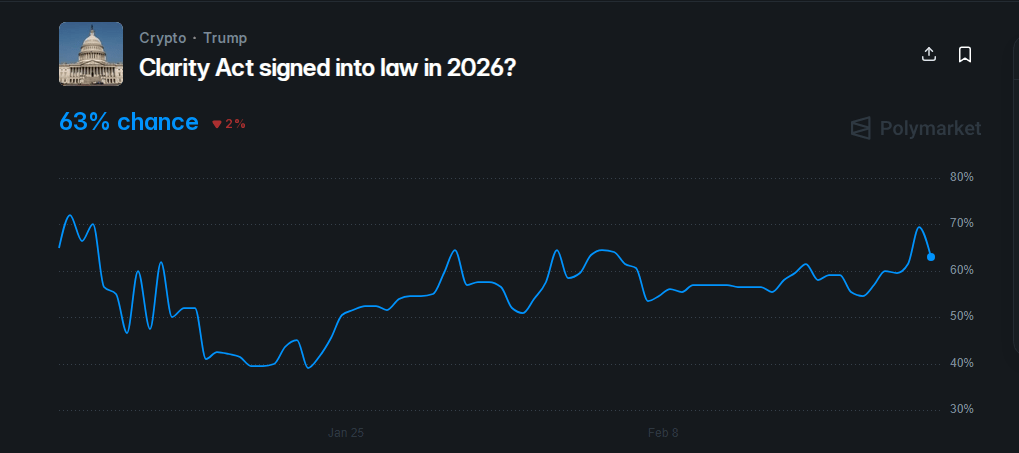
Source: Polymarket

“Hopefully by April,” Moreno said during an interview at US President Donald Trump’s Mar-a-Lago resort in Florida on Wednesday.

BTCUSD currently trading at $66,621. Chart: TradingView

What Could Break The Deal

Trump has pushed a pro-crypto message, and that helps gathering momentum among allies in Congress. But partisan lines remain.

If members tie the bill too closely to a single political brand, bipartisan support could fray. Also, banks and regulators are not uniform: some large institutions want stricter rules; others prefer limited, clearer guardrails that let certain products exist under oversight.

Why Fast Passage Is Uncertain

Reports say industry players want clarity asap, while some regulators want broader authority. That difference explains the public sparring.

Negotiators can and do move quickly when leadership prioritizes a measure, yet complex financial bills often require many rounds of drafting and amendment. Even so, lawmakers and execs at industry meetings appear to be pushing hard for a resolution soon.

If the bill clears, it could bring clearer rules for exchanges, banks, and stablecoin issuers. For investors, clarity is usually good. For firms, the shape of the final text will determine whether new products live or die.

Featured image from Wallpapers.com, chart from TradingView

Preguntas relacionadas

QWhat is the expected timeline for the CLARITY Act to pass Congress according to Senator Bernie Moreno?

ASenator Bernie Moreno hopes the CLARITY Act will clear Congress by April.

QWhat is the main point of contention regarding the CLARITY Act between lawmakers and the crypto industry?

AThe biggest fight is over stablecoin yields, specifically the bill's provision to ban interest-bearing stablecoins and establish the SEC as the lead regulator.

QHow did the prediction market Polymarket react to the news about the CLARITY Act?

APolymarket showed a sharp uptick in the probability that the bill would pass, followed by a pullback once details were questioned.

QWhy is there uncertainty surrounding the fast passage of the CLARITY Act despite momentum?

AUncertainty exists because complex financial bills often require many rounds of drafting and amendment, and there are differences between industry wanting clarity and some regulators wanting broader authority.

QWhat potential consequence could arise if the bill is tied too closely to a single political brand?

ABipartisan support for the bill could fray if it is tied too closely to a single political brand.

Lecturas Relacionadas

The "Impossible Triad" Is Fundamentally a Pseudo-Problem

The article argues that blockchain's fundamental limitation is not the scalability trilemma (decentralization, scalability, security), which has been largely solved, but the lack of **privacy** and, until recently, clear **legitimacy**. Blockchain is described as a slow, expensive, globally shared computer whose core value is censorship resistance and verifiability. While ideal for native digital assets like money (e.g., stablecoins), its default transparency acts as a **tax**, exposing all transactions and enabling MEV extraction, which deters serious institutional capital. Simultaneously, its permissionless nature created regulatory ambiguity. The piece contends that **privacy** is the missing critical feature. It rejects the false choice between total transparency and complete anonymity. Modern cryptography (like zero-knowledge proofs) enables **compliant privacy**: users can prove facts (solvency, KYC status, compliance) without revealing the underlying sensitive data (specific holdings, identities). This preserves auditability for regulators and eliminates the leak of financial information. With recent regulatory progress (e.g., the GENIUS Act) addressing legitimacy, adding default, provably compliant privacy becomes a pure upgrade. It transforms blockchain from a costly, public ledger into a confidential settlement layer, finally bridging the gap to mainstream institutional and individual adoption of on-chain finance.

链捕手Hace 12 hora(s)

The "Impossible Triad" Is Fundamentally a Pseudo-Problem

链捕手Hace 12 hora(s)

Optical Chips: Collective Capacity Expansion

The global optical chip industry is experiencing a massive wave of expansion driven by surging AI data center demand. Major players across the US, Japan, Europe, and China are aggressively investing to ramp up production capacity. In the US, Coherent is expanding its 6-inch Indium Phosphide (InP) semiconductor fab in Texas, supported by CHIPS Act funding and a $2 billion strategic investment from NVIDIA. Lumentum is building a new factory for InP optical devices, and Nokia is scaling its advanced photonic chip packaging and testing capabilities. NVIDIA's investments aim to secure future supply of critical lasers and optical interconnect products for AI infrastructure. Japan's JX Advanced Metals, a leading InP substrate supplier, plans a multi-billion yen investment to increase its capacity 7-10 times, strengthening its grip on the crucial upstream materials market. In Europe, IQE and Tower Semiconductor settled a patent dispute and signed a multi-year InP epitaxial wafer supply agreement, highlighting that next-generation silicon photonics platforms will integrate high-performance InP components. STMicroelectronics and Sivers Semiconductors are also expanding silicon photonics production and partnerships. China is rapidly building out its domestic supply chain. Dongshan Precision's subsidiary, Source Photonics, announced a $12 billion project to expand optical chip and module production. Companies like Sanan Optoelectronics and Yunnan Germanium are scaling up InP chip manufacturing and substrate production, moving towards vertical integration from materials to modules. While debate continues around the exact future architecture—whether CPO (Co-Packaged Optics), NPO, or pluggables will dominate—analysts like Morgan Stanley argue the underlying driver is unchangeable: the explosive growth in bandwidth demand. This will inevitably increase the volume of optical engines, lasers, and related content per GPU, regardless of the final technical path. The competition for "more light" in the AI era has intensified into a global, full-chain capacity race.

marsbitHace 14 hora(s)

Optical Chips: Collective Capacity Expansion

marsbitHace 14 hora(s)

Trading

Spot
Futuros
活动图片