CLARITY Act edges closer – But ONE disagreement is holding everything up

ambcryptoPublicado a 2026-03-18Actualizado a 2026-03-18

Resumen

The CLARITY Act, a key piece of U.S. crypto market structure legislation, is advancing but remains stalled due to a major disagreement over interest-bearing stablecoins. While the crypto industry supports such products, traditional banks oppose them, fearing capital flight from deposits. Despite this impasse, political pressure is mounting, notably from President Donald Trump, who publicly demanded the bill's swift passage to maintain U.S. financial leadership and prevent innovation from moving abroad. The crypto community expresses growing confidence in the bill's eventual success, with Polymarket bettors assigning a 62% probability of it passing in 2026. The legislation aims to provide regulatory clarity and unlock institutional investment, but disagreements continue to delay progress.

The GENIUS Act, passed in 2025, created a regulatory framework for U.S. stablecoins. However, clear rules for the rest of the crypto market are still missing.

That may soon change, as the recent data from Santiment suggested the Digital Asset Market CLARITY Act is moving closer to the final stage of the legislative process.

If passed, the bill could mark a turning point for institutional investment in crypto, providing clearer regulatory guidance for large investors.
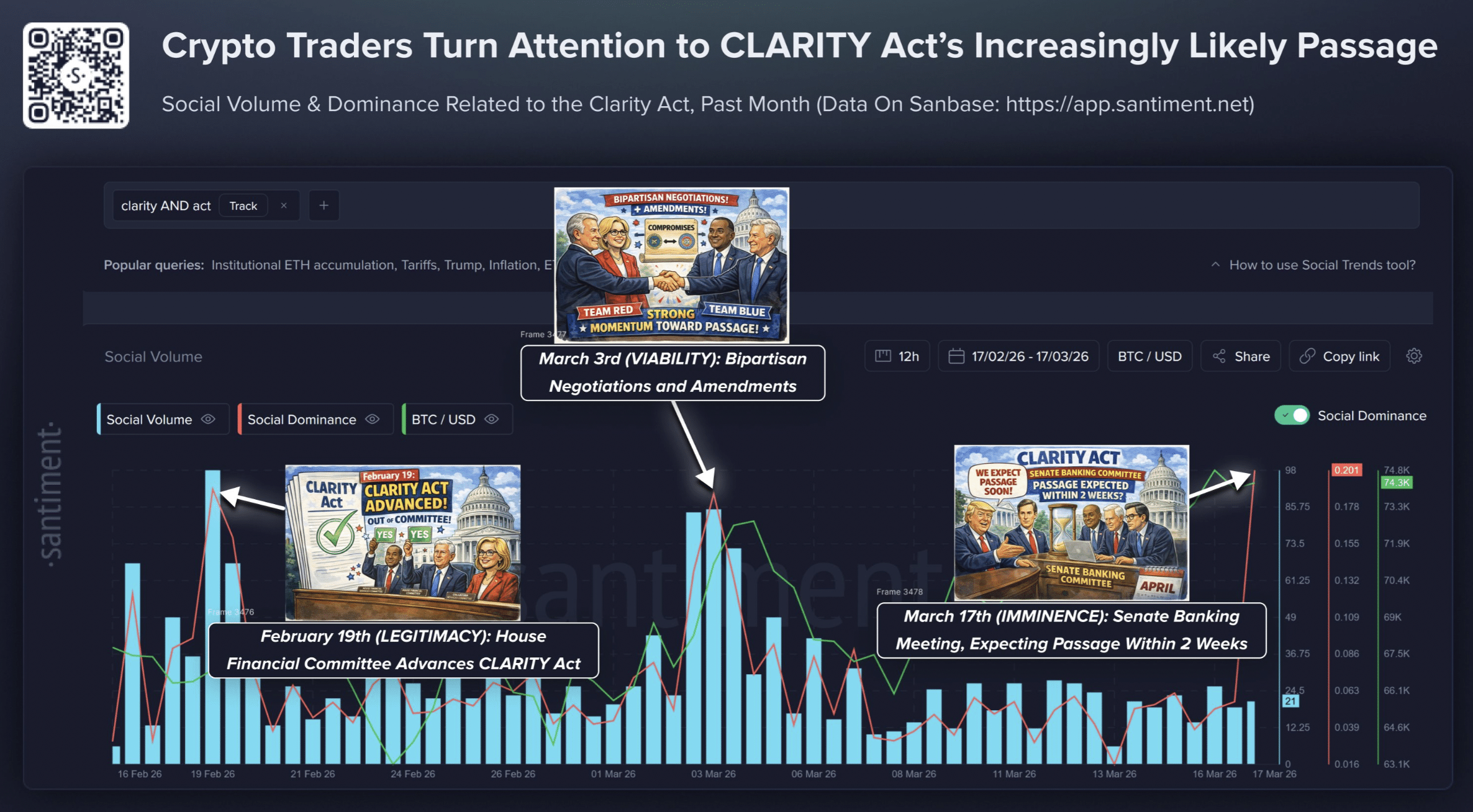
Source: Santiment/X

CLARITY Act talks continue

Talking about the same at the DC Blockchain Summit on the 17th of March, Senate Banking Committee Chair Tim Scott said the bill is still delayed due to a disagreement over interest-bearing stablecoins.

While the crypto industry supports such products, banks fear they could pull large amounts of money away from traditional deposits.

That said, Senators Thom Tillis and Angela Alsobrooks are currently reviewing these concerns and pushing for stronger safeguards if crypto products function like bank services.

This cautious approach has slowed the bill’s progress. Meanwhile, political pressure is growing, especially after U.S. President Donald Trump urged lawmakers to pass the Act quickly.

President Trump demands CLARITY Act passage

On the 4th of March, U.S. President Donald Trump wrote in a post on Truth Social,

The Genius Act is being threatened and undermined by the Banks, and that is unacceptable — We are not going to allow it. The U.S. needs to get Market Structure done, ASAP.

Donald Trump’s statement has shifted the debate around the CLARITY Act from a technical policy issue to a broader economic and strategic concern.

He argues that without clear crypto regulations, capital and innovation could move to countries like China, making the bill important for maintaining U.S. financial leadership.

Trump also criticized major banks for resisting crypto reforms, despite reporting record profits, suggesting they are prioritizing their own interests.

By linking the CLARITY Act to his goal of making the U.S. the global crypto capital, he has increased pressure on lawmakers to move the legislation forward.

Crypto community stands confident

The confidence was also reflected in the crypto community, as noted by Senator Kevin Cramer when he said,

I think we have to make this a committee priority for some time just before Easter or shortly after.

Echoing similar sentiments, Dan Spuller, EVP of Industry Affairs at Blockchain Association, added,

I’m now increasingly confident we’re going to get CLARITY through, and we’re not going to let the banks rig the outcome.

Polymarket odds and other hiccups

Additionally, Polymarket bettors have also pushed the odds of the CLARITY Act passing in 2026 to a commanding 62%.
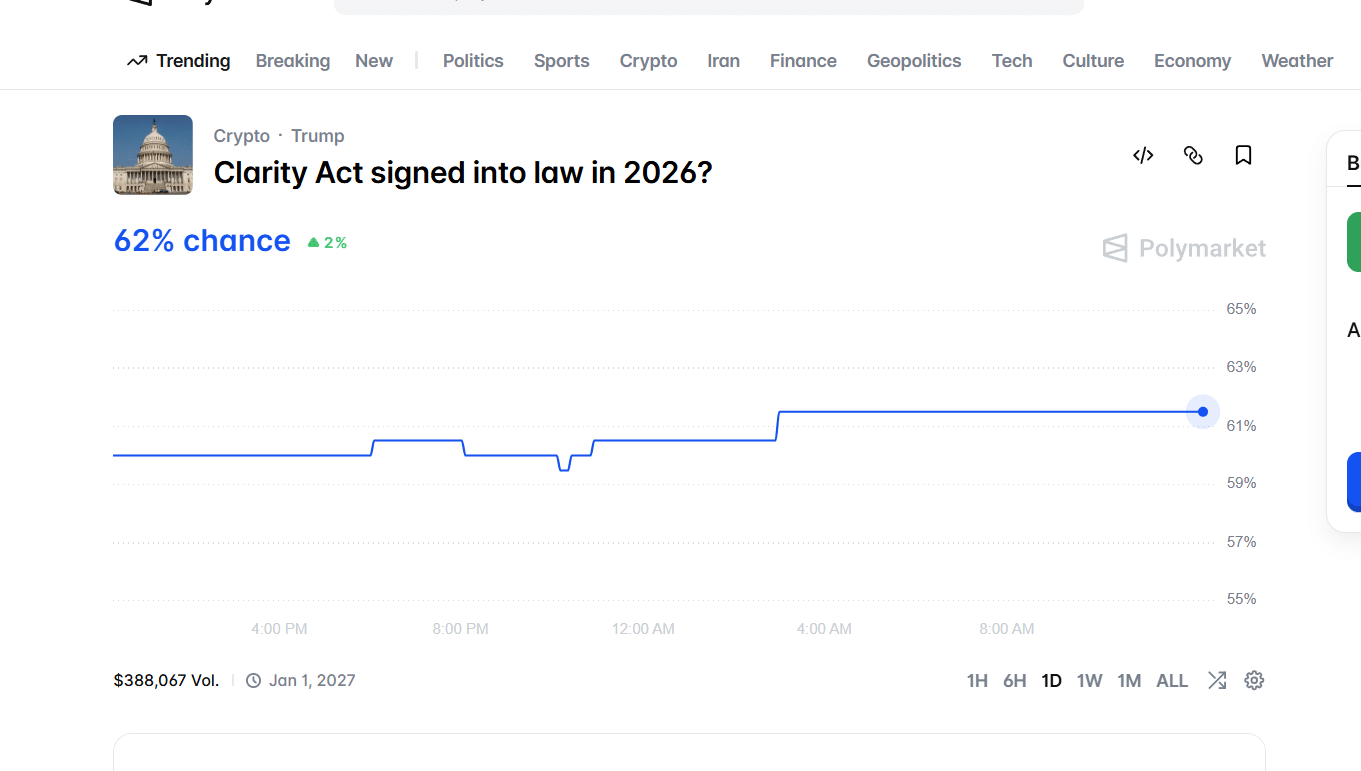
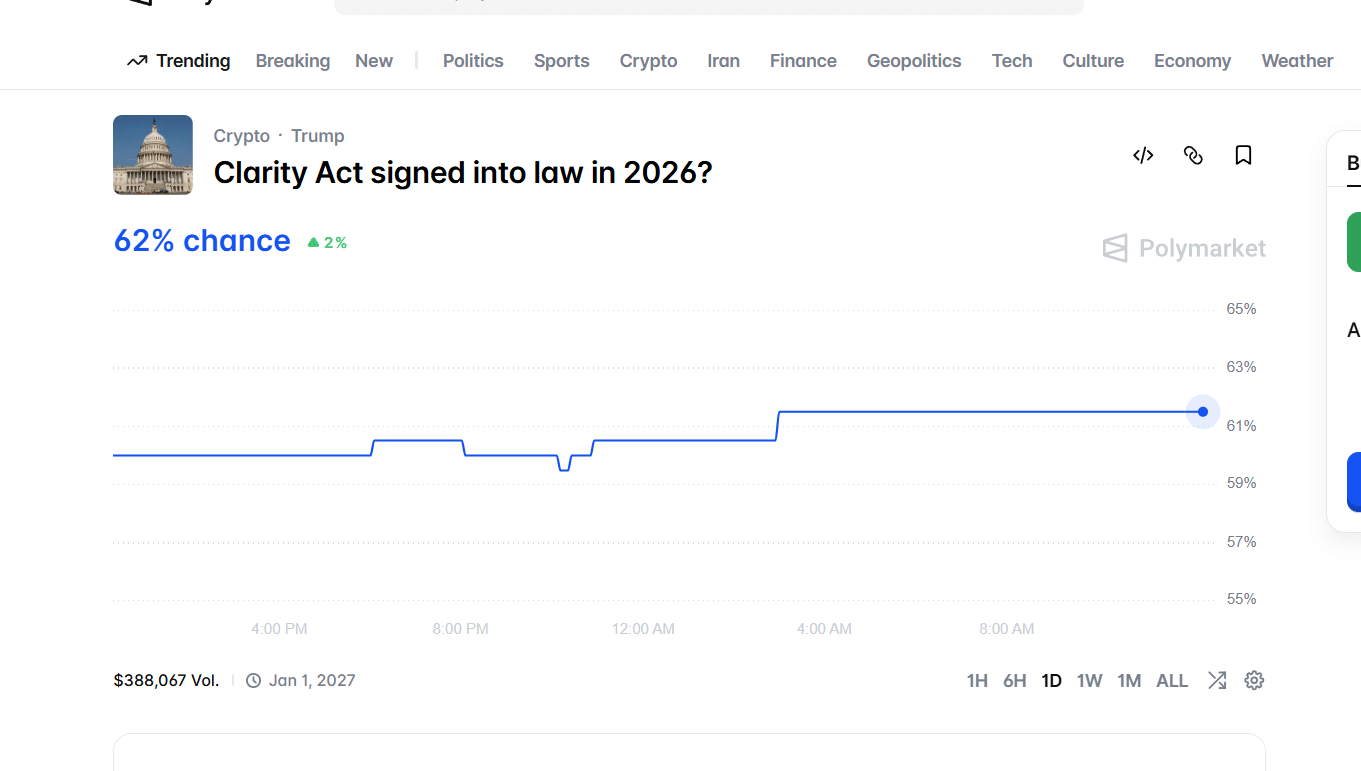
Source: Polymarket

Needless to say, the bill has now become the center of a growing clash between the U.S. government and traditional banks.

This disagreement has stalled the bill since early 2026. Thus, as expected, Trump’s crypto advisor, Patrick Witt, had put it best when he said,

The CLARITY Act must remain a pro-innovation piece of legislation. Attempts to hijack the legislative process and turn it into an anti-competition bill are shameful.


Final Summary

  • Clear rules could unlock large institutional capital that has remained cautious due to regulatory uncertainty.
  • However, a key disagreement over interest-bearing stablecoins continues to slow progress.

Criptos en tendencia

Preguntas relacionadas

QWhat is the main disagreement holding up the CLARITY Act according to the article?

AThe main disagreement is over interest-bearing stablecoins, with the crypto industry supporting such products while banks fear they could pull large amounts of money away from traditional deposits.

QWhat did U.S. President Donald Trump say about the CLARITY Act and the banks?

APresident Trump stated that the 'Genius Act' (referring to the CLARITY Act) is being 'threatened and undermined by the Banks' and that this is unacceptable. He argued that the U.S. needs to get Market Structure done ASAP and criticized major banks for resisting crypto reforms despite reporting record profits.

QAccording to the article, what is the predicted probability of the CLARITY Act passing in 2026 on Polymarket?

APolymarket bettors have pushed the odds of the CLARITY Act passing in 2026 to 62%.

QHow did Trump's advisor, Patrick Witt, characterize attempts to change the CLARITY Act?

APatrick Witt characterized attempts to hijack the legislative process and turn the CLARITY Act into an anti-competition bill as 'shameful,' stating that the act must remain a pro-innovation piece of legislation.

QWhat previous legislation created a regulatory framework for U.S. stablecoins, as mentioned in the article?

AThe GENIUS Act, passed in 2025, created a regulatory framework for U.S. stablecoins.

Lecturas Relacionadas

Will the Fed Definitely Raise Interest Rates in September? How Will Crypto and U.S. Stocks Withstand the Pressure?

The market's expectation for a September Fed rate hike surged dramatically in early August, jumping from under 50% to over 80% within a week. This shift followed a contentious July FOMC meeting, where a 9-3 vote to hold rates revealed growing dissent from hawkish members advocating for an immediate hike to combat persistent inflation. The primary catalyst for this repricing is rising oil prices, driven by renewed geopolitical tensions around the Strait of Hormuz, which threaten global supply. Energy costs directly influence inflation metrics, making the upcoming July CPI report (due August 12th) a critical data point. If it shows inflation reaccelerating, the probability of a September hike will solidify. For Bitcoin and crypto assets, this is typically bearish news. Bitcoin continues to behave as a high-beta, liquidity-sensitive risk asset. A rate hike raises the opportunity cost of holding non-yielding assets and could drive capital toward money markets, pressuring crypto prices in the short term. However, historical patterns suggest that if a hike is perceived as the end of a tightening cycle rather than the start, any negative price impact may be brief. U.S. stocks, particularly crypto-linked equities like Coinbase and growth-oriented tech stocks, are also vulnerable. Higher rates increase discount rates in valuation models, putting pressure on high-multiple companies. This coincides with a pivotal tech earnings season where investor focus has shifted from massive AI capital expenditure to tangible revenue and cash flow generation. Companies with negative cash flow and weak growth narratives could face heightened volatility if borrowing costs rise in September. In summary, a September Fed hike has evolved into a mainstream market scenario. Key factors to watch are oil prices, the July CPI report, and Fed communications, which will determine the final decision and its impact on volatile crypto and equity markets.

marsbitHace 3 min(s)

Will the Fed Definitely Raise Interest Rates in September? How Will Crypto and U.S. Stocks Withstand the Pressure?

marsbitHace 3 min(s)

A 'Overlooked' Market Event: Joint US-Japan-South Korea Intervention, Rare US Treasury Involvement, and Bessent's Quiet 'Market Rescue'?

Summary: The United States, Japan, and South Korea executed their largest coordinated foreign exchange intervention in nearly 30 years. The action targeted depreciation pressure on the Japanese yen and South Korean won. This move is seen as a significant effort by the US to stabilize the financial markets of its key allies and prevent the spillover of risks. Key details: * Japan reportedly intervened on July 30 using approximately 8.45 trillion yen (about $52.8 billion). South Korean authorities also intervened that day, selling dollars to support the won. * Notably, the US Treasury Department intervened directly in yen markets for the first time in roughly 30 years. The New York Fed, reportedly acting on behalf of the Treasury, sold euros to buy yen via Goldman Sachs and Morgan Stanley on July 31. Analysts view the use of the euro-yen pair as a way to alleviate yen pressure without adding selling pressure to the US dollar. * Prior to the action, the New York Fed conducted "rate checks" on both USD/JPY and EUR/JPY, a newer signaling tool that falls between verbal and physical intervention. The intervention is interpreted as going beyond traditional currency stabilization. Analysts, such as Michael Hartnett of Bank of America, suggest it resembles a "Price Keeping Operation" for the AI era. The core US objectives are perceived to be: 1. Preventing rapid yen depreciation from triggering a sharp rise in Japanese government bond yields. 2. Containing financial stress from spreading across Asian markets like South Korea and Japan. 3. Reducing the risk of disorderly capital flows impacting the US bond market. This coordinated action underscores the importance of Japan and South Korea as critical partners in the US semiconductor and AI supply chain. Stabilizing their financial markets is seen as vital to mitigating risks to the broader tech industry and the US market itself. The intervention coincides with market pressures, including the KOSDAQ index hitting a low since October 2022. While seen as a move to control volatility, some analysts caution it may not fundamentally reverse existing market trends.

marsbitHace 6 min(s)

A 'Overlooked' Market Event: Joint US-Japan-South Korea Intervention, Rare US Treasury Involvement, and Bessent's Quiet 'Market Rescue'?

marsbitHace 6 min(s)

Will the Federal Reserve Definitely Raise Interest Rates in September? How Will Cryptocurrencies and US Stocks Bear the Pressure?

In early August 2024, market expectations for a September Federal Reserve rate hike surged dramatically, from below 50% to over 80%, driven by renewed inflation concerns. This shift followed a contentious July FOMC meeting where a 9-3 vote to hold rates revealed a growing hawkish faction advocating for an immediate hike, citing prolonged above-target inflation. The key catalyst is escalating conflict near the Strait of Hormuz, which has pushed oil prices up approximately 20% in July, threatening to reignite inflation. The next critical data point is the July CPI report on August 12th; a hot reading could solidify hike expectations. For crypto assets, particularly Bitcoin, this represents near-term pressure. Bitcoin continues to exhibit high-beta, risk-on characteristics, making it sensitive to tightening liquidity and higher opportunity costs. However, historical precedent suggests that if a hike is perceived as the cycle's end rather than its start, the negative impact may be brief, with markets quickly pivoting to anticipate future rate cuts. U.S. stocks, especially crypto-linked equities like Coinbase and high-valuation tech stocks, face amplified volatility. Higher rates increase discount rates in valuation models, pressuring growth stocks. This coincides with a pivotal tech earnings season where investor focus has shifted from massive AI capital expenditures to demonstrable revenue and cash flow generation. Companies with negative cash flows and weak growth narratives could see severe pressure if a September hike materializes, as financing costs would rise. Key indicators to watch include oil prices, upcoming inflation data, and Fed commentary at events like the Jackson Hole symposium.

Odaily星球日报Hace 6 min(s)

Will the Federal Reserve Definitely Raise Interest Rates in September? How Will Cryptocurrencies and US Stocks Bear the Pressure?

Odaily星球日报Hace 6 min(s)

Trading

Spot

Artículos destacados

Cómo comprar ONE

¡Bienvenido a HTX.com! Hemos hecho que comprar Harmony (ONE) sea simple y conveniente. Sigue nuestra guía paso a paso para iniciar tu viaje de criptos.Paso 1: crea tu cuenta HTXUtiliza tu correo electrónico o número de teléfono para registrarte y obtener una cuenta gratuita en HTX. Experimenta un proceso de registro sin complicaciones y desbloquea todas las funciones.Obtener mi cuentaPaso 2: ve a Comprar cripto y elige tu método de pagoTarjeta de crédito/débito: usa tu Visa o Mastercard para comprar Harmony (ONE) al instante.Saldo: utiliza fondos del saldo de tu cuenta HTX para tradear sin problemas.Terceros: hemos agregado métodos de pago populares como Google Pay y Apple Pay para mejorar la comodidad.P2P: tradear directamente con otros usuarios en HTX.Over-the-Counter (OTC): ofrecemos servicios personalizados y tipos de cambio competitivos para los traders.Paso 3: guarda tu Harmony (ONE)Después de comprar tu Harmony (ONE), guárdalo en tu cuenta HTX. Alternativamente, puedes enviarlo a otro lugar mediante transferencia blockchain o utilizarlo para tradear otras criptomonedas.Paso 4: tradear Harmony (ONE)Tradear fácilmente con Harmony (ONE) en HTX's mercado spot. Simplemente accede a tu cuenta, selecciona tu par de trading, ejecuta tus trades y monitorea en tiempo real. Ofrecemos una experiencia fácil de usar tanto para principiantes como para traders experimentados.

404 Vistas totalesPublicado en 2024.12.12Actualizado en 2026.06.02

Cómo comprar ONE

Discusiones

Bienvenido a la comunidad de HTX. Aquí puedes mantenerte informado sobre los últimos desarrollos de la plataforma y acceder a análisis profesionales del mercado. A continuación se presentan las opiniones de los usuarios sobre el precio de ONE (ONE).

活动图片