CLARITY Act Could Unlock Wider Tech Growth In America, Says a16z

bitcoinistPublicado a 2026-05-17Actualizado a 2026-05-17

Resumen

The CLARITY Act, a crypto market structure bill, faces its main hurdle in securing bipartisan Senate support, according to Grayscale. While it advanced from committee with mostly Republican votes, achieving the needed 60 votes will require significant Democratic support. Analysts cite the bipartisan passage of the GENIUS Act as a hopeful precedent. Venture firm a16z argues the bill's impact extends beyond crypto, claiming a clear U.S. legal framework would drive wider domestic innovation and bolster the dollar's global standing. Internationally, the legislation is seen as a regulatory signal for other countries. The outcome now depends on Senate vote counts.

Bipartisan support remains the main obstacle standing between the CLARITY Act and becoming law. That was the assessment from asset management firm Grayscale on Friday, even as the company said it believes the bill has a strong chance of passing.

Republicans hold 53 Senate seats, meaning at least seven Democrats would need to cross the aisle for the legislation to clear the full chamber.

CLARITY Act Advances

The CLARITY Act advanced out of the US Senate Banking Committee last Thursday after a vote that split mostly along party lines. All 13 Republican members voted in favor, joined by two Democrats.

Nine Democrats voted against it. The bill, which aims to give the crypto industry clearer rules around market structure, has been a subject of intense debate since its introduction in July 2025.

Grayscale pointed to the GENIUS Act as a possible guide for what comes next. That stablecoin legislation passed the Senate with 66 votes, including 18 Democrats.

Based on that track record, Grayscale said it believes similar bipartisan backing for the CLARITY Act is achievable, though it acknowledged that several hurdles remain before it can be signed into law.

Broader Economic Stakes

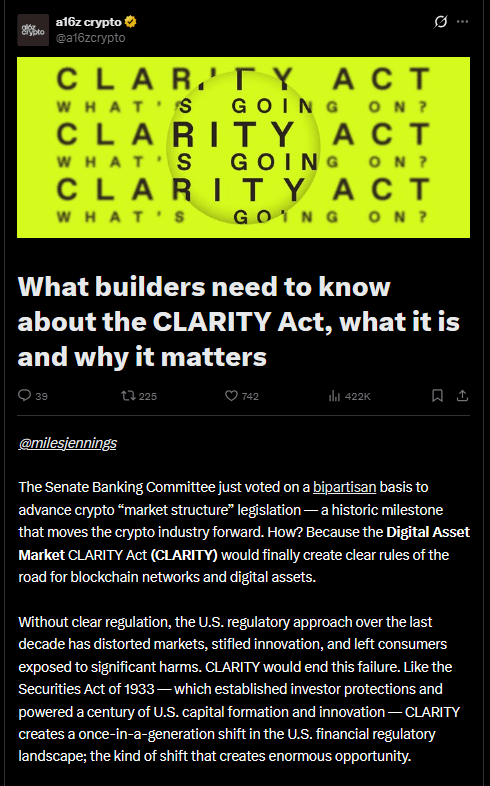
Venture capital firm a16z crypto argued Friday that the implications of the bill go well beyond the crypto sector. According to the firm, giving builders in the US a clear legal framework would drive wider domestic innovation.

BTCUSD now trading at $78,417. Chart: TradingView

It cited the GENIUS Act’s passage as a precedent, saying that legislation produced strong growth and adoption that it described as beneficial not just for the US economy but for the long-term position of the US dollar globally.

The US dollar index, which measures the dollar’s strength against a basket of major currencies, stood at 99.26 at the time of publication, up 1.25% over the prior 30 days, according to TradingView data.

Image: IQ.wiki

Global Signal

Sharplink Gaming CEO Joseph Chalom added another dimension to the conversation, saying the bill is being watched far beyond US borders.

While many see the legislation as a domestic matter, Chalom said other countries are treating it as a signal for how they might approach their own crypto regulations.

A16z framed the broader stakes plainly: when US legal frameworks balance innovation with consumer protection, the country tends to lead and the rest of the world follows.

Whether the Senate delivers that framework is now a question of vote counting.

Featured image from MadebyBaurley, chart from TradingView

Preguntas relacionadas

QWhat is the main obstacle for the CLARITY Act to become law according to Grayscale?

ABipartisan support remains the main obstacle for the CLARITY Act to become law.

QHow did the US Senate Banking Committee vote on the CLARITY Act, and what was the party-line split?

AThe CLARITY Act advanced out of the US Senate Banking Committee with all 13 Republican members voting in favor, joined by two Democrats, while nine Democrats voted against it.

QWhat precedent does a16z crypto cite to argue for the potential benefits of the CLARITY Act?

Aa16z crypto cites the passage of the GENIUS Act as a precedent, saying it produced strong growth and adoption beneficial for the US economy and the long-term global position of the US dollar.

QAccording to Sharplink Gaming CEO Joseph Chalom, how are other countries viewing the CLARITY Act?

AJoseph Chalom said that other countries are treating the CLARITY Act as a signal for how they might approach their own crypto regulations, watching it far beyond US borders.

QWhat does a16z crypto argue is the broader implication of passing the CLARITY Act for US innovation?

Aa16z crypto argues that giving builders in the US a clear legal framework through the CLARITY Act would drive wider domestic innovation.

Lecturas Relacionadas

STRC Breaks Below $95: Why Does It Continue to Depeg? Is There Default Risk?

"STRC Falls Below $95: Why the Persistent Depegging and Is There Default Risk?" The article discusses the recent decline in the price of STRC, a perpetual preferred stock issued by Strategy (MSTR) designed to trade around a $100 par value. As of publication, STRC traded at $94.65, raising market concerns. STRC is described as a high-yield cash flow product, offering an 11.50% annual dividend paid monthly. Its "preferred" status grants it priority over common stock for dividends and in liquidation. Key reasons cited for the price depegging include: 1. **Bitcoin's Price Drop:** MSTR's assets are heavily tied to Bitcoin (BTC), which fell over 21% from its recent high, pressuring all Strategy-related products. 2. **Competitive Pressure:** Rival Strive Asset Management's similar product, SATA, offers daily dividends and has maintained its $100 par value with a ~13% yield. In response, Strategy has proposed changing STRC's dividend frequency from monthly to bi-weekly, pending shareholder vote. 3. **Technical Selling:** A break below $100 may have triggered algorithmic selling and stop-losses, exacerbating the decline. Regarding default risk, the analysis suggests it is currently low. Strategy founder Michael Saylor confirmed the June 2026 dividend rate remains at 11.50% with no cuts or suspensions. The company's massive reserve of 843,706 BTC provides a significant backstop for its obligations. Industry opinions are mixed. Some analysts view the BTC holdings as reliable support for dividends, while critics like Peter Schiff warn of potential dividend cuts leading to price crashes and lawsuits. Others highlight inflation risk and the company's ability to reduce dividends without a formal default. In summary, STRC's drop is attributed to BTC volatility, competition, and technical factors. While immediate default risk appears contained, the product faces challenges from market conditions and competitive dynamics.

marsbitHace 50 min(s)

STRC Breaks Below $95: Why Does It Continue to Depeg? Is There Default Risk?

marsbitHace 50 min(s)

AI Trading Cools, South Korean Stocks Plunge 1.8%, Spot Gold Rises 1%, Bitcoin Dives

A sell-off in AI-related stocks, triggered by Broadcom's disappointing earnings forecast, sent shockwaves through global markets. South Korea's KOSPI led Asia's decline, plunging 1.8% as the risks from concentrated chip stock gains and surging leveraged investments came to the fore. The tech-heavy Nasdaq 100 futures fell 0.5% following Broadcom's 14% after-hours plunge, which signaled a slower-than-expected transition to AI clients. This pullback extended Wall Street's weakness, halting the S&P 500's nine-day rally amid hawkish Fed signals and renewed Middle East tensions. South Korean authorities convened an emergency meeting, pledging "immediate measures" against market volatility and warning of record-high stock margin debt. The adjustment rippled across assets: Bitcoin fell to around $64,000, its lowest since February, while safe-haven gold rose 1% on bargain hunting. Oil prices dipped on Middle East ceasefire news. Market analysts noted the sell-off was driven by profit-taking after massive gains, particularly in chip stocks like Samsung and SK Hynix, which now dominate the KOSPI. Wall Street banks are divided on Korea's outlook, with Goldman Sachs raising its target while Citigroup and others warn of overvaluation and a potential bubble. Bridgewater's Ray Dalio noted that great technological shifts often create bubbles. Meanwhile, Fed officials' hints at potential future rate hikes added to the cautious mood ahead of key U.S. jobs data.

华尔街日报Hace 1 hora(s)

AI Trading Cools, South Korean Stocks Plunge 1.8%, Spot Gold Rises 1%, Bitcoin Dives

华尔街日报Hace 1 hora(s)

Trading

Spot
Futuros
活动图片