CLARITY Act Could Unlock Wider Tech Growth In America, Says a16z

bitcoinistPublicado a 2026-05-17Actualizado a 2026-05-17

Resumen

The CLARITY Act, a crypto market structure bill, faces its main hurdle in securing bipartisan Senate support, according to Grayscale. While it advanced from committee with mostly Republican votes, achieving the needed 60 votes will require significant Democratic support. Analysts cite the bipartisan passage of the GENIUS Act as a hopeful precedent. Venture firm a16z argues the bill's impact extends beyond crypto, claiming a clear U.S. legal framework would drive wider domestic innovation and bolster the dollar's global standing. Internationally, the legislation is seen as a regulatory signal for other countries. The outcome now depends on Senate vote counts.

Bipartisan support remains the main obstacle standing between the CLARITY Act and becoming law. That was the assessment from asset management firm Grayscale on Friday, even as the company said it believes the bill has a strong chance of passing.

Republicans hold 53 Senate seats, meaning at least seven Democrats would need to cross the aisle for the legislation to clear the full chamber.

CLARITY Act Advances

The CLARITY Act advanced out of the US Senate Banking Committee last Thursday after a vote that split mostly along party lines. All 13 Republican members voted in favor, joined by two Democrats.

Nine Democrats voted against it. The bill, which aims to give the crypto industry clearer rules around market structure, has been a subject of intense debate since its introduction in July 2025.

Grayscale pointed to the GENIUS Act as a possible guide for what comes next. That stablecoin legislation passed the Senate with 66 votes, including 18 Democrats.

Based on that track record, Grayscale said it believes similar bipartisan backing for the CLARITY Act is achievable, though it acknowledged that several hurdles remain before it can be signed into law.

Broader Economic Stakes

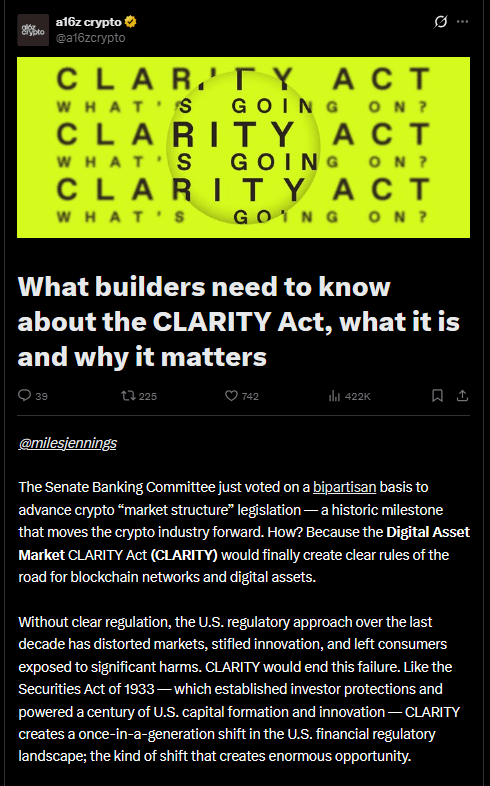
Venture capital firm a16z crypto argued Friday that the implications of the bill go well beyond the crypto sector. According to the firm, giving builders in the US a clear legal framework would drive wider domestic innovation.

BTCUSD now trading at $78,417. Chart: TradingView

It cited the GENIUS Act’s passage as a precedent, saying that legislation produced strong growth and adoption that it described as beneficial not just for the US economy but for the long-term position of the US dollar globally.

The US dollar index, which measures the dollar’s strength against a basket of major currencies, stood at 99.26 at the time of publication, up 1.25% over the prior 30 days, according to TradingView data.

Image: IQ.wiki

Global Signal

Sharplink Gaming CEO Joseph Chalom added another dimension to the conversation, saying the bill is being watched far beyond US borders.

While many see the legislation as a domestic matter, Chalom said other countries are treating it as a signal for how they might approach their own crypto regulations.

A16z framed the broader stakes plainly: when US legal frameworks balance innovation with consumer protection, the country tends to lead and the rest of the world follows.

Whether the Senate delivers that framework is now a question of vote counting.

Featured image from MadebyBaurley, chart from TradingView

Preguntas relacionadas

QWhat is the main obstacle for the CLARITY Act to become law according to Grayscale?

ABipartisan support remains the main obstacle for the CLARITY Act to become law.

QHow did the US Senate Banking Committee vote on the CLARITY Act, and what was the party-line split?

AThe CLARITY Act advanced out of the US Senate Banking Committee with all 13 Republican members voting in favor, joined by two Democrats, while nine Democrats voted against it.

QWhat precedent does a16z crypto cite to argue for the potential benefits of the CLARITY Act?

Aa16z crypto cites the passage of the GENIUS Act as a precedent, saying it produced strong growth and adoption beneficial for the US economy and the long-term global position of the US dollar.

QAccording to Sharplink Gaming CEO Joseph Chalom, how are other countries viewing the CLARITY Act?

AJoseph Chalom said that other countries are treating the CLARITY Act as a signal for how they might approach their own crypto regulations, watching it far beyond US borders.

QWhat does a16z crypto argue is the broader implication of passing the CLARITY Act for US innovation?

Aa16z crypto argues that giving builders in the US a clear legal framework through the CLARITY Act would drive wider domestic innovation.

Lecturas Relacionadas

Is Ethereum Truly a "World Computer"?

Title: Is Ethereum Really a "World Computer"? Ethereum, envisioned as a "world computer" by its founder Vitalik Buterin, aims to be a decentralized platform for global applications. However, a recent analysis by Four Pillars raises questions about whether it is more accurately a "Western computer," based on the geographical distribution of its validators. Currently, the United States dominates with 38.19% of all validators, followed by Germany at 13.04%. Combined, these two countries account for over half of the network. In contrast, Asian representation is minimal, with Singapore holding only 3.15%. The concentration is partly due to affordable cloud hosting services like Hetzner and OVH in Europe and North America, as well as the prevalence of residential validators in the U.S., where individuals run nodes via home internet connections. When examining professionally operated validators, the distribution becomes more balanced. The U.S. share drops to 25.81%, while Asian countries like Singapore (7.28%), Hong Kong (6.44%), Japan (6.38%), and South Korea (4.59%) collectively approach the U.S. level. This shift reflects strategic deployments by institutions to meet regulatory requirements and reduce latency for local users. However, regions like South America, the Middle East, and Africa remain underrepresented. Ethereum's peer-to-peer network mechanisms, such as gossipsub, disadvantage areas with low node density, creating a feedback loop where delayed message propagation reduces validator performance and rewards. This imbalance challenges Ethereum's promises of censorship resistance and global accessibility. Despite these issues, opportunities exist for growth in underrepresented regions. As demand for localized staking infrastructure rises, early entrants in areas like the Middle East could establish dominant positions by offering compliant, low-latency solutions. The evolving validator landscape highlights both the structural challenges and the potential for Ethereum to move closer to its "world computer" ideal.

Foresight NewsHace 1 hora(s)

Is Ethereum Truly a "World Computer"?

Foresight NewsHace 1 hora(s)

Trading

Spot
活动图片