Claiming the "Happy Horse": Alibaba's AI Lays Out the "Eight Trigrams Formation"

marsbitPublicado a 2026-04-11Actualizado a 2026-04-11

Resumen

Alibaba has officially claimed the "HappyHorse" (HappyHorse-1.0) AI video generation model, which recently topped the global benchmark on Artificial Analysis with an Elo score of 1357. Developed by Alibaba’s ATH (Alibaba Token Hub) innovation unit, the model is notable for its ability to generate high-definition video with synchronized audio and sound effects from text input, significantly improving motion coherence and reducing production time and cost. This launch is part of a broader acceleration in Alibaba’s AI strategy. In late March and early April, the company released three flagship models in quick succession: Qwen3.5-Omni, Wan2.7-Image, and Qwen3.6-Plus. The latter broke global daily call volume records with 1.4 trillion tokens processed shortly after release. Alibaba has also undergone significant organizational restructuring to support its AI ambitions. In March, it established the ATH business group, led by CEO Wu Yongming, to integrate AI development, cloud services, and application deployment. Further changes in April included forming a group-level technology committee and consolidating the Tongyi Lab into a dedicated AI model division. The company is investing heavily in AI, with plans to spend over 380 billion RMB on cloud and AI infrastructure over three years. Its self-developed GPUs have already seen mass production. While the market has responded positively to these moves, challenges remain in balancing centralized control with operational flexibility a...

By | Tingtong Tech (ID:tingtongtech), Author | Chen Ke, Editor | Rao Yan

Just as the market thought the AI video generation battlefield would still be a showdown between ByteDance and Kuaishou, a "dark horse" has joined the game.

Without any预告, without any paper, without any official account, a mysterious video generation model named HappyHorse topped the overseas evaluation platform Artificial Analysis, becoming the new technical throne.

The shockwave this "three-noes" product caused in the AI circle was no less than when AlphaGo defeated Lee Sedol. However, all the "technical fingerprints" and personnel change clues in the market pointed to the same origin: Alibaba. However, Alibaba did not admit it initially when the news broke.

After the market "speculated" for a few days, on April 10th, Alibaba finally claimed HappyHorse, stating it is a model developed by its ATH (Alibaba Token Hub) Innovation Business Unit.

For Alibaba, the "Happy Horse" is not the most eye-catching news this year. In fact, prior to this, whether it was the "triple release" of three flagship models at the end of March, or Qwen3.6Plus breaking the global call volume record, or the restructuring of the technical command, Alibaba's series of actions, like a "hat-trick," showed the market a new way of running.

More interestingly, this wave of密集 releases happened恰好 after researchers like Lin Junyang, Yu Bowen, and Hui Binyuan from the Tongyi Lab left in early March. Previously, the outside world was once deeply concerned about Alibaba's AI progress, and the capital market was also questioning. However, Alibaba quickly made the market look at it differently with the rapid iteration of products and market performance.

The industry jokingly called this the turning point for Alibaba's AI from "scattered" to "systematic"; others said that this time Alibaba is not是为了守住 the old territory of e-commerce, but to expand its territory on the AI map.

The final outcome, the market still cannot give an answer. But undoubtedly, for Alibaba, this is ultimately a gamble.

The stakes are not only huge amounts of money but also the company's "next ten years." Now, Alibaba has placed its heaviest bet in this gamble. Next, it depends on whether Alibaba has more "Happy Horses" breaking out and how far these "Happy Horses" can run.

-01- The Emergence of "Happy Horse"

"Whose model is this anyway?"

That's the answer global AI investors and practitioners wanted to know over the past few days.

In a blind test on the third-party platform Artificial Analysis, HappyHorse-1.0 (Happy Horse) topped the text-to-video track with an Elo score of 1357, leaving other video models far behind.

Insiders even called HappyHorse's emergence a "dimensionality reduction strike" in the video model world.

The reason is simple: HappyHorse not only solved the hard problem of motion logic where previous AI videos "moved like PowerPoint slides," but more importantly, it integrated synchronized audio and video generation. Input a script, and it can not only output high-definition footage but also同步生成 sound effects and even background music that fit the scene.

Public reports stated that "Happy Horse" has extremely bright efficiency metrics, taking only about 38 seconds to generate a 5-second 1080P video on a high-end graphics card. This saves not just time, but also computing power costs. It is rumored that its后续 pricing will be user-friendly, and it will open up some open-source capabilities, potentially reducing post-production costs by more than 50%.
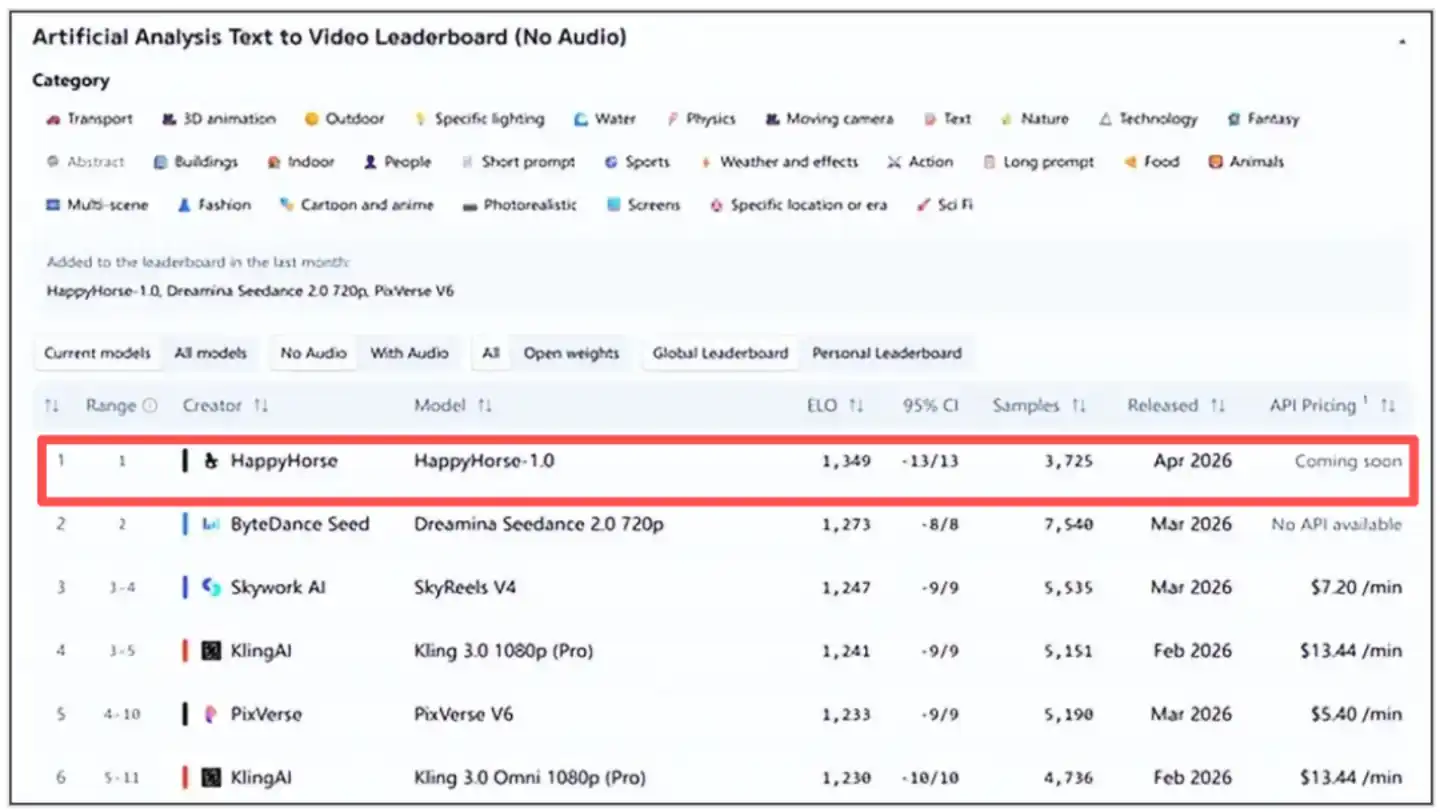
Figure: HappyHorse ranking on Artificial Analysis

Source: Internet

Over the past few days, because the "Happy Horse" was unclaimed, the market was full of curiosity about the origin of this "horse," leading the tech community to collectively play "Sherlock Holmes" to dig into its background.

At that time, many analyses pointed out that "Happy Horse" was an Alibaba product.

The analysis indicated two main evidence chains: first, the technical path displayed by HappyHorse has a very high affinity with the architecture of the Wan 2.6 series just released by Alibaba's Tongyi Lab; second, the return of key figures, Zhang Di, known as the "Father of Kling," who returned to Alibaba at the end of 2025, might have led the team to complete this product in just five months.

After the market "detectived" for a few days, on April 10th, Alibaba finally confirmed that the HappyHorse video model is a model developed by its innovation business unit and is currently in internal testing, with the API interface expected to be launched on April 30th.

It is said that the ATH Innovation Business Unit has launched an exploration plan for a new interactive方式 in the AI era, and HappyHorse is part of this exploration direction. More products will be launched陆续.
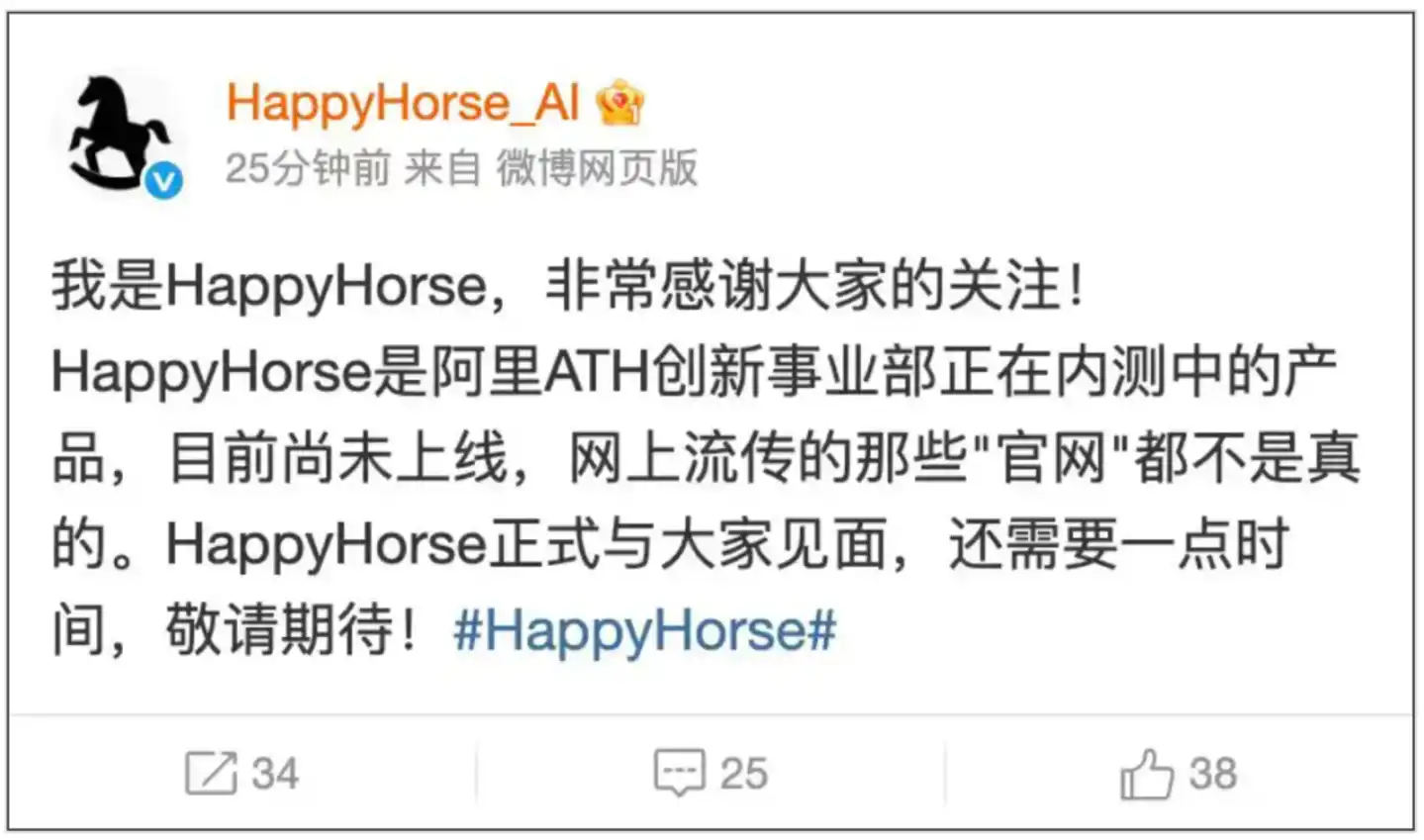
Figure: Alibaba confirms HappyHorse as its product

Source: Weibo 《Tingtong Tech》 Screenshot

At the same time, news indicated that the product was not completed by Zhang Di's team but by Zheng Bo's team from ATH.

Zheng Bo is an Alibaba Group Vice President. Public information shows that Zheng Bo holds a Ph.D. from the Tsinghua University Computer Science Department and joined Alibaba in September 2017. He has served as the head of Taobao Search and Recommendation Algorithms, CTO of Alimama, and head of algorithm technology for Taotian Group. His main research areas include large models, multimodal AI, decision intelligence, deep learning, advertising algorithms, and engine optimization.

This "claiming" news was not surprising to the market. Many analyses pointed out that the emergence of the "Happy Horse" means that Alibaba has completed a leap from "catching up" to "leading" in the multimodal field.

More importantly, this is not just a simple technical muscle show but a strategic "surprise attack" by Alibaba.

In the past, although Qwen was aligned internationally in text models, it rarely had products that captured user mindshare in the AI video track, which has the shortest path to commercialization. The performance of "Happy Horse"验证了 that Alibaba is maintaining a fast offensive pace in full-stack AI.

The market pointed out that the birth of "Happy Horse" accelerates the process of AI video generation moving from the laboratory to commercialization, becoming the "new quality productive forces" for the content industry.

An AI creator, Lin Shao, told 《Tingtong Tech》 that with the rapid iteration of "Happy Horse" and Seedance 2.0, AI video is transforming from a "toy" to a "tool".

Particularly important is that "Happy Horse" has changed the overall industry landscape of AI video large models, marking the entry of the AI video track into a new stage of multi-power melee.

More analyses pointed out that the impact on the former AI video "leader" Kling AI is especially obvious. Lin Shao直言, "Under the influence of Seedance 2.0 and Happy Horse, a 'double strangulation' pattern has formed against Kling AI."

-02- Alibaba's AI Formation

In fact, besides the "Happy Horse," Alibaba has明显 accelerated the推进 speed of its full-stack AI products in the past period.

From late March to early April 2026, Alibaba's Tongyi Lab completed a "triple release" of the full-modal large model Qwen3.5-Omni, the image generation model Wan2.7-Image, and the large language model Qwen3.6-Plus at a "daily update" pace.

This also allowed Alibaba to achieve全方位 matrix coverage of the underlying foundation (Qwen), vertical applications (Coding), and multimodal video (HappyHorse/Wanxiang).

According to a report by China National Radio, Qwen3.6Plus performed on par with or even surpassed competitors with 2 to 3 times larger parameter scales in programming capability evaluations. Just one day after its release, the model rushed to the top of the OpenRouter daily chart, with daily call volume breaking 1.4 trillion Tokens, setting a global record.
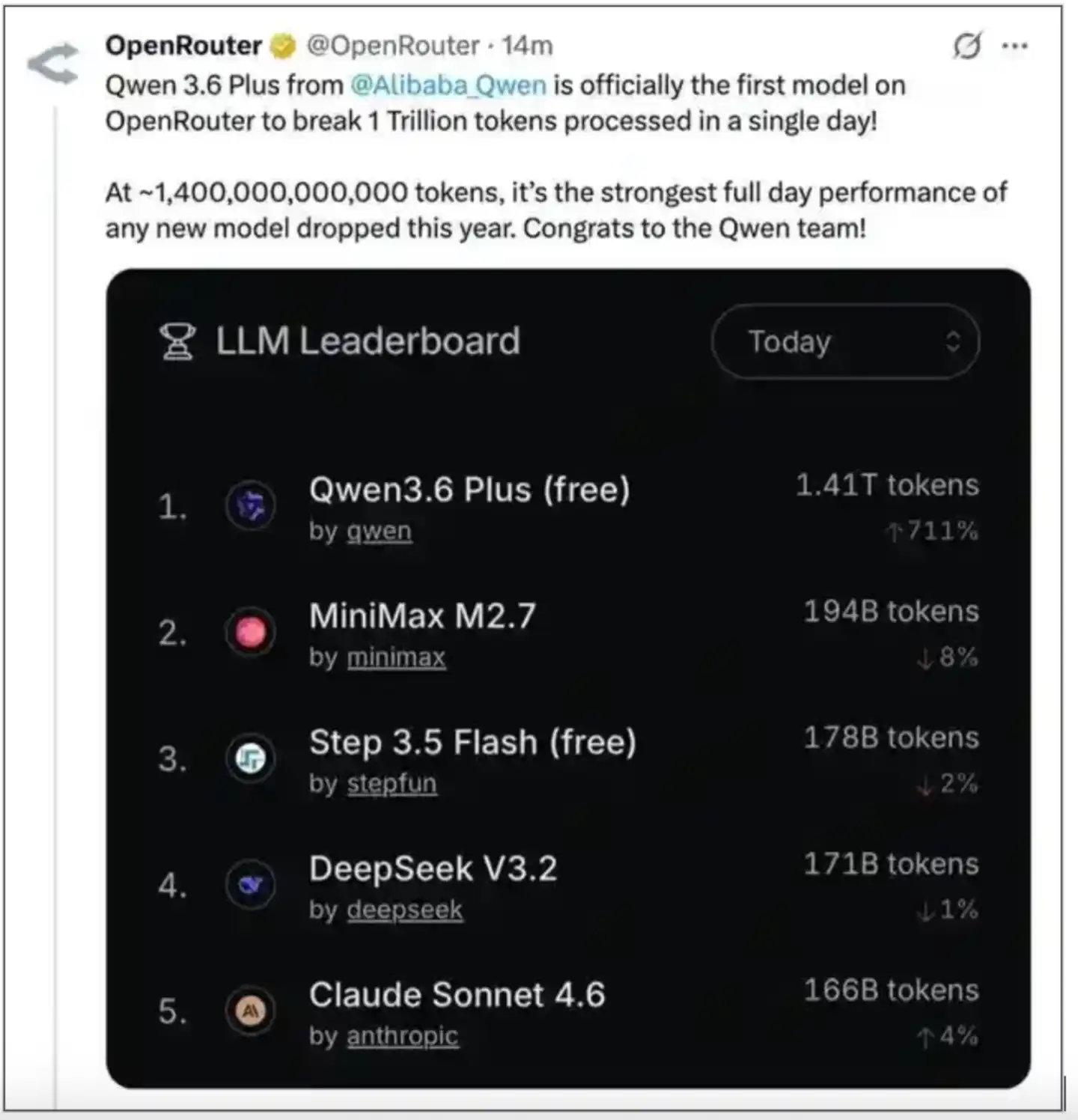
Figure: Qwen3.6Plus tops the OpenRouter daily chart

Source: Internet

Many analyses believe that this density and speed恍惚间让人看到当年阿里在电商领域“碾压一切”的气势 (vaguely reminds people of Alibaba's "crushing everything" momentum in the e-commerce field back in the day).

Actually, Alibaba's offensive is far more than just quickly deploying troops to seize positions.

Public information shows that the Qwen series has already produced multiple data points. As of January 2026, the cumulative downloads of the Tongyi Qianwen series models on the Hugging Face platform had exceeded 700 million, making it the most downloaded open-source AI series on the platform. By February, this number had exceeded 1 billion.

Performance on the C-end is同样亮眼. Public data shows that the monthly active users of the Qwen App have exceeded 300 million. By the end of February, nearly 140 million users had completed their first AI shopping through the Qwen App's智能体 function.

Call volume data also tells a story. According to the latest data from OpenRouter, the global call volume of Chinese AI large models has surpassed that of the US for five consecutive weeks, and two of the top three are models from Alibaba's Qwen 3.6 series.

This strategy is also being validated by the market. Alibaba's latest financial report data shows that Alibaba Cloud revenue increased by 36% year-on-year, and AI-related product revenue has achieved triple-digit year-on-year growth for the tenth consecutive quarter.

Of course, in the view of the market, Alibaba's ambition is far more than just making a few good models.

Judging from Alibaba's various actions in 2026, Alibaba is trying to重塑 its commercial底色, shifting from "selling goods" to "selling Tokens."

At Alibaba's earnings conference in March, Alibaba Group CEO Wu Yongming stated that in the future, relying on the full-stack AI capability of "large model + cloud + chip," and the comprehensive integration with Alibaba's business ecosystem, Alibaba will continue to exert efforts in both AI to B and to C directions.

Wu Yongming used "full-stack AI capability" to summarize Alibaba's core competitiveness, with chips and cloud computing as the AI infrastructure layer, and Token Hub as the main line, composed of large models, MaaS business, and ToB+ToC applications forming the AI model and application layer.

This system also nests chips, computing power, models, and applications layer by layer, forming a complete closed loop from the bottom to the front end.

This means that in the past, Alibaba's e-commerce story was about GMV and user growth; the cloud business story was about infrastructure and customer scale. Now, Alibaba is telling a new story, the full-stack AI story of "large model + cloud + chip".

-03- The Key to the "Sudden" Acceleration

Whether it is the emergence of the "Happy Horse" or the sudden acceleration of the Qwen series, the market has raised a question: Hasn't Alibaba's AI capability always been there? Why does it feel like this is a "sudden"爆发?

One of the key answers is "system."

In the past, Alibaba's AI could be described as "scattered." Damo Academy did research, Alibaba Cloud built platforms, and Taotian Group developed applications. Each had its own turf, inevitably leading to internal friction. Superficially, it looked like multiple points were blooming and advancing separately, but in reality, it wasted resources and was inefficient in coordination.

But all this was broken.

The change began this spring.

On March 16th, Alibaba established the Alibaba Token Hub (ATH) business group, personally led by CEO Wu Yongming. It includes the Tongyi Lab, MaaS business line, Qianwen business unit, Wukong business unit, and AI Innovation business unit, covering the complete chain from basic model R&D to personal and enterprise AI applications.

In the view of the market, the establishment of ATH is precisely about dismantling departmental barriers from the top-level design, eliminating the situation where model R&D, computing power supply, and application落地各自为战. The core logic is also very clear: "create Tokens, deliver Tokens, apply Tokens,"打通 the computing power layer, model layer, and application layer.

But this is not enough.

On April 8th, Alibaba conducted an even deeper organizational restructuring. Wu Yongming announced the establishment of a technology committee at the group level, with himself serving as the leader. Zhou Jingren serves as the Chief AI Architect of the technology committee, Li Feifei is responsible for Alibaba Cloud technology and AI cloud infrastructure construction, and Wu Zeming is responsible for the group's business technology platform and AI inference platform construction.

At the same time, the Tongyi Lab was officially upgraded to the "Tongyi Large Model Business Unit,"全面负责 by Zhou Jingren. This upgrade marks the shift of AI technology from R&D-oriented to full-scale commercial use.

Coupled with Li Feifei taking up the role of Alibaba Cloud CTO and Wu Zeming focusing on his group CTO work, Alibaba's AI governance architecture has formed a clear troika: the group technology committee is responsible for top-level design, the ATH business group is responsible for the business closed loop, and the Tongyi Large Model Business Unit is responsible for core R&D.

A series of system integrations also directly contributed to the recent "hat-trick" of密集 model releases.

Beyond organizational changes, the hardest force driving acceleration is money and resources.

For this AI battle, Alibaba's capital investment has reached the point of不计成本. In the latest quarterly report, Alibaba's free cash flow plummeted by 71% year-on-year. Where did the money go? There are two answers: one is burned on instant retail, and the other is burned on AI.

In the talent war, Alibaba also acted出击 quickly. Although it experienced the departure of people like Lin Junyang, it is understood that the personnel scale and technical梯队 of the Tongyi Lab were not substantially impacted.

Wu Yongming also responded in an internal letter that they will continue to increase AI R&D investment and the efforts to absorb outstanding talent. Additionally, the return of former Kuaishou VP and Kling technical负责人 Zhang Di in November 2025 is also a trophy of Alibaba's talent grab.

Especially in terms of the computing power base, in early 2025, Alibaba announced it would invest over 380 billion yuan in the next three years for云 and AI hardware infrastructure construction. In terms of T-Head's self-developed GPU chips, mass production has been achieved规模化. As of the end of February, cumulative deliveries had reached 470,000 units. This also means that Alibaba is摆脱 external dependence in computing power.

However, with such a big fanfare of burning money, does the capital market really buy it?

At least, judging from the current stock price reaction, the signal given by the market is that under the concept of organizational adjustment and "Happy Horse," Alibaba's stock price rose accordingly.

Of course, there are also different voices in the market.

E-commerce expert Cao Lei said that Alibaba also faces several challenges: how to balance centralization and business flexibility to avoid the technology committee becoming a "rubber stamp"; additionally, two major架构 adjustments in a short period may cause employee adaptation issues, affecting team stability.

Although the outcome is not yet determined, one fact is that Alibaba has shown sufficient sincerity in undertaking full-stack AI entrepreneurship.

This is a豪赌, concerning Alibaba's next ten years. And in the new round of organizational restructuring and ecological synergy, whether more "Happy Horses" will emerge is still worth waiting for the market.

(Header image generated by AI.)

(Disclaimer: This article is for information exchange only and does not constitute any investment reference advice.)


Criptos en tendencia

Preguntas relacionadas

QWhat is HappyHorse and why did it cause a stir in the AI community?

AHappyHorse is a video generation model developed by Alibaba's ATH Innovation Business Unit. It caused a stir because it unexpectedly topped the global evaluation platform Artificial Analysis with an Elo score of 1357, outperforming other video models. It was notable for its ability to generate high-definition videos with synchronized audio and sound effects from a script, significantly improving motion logic and efficiency.

QHow did the market initially react to HappyHorse before Alibaba confirmed it as their product?

ABefore Alibaba's confirmation, the market was highly curious and engaged in detective work to identify the origin of HappyHorse. Technical communities analyzed evidence such as its architectural similarities to Alibaba's Wan 2.6 series and the return of key personnel like Zhang Di, leading to widespread speculation that it was an Alibaba product.

QWhat organizational changes has Alibaba made to accelerate its AI development?

AAlibaba established the Alibaba Token Hub (ATH) business group, led by CEO Wu Yongming, to integrate AI efforts across research, platform, and application layers. They also set up a group-level technology committee with Wu Yongming as head, appointed key leaders like Zhou Jingren as Chief AI Architect, and upgraded the Tongyi Lab to the Tongyi Large Model Business Unit to focus on commercial scaling.

QWhat are some key achievements of Alibaba's AI models as mentioned in the article?

AAlibaba's Qwen3.6Plus model topped the OpenRouter daily chart with over 1.4 trillion token calls in a day, setting a global record. The Qwen series surpassed 1 billion downloads on Hugging Face, and the Qwen App reached 300 million monthly active users, with nearly 140 million users completing their first AI-powered shopping through it.

QWhat challenges does Alibaba face in its AI strategy according to the article?

AAlibaba faces challenges in balancing centralized control with business flexibility, ensuring the technology committee does not become a mere formality. Additionally, rapid organizational changes may cause employee adaptation issues and affect team stability. The company is also making significant financial investments, with free cash flow dropping 71% year-over-year, primarily due to spending on AI and instant retail.

Lecturas Relacionadas

Base Under Pressure

**Title: The Pressure Mounts for Base** Base, the Ethereum Layer 2 scaling solution backed by Coinbase, is facing significant pressure and public scrutiny from its leadership following the launch of Robinhood Chain. Base co-founder Jesse Pollak recently acknowledged strategic missteps, admitting that the chain's past focus on social and creator tokens (e.g., through Farcaster, Zora) failed to deliver sustainable adoption. He has refocused on core infrastructure, handing leadership of the Base App back to Coinbase's Cobie. While Base remains a top L2 contender alongside OP Mainnet and Arbitrum, and boasts the highest TVL (nearly $12B), its weaknesses are being highlighted by the new competitor. Key criticisms include its slow progress on decentralization. Base has faced issues with its single sequencer causing block production halts, and L2BEAT is reportedly considering downgrading its decentralization rating from Stage 1 to Stage 0. This contrasts sharply with the rapid initial success of Robinhood Chain, whose DEX quickly entered the top five by volume. The leadership styles of the parent companies are also being compared: Robinhood's CEO actively engages with new projects, while a recent incident where Coinbase's Brian Armstrong briefly changed his profile picture—sparking and then crashing a related meme token—drew community ire and mockery. Pollak stated Base is working with Coinbase on tokenized stocks backed 1:1 by real equity, differentiating it from Robinhood's derivatives model. However, the article argues that Base's most urgent task is to address its long-standing technical and trust issues. With more traditional finance players likely to emulate Robinhood's path, Base must use this competitive pressure to solidify its position as long-term financial infrastructure.

Foresight NewsHace 12 min(s)

Base Under Pressure

Foresight NewsHace 12 min(s)

White House Concession Removes Ethical Hurdle, Clarity Act Races Against Final Window Before Recess?

On July 21st, industry sources reported that the Trump administration has agreed to include an ethics provision in the "Clarity Act" (Digital Asset Market Clarity Act of 2025). This concession addresses the long-standing conflict-of-interest concerns regarding government officials and the crypto industry, potentially removing the final major obstacle to the bill's progress. Additionally, Patrick Witt, the executive director of the White House's Digital Asset Advisory Committee, confirmed he will remain in his role to help finalize the bill, alleviating previous concerns about his potential departure. The Clarity Act aims to establish a unified federal regulatory framework for the U.S. digital asset market. Its core objective is to resolve regulatory ambiguity by defining different types of digital assets (digital commodities, investment contract assets, and permitted payment stablecoins) and clarifying the respective oversight roles of the SEC and CFTC. This would end the long-running jurisdictional dispute between the two agencies and provide clearer compliance paths for the industry. With the ethics issue moving toward resolution, the most urgent challenge now is time. The U.S. Congress is set to begin its August recess in mid-August, leaving only a few working weeks to finalize the text and advance the bill through the Senate. Industry advocates, like the Blockchain Association's Kristin Smith, stress that this is a critical moment. If negotiations conclude successfully in the coming weeks, the Clarity Act could pass a key hurdle before the recess; otherwise, it may face significant delays. If enacted, the Clarity Act could mark a historic turning point in crypto regulation. By providing a clearer and more predictable legal framework, it aims to reduce uncertainty for businesses, developers, and traditional financial institutions looking to enter the digital asset space, potentially setting a global benchmark for market structure regulation.

Odaily星球日报Hace 18 min(s)

White House Concession Removes Ethical Hurdle, Clarity Act Races Against Final Window Before Recess?

Odaily星球日报Hace 18 min(s)

AI Era, Industrial Revolution, and Future Civilization Interview — Zhang Dingwen: The Future Does Not Belong to Chasers

"AI Era, Industrial Revolution and Future Civilization: An Interview with Zhang Dingwen – The Future Does Not Belong to Those Who Chase" In this interview, entrepreneur Zhang Dingwen reflects on his entrepreneurial journey and philosophy, moving beyond discussions of financing or success to emphasize understanding the "era" itself. He argues that true entrepreneurs should not chase short-term trends ("winds"), but position themselves in the direction of long-term technological and societal evolution. Zhang shares key lessons from his early days, including the realization that user value does not automatically translate to commercial value. For him, the core of entrepreneurship is not building a company but constantly upgrading one's own "cognition" – the ability to interpret information, ask the right questions, and understand the underlying "causes" behind business outcomes, not just the effects. His thinking has evolved from a focus on creating good products to a strategic focus on building "entrances" – platforms that naturally connect users to digital services. He sees smart wearables, like watches, not merely as hardware but as potential future gateways combining technological, financial, social, and even fashion attributes to create sustained user relationships and ecosystems. Ultimately, Zhang's vision transcends individual products or companies. He discusses business competition in three stages: product, platform, and finally, "civilization" – where the greatest companies influence how society operates by defining new rules and ways of life. He believes the mission of a truly great enterprise is to solve problems of its time, build enduring trust, and contribute lasting value, leaving behind not just wealth but a positive impact on how the world works. The future, he concludes, belongs not to the fastest, but to those with the correct long-term direction and a commitment to continuous learning and evolution.

marsbitHace 29 min(s)

AI Era, Industrial Revolution, and Future Civilization Interview — Zhang Dingwen: The Future Does Not Belong to Chasers

marsbitHace 29 min(s)

Cryptocurrency & Stock Market Barometer丨Strategy Cash Reserves Increase to $3.23 Billion, Halting BTC Purchases; Vanguard and Other Asset Managers Increase Holdings in Strategy Stock (July 21)

Market Overview & Warnings: The article warns of high volatility in South Korean stocks and continued dependence on U.S. stocks on geopolitics. Chinese A-shares remain under pressure. It advises against using leverage in current equity markets. For crypto-linked stocks, most have limited growth except Robinhood, with caution advised. U.S. Stock Market: Bearish bets on U.S. stocks, particularly targeting AI-related companies, have reached record highs since 2010, signaling deep skepticism about the sustainability of the AI-driven rally. Tech and chip stocks led a market decline, with the Philadelphia Semiconductor Index potentially entering a bear market. Increased expectations for Federal Reserve interest rate hikes and geopolitical tensions contributed to the negative sentiment. Bitcoin Treasury Company Updates: * Strategy: Increased its cash reserves to $3.23 billion and paused Bitcoin purchases. Several major asset managers, including Vanguard Group and Capital Group, increased their holdings of Strategy (MSTR) stock. * Global corporate Bitcoin buying slowed significantly to just $1.33 million last week. * Other notable activity: Strive purchased 21 BTC; ORANGE JUICE raised $40 million for Bitcoin acquisitions; Bitcoin Japan Corp. raised $60 million, allocating $4.08 million for its first BTC purchase. Other Crypto Treasury Holdings: * Ethereum: BitMine increased its ETH holdings to 5.78 million, nearing its 5% of supply goal. Its total crypto assets, cash, and securities are valued at $11.5 billion. * Solana: No significant corporate treasury activity reported. * Altcoins: HypeStrat made no adjustments to its treasury; its mNAV ratio fell to a long-term low. (Note: This summary is for informational purposes only and does not constitute investment advice.)

marsbitHace 30 min(s)

Cryptocurrency & Stock Market Barometer丨Strategy Cash Reserves Increase to $3.23 Billion, Halting BTC Purchases; Vanguard and Other Asset Managers Increase Holdings in Strategy Stock (July 21)

marsbitHace 30 min(s)

Trading

Spot

Artículos destacados

Qué es $S$

Entendiendo SPERO: Una Visión General Completa Introducción a SPERO A medida que el panorama de la innovación continúa evolucionando, la aparición de tecnologías web3 y proyectos de criptomonedas juega un papel fundamental en la configuración del futuro digital. Un proyecto que ha atraído la atención en este campo dinámico es SPERO, denotado como SPERO,$$s$. Este artículo tiene como objetivo reunir y presentar información detallada sobre SPERO, para ayudar a entusiastas e inversores a comprender sus fundamentos, objetivos e innovaciones dentro de los dominios web3 y cripto. ¿Qué es SPERO,$$s$? SPERO,$$s$ es un proyecto único dentro del espacio cripto que busca aprovechar los principios de descentralización y tecnología blockchain para crear un ecosistema que promueva la participación, la utilidad y la inclusión financiera. El proyecto está diseñado para facilitar interacciones de igual a igual de nuevas maneras, proporcionando a los usuarios soluciones y servicios financieros innovadores. En su esencia, SPERO,$$s$ tiene como objetivo empoderar a los individuos al proporcionar herramientas y plataformas que mejoren la experiencia del usuario en el espacio de las criptomonedas. Esto incluye habilitar métodos de transacción más flexibles, fomentar iniciativas impulsadas por la comunidad y crear caminos para oportunidades financieras a través de aplicaciones descentralizadas (dApps). La visión subyacente de SPERO,$$s$ gira en torno a la inclusividad, buscando cerrar brechas dentro de las finanzas tradicionales mientras aprovecha los beneficios de la tecnología blockchain. ¿Quién es el Creador de SPERO,$$s$? La identidad del creador de SPERO,$$s$ sigue siendo algo oscura, ya que hay recursos públicos limitados que proporcionan información de fondo detallada sobre su(s) fundador(es). Esta falta de transparencia puede derivarse del compromiso del proyecto con la descentralización, una ética que muchos proyectos web3 comparten, priorizando las contribuciones colectivas sobre el reconocimiento individual. Al centrar las discusiones en torno a la comunidad y sus objetivos colectivos, SPERO,$$s$ encarna la esencia del empoderamiento sin señalar a individuos específicos. Como tal, comprender la ética y la misión de SPERO sigue siendo más importante que identificar a un creador singular. ¿Quiénes son los Inversores de SPERO,$$s$? SPERO,$$s$ cuenta con el apoyo de una diversa gama de inversores que van desde capitalistas de riesgo hasta inversores ángeles dedicados a fomentar la innovación en el sector cripto. El enfoque de estos inversores generalmente se alinea con la misión de SPERO, priorizando proyectos que prometen avances tecnológicos sociales, inclusión financiera y gobernanza descentralizada. Estas fundaciones de inversores suelen estar interesadas en proyectos que no solo ofrecen productos innovadores, sino que también contribuyen positivamente a la comunidad blockchain y sus ecosistemas. El respaldo de estos inversores refuerza a SPERO,$$s$ como un contendiente notable en el dominio de proyectos cripto que evoluciona rápidamente. ¿Cómo Funciona SPERO,$$s$? SPERO,$$s$ emplea un marco multifacético que lo distingue de los proyectos de criptomonedas convencionales. Aquí hay algunas de las características clave que subrayan su singularidad e innovación: Gobernanza Descentralizada: SPERO,$$s$ integra modelos de gobernanza descentralizada, empoderando a los usuarios para participar activamente en los procesos de toma de decisiones sobre el futuro del proyecto. Este enfoque fomenta un sentido de propiedad y responsabilidad entre los miembros de la comunidad. Utilidad del Token: SPERO,$$s$ utiliza su propio token de criptomoneda, diseñado para servir diversas funciones dentro del ecosistema. Estos tokens permiten transacciones, recompensas y la facilitación de servicios ofrecidos en la plataforma, mejorando la participación y la utilidad general. Arquitectura en Capas: La arquitectura técnica de SPERO,$$s$ apoya la modularidad y escalabilidad, permitiendo la integración fluida de características y aplicaciones adicionales a medida que el proyecto evoluciona. Esta adaptabilidad es fundamental para mantener la relevancia en el cambiante paisaje cripto. Participación de la Comunidad: El proyecto enfatiza iniciativas impulsadas por la comunidad, empleando mecanismos que incentivan la colaboración y la retroalimentación. Al nutrir una comunidad sólida, SPERO,$$s$ puede abordar mejor las necesidades de los usuarios y adaptarse a las tendencias del mercado. Enfoque en la Inclusión: Al ofrecer tarifas de transacción bajas e interfaces amigables para el usuario, SPERO,$$s$ busca atraer a una base de usuarios diversa, incluyendo a individuos que anteriormente pueden no haber participado en el espacio cripto. Este compromiso con la inclusión se alinea con su misión general de empoderamiento a través de la accesibilidad. Cronología de SPERO,$$s$ Entender la historia de un proyecto proporciona información crucial sobre su trayectoria de desarrollo y hitos. A continuación se presenta una cronología sugerida que mapea eventos significativos en la evolución de SPERO,$$s$: Fase de Conceptualización e Ideación: Las ideas iniciales que forman la base de SPERO,$$s$ fueron concebidas, alineándose estrechamente con los principios de descentralización y enfoque comunitario dentro de la industria blockchain. Lanzamiento del Whitepaper del Proyecto: Tras la fase conceptual, se lanzó un whitepaper completo que detalla la visión, los objetivos y la infraestructura tecnológica de SPERO,$$s$ para generar interés y retroalimentación de la comunidad. Construcción de Comunidad y Primeras Interacciones: Se realizaron esfuerzos de divulgación activa para construir una comunidad de primeros adoptantes y posibles inversores, facilitando discusiones en torno a los objetivos del proyecto y obteniendo apoyo. Evento de Generación de Tokens: SPERO,$$s$ llevó a cabo un evento de generación de tokens (TGE) para distribuir sus tokens nativos a los primeros seguidores y establecer liquidez inicial dentro del ecosistema. Lanzamiento de la dApp Inicial: La primera aplicación descentralizada (dApp) asociada con SPERO,$$s$ se puso en marcha, permitiendo a los usuarios interactuar con las funcionalidades centrales de la plataforma. Desarrollo Continuo y Alianzas: Actualizaciones y mejoras continuas a las ofertas del proyecto, incluyendo alianzas estratégicas con otros actores en el espacio blockchain, han moldeado a SPERO,$$s$ en un jugador competitivo y en evolución en el mercado cripto. Conclusión SPERO,$$s$ se erige como un testimonio del potencial de web3 y las criptomonedas para revolucionar los sistemas financieros y empoderar a los individuos. Con un compromiso con la gobernanza descentralizada, la participación comunitaria y funcionalidades diseñadas de manera innovadora, allana el camino hacia un paisaje financiero más inclusivo. Como con cualquier inversión en el espacio cripto que evoluciona rápidamente, se anima a los posibles inversores y usuarios a investigar a fondo y participar de manera reflexiva con los desarrollos en curso dentro de SPERO,$$s$. El proyecto muestra el espíritu innovador de la industria cripto, invitando a una mayor exploración de sus innumerables posibilidades. Mientras el viaje de SPERO,$$s$ aún se desarrolla, sus principios fundamentales pueden, de hecho, influir en el futuro de cómo interactuamos con la tecnología, las finanzas y entre nosotros en ecosistemas digitales interconectados.

150 Vistas totalesPublicado en 2024.12.17Actualizado en 2024.12.17

Qué es $S$

Qué es AGENT S

Agent S: El Futuro de la Interacción Autónoma en Web3 Introducción En el paisaje en constante evolución de Web3 y las criptomonedas, las innovaciones están redefiniendo constantemente cómo los individuos interactúan con las plataformas digitales. Uno de estos proyectos pioneros, Agent S, promete revolucionar la interacción humano-computadora a través de su marco agente abierto. Al allanar el camino para interacciones autónomas, Agent S busca simplificar tareas complejas, ofreciendo aplicaciones transformadoras en inteligencia artificial (IA). Esta exploración detallada profundizará en las complejidades del proyecto, sus características únicas y las implicaciones para el dominio de las criptomonedas. ¿Qué es Agent S? Agent S se presenta como un marco agente abierto innovador, diseñado específicamente para abordar tres desafíos fundamentales en la automatización de tareas informáticas: Adquisición de Conocimiento Específico del Dominio: El marco aprende inteligentemente de diversas fuentes de conocimiento externas y experiencias internas. Este enfoque dual le permite construir un rico repositorio de conocimiento específico del dominio, mejorando su rendimiento en la ejecución de tareas. Planificación a Largo Plazo de Tareas: Agent S emplea planificación jerárquica aumentada por la experiencia, un enfoque estratégico que facilita la descomposición y ejecución eficiente de tareas complejas. Esta característica mejora significativamente su capacidad para gestionar múltiples subtareas de manera eficiente y efectiva. Manejo de Interfaces Dinámicas y No Uniformes: El proyecto introduce la Interfaz Agente-Computadora (ACI), una solución innovadora que mejora la interacción entre agentes y usuarios. Utilizando Modelos de Lenguaje Multimodal de Gran Escala (MLLMs), Agent S puede navegar y manipular diversas interfaces gráficas de usuario sin problemas. A través de estas características pioneras, Agent S proporciona un marco robusto que aborda las complejidades involucradas en la automatización de la interacción humana con las máquinas, preparando el terreno para una multitud de aplicaciones en IA y más allá. ¿Quién es el Creador de Agent S? Si bien el concepto de Agent S es fundamentalmente innovador, la información específica sobre su creador sigue siendo elusiva. El creador es actualmente desconocido, lo que resalta ya sea la etapa incipiente del proyecto o la elección estratégica de mantener a los miembros fundadores en el anonimato. Independientemente de la anonimidad, el enfoque sigue siendo en las capacidades y el potencial del marco. ¿Quiénes son los Inversores de Agent S? Dado que Agent S es relativamente nuevo en el ecosistema criptográfico, la información detallada sobre sus inversores y patrocinadores financieros no está documentada explícitamente. La falta de información disponible públicamente sobre las bases de inversión u organizaciones que apoyan el proyecto plantea preguntas sobre su estructura de financiamiento y hoja de ruta de desarrollo. Comprender el respaldo es crucial para evaluar la sostenibilidad del proyecto y su posible impacto en el mercado. ¿Cómo Funciona Agent S? En el núcleo de Agent S se encuentra una tecnología de vanguardia que le permite funcionar de manera efectiva en diversos entornos. Su modelo operativo se basa en varias características clave: Interacción Humano-Computadora Similar a la Humana: El marco ofrece planificación avanzada de IA, esforzándose por hacer que las interacciones con las computadoras sean más intuitivas. Al imitar el comportamiento humano en la ejecución de tareas, promete elevar las experiencias de los usuarios. Memoria Narrativa: Empleada para aprovechar experiencias de alto nivel, Agent S utiliza memoria narrativa para hacer un seguimiento de las historias de tareas, mejorando así sus procesos de toma de decisiones. Memoria Episódica: Esta característica proporciona a los usuarios una guía paso a paso, permitiendo que el marco ofrezca apoyo contextual a medida que se desarrollan las tareas. Soporte para OpenACI: Con la capacidad de ejecutarse localmente, Agent S permite a los usuarios mantener el control sobre sus interacciones y flujos de trabajo, alineándose con la ética descentralizada de Web3. Fácil Integración con APIs Externas: Su versatilidad y compatibilidad con varias plataformas de IA aseguran que Agent S pueda encajar sin problemas en ecosistemas tecnológicos existentes, convirtiéndolo en una opción atractiva para desarrolladores y organizaciones. Estas funcionalidades contribuyen colectivamente a la posición única de Agent S dentro del espacio cripto, ya que automatiza tareas complejas y de múltiples pasos con una intervención humana mínima. A medida que el proyecto evoluciona, sus posibles aplicaciones en Web3 podrían redefinir cómo se desarrollan las interacciones digitales. Cronología de Agent S El desarrollo y los hitos de Agent S pueden encapsularse en una cronología que resalta sus eventos significativos: 27 de septiembre de 2024: El concepto de Agent S fue lanzado en un documento de investigación integral titulado “Un Marco Agente Abierto que Usa Computadoras Como un Humano”, mostrando las bases del proyecto. 10 de octubre de 2024: El documento de investigación fue puesto a disposición del público en arXiv, ofreciendo una exploración profunda del marco y su evaluación de rendimiento basada en el benchmark OSWorld. 12 de octubre de 2024: Se lanzó una presentación en video, proporcionando una visión visual de las capacidades y características de Agent S, involucrando aún más a posibles usuarios e inversores. Estos marcadores en la cronología no solo ilustran el progreso de Agent S, sino que también indican su compromiso con la transparencia y la participación comunitaria. Puntos Clave Sobre Agent S A medida que el marco Agent S continúa evolucionando, varios atributos clave destacan, subrayando su naturaleza innovadora y potencial: Marco Innovador: Diseñado para proporcionar un uso intuitivo de las computadoras similar a la interacción humana, Agent S aporta un enfoque novedoso a la automatización de tareas. Interacción Autónoma: La capacidad de interactuar de manera autónoma con las computadoras a través de GUI significa un salto hacia soluciones informáticas más inteligentes y eficientes. Automatización de Tareas Complejas: Con su metodología robusta, puede automatizar tareas complejas y de múltiples pasos, haciendo que los procesos sean más rápidos y menos propensos a errores. Mejora Continua: Los mecanismos de aprendizaje permiten a Agent S mejorar a partir de experiencias pasadas, mejorando continuamente su rendimiento y eficacia. Versatilidad: Su adaptabilidad en diferentes entornos operativos como OSWorld y WindowsAgentArena asegura que pueda servir a una amplia gama de aplicaciones. A medida que Agent S se posiciona en el paisaje de Web3 y criptomonedas, su potencial para mejorar las capacidades de interacción y automatizar procesos significa un avance significativo en las tecnologías de IA. A través de su marco innovador, Agent S ejemplifica el futuro de las interacciones digitales, prometiendo una experiencia más fluida y eficiente para los usuarios en diversas industrias. Conclusión Agent S representa un audaz avance en la unión de la IA y Web3, con la capacidad de redefinir cómo interactuamos con la tecnología. Aunque aún se encuentra en sus primeras etapas, las posibilidades para su aplicación son vastas y atractivas. A través de su marco integral que aborda desafíos críticos, Agent S busca llevar las interacciones autónomas al primer plano de la experiencia digital. A medida que nos adentramos más en los reinos de las criptomonedas y la descentralización, proyectos como Agent S sin duda desempeñarán un papel crucial en la configuración del futuro de la tecnología y la colaboración humano-computadora.

561 Vistas totalesPublicado en 2025.01.14Actualizado en 2025.01.14

Qué es AGENT S

Cómo comprar S

¡Bienvenido a HTX.com! Hemos hecho que comprar Sonic (S) sea simple y conveniente. Sigue nuestra guía paso a paso para iniciar tu viaje de criptos.Paso 1: crea tu cuenta HTXUtiliza tu correo electrónico o número de teléfono para registrarte y obtener una cuenta gratuita en HTX. Experimenta un proceso de registro sin complicaciones y desbloquea todas las funciones.Obtener mi cuentaPaso 2: ve a Comprar cripto y elige tu método de pagoTarjeta de crédito/débito: usa tu Visa o Mastercard para comprar Sonic (S) al instante.Saldo: utiliza fondos del saldo de tu cuenta HTX para tradear sin problemas.Terceros: hemos agregado métodos de pago populares como Google Pay y Apple Pay para mejorar la comodidad.P2P: tradear directamente con otros usuarios en HTX.Over-the-Counter (OTC): ofrecemos servicios personalizados y tipos de cambio competitivos para los traders.Paso 3: guarda tu Sonic (S)Después de comprar tu Sonic (S), guárdalo en tu cuenta HTX. Alternativamente, puedes enviarlo a otro lugar mediante transferencia blockchain o utilizarlo para tradear otras criptomonedas.Paso 4: tradear Sonic (S)Tradear fácilmente con Sonic (S) en HTX's mercado spot. Simplemente accede a tu cuenta, selecciona tu par de trading, ejecuta tus trades y monitorea en tiempo real. Ofrecemos una experiencia fácil de usar tanto para principiantes como para traders experimentados.

1.1k Vistas totalesPublicado en 2025.01.15Actualizado en 2026.06.02

Cómo comprar S

Discusiones

Bienvenido a la comunidad de HTX. Aquí puedes mantenerte informado sobre los últimos desarrollos de la plataforma y acceder a análisis profesionales del mercado. A continuación se presentan las opiniones de los usuarios sobre el precio de S (S).

活动图片