Editor's Note: From August 19 to 20, the stock price of stablecoin issuer Circle cumulatively rose about 16.7%. During the same period, Bitcoin broke through $70,000, U.S. Treasury yields retreated, and crypto-related stocks generally strengthened. News of a White House meeting with crypto industry executives and increased USDC market share further boosted market sentiment.
This rebound is largely driven by sector-wide momentum. Circle's own fundamentals present a mixed picture: while USDC circulation and on-chain transaction volume maintained growth in the second quarter, revenue growth has already slowed, with over 85% of revenue still coming from interest generated on reserve assets. As interest rates decline, whether USDC's scale expansion can offset the drop in reserve yield becomes a key factor affecting short-term profitability.
The more significant long-term variables are the Arc blockchain and the Circle Payments Network (CPN). The Arc public mainnet is scheduled to launch on September 16, with institutions like BlackRock, Visa, Mastercard, and DTCC participating as validators or integrating related services. Circle hopes this will expand transaction, settlement, and software service revenue, reducing reliance on reserve interest.
The valuation of $259 presented in this article corresponds to a neutral scenario for 2030, significantly higher than the Wall Street average target price of about $101. The former already incorporates the commercial success of Arc and CPN, while the latter is mainly based on reserve revenue, interest rate environment, and near-term performance over the next 12 months. Which valuation set Circle ultimately achieves depends on whether Arc, after its launch, can bring real assets, transaction activity, and sustainable revenue.
Below is the translated original text:
Circle's stock price rose 9.56% on August 19, closing at $78.59; it gained another 6.45% the next day, closing at $83.66, for a cumulative two-day increase of approximately 16.7%. On August 21, Circle continued to rise 5.16%, closing at $87.98.
The consecutive gains indicate a clear improvement in market sentiment. However, this article argues that the movement over the first two trading days was primarily driven by Bitcoin's rise, the pullback in U.S. Treasury yields, and the strength in crypto-related stocks, with no significant fundamental changes in Circle itself sufficient to explain this magnitude of gain.
Two-Day Gain of Nearly 17%, Primarily Driven by Crypto Market Conditions
From August 19 to 20, Bitcoin climbed past $70,000, U.S. Treasury yields fell, and crypto-related stocks broadly advanced. Circle's stock price is relatively sensitive to crypto market sentiment, thus recording a larger gain.
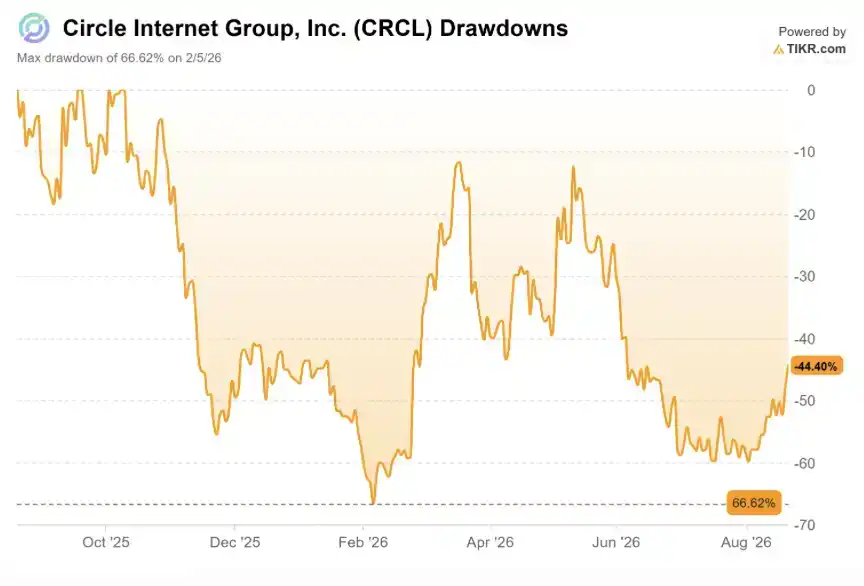
Historical drawdown of Circle's stock price. Despite a cumulative gain of about 16.7% from August 19 to 20, the price remains significantly below previous highs. Source: TIKR
Additional support for the stock price came from the White House meeting with crypto industry executives, increased USDC market share, and Circle's quarterly earnings Q&A session. Overall, the improvement in sector risk appetite remains the main driver of this rally.
The two-day movement is not yet sufficient to confirm a fundamental reversal for Circle. When Bitcoin rises and interest rate expectations turn accommodative, the market is often willing to assign Circle a higher valuation; however, once the crypto market cools or Treasury yields rise again, its stock price could also experience significant volatility.
Compared to the short-term market movement, Circle's acquisition of a portion of IBM's blockchain patent assets on July 27 holds greater long-term significance. This acquisition covers over 680 patent families and nearly 1,000 granted patents in areas including blockchain, banking, insurance, enterprise infrastructure, and secure cloud services.
Circle stated that after the acquisition, the company becomes the largest holder of blockchain patents in the United States. This intellectual property portfolio will be used to support the development of USDC, CPN, and Arc. While the patent portfolio helps strengthen Circle's technology reserves, it is difficult to translate directly into revenue or profit in the short term.
USDC Growth Remains Robust, but Revenue Growth is Slowing
Circle announced its Q2 2026 earnings on August 5. Quarterly total revenue & reserve revenue was $701 million, up 7% year-over-year; net income from continuing operations was $48 million; adjusted EBITDA was $143 million, up 8% year-over-year.
USDC-related business metrics maintained strong growth:
· USDC circulation at quarter-end was $73.3 billion, up 19% year-over-year;
· Average quarterly circulation reached $76.5 billion;
· On-chain transaction volume reached $14.8 trillion, up 151% year-over-year.
While USDC's usage scale continues to expand, revenue growth is relatively limited. Circle's Q2 total revenue saw only a slight increase from Q1's $694 million, and its year-over-year growth rate has noticeably slowed compared to previous periods.
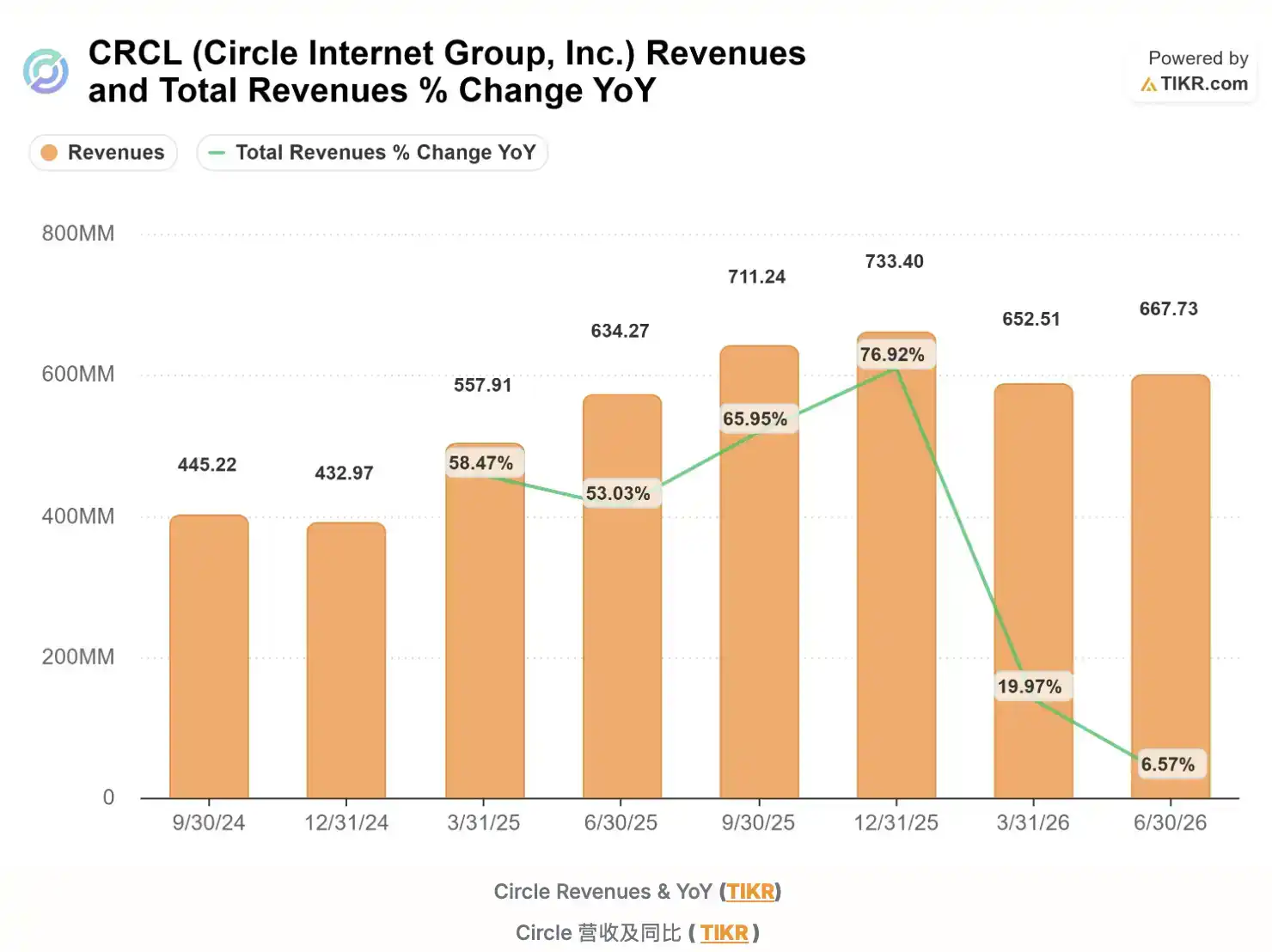
Circle's quarterly revenue and year-over-year growth rate. Q2 total revenue & reserve revenue was $701 million, up 7% year-over-year, with growth slowing. Source: TIKR
Interest rates are a key variable here. Circle primarily allocates USDC reserve assets to short-term U.S. Treasuries and cash-like assets, generating interest income. The Q2 reserve yield decreased to 3.48% from 4.14% in the same period last year, offsetting some of the gains brought by USDC circulation growth.
Circle's current profitability remains dominated by two variables: USDC circulation determines the size of reserve assets, and short-term interest rates determine the yield on those assets. As long as interest income remains a high proportion of total revenue, interest rate cuts will continue to depress the revenue generated per unit of USDC.
Arc Bears the Expectation of Circle's Platform Transformation
Circle hopes to expand software and network service revenue through Arc and CPN, gradually reducing the weight of reserve interest in its revenue structure.
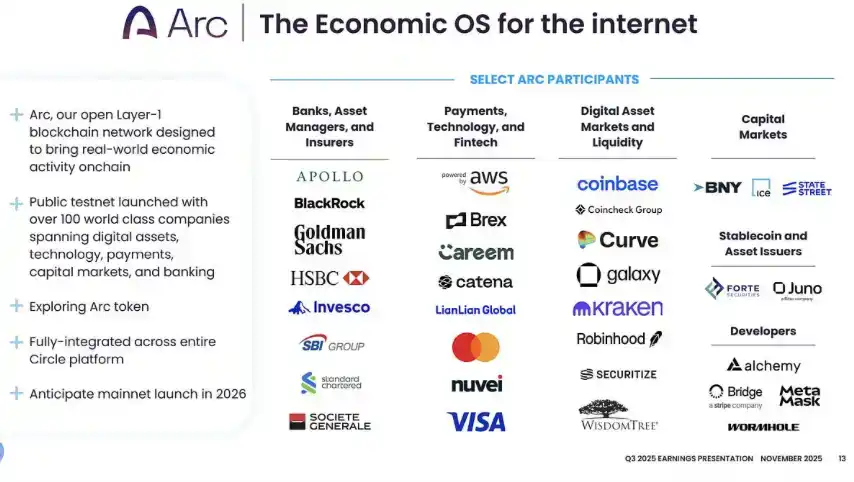
Arc ecosystem participants cover asset management, banking, payments, trading, and blockchain infrastructure. The public mainnet is scheduled for launch on September 16. Source: Circle
Arc is a stablecoin-native blockchain launched by Circle, with its public mainnet scheduled to launch on September 16. Circle states that over 100 institutions and ecosystem projects are currently participating in its development, with initial validators including institutions such as BlackRock, DTCC, Visa, Mastercard, ICE, Standard Chartered, and MoneyGram.
BlackRock is expected to deploy its tokenized money market fund BUIDL on Arc, and DTCC plans to explore tokenizing its custodied securities and connecting them to Arc. These partnerships lend institutional credibility to Arc, but there is still a distance to go before scaled adoption and stable revenue materialize.
Circle CEO Jeremy Allaire positions Arc as financial infrastructure serving on-chain enterprises, tokenized assets, and AI agent payments. According to this plan, Circle could in the future generate revenue from transactions, settlements, software, and network services, gradually expanding its business model from stablecoin issuance to an on-chain financial platform.
In Q2, Circle completed a $242 million Arc token presale, with related revenue to be recognized gradually as product milestones are achieved. Driven by this, the company raised its 2026 guidance for other revenue from $150–170 million to $310–330 million, and increased its revenue less distribution cost margin (RLDC Margin) guidance from 38–40% to 41.7–43.7%.
While the token presale can boost non-reserve revenue in the short term, its sustainability remains to be seen. The viability of Arc's business model ultimately depends on whether, after the mainnet launch, it can consistently attract assets, transactions, and developers, thereby generating stable service revenue.
CPN is also in its early commercial stages. The payment network had an annualized payment volume of approximately $15 billion at the end of Q2, rising to $23 billion by the end of July. Commercialization is expected to begin in the second half of 2026. While payment scale has grown, the conversion to revenue still awaits validation in subsequent financial reports.
The $259 Valuation Incorporates Platform Transformation by 2030
TIKR assigns Circle a valuation of approximately $259 per share by the end of 2030 under a neutral scenario. Based on the $83.66 share price used in this article, this implies a potential cumulative return of about 210%, or an annualized return of roughly 30% over approximately 4.4 years.
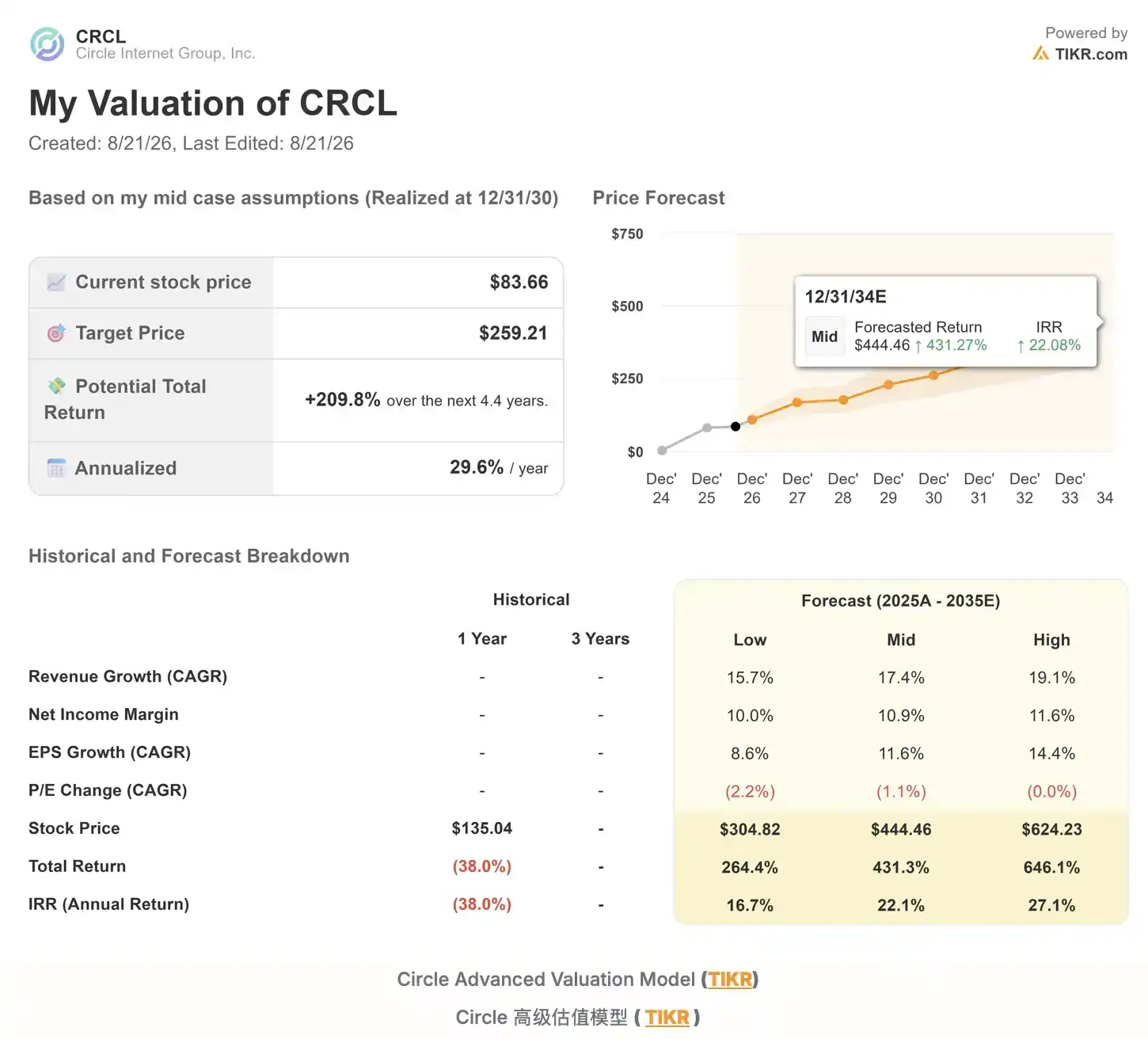
TIKR's neutral scenario estimates Circle's per-share value at about $259 by the end of 2030. This result is based on assumptions of continued USDC growth, gradual commercialization of Arc and CPN, and is not Wall Street's 12-month consensus target price. Source: TIKR
This figure comes from TIKR's long-term valuation model and is not Circle management guidance or Wall Street's consensus target price for the next 12 months. The model is built on the following assumptions:
· USDC circulation maintains a compound growth rate of approximately 40% over a full cycle;
· The global stablecoin market expands to $1–4 trillion by 2030;
· Arc and CPN gradually contribute significant non-reserve revenue;
· More USDC remains on Circle's own infrastructure, leading to lower distribution costs and improved margins.
The average Wall Street target price listed in this article is approximately $101, about 21% higher than $83.66. The two valuations differ significantly in time horizon and business assumptions. Analysts' short-term targets primarily reference reserve revenue, interest rate changes, and recent performance; the $259 scenario, however, already factors in the successful transformation of Circle into an on-chain financial infrastructure platform.
Therefore, the $259 figure is closer to a long-term optimistic scenario. If Arc grows into a significant settlement network for tokenized assets and smart payments, Circle has the opportunity to receive a platform-type company valuation. If network usage and commercial revenue fall short of expectations, interest rates, USDC scale, and crypto market sentiment will continue to dominate its valuation.
After September 16, Commercial Revenue is the Real Test
Whether Arc can launch as planned on September 16 is the most clear-cut near-term observation point for Circle. However, mainnet launch and institutional participation only complete the first step of commercialization; subsequent validation must come through actual business data.
The market needs to watch for:
· Whether institutions like BlackRock and DTCC connect real assets and transactions to Arc;
· Whether Arc's transaction volume, active addresses, and fee revenue can grow sustainably;
· Whether CPN, after commercialization, can generate stable payment and network revenue;
· Whether the proportion of non-reserve revenue to total revenue can increase;
· Whether USDC scale growth and platform revenue can offset the pressure on reserve revenue caused by interest rate cuts.
If Circle reports sustained growth in on-chain assets, transaction activity, and commercial revenue in subsequent earnings reports, its platform transformation will gain more solid evidence, potentially further unlocking long-term valuation.
If progress after Arc's launch remains concentrated in institutional announcements and partnership news, with limited revenue contribution, Circle's stock performance will remain highly dependent on interest rates, USDC circulation, and crypto market sentiment. The recent two-day gain of nearly 17% largely reflects the market trading its growth expectations again, while the platform transformation still awaits validation.