Circle's Second Growth Curve: After the $222 Million ARC Financing, CRCL or ARC?

链捕手Publicado a 2026-05-14Actualizado a 2026-05-14

Resumen

Circle, the issuer of USDC, announced that its new public blockchain Arc completed a $222 million private sale for its native token ARC, with the network's fully diluted valuation reaching $3 billion. The funding round was led by a16z crypto, with participation from major institutions including BlackRock, Apollo, and ICE. The article explains Circle's rationale for building its own L1 blockchain, Arc. Existing chains like Ethereum and Solana are seen as lacking native support for large-scale institutional needs, such as regulatory compliance, predictable transaction costs, and asset issuance/redemption workflows. Arc is designed to fill this gap as a foundational layer for the on-chain economy, moving beyond Circle's reliance on USDC reserve interest for revenue. It details the dual-token model of Arc: USDC serves as the stable gas token for predictable transactions, while ARC is the network's native asset used for staking in the planned transition to Proof-of-Stake, governance, and aligning long-term incentives among participants. ARC's total supply is 10 billion, with 60% allocated to ecosystem development, 25% to Circle, and 15% to a long-term reserve. All protocol fees are converted to ARC, with portions burned and distributed to stakers. The piece contrasts the value proposition of Circle's public stock (CRCL) and the ARC token. CRCL captures the company's core cash flows from USDC interest and other business lines. ARC captures the growth potential of the Arc network...

Author: Zhou, ChainCatcher

On May 11th, while releasing its Q1 2026 financial report, Circle announced that the ARC native token of its public blockchain Arc had completed a $222 million presale, with a fully diluted valuation of $3 billion for the network.

The round was led by a16z crypto with a $75 million investment, followed by top-tier institutions including BlackRock, Apollo, ICE (parent company of NYSE), SBI Group, SC Ventures, and ARK Invest.

CRCL's stock price surged nearly 16% that day, with its market cap rebounding above $30 billion.
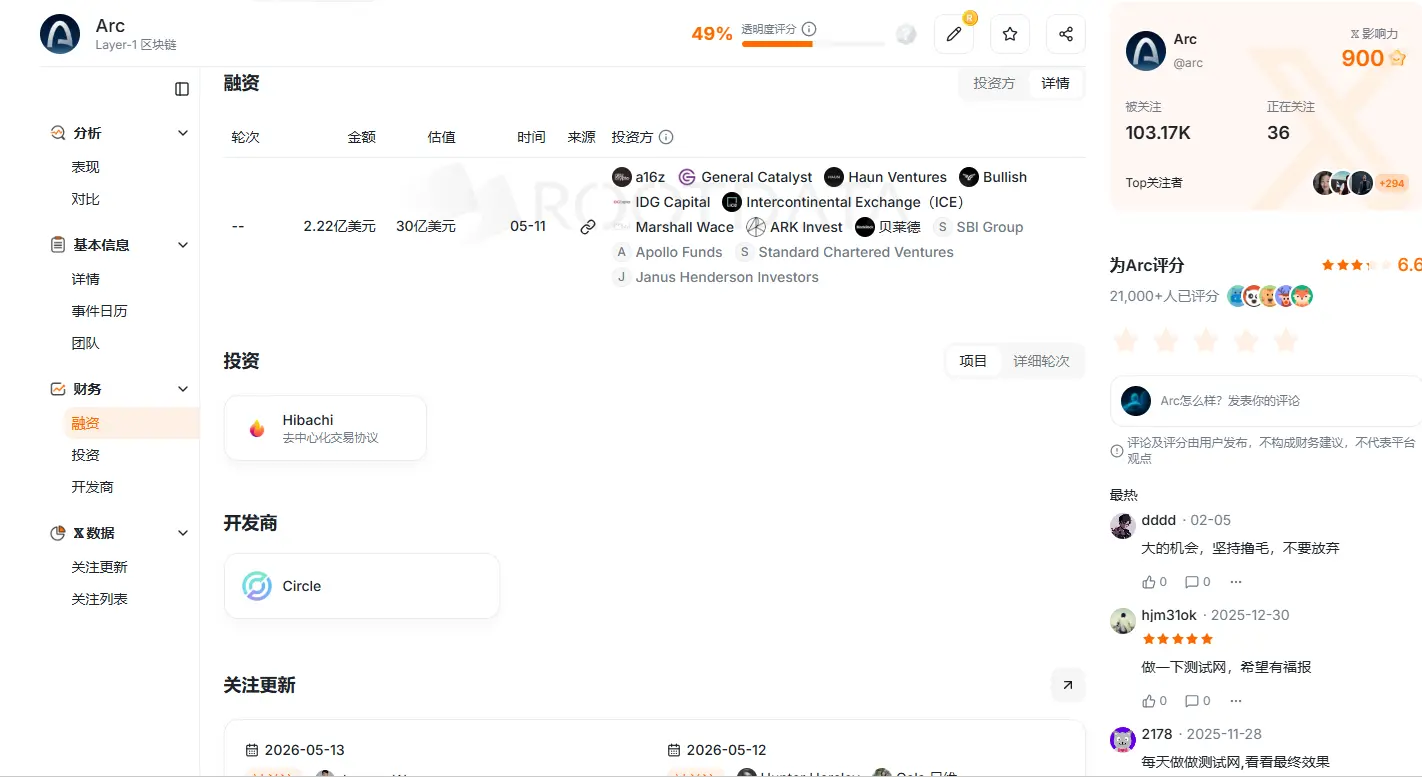
Image source: RootData

This development raises a core market question: Circle is already a public company; if investors are optimistic about its future, why not simply hold CRCL stock? Why issue the ARC token as well? Both are capturing the value of the Arc network. What exactly does each represent?

1. Why Did Circle Build Arc Itself?

Why did Circle choose to invest massive resources into building its own public blockchain instead of continuing to issue and use USDC on Ethereum or Solana?

a16z Crypto explains that as global finance gradually moves on-chain, only a few public blockchains will be able to serve as the "foundational base for an on-chain economic system."

Stablecoin transaction volume approached $9 trillion last year, placing it in the same league as global payment networks like Visa and PayPal. Cross-border payments, B2B settlement, and forex trading are becoming core use cases for stablecoins, which have upgraded to become a core layer of global financial infrastructure.

However, existing blockchain infrastructure is still primarily geared towards crypto-native users and individual developers, lacking native support for large-scale institutional-level demands.

Industry insiders point out that institutions face several core pain points when conducting business on-chain, including: the need for fully closed-loop on-chain/off-chain validation for asset issuance and redemption; payments requiring deterministic finality; compliance capabilities needing to be embedded at the foundational layer; configurable privacy protection; and the need for predictable Gas costs using USDC, among others.

Ethereum, Solana, and other existing public blockchains struggle to natively meet these demands.

For Circle, the company has historically relied primarily on USDC reserve interest for profitability. In Q1, USDC circulation reached $77 billion, a 28% year-over-year increase. As its business scale continues to expand, relying solely on existing public chains can no longer fully meet the deeper needs of institutional clients.

Therefore, Circle's launch of Arc aims precisely to fill this gap. The underlying logic is that having a stablecoin circulate on someone else's chain does not mean owning the stablecoin financial ecosystem—which is why Circle decided to build its own L1.
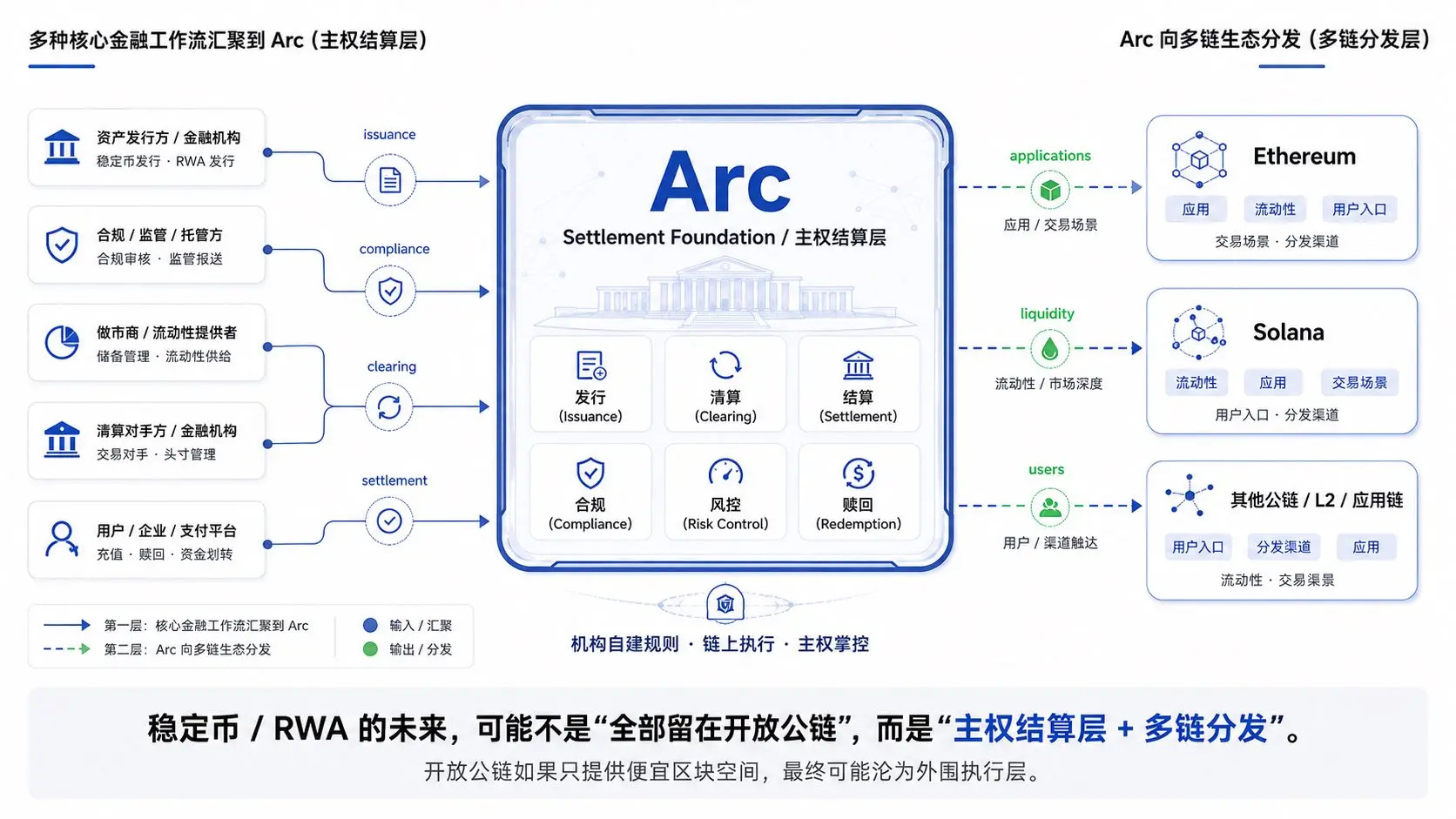
Image source: X user @vanisaxxm

2. USDC Solves the Transaction Problem, ARC Solves the Coordination Problem

Since USDC is already the Gas token for Arc, why is another ARC token needed?

USDC has effectively solved the stability issue at the transaction level. Institutions can pay fees directly priced in USD, with predictable costs that can be accounted for, avoiding the troubles caused by crypto asset price volatility for finance departments.

However, for a network to operate healthily in the long term, solving the transaction problem alone is not enough. It also needs to address coordination problems.

According to the official whitepaper, Arc will gradually transition from its current Proof-of-Authority to Proof-of-Stake. Validator nodes need to stake assets to secure the network, with the core principle of staking being to bind node behavior through economic incentives; malicious actions risk slashing. USDC's value is pegged at $1, making it unable to truly bind node interests to the network's success or failure. Only the native ARC token can provide such dynamic economic incentives.
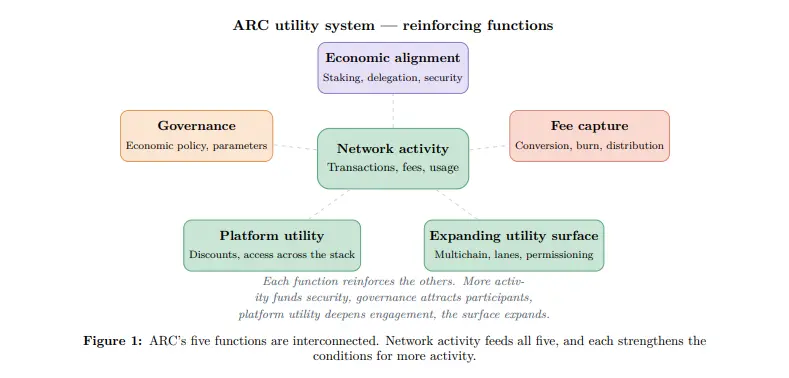
Governance also requires interest alignment. Key decisions such as fee rates, inflation parameters, and burn ratios require participants to adopt a long-term perspective. If voting were based solely on USDC, holders could easily lack sustained motivation, potentially voting and then exiting. ARC holders' asset value is directly tied to network performance, giving them stronger motivation to make choices beneficial for the network's long-term development.

The whitepaper also clarifies that ARC's governance authority has phased boundaries. Economic parameters are determined by token holder votes, but important matters like protocol upgrades, security incident handling, and validator qualification reviews initially remain under Circle's control, with gradual decentralization planned as governance matures.

In simple terms, USDC is the lifeblood of the Arc network, responsible for efficient daily flow; ARC is the equity of the network, responsible for aligning the long-term interests of all parties. This dual-token design also partially transforms the cost of ecosystem development from Circle's fixed cash expenditures into incentive arrangements tied to the network's success or failure.

3. CRCL and ARC: Which Pieces of the Pie Do They Capture?

Thus, Circle now holds both the publicly listed equity CRCL and the network's native token ARC, both capturing the value of the same Arc network. So, which pieces of the pie do they respectively capture?

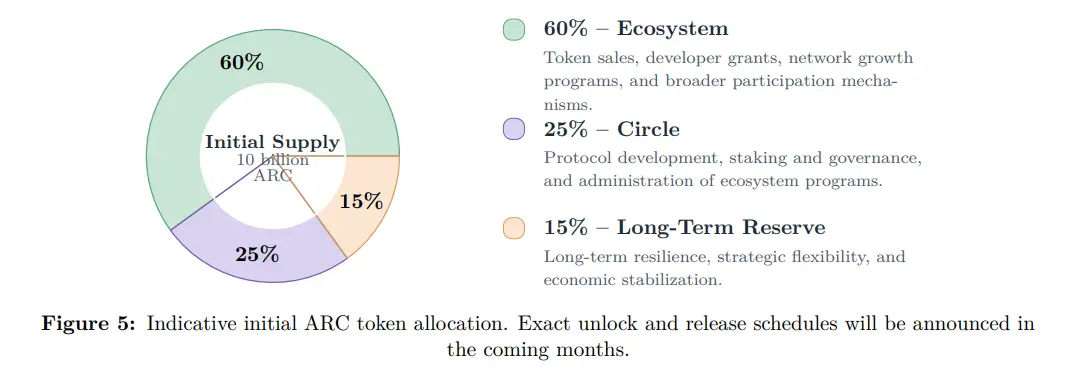
According to the whitepaper, the total supply of ARC is 10 billion tokens, with a clear allocation: 60% for the ecosystem, including developer incentives, network growth programs, and user participation rewards; 25% allocated to Circle for operating validator nodes, staking, and governance; 15% as a long-term reserve for network stability and strategic flexibility.
Regarding the fee mechanism, all protocol fees on Arc, regardless of the asset used for payment, will be fully converted to ARC at the protocol layer, with a portion permanently burned and a portion distributed to stakers and validators. The more active the network, the stronger the value capture by ARC.

CRCL shareholders primarily benefit through Circle as a company. The company continues to enjoy the core revenue from USDC reserve interest, along with gains from the growth of other businesses like the payment network CPN. Simultaneously, Circle's 25% ARC holdings allow it to indirectly share in network-level rewards.

Crypto analyst BTCdayu proposes a three-dimensional valuation framework for CRCL: The first dimension is reserve interest income, the most stable current cash flow and the valuation floor. The second dimension is payment network revenue, which, as CPN scales, could approach a Visa-like network fee model. The third dimension is the network option value brought by Arc, reflecting market expectations for Circle's transformation from a stablecoin issuer to a financial infrastructure platform.

Simply put, CRCL captures the company's overall stable cash flow and existing business growth, while ARC captures the growth elasticity at the network level, including Gas fee conversion, ecosystem expansion, and long-term network effects.

This forms a clear dual-track structure. The more successful the Arc network, the greater the USDC usage and business synergies, benefiting Circle at the corporate level. Concurrently, the rising value of the ARC token increases the value of Circle's 25% share, ultimately benefiting CRCL shareholders.

However, the two are legally completely separate. As mentioned officially, ARC does not represent equity in Circle and does not grant any claim to Circle's revenue, profits, assets, or CRCL shares. This means ARC holders lack the fiduciary duty protections afforded to public company shareholders; their returns depend entirely on the network's actual adoption and the tokenomics design.

4. How Can Ordinary Users Participate?

Having understood the value distribution between CRCL and ARC, a practical question arises: Who exactly is the ARC token being sold to? And how can ordinary users participate at low cost?

The first category of buyers is strategic institutional investors. They entered via the $222 million presale at a unit price of $0.3, with lock-up periods ranging from 1 to 4 years. These institutions not only provide capital but are also potential users and builders of Arc. For example, BlackRock is already testing tokenized asset settlement on the testnet; ICE, as the parent of NYSE, and SBI Group, as Japan's largest financial group, are strategically positioning themselves for future business on Arc.

The second category is ecosystem builders and long-term holders. Developers and liquidity providers receive ARC incentives for their contributions; the 60% ecosystem allocation is for this purpose. They prioritize the network's long-term growth, akin to early employees holding company equity.

The third category is retail speculators and participants. They focus on early narrative opportunities and ecosystem incentives, anticipating price volatility post-mainnet launch.

For ordinary users without presale access, Arc offers several low-cost participation paths.

The Arc Testnet launched in October 2025 and has processed over 244 million test transactions to date. The mainnet is expected to launch in the summer of 2026. Users can claim free test tokens to perform operations like Swaps, bridging, and contract deployment to familiarize themselves with network interaction.

The Arc House community is the primary entry point for ordinary users. Users can accumulate points by registering, staying active, posting, reading content, and participating in Q&A. Having an answer accepted yields extra points.

Advanced methods include content contribution, video sharing, event organization, and even hosting offline Meetups. Additionally, users with teams or products can apply for Circle Developer Grants.

It should be noted that Arc House points merely represent community contribution recognition; they hold no monetary value, nor do they guarantee any specific rights allocation. Specific rules are subject to the latest official announcements.

Conclusion

Currently, competition in the institutional on-chain sector is fierce, and Arc is not alone. Canton Network, under Digital Asset, is reportedly completing a new funding round at a valuation of around $2 billion, led by a16z crypto; Plasma positions itself as a stablecoin-native settlement layer with a relatively more attractive valuation; Visa included Arc, Canton, Plasma, Base, Tempo, and others as stablecoin settlement test points in April. This indicates the sector is still in a phase of parallel development with multiple competitors.

Against this backdrop, Arc's $3 billion presale FDV (Fully Diluted Valuation) sits at a relatively high level. Retail investors considering secondary market participation need to thoroughly evaluate the project's narrative potential and the competitive landscape within the sector.

From a long-term perspective, holding ARC, which carries an annual inflation of 2% to 3%, requires the network to generate sufficient real transaction fees to offset the inflation pressure for value appreciation. CRCL, in contrast, relies on USDC reserve interest and payment network revenue, supported by relatively clear cash flows. They represent different risk-return structures.

Short-term, market sentiment often follows its own logic. Around the mainnet launch, concentrated narrative hype could bring periodic opportunities. During such times, the value of Circle's 25% ARC holdings would also appreciate, benefiting CRCL shareholders.

On the regulatory front, the passage of the GENIUS Act has solidified Circle's moat, while the CLARITY Act's new draft version has been made public and is advancing in Congress, potentially providing clearer regulatory certainty for the digital asset ecosystem—a significant positive for Circle.

Overall, Arc is currently one of Circle's key strategic initiatives. As the whitepaper states, "A global economic operating system cannot be coordinated by a single entity; it transforms participants who use Arc into participants who sustain Arc." Whether this vision ultimately materializes still depends on the network's ability to attract sufficient real institutional transactions and economic activity after the mainnet launch.

Until all data lands, all narratives remain just narratives.

Preguntas relacionadas

QWhat is the purpose of Circle launching its own Layer 1 blockchain, Arc, instead of continuing to operate on established chains like Ethereum or Solana?

ACircle launched Arc to address the core needs of institutional clients, such as asset issuance/redemption with on/off-chain settlement, deterministic finality for payments, embedded compliance, configurable privacy, and predictable Gas costs paid in USDC. These needs are not natively met by existing public chains. Arc is designed to be an economic infrastructure base capable of hosting a global financial system on-chain, allowing Circle to capture more value from the stablecoin ecosystem it facilitates.

QWhy does the Arc network need a native ARC token when it already uses USDC for transaction fees?

AUSDC is used as a stable gas token for predictable transaction costs. The ARC token is needed to solve network coordination problems. It provides economic incentives for staking in the planned Proof-of-Stake security model, aligns long-term interests for governance decisions, and binds participants to the network's success. While USDC handles the flow of value, ARC acts as the network's 'equity', facilitating security and decentralized governance.

QHow do the CRCL stock and ARC token capture value differently from the Arc network and Circle's business?

ACRCL stock captures the value of Circle the company, primarily through stable revenue streams like USDC reserve interest and its payment network (CPN). It also benefits indirectly from Circle's 25% holding of ARC tokens. The ARC token directly captures the value of the Arc network itself, including gas fees converted to ARC (partly burned, partly distributed), ecosystem growth, and long-term network effects. CRCL offers stable cash flows, while ARC offers growth elasticity tied to network adoption.

QWhat are the main ways for ordinary users to participate in the Arc ecosystem early, such as for potential airdrops or rewards?

AOrdinary users can participate through several low-cost methods: 1) Using the Arc Testnet to perform transactions and interact with dApps. 2) Joining the Arc House community to earn contribution points through activities like registration, posting, reading content, and answering questions. 3) More advanced participation includes content creation, video sharing, event organization, and applying for Circle Developer Grants. Note that Arc House points are for community recognition and do not guarantee specific token rewards.

QWhat are some of the competitive challenges and considerations for Arc mentioned in the article?

AThe institutional on-chain sector is highly competitive. Key competitors include Canton Network (backed by Digital Asset), Plasma (positioned for stablecoin-native settlement), and others like Base and Tempo. Visa is testing multiple networks including Arc. The article notes that Arc's $3 billion fully diluted valuation (FDV) from its presale is relatively high. For long-term value, the ARC token needs to generate sufficient real transaction fees to offset its 2-3% annual inflation. Success depends on attracting substantial real institutional activity post-mainnet launch.

Lecturas Relacionadas

From 'Old Guys' to 'New Favorites': How AI Is Revaluing Old Infrastructure from Dell to Nokia?

From "Vintage Tech" to "New AI Darlings": How AI Revalues Old Infrastructure One year ago, tech giants like Dell, Nokia, Cisco, and Western Data were seen as slow-growth, low-valuation stories, far from the AI spotlight dominated by players like Nvidia. Now, these legacy tech stocks are gaining market attention, sparking debate on whether this is genuine industry revaluation or a temporary narrative. As AI moves from model parameters to real-world data centers, the market is recognizing companies with proven delivery and infrastructure capabilities. This shift marks a change in the AI investment thesis: from pure model and GPU focus to the complex systems engineering required for deployment. Companies like Dell, HPE, and Corning are being revalued not for being "sexy" AI innovators, but for their decades of accumulated expertise in supply chains, enterprise delivery, and infrastructure—assets that have become critical in the AI buildout phase. The revaluation is unfolding across three key infrastructure lines: 1. **Servers & System Integration:** Dell and HPE are emerging as crucial system integrators or "general contractors" for AI data centers, translating GPU orders into complete, deployable server racks integrated with power, cooling, and networking. 2. **Networking & Connectivity:** AI's scale demands robust high-speed connections. Corning (fiber optics), Nokia (AI-RAN, 6G), and Cisco (data center switches) are gaining importance for enabling efficient data transfer within and between AI clusters. 3. **Storage:** Beyond high-speed memory (HBM/DRAM), the AI data explosion is driving demand for high-capacity hard drives (HDDs) from companies like Western Digital and Seagate to handle training data, logs, and cold storage cost-effectively. For this revaluation to be substantive and not just a narrative, three criteria are key: 1) Concrete AI-related order and revenue growth (e.g., Dell's AI server sales), 2) Upward revisions to company financial guidance, and 3) Sustainable improvements in profit quality, not just top-line revenue spikes. In essence, AI's transition to a real construction phase is re-pricing "old assets" against "new demand." The opportunity, however, is selective. Only those legacy firms that are demonstrably integrated into the capital expenditure chains of data center and enterprise AI deployment are likely to experience a true "logic re-rating" rather than just a temporary valuation bounce.

marsbitHace 3 min(s)

From 'Old Guys' to 'New Favorites': How AI Is Revaluing Old Infrastructure from Dell to Nokia?

marsbitHace 3 min(s)

The Merger of Codex and ChatGPT Marks the Beginning of a Major Reshuffle in Programming Tools

OpenAI is shifting its strategic focus from ChatGPT to Codex, merging them along with the browser tool Atlas into a unified desktop super-app. This move signals an internal belief that Codex, originally a programming tool, represents the next evolution of AI more than conversational models like ChatGPT. Over the past year, Codex's weekly active users have surged past 5 million. The key distinction is that while ChatGPT answers questions, Codex executes tasks. Enterprises increasingly value this ability to get work done over simply receiving advice. Consequently, Codex is attracting professionals beyond developers, including analysts, bankers, marketers, and product managers. OpenAI's reorganization and increased investment in Codex stem from recognizing that the future of AI competition lies in execution capabilities, not just conversation. The company is launching role-specific plugins (e.g., for data analysis, sales, design) to transform Codex into a broad knowledge work platform that automates and redefines white-collar workflows. Beyond being a tool, Codex reflects OpenAI's ambition to redefine software. New features like "Sites"—which generates interactive websites from documents—and collaborative "Annotations" aim to create a paradigm where the AI understands the goal and handles the tools and steps, functioning more like a digital colleague than traditional software. The ultimate goal is a unified experience where the user cares only about the completed task.

marsbitHace 12 min(s)

The Merger of Codex and ChatGPT Marks the Beginning of a Major Reshuffle in Programming Tools

marsbitHace 12 min(s)

Interpreting Investment Opportunities in the Age of Great Navigation, Invesco Great Wall Fund Releases '2026 Report on Chinese Enterprises Going Global'

Invesco Great Wall Fund has released its "2026 China Corporate Globalization Report," titled "The 'Great Navigation Era' of Chinese Enterprises." The report analyzes the new trends and investment opportunities as Chinese companies expand globally, moving from simple product exports to comprehensive overseas operations involving services, branding, and local production. Driven by factors like trade friction, the pursuit of higher profit margins abroad, and policy support, globalization is becoming essential for Chinese companies. The report outlines an evolution: from early product export ("Globalization 1.0") to the current "Globalization 2.0," characterized by overseas capacity, capital goods investment, consumer brand expansion, and service exports. Chinese firms' competitive advantages are highlighted, including a vast engineer talent pool, low-cost and robust infrastructure, and complete industrial clusters. Specific sectors with significant出海 potential are identified: * **Capital Goods** (e.g., engineering machinery, power equipment): Benefiting from global demand, especially in Belt & Road markets and the AI-driven power grid upgrade cycle. * **Consumer Brands**: Transitioning from cost to brand advantage, leveraging供应链 efficiency. * **Technology & Innovation**: Including AI applications, optical modules within global tech supply chains, and new energy vehicles focusing on local production. * **Pharmaceuticals**: Chinese biotech firms are becoming preferred partners for global pharma, with potential for breakthrough drugs in areas like oncology and weight loss. The report concludes that corporate globalization represents a sustained, core theme for China's capital markets, though companies must navigate challenges like geopolitics and localization.

marsbitHace 24 min(s)

Interpreting Investment Opportunities in the Age of Great Navigation, Invesco Great Wall Fund Releases '2026 Report on Chinese Enterprises Going Global'

marsbitHace 24 min(s)

GitHub, Transfixed by AI

On the night of February 9th, GitHub suffered a major outage caused by a simple configuration change—reducing a cache refresh interval from 12 to 2 hours—that triggered a cascade of failures. This was not an isolated event, but part of a broader pattern. In early 2026, GitHub experienced at least 8 major incidents, failing to meet its promised 99.9% availability. These outages stemmed from structural issues: explosive growth in load, tight service coupling, and insufficient protection against abnormal traffic. This unprecedented load is driven by AI Agents. In 2025, GitHub handled ~1 billion commits. By 2026, weekly commits reached 275 million, projecting to ~14 billion for the year—a 14x increase. AI tools like Claude Code now contribute 4.5% of all public repository commits, with weekly submissions surging 25x in just three months. AI-generated pull requests jumped from 4 million to 17 million per month in half a year. Unlike human developers, AI Agents work continuously, generating commits at a scale that overwhelms infrastructure designed for human rhythms. The surge also shattered GitHub's business model. Copilot's flat-rate pricing, based on assisting human developers, became unsustainable as Agentic AI sessions consumed resources worth hundreds of dollars for a few dollars in fees. In response, GitHub imposed usage limits and, by June 1st, shifted to a pay-per-use "AI Credits" system. Facing this new reality, GitHub realized a 10x scaling plan was insufficient. It announced a need to *redesign* its architecture for 30x current scale—decoupling services, adding fault isolation, and improving change management to prevent cascading failures. Other platforms like Stripe and AWS are facing similar challenges with AI Agents. Fundamentally, GitHub is transitioning from a human collaboration platform to an "exhaust pipe" for automated AI workflows. Its detailed post-mortem reports aim to maintain trust during this turbulent rebuild. The February outage was not just a technical glitch, but a signal of the software industry's entry into a new, AI-driven era.

marsbitHace 1 hora(s)

GitHub, Transfixed by AI

marsbitHace 1 hora(s)

Trading

Spot
Futuros

Artículos destacados

Cómo comprar ARC

¡Bienvenido a HTX.com! Hemos hecho que comprar AI Rig Complex (ARC) sea simple y conveniente. Sigue nuestra guía paso a paso para iniciar tu viaje de criptos.Paso 1: crea tu cuenta HTXUtiliza tu correo electrónico o número de teléfono para registrarte y obtener una cuenta gratuita en HTX. Experimenta un proceso de registro sin complicaciones y desbloquea todas las funciones.Obtener mi cuentaPaso 2: ve a Comprar cripto y elige tu método de pagoTarjeta de crédito/débito: usa tu Visa o Mastercard para comprar AI Rig Complex (ARC) al instante.Saldo: utiliza fondos del saldo de tu cuenta HTX para tradear sin problemas.Terceros: hemos agregado métodos de pago populares como Google Pay y Apple Pay para mejorar la comodidad.P2P: tradear directamente con otros usuarios en HTX.Over-the-Counter (OTC): ofrecemos servicios personalizados y tipos de cambio competitivos para los traders.Paso 3: guarda tu AI Rig Complex (ARC)Después de comprar tu AI Rig Complex (ARC), guárdalo en tu cuenta HTX. Alternativamente, puedes enviarlo a otro lugar mediante transferencia blockchain o utilizarlo para tradear otras criptomonedas.Paso 4: tradear AI Rig Complex (ARC)Tradear fácilmente con AI Rig Complex (ARC) en HTX's mercado spot. Simplemente accede a tu cuenta, selecciona tu par de trading, ejecuta tus trades y monitorea en tiempo real. Ofrecemos una experiencia fácil de usar tanto para principiantes como para traders experimentados.

181 Vistas totalesPublicado en 2025.01.09Actualizado en 2026.06.02

Cómo comprar ARC

Discusiones

Bienvenido a la comunidad de HTX. Aquí puedes mantenerte informado sobre los últimos desarrollos de la plataforma y acceder a análisis profesionales del mercado. A continuación se presentan las opiniones de los usuarios sobre el precio de ARC (ARC).

活动图片