Circle gets Abu Dhabi greenlight amid UAE stablecoin and crypto push

cointelegraphPublicado a 2025-12-09Actualizado a 2025-12-09

Resumen

Circle has received regulatory approval from the Abu Dhabi Global Market (ADGM) to operate as a licensed Money Services Provider, expanding its presence in the UAE. The company also appointed Saeeda Jaffar as managing director for the Middle East and Africa. This move is part of a broader trend of crypto firms, including Tether, Ripple, and Binance, gaining regulatory clearance in Abu Dhabi. The UAE has been advancing its crypto regulatory framework, introducing rules for DeFi and Web3, while also enforcing stricter oversight on unlicensed crypto operations.

Stablecoin issuer Circle has secured regulatory approval to operate as a financial service provider in the Abu Dhabi International Financial Center, deepening its push into the United Arab Emirates.

In an announcement Tuesday, Circle Internet Group said it received a Financial Services Permission license from the Financial Services Regulatory Authority of the Abu Dhabi Global Market (ADGM), the International Financial Centre of Abu Dhabi. This allows the stablecoin issuer to operate as a Money Services Provider in the IFC.

The USDC (USDC) issuer also appointed Saeeda Jaffar as its managing director for Circle Middle East and Africa. The new executive also serves as a senior vice president and group country manager for the Gulf Operation Council at Visa and will be tasked with developing the stablecoin issuer’s regional strategy and partnerships.

Circle co-founder, chairman and CEO Jeremy Allaire said that the relevant regulatory framework “sets a high bar for transparency, risk management, and consumer protection,” adding that those standards are needed if “trusted stablecoins” are going to support payments and finance at scale.
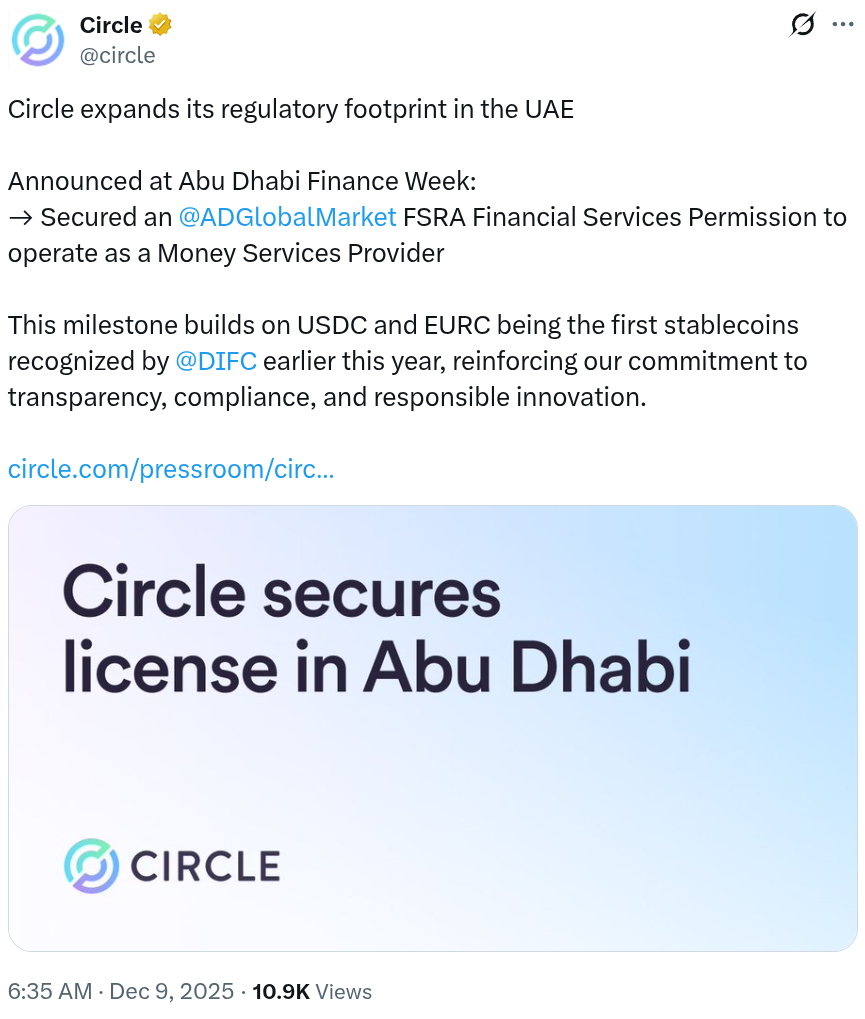
Source: Circle

Related: Abu Dhabi Investment Council triples stake in Bitcoin ETF in Q3: Report

Abu Dhabi awards a wave of licenses

The ADGM has recently awarded licenses for financial operations to a wave of crypto companies. Earlier this week, Tether’s USDt (USDT) — the largest stablecoin by circulation and Circle’s top competitor — secured a regulatory milestone in Abu Dhabi’s international financial center, as did Ripple’s dollar-pegged stablecoin Ripple USD at the end of November.

On Monday, crypto exchange Binance was granted three separate licenses from Abu Dhabi’s financial regulator, allowing it to operate its exchange, clearing house and broker-dealer services. This followed its competitor Bybit receiving regulatory approval in the UAE in early October.

Related: HSBC to bring tokenized deposits to US and UAE as stablecoin race heats up

UAE bets on crypto

The Central Bank of the UAE has been actively reviewing its cryptocurrency regulations. In November, it introduced rules for decentralized finance (DeFi) and the broader Web3 industry.

The newly-introduced Federal Decree Law No. 6 of 2025 brings DeFi platforms, related services and infrastructure providers under the scope of regulations if they enable payments, exchange, lending, custody, or investment services, with licenses now required. Local crypto lawyer Irina Heaver said that “DeFi projects can no longer avoid regulation by claiming they are just code.”

Heaver told Cointelegraph at the end of 2024 that during that year the country cemented its status as a global crypto hub.

In October 2024, the UAE exempted cryptocurrency transfers and conversions from value-added tax, just a month after Dubai’s digital asset regulator announced stricter rules on crypto marketing. Around the same time, local free economic zone Ras Al Khaimah Digital Assets Oasis was also working to introduce a legal framework for decentralized autonomous organizations.

Local regulators were also not shy about enforcing the rules, with Dubai’s Virtual Assets Regulatory Authority cracking down on seven unlicensed crypto businesses, issuing fines and cease-and-desist orders.

Magazine: Review: The Devil Takes Bitcoin, a wild history of Mt. Gox and Silk Road

Lecturas Relacionadas

$292 Million KelpDAO Cross-Chain Bridge Hack: Who Should Foot the Bill?

On April 18, 2026, an attacker stole 116,500 rsETH (worth ~$292M) from KelpDAO’s cross-chain bridge in 46 minutes—the largest DeFi exploit of 2026. The stolen assets were deposited into Aave V3 as collateral, causing $177–200M in bad debt and triggering a cascade of losses across nine DeFi protocols. Aave’s TVL dropped by ~$6B overnight. This legal analysis argues that KelpDAO and LayerZero Labs share concurrent liability, with fault apportioned 60%/40%. KelpDAO negligently configured its bridge with a 1-of-1 decentralized verifier network (DVN)—a single point of failure—despite LayerZero’s explicit recommendation of a 2-of-3 setup. LayerZero, which operated the compromised DVN, failed to secure its RPC infrastructure against a known poisoning attack vector. Both protocols’ terms of service cap liability at $200 (KelpDAO) or $50 (LayerZero), but these limits are likely unenforceable due to unconscionability, gross negligence exceptions, and potential securities law invalidation (if rsETH is deemed a security under the Howey test). Aave’s governance also faces fiduciary duty claims for raising rsETH’s loan-to-value ratio to 93%—far above competitors’ 72–75%—without adequately assessing bridge risks, amplifying the systemic fallout. Practical recovery targets include LayerZero Labs (a registered Canadian entity), KelpDAO’s founders, auditors, and identifiable Aave governance delegates. The incident underscores escalating legal risks for DeFi protocols, infrastructure providers, and governance participants.

marsbitHace 37 min(s)

$292 Million KelpDAO Cross-Chain Bridge Hack: Who Should Foot the Bill?

marsbitHace 37 min(s)

Insider Trading in War: 5 People Involved, the Highest Earner Was Arrested

On April 24, the U.S. Department of Justice arrested U.S. Army Special Forces Staff Sergeant Gannon Ken Van Dyke for insider trading related to the capture of Venezuelan President Nicolás Maduro on January 3. Van Dyke allegedly profited over $400,000 by placing bets on a prediction market, Polymarket, using insider knowledge of the covert operation. According to the indictment, Van Dyke registered an account (0x31a5) on December 26 and made a series of bets predicting Maduro’s capture and U.S. military involvement in Venezuela. He withdrew most of his funds on the day of the operation and attempted to obscure his tracks by transferring assets through crypto and brokerage accounts. This case marks the first time the DOJ has prosecuted insider trading on Polymarket. PolyBeats had previously identified five suspicious accounts, including Van Dyke’s—the highest earner—in January. The other accounts, with profits ranging from $34,000 to $145,000, remain under unofficial scrutiny but have not been charged. Their lower profits, indirect access to information, and unclear legal boundaries may complicate prosecution. Polymarket has since strengthened its market integrity rules, explicitly prohibiting trading based on confidential or insider information. Van Dyke’s arrest, nearly four months after his trades, signals increased regulatory attention and the persistent traceability of blockchain-based transactions.

marsbitHace 39 min(s)

Insider Trading in War: 5 People Involved, the Highest Earner Was Arrested

marsbitHace 39 min(s)

Bitwise: Bullish on Bitcoin's Performance in the Second Half of the Year, AI and Regulation Will Spark a New Altcoin Season

Bitwise CIO Matt Hougan and Research Lead Ryan Rasmussen express strong bullish sentiment on Bitcoin's long-term prospects, suggesting that its $1 million price target may be too conservative. They argue Bitcoin serves a dual role: as digital gold and a potential global settlement asset, especially amid declining trust in traditional monetary systems. Despite a weak Q1 2026 where nearly all crypto assets and prices saw double-digit declines, the analysts remain optimistic due to strong forward-looking catalysts, including institutional adoption via Bitcoin ETFs from major firms like Morgan Stanley and Goldman Sachs. Geopolitical instability, such as Iran’s mention of using Bitcoin for international payments, increases the value of Bitcoin’s “out-of-the-money call option” as a non-political, global settlement currency. This enhances its appeal beyond a mere store of value. . Additionally, Hougan highlights that a clearer regulatory token framework under current SEC leadership, combined with AI efficiency gains and high-performance blockchains, could fuel a new “altseason” by late 2026. This may lead to a wave of legitimate, value-capturing token projects, unlike the earlier ICO boom. . Bitwise also announced an Avalanche ETF, citing its unique architecture and rapid growth in real-world asset (RWA) tokenization, which has surged 10x to nearly $30 billion in two years. The firm believes Layer 1 blockchains are still early in their growth cycle, with significant potential ahead.

marsbitHace 1 hora(s)

Bitwise: Bullish on Bitcoin's Performance in the Second Half of the Year, AI and Regulation Will Spark a New Altcoin Season

marsbitHace 1 hora(s)

Trading

Spot
Futuros

Artículos destacados

Cómo comprar PUSH

¡Bienvenido a HTX.com! Hemos hecho que comprar Push Protocol (PUSH) sea simple y conveniente. Sigue nuestra guía paso a paso para iniciar tu viaje de criptos.Paso 1: crea tu cuenta HTXUtiliza tu correo electrónico o número de teléfono para registrarte y obtener una cuenta gratuita en HTX. Experimenta un proceso de registro sin complicaciones y desbloquea todas las funciones.Obtener mi cuentaPaso 2: ve a Comprar cripto y elige tu método de pagoTarjeta de crédito/débito: usa tu Visa o Mastercard para comprar Push Protocol (PUSH) al instante.Saldo: utiliza fondos del saldo de tu cuenta HTX para tradear sin problemas.Terceros: hemos agregado métodos de pago populares como Google Pay y Apple Pay para mejorar la comodidad.P2P: tradear directamente con otros usuarios en HTX.Over-the-Counter (OTC): ofrecemos servicios personalizados y tipos de cambio competitivos para los traders.Paso 3: guarda tu Push Protocol (PUSH)Después de comprar tu Push Protocol (PUSH), guárdalo en tu cuenta HTX. Alternativamente, puedes enviarlo a otro lugar mediante transferencia blockchain o utilizarlo para tradear otras criptomonedas.Paso 4: tradear Push Protocol (PUSH)Tradear fácilmente con Push Protocol (PUSH) en HTX's mercado spot. Simplemente accede a tu cuenta, selecciona tu par de trading, ejecuta tus trades y monitorea en tiempo real. Ofrecemos una experiencia fácil de usar tanto para principiantes como para traders experimentados.

192 Vistas totalesPublicado en 2024.12.13Actualizado en 2025.03.21

Cómo comprar PUSH

Discusiones

Bienvenido a la comunidad de HTX. Aquí puedes mantenerte informado sobre los últimos desarrollos de la plataforma y acceder a análisis profesionales del mercado. A continuación se presentan las opiniones de los usuarios sobre el precio de PUSH (PUSH).

活动图片