Chips, Open-Source Models, and $50 Trillion: Joe Tsai Reassesses Alibaba Once Again

marsbitPublicado a 2026-06-22Actualizado a 2026-06-22

Resumen

Alibaba Executive Chairman Joe Tsai recently outlined the company's comprehensive AI strategy in a public discussion. He believes AI represents a massive opportunity, estimating its potential economic impact at up to $50 trillion, stemming from the automation of human intelligence and productivity. Tsai detailed Alibaba's four-layer investment approach across the AI stack: starting from the chip level, moving to cloud infrastructure (Alibaba Cloud), then the model layer with its open-source Qwen model, and finally applications within its vast digital ecosystem (e-commerce, logistics, etc.). The company avoids the energy layer due to China's efficient infrastructure. This broad strategy is designed to ensure Alibaba captures value regardless of where it ultimately concentrates in the AI value chain. He dismissed concerns about an AI investment bubble, pointing to the enormous $50 trillion opportunity. While acknowledging U.S. cloud giants' higher capital expenditure, he argued Chinese firms, including Alibaba (funded by its cash-generative e-commerce core), need to invest more in AI infrastructure. A key theme was technological sovereignty. Tsai positioned open-source models like Qwen as a solution for companies, especially in Europe, seeking independence from proprietary U.S. models and greater data privacy control. He contrasted this with the trend of U.S. giants keeping their models closed-source. Tsai highlighted Alibaba's collaborations with European manufacturers lik...

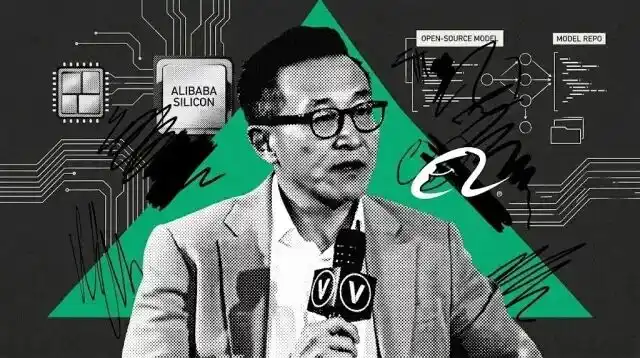
Alibaba Group Chairman Joe Tsai. Image processed via AI.

At this year's VivaTech conference, Alibaba Chairman Joe Tsai systematically outlined the company's long-term AI vision during a "fireside chat." This marks his second public reassessment of Alibaba following a summit at Yale University in late May.

"From a macro perspective, we are going all-in on AI. The logic is simple."

Tsai stated that global GDP exceeds $100 trillion, with at least half coming from human intelligence and productivity contributions. "This $50 trillion is the total addressable market for AI, far larger than any company's IT budget or the software market."

Everyone is talking about going all-in on AI, and Tsai is no exception. He summarized Alibaba's strategic approach as covering almost all layers except the energy layer, encompassing chips, cloud infrastructure, models, and applications.

"We are primarily investing in four layers, but we are not touching the bottommost energy layer because China's energy efficiency is high and costs are relatively low."

In Tsai's view, this near-full-stack strategy stems from future uncertainty, as no one can accurately predict where the ultimate value will settle—whether in chips, cloud infrastructure, or the model layer. "We choose to participate comprehensively, so no matter where the value ultimately lands, we are present."

Compared to Alibaba, U.S. cloud giants are even more aggressive, investing across the entire infrastructure stack, with a combined capital expenditure of $800 billion by 2027, which short-sellers have criticized as a "bubble." Tsai not only disagrees with the bubble theory but also emphasizes that Chinese companies need to increase their infrastructure investments.

"The investment numbers are indeed staggering," Tsai said. "But we need to go back to that $50 trillion total market. That's the reason for optimism."

Discussing open source, Tsai first mentioned the recent suspension of Anthropic's most advanced model by the Trump administration, bluntly stating this is the consequence of "putting all your eggs in one basket." In his view, models from Google, OpenAI, and Anthropic are now all closed-source, while the open-source path is currently being pursued by Chinese companies.

"You truly cannot base trust on the assumption that a third-party government will never act against your interests."

Below is an edited version of Joe Tsai's interview:

01. The $50 Trillion "Market"

Q: Alibaba has changed significantly over the years, with achievements like its open-source large model. But many still see you primarily as a B2B/B2C platform. Can you talk about the group's evolution?

Joe Tsai: When Alibaba started in 1999, it was indeed a B2B platform. The idea was simple: to bring small Chinese manufacturers and trading companies online, helping them wholesale products globally. Later, we entered the B2C space with Taobao, now China's largest consumer e-commerce platform.

Q: How many consumers does this serve?

Joe Tsai: 820 million Chinese consumers. Moreover, this platform helps European companies and brands sell approximately €30 billion worth of goods to Chinese consumers annually. But the story doesn't end there. We are heavily investing in AI and cloud.

We started investing in cloud technology 17 years ago, but out of necessity. Our e-commerce business was generating massive amounts of data daily. If we kept relying on others' database and storage technologies, eventually all our profits would go to the tech vendors. So we decided to build our own proprietary technology to manage this data, and that's how our cloud business began.

From a macro perspective, we are now going all-in on AI, and the logic is simple.

If you ask me how big the AI market is, I'd say it's far larger than any company's IT budget or the software market. Because AI is essentially about producing human intelligence and productivity. Global GDP today is over $100 trillion, with at least half ($50 trillion) related to human productivity and intelligence. That's the total AI market. So we must go all-in.

Q: Do you really believe AI can boost productivity? Many have invested heavily without seeing results yet.

Joe Tsai: Many CEOs will tell you that engineers are consuming a huge number of tokens, and costs are rising. But I'd say we are on the cusp of a real productivity explosion.

Take our company. Some engineers are super-users of AI. They not only use programming tools for their core work but also explore new uses. Give engineers a toy, and they'll find more ways to play with it, sometimes without realizing the company is paying for these usage costs. That's the current reality.

But I am deeply convinced—it's more like a belief, a conviction that artificially produced intelligence units can add value to human intelligence. It's close to a kind of faith. I don't want to try to convince you this will definitely happen, but we ourselves firmly believe it.

02. The Logic of Going All-In on AI

Q: Returning to Alibaba's layout, which AI layer do you invest the most in? Infrastructure, models, or cloud services?

Joe Tsai: We primarily invest in four layers, but we skip the bottommost energy layer because China's energy efficiency is high and costs are low.

We really started at the chip layer—that's the first layer. The second is the infrastructure layer, corresponding to our cloud business. The third is the model layer, like Qwen, which is now one of the world's hottest open-source models. The fourth is the application layer, where we have a complete digital life ecosystem—e-commerce, food delivery, local services, travel, maps, etc. These are all scenarios where AI capabilities can be directly embedded to serve users.

The advantage of this approach is that we are not betting on a single track.

Today, pure model companies have high valuations, making it seem like all the value is in the model layer. But looking five or ten years ahead, no one can say for sure whether the value will settle in chips, cloud infrastructure, models, or applications. We choose comprehensive participation so that, no matter where the value ultimately lands, we are there.

Q: Speaking of AI infrastructure, when you see such massive investments, do you think there's a bubble? Do we really need this much computing power? Some models are more efficient and don't require as many resources.

Joe Tsai: I don't think it's a bubble. The investment numbers are indeed staggering. Just looking at the U.S. hyperscale cloud providers, the combined capital expenditure of the top four or five companies next year exceeds $800 billion, potentially over a trillion the year after. Investments at this scale naturally raise concerns about overcapacity.

But we must return to that $50 trillion total market. That's the reason for optimism.

Moreover, in China, our investment in AI infrastructure and the supply chain is actually insufficient. Theoretically, all Chinese companies should increase their investments. Of course, we won't reach the investment level of the U.S. hyperscale players, but our investment intensity is already quite substantial.

Q: Why can't you reach U.S. levels?

Joe Tsai: Sometimes there are funding constraints, depending on how much free cash flow you can generate. Fortunately, Alibaba is one of the few companies with a core e-commerce business that generates about $25 billion in annual free cash flow, which can support our AI investments. So we are in a relatively good position.

Q: Currently, does the e-commerce platform business still account for 80% to 85% of Alibaba's total revenue?

Joe Tsai: Yes, e-commerce platform revenue still accounts for over 80%. This generates stable cash flow, allowing us to invest in the future, primarily in AI and cloud.

03. Open Source and the Second Basket

Q: Qwen is an open-source model. Who are your main customers, and how do you help them?

Joe Tsai: In recent weeks in Europe, I've spoken with many company executives, CEOs, and scientists. One word that came up most frequently was "sovereignty."

But what is sovereignty?

Ask ten Europeans, and you might get twelve different answers. For me, the core is two things.

First, technological independence. Everyone is worried about the risk of a "one-click shutdown," the fear of relying too heavily on technology from a single country that could flip a switch at any time. We just saw a vivid example of this in recent days.

Second is data privacy. People want to use AI technology but want their data to belong entirely to them, used within their own environment, with a firewall to protect it.

I believe open source addresses both these issues. It is essentially free software; you can download it to your own data center, even onto a laptop. At that point, it has little to do with the original manufacturer—we can't even figure out how to charge for it. That achieves independence.

More importantly, with an open-source model, you can use your own data for further training, fine-tuning, or post-training. The entire process and all data remain entirely confidential within your firewall. This point is crucial for European companies.

But I want to emphasize that open source is not a panacea or the only path, but it is a practical route to achieving a certain degree of sovereignty.

Interestingly, the open-source movement today is largely being driven by Chinese companies, while the major U.S. players have closed their models. They want you to call them via APIs; you have no idea where the data goes. When you converse with a chatbot, your most private questions and thoughts enter their data pool to further train the model. The data flow is completely opaque to you.

Q: Honestly, European sovereignty is a huge concern right now. We've just realized we were too dependent on U.S. technology. I acknowledge the benefits of open source, but I still worry about the risk of future access being cut off to models. That's a significant risk for Europe.

Joe Tsai: You're right; that concern cannot be completely eliminated. Simply put, you truly cannot base trust on the assumption that a third-party government will never act against your interests. But the problem is, right now, all your eggs are in one basket.

Why not choose a second basket and put some eggs there? Even if Europe might develop its own basket in the long term, at least for now, you have two baskets.

04. AI in the Factory

Q: That's true. How do you cooperate with German companies and what do you help them do?

Joe Tsai: These German manufacturing companies are very interesting. In the Chinese market, they are all Alibaba Cloud customers. We collaborate with them in manufacturing, covering areas like design, testing, and quality control.

I believe this will be a very important field in the future. Because most AI applications today are either consumer products like ChatGPT or tools for programmers and knowledge workers like Copilot. But in the future, these manufacturing companies will be extremely valuable because they accumulate their own unique, high-quality data from the production process, which can be used to train proprietary models to improve manufacturing processes.

We have collaborations with companies like BMW, Siemens, and Bosch. Last week, I attended the Bosch ConnectedWorld conference. They are using AI to develop driver assistance and autonomous driving technologies, requiring massive computing power.

A lot of interesting things are happening in manufacturing.

Q: Can I understand it this way: The U.S. export controls on high-end chips have actually created an opportunity for you?

Joe Tsai: You could put it that way. There are two paths here:

First, they directly adopt our open-source model and deploy it on their own infrastructure, like a data center. But our infrastructure is developed in tight integration with our models, achieving high efficiency and helping customers train models. If they use our open-source model, they can also procure computing power from us. The model and infrastructure have a symbiotic relationship. That's one path.

The other path is the emergence of inference platform companies that can offer users multiple model choices. You don't necessarily have to use Qwen. As long as there is an agreement between the model provider and the platform to open the weights in a private environment, customers can use models on these platforms.

05. AI, Agents, and Humanity

Q: A more philosophical question. What's your view on the balance between AI, large language models, and humanity, even the future of human nature? What state will humanity be in ten years from now?

Joe Tsai: Earlier today, I was chatting with colleagues at our Paris office. We just moved into a new office on the upper floors of a beautiful building. I looked out the window; there was a café outside. The weather was nice, people were sitting outdoors drinking coffee, enjoying life.

I pointed to the scene and told my colleagues, "This is the future of AI."

You might think they're just drinking coffee, having fun, seemingly not working. But in reality, they have already deployed agents to work for them. While you sleep, agents are working for you. Think about that productivity boost—having "someone" working for you 24/7.

Q: This sounds similar to some ideas in Silicon Valley, where many people might not need to work, as agents and robots will do it for them.

Joe Tsai: I believe this will definitely free up human time to enjoy life, spend time with family, and engage in more entertainment. That's also why I place great importance on live entertainment. When people spend less time in the office, where will they go? They won't just stay at home; they'll want to go to concerts, watch football, watch basketball games.

Q: The Chinese are known for their diligence. Chinese engineers, even with agents and AI, still work very long hours.

Joe Tsai: There will always be people who work harder than others. But I believe most people, deep down, wish to enjoy life a bit more and spend more time with their families.

This article is from WeChat public account "Tencent Technology," author: Su Yang.

Criptos en tendencia

Preguntas relacionadas

QAccording to Joseph Tsai, what is the total market opportunity he sees for AI, and why?

AJoseph Tsai sees a total market opportunity of 50 trillion dollars for AI. He argues that global GDP exceeds 100 trillion dollars, and at least half of it comes from human intelligence and productivity contributions. Since AI essentially produces human-like intelligence and productivity, its total addressable market is this 50 trillion dollar share of global GDP.

QWhat are the four layers of AI that Alibaba is investing in, according to Joseph Tsai?

AAccording to Joseph Tsai, Alibaba is investing in four layers of AI: 1) The chip layer, 2) The infrastructure/cloud layer, 3) The model layer (e.g., the Qwen open-source model), and 4) The application layer (integrating AI into Alibaba's digital ecosystem like e-commerce, food delivery, and travel). He stated they do not invest in the foundational energy layer due to China's high energy efficiency and low costs.

QWhy does Joseph Tsai argue that open-source models, like Alibaba's Qwen, are crucial for technological sovereignty, particularly in Europe?

AJoseph Tsai argues open-source models address two core aspects of technological sovereignty: 1) Independence from a single-point-of-failure or 'kill switch' risk, as companies can download and run the model independently, and 2) Data privacy, as companies can train, fine-tune, and use the model entirely within their own secure firewalls. He contrasts this with closed-source models from US companies, where data flows opaquely to the provider's servers.

QHow does Joseph Tsai respond to concerns about a potential bubble in massive AI infrastructure investments by cloud giants?

AJoseph Tsai does not believe it is a bubble. While acknowledging the staggering scale of investment (e.g., US hyperscalers planning $800 billion+ in capex), he argues it must be viewed in the context of the massive 50 trillion dollar AI opportunity. He further states that Chinese companies, including Alibaba, actually need to invest more in AI infrastructure and supply chains, though likely not reaching US levels due to different free cash flow realities.

QWhat is Joseph Tsai's vision for how AI will change human life and work in the future?

AJoseph Tsai envisions AI, particularly intelligent agents, will liberate human time. He believes agents will work continuously, even while people sleep, dramatically boosting productivity. This will free people to enjoy life more, spend time with family, and engage in entertainment and leisure activities like attending live sports or concerts, shifting the balance from work to life enjoyment.

Lecturas Relacionadas

Base Under Pressure

**Title: The Pressure Mounts for Base** Base, the Ethereum Layer 2 scaling solution backed by Coinbase, is facing significant pressure and public scrutiny from its leadership following the launch of Robinhood Chain. Base co-founder Jesse Pollak recently acknowledged strategic missteps, admitting that the chain's past focus on social and creator tokens (e.g., through Farcaster, Zora) failed to deliver sustainable adoption. He has refocused on core infrastructure, handing leadership of the Base App back to Coinbase's Cobie. While Base remains a top L2 contender alongside OP Mainnet and Arbitrum, and boasts the highest TVL (nearly $12B), its weaknesses are being highlighted by the new competitor. Key criticisms include its slow progress on decentralization. Base has faced issues with its single sequencer causing block production halts, and L2BEAT is reportedly considering downgrading its decentralization rating from Stage 1 to Stage 0. This contrasts sharply with the rapid initial success of Robinhood Chain, whose DEX quickly entered the top five by volume. The leadership styles of the parent companies are also being compared: Robinhood's CEO actively engages with new projects, while a recent incident where Coinbase's Brian Armstrong briefly changed his profile picture—sparking and then crashing a related meme token—drew community ire and mockery. Pollak stated Base is working with Coinbase on tokenized stocks backed 1:1 by real equity, differentiating it from Robinhood's derivatives model. However, the article argues that Base's most urgent task is to address its long-standing technical and trust issues. With more traditional finance players likely to emulate Robinhood's path, Base must use this competitive pressure to solidify its position as long-term financial infrastructure.

Foresight NewsHace 5 min(s)

Base Under Pressure

Foresight NewsHace 5 min(s)

White House Concession Removes Ethical Hurdle, Clarity Act Races Against Final Window Before Recess?

On July 21st, industry sources reported that the Trump administration has agreed to include an ethics provision in the "Clarity Act" (Digital Asset Market Clarity Act of 2025). This concession addresses the long-standing conflict-of-interest concerns regarding government officials and the crypto industry, potentially removing the final major obstacle to the bill's progress. Additionally, Patrick Witt, the executive director of the White House's Digital Asset Advisory Committee, confirmed he will remain in his role to help finalize the bill, alleviating previous concerns about his potential departure. The Clarity Act aims to establish a unified federal regulatory framework for the U.S. digital asset market. Its core objective is to resolve regulatory ambiguity by defining different types of digital assets (digital commodities, investment contract assets, and permitted payment stablecoins) and clarifying the respective oversight roles of the SEC and CFTC. This would end the long-running jurisdictional dispute between the two agencies and provide clearer compliance paths for the industry. With the ethics issue moving toward resolution, the most urgent challenge now is time. The U.S. Congress is set to begin its August recess in mid-August, leaving only a few working weeks to finalize the text and advance the bill through the Senate. Industry advocates, like the Blockchain Association's Kristin Smith, stress that this is a critical moment. If negotiations conclude successfully in the coming weeks, the Clarity Act could pass a key hurdle before the recess; otherwise, it may face significant delays. If enacted, the Clarity Act could mark a historic turning point in crypto regulation. By providing a clearer and more predictable legal framework, it aims to reduce uncertainty for businesses, developers, and traditional financial institutions looking to enter the digital asset space, potentially setting a global benchmark for market structure regulation.

Odaily星球日报Hace 11 min(s)

White House Concession Removes Ethical Hurdle, Clarity Act Races Against Final Window Before Recess?

Odaily星球日报Hace 11 min(s)

AI Era, Industrial Revolution, and Future Civilization Interview — Zhang Dingwen: The Future Does Not Belong to Chasers

"AI Era, Industrial Revolution and Future Civilization: An Interview with Zhang Dingwen – The Future Does Not Belong to Those Who Chase" In this interview, entrepreneur Zhang Dingwen reflects on his entrepreneurial journey and philosophy, moving beyond discussions of financing or success to emphasize understanding the "era" itself. He argues that true entrepreneurs should not chase short-term trends ("winds"), but position themselves in the direction of long-term technological and societal evolution. Zhang shares key lessons from his early days, including the realization that user value does not automatically translate to commercial value. For him, the core of entrepreneurship is not building a company but constantly upgrading one's own "cognition" – the ability to interpret information, ask the right questions, and understand the underlying "causes" behind business outcomes, not just the effects. His thinking has evolved from a focus on creating good products to a strategic focus on building "entrances" – platforms that naturally connect users to digital services. He sees smart wearables, like watches, not merely as hardware but as potential future gateways combining technological, financial, social, and even fashion attributes to create sustained user relationships and ecosystems. Ultimately, Zhang's vision transcends individual products or companies. He discusses business competition in three stages: product, platform, and finally, "civilization" – where the greatest companies influence how society operates by defining new rules and ways of life. He believes the mission of a truly great enterprise is to solve problems of its time, build enduring trust, and contribute lasting value, leaving behind not just wealth but a positive impact on how the world works. The future, he concludes, belongs not to the fastest, but to those with the correct long-term direction and a commitment to continuous learning and evolution.

marsbitHace 22 min(s)

AI Era, Industrial Revolution, and Future Civilization Interview — Zhang Dingwen: The Future Does Not Belong to Chasers

marsbitHace 22 min(s)

Cryptocurrency & Stock Market Barometer丨Strategy Cash Reserves Increase to $3.23 Billion, Halting BTC Purchases; Vanguard and Other Asset Managers Increase Holdings in Strategy Stock (July 21)

Market Overview & Warnings: The article warns of high volatility in South Korean stocks and continued dependence on U.S. stocks on geopolitics. Chinese A-shares remain under pressure. It advises against using leverage in current equity markets. For crypto-linked stocks, most have limited growth except Robinhood, with caution advised. U.S. Stock Market: Bearish bets on U.S. stocks, particularly targeting AI-related companies, have reached record highs since 2010, signaling deep skepticism about the sustainability of the AI-driven rally. Tech and chip stocks led a market decline, with the Philadelphia Semiconductor Index potentially entering a bear market. Increased expectations for Federal Reserve interest rate hikes and geopolitical tensions contributed to the negative sentiment. Bitcoin Treasury Company Updates: * Strategy: Increased its cash reserves to $3.23 billion and paused Bitcoin purchases. Several major asset managers, including Vanguard Group and Capital Group, increased their holdings of Strategy (MSTR) stock. * Global corporate Bitcoin buying slowed significantly to just $1.33 million last week. * Other notable activity: Strive purchased 21 BTC; ORANGE JUICE raised $40 million for Bitcoin acquisitions; Bitcoin Japan Corp. raised $60 million, allocating $4.08 million for its first BTC purchase. Other Crypto Treasury Holdings: * Ethereum: BitMine increased its ETH holdings to 5.78 million, nearing its 5% of supply goal. Its total crypto assets, cash, and securities are valued at $11.5 billion. * Solana: No significant corporate treasury activity reported. * Altcoins: HypeStrat made no adjustments to its treasury; its mNAV ratio fell to a long-term low. (Note: This summary is for informational purposes only and does not constitute investment advice.)

marsbitHace 23 min(s)

Cryptocurrency & Stock Market Barometer丨Strategy Cash Reserves Increase to $3.23 Billion, Halting BTC Purchases; Vanguard and Other Asset Managers Increase Holdings in Strategy Stock (July 21)

marsbitHace 23 min(s)

Trading

Spot

Artículos destacados

Cómo comprar JOE

¡Bienvenido a HTX.com! Hemos hecho que comprar TraderJoe (JOE) sea simple y conveniente. Sigue nuestra guía paso a paso para iniciar tu viaje de criptos.Paso 1: crea tu cuenta HTXUtiliza tu correo electrónico o número de teléfono para registrarte y obtener una cuenta gratuita en HTX. Experimenta un proceso de registro sin complicaciones y desbloquea todas las funciones.Obtener mi cuentaPaso 2: ve a Comprar cripto y elige tu método de pagoTarjeta de crédito/débito: usa tu Visa o Mastercard para comprar TraderJoe (JOE) al instante.Saldo: utiliza fondos del saldo de tu cuenta HTX para tradear sin problemas.Terceros: hemos agregado métodos de pago populares como Google Pay y Apple Pay para mejorar la comodidad.P2P: tradear directamente con otros usuarios en HTX.Over-the-Counter (OTC): ofrecemos servicios personalizados y tipos de cambio competitivos para los traders.Paso 3: guarda tu TraderJoe (JOE)Después de comprar tu TraderJoe (JOE), guárdalo en tu cuenta HTX. Alternativamente, puedes enviarlo a otro lugar mediante transferencia blockchain o utilizarlo para tradear otras criptomonedas.Paso 4: tradear TraderJoe (JOE)Tradear fácilmente con TraderJoe (JOE) en HTX's mercado spot. Simplemente accede a tu cuenta, selecciona tu par de trading, ejecuta tus trades y monitorea en tiempo real. Ofrecemos una experiencia fácil de usar tanto para principiantes como para traders experimentados.

94 Vistas totalesPublicado en 2024.12.11Actualizado en 2026.06.02

Cómo comprar JOE

Discusiones

Bienvenido a la comunidad de HTX. Aquí puedes mantenerte informado sobre los últimos desarrollos de la plataforma y acceder a análisis profesionales del mercado. A continuación se presentan las opiniones de los usuarios sobre el precio de JOE (JOE).

活动图片