China Turns To Interest Rates To Kick-Start Digital Yuan Adoption

bitcoinistPublicado a 2025-12-30Actualizado a 2025-12-30

Resumen

China will allow commercial banks to pay interest on digital yuan (e-CNY) wallet balances starting January 1, 2026, shifting the digital currency from a cash-like instrument to a deposit-like asset. The People’s Bank of China (PBOC) introduced the new framework, which brings e-CNY under deposit insurance protection and requires non-bank payment providers to hold full reserves. By November 2025, e-CNY recorded 3.48 billion transactions totaling ¥16.7 trillion ($2.37 trillion). The move may influence where consumers and businesses store funds, as interest-bearing e-CNY becomes more attractive. Banks may face higher operational costs but could benefit from reduced nonbank platform deposits. The policy also strengthens cross-border testing and regulatory oversight.

According to reports, China will let commercial banks pay interest on balances held in digital yuan wallets starting January first, 2026.

The People’s Bank of China has laid out a new framework that moves the e-CNY from a cash-like tool to something closer to a bank deposit. Lu Lei of the PBOC is named in official notices about the change.

Banks To Pay Interest On e-CNY

Based on reports, holders of merchant or personal digital wallets will earn interest calculated by the banks that run those wallets.

The move requires banks to treat digital yuan holdings more like deposits, and it brings those balances under China’s deposit insurance protections. Reports say non-bank payment firms that operate wallets must keep 100% reserves for the e-CNY they manage.

Adoption Numbers And Rules

According to official figures cited in media coverage, by November 2025 there were about 3.48 billion e-CNY transactions with a combined value near ¥16.7 trillion — roughly $2.37 trillion.

The new policy links interest payments to existing deposit rate arrangements, which means interest rates on e-CNY will be set in line with how banks price other deposit accounts.

Observers have pointed out that the change could shift where consumers keep money, since insured, interest-bearing e-CNY becomes more attractive for storing funds.
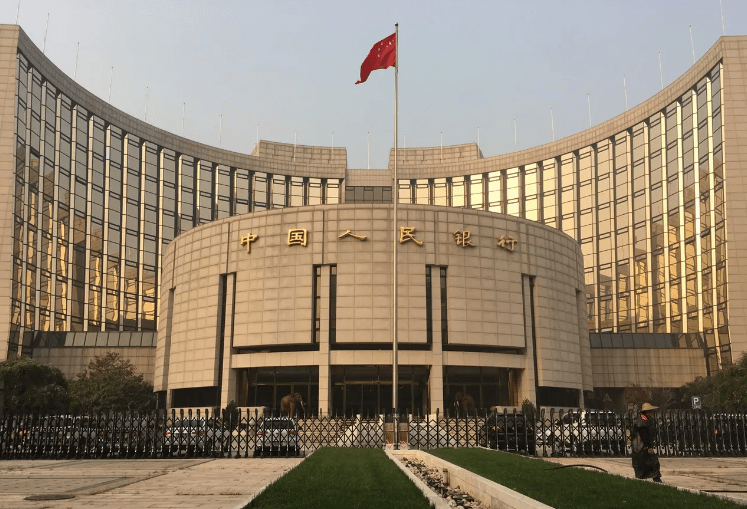
The People's Bank of China. Image: Fintech Futures

Reports have disclosed that digital yuan wallets will be subject to rules similar to those for regular bank accounts. Deposit insurance will apply, and reserve and reporting requirements will be tightened for third-party payment providers.

The PBOC framework also sets clearer rules for cross-border testing that was already under way with partners such as Singapore, Thailand, Hong Kong, the UAE and Saudi Arabia.

Banking And Policy Impact

Banks will need to adapt systems for interest calculation and for clearing e-CNY transactions at scale, which could increase operational costs in the short term. That said, some costs may be offset if more money flows into e-CNY wallets and fewer funds stay in nonbank payment platforms.

Total crypto market cap currently at $2.95 trillion. Chart: TradingView

Monetary authorities will watch how these flows interact with the broader money supply and lending operations, because shifts in where deposits sit can affect credit channels.

For everyday users, the most direct change is that holding e-CNY could earn interest and enjoy the same insurance protection as deposits. For businesses, payment settlement may become cheaper or faster depending on how banks price services.

Reports suggest regulators aim to keep the system safe by demanding full reserves from third-party operators and clearer oversight by banks.

Based on reports and official statements, the change takes effect on January 1, 2026, and it marks a major step in China’s long running e-CNY program. Regulators, banks and users will all be watching how interest rules are applied and whether the shift leads to wider use of the digital currency.

Featured image from Unsplash, chart from TradingView

Preguntas relacionadas

QWhen will commercial banks start paying interest on digital yuan wallet balances in China?

AJanuary 1, 2026.

QWhat is the People's Bank of China (PBOC) transforming the e-CNY into with this new framework?

AIt is moving the e-CNY from a cash-like tool to something closer to a bank deposit.

QHow will the interest on e-CNY wallets be calculated and set?

AInterest will be calculated by the banks that run the wallets and will be set in line with how banks price other deposit accounts.

QWhat protection will digital yuan wallet balances receive under the new policy?

AThey will be brought under China’s deposit insurance protections.

QWhat are the operational implications for banks due to this new policy?

ABanks will need to adapt systems for interest calculation and clearing e-CNY transactions at scale, which could increase operational costs in the short term.

Lecturas Relacionadas

The Tao (τ) Law Makes EDA Go Viral

In May 2026, Huawei's semiconductor division introduced the "Tao (τ) Law" at IEEE ISCAS, shifting the industry focus from Moore's Law's geometric scaling to "time scaling." Unlike traditional approaches relying on transistor miniaturization, τ Law optimizes the time constant (τ) across device, circuit, chip, and system levels to improve information processing speed and efficiency. Huawei has already applied this principle, mass-producing 381 chips across various applications, with a target to achieve performance equivalent to 1.4nm technology by 2031. The implementation of τ Law, involving techniques like Chiplet, 3DIC, and Logic Folding, places new demands on EDA tools, highlighting gaps in current offerings. Traditional 2D or pseudo-3D EDA flows lack native support for true 3D design, cross-layer co-optimization (STCO), and coupled multi-physics analysis (thermal, power, stress), which are crucial for advanced integration. Chinese EDA companies, such as Empyrean Software, Primarius Technologies, and Xpeedic, are evolving from point-tool specialists to providing full-flow, system-level solutions. For instance, Peking University has developed a prototype "true 3D" EDA tool showing significant improvements in wirelength and timing. Empyrean Software has also launched a comprehensive 3DIC design and verification platform. The τ Law framework presents an opportunity for the domestic EDA industry to transition from achieving basic functionality to developing robust, integrated toolsets essential for next-generation chip design.

marsbitHace 2 hora(s)

The Tao (τ) Law Makes EDA Go Viral

marsbitHace 2 hora(s)

It's Not Jensen Huang Who Wants to Change the PC, But the PC That's Revolting Against Itself

The 40-year-old PC industry is undergoing a fundamental transformation, driven by the rise of AI PCs. At the GTC Taipei 2026 event, NVIDIA, backed by Microsoft and major PC OEMs, announced the RTX Spark super chip for Windows PCs, marking its official entry into the PC core processor market. This move aims to redefine the AI PC by shifting its core from the CPU to an AI-focused SoC (System on Chip). NVIDIA envisions the PC evolving from a personal computer to a "personal AI"—a platform where local AI Agents can autonomously perform tasks. While Intel pioneered the AI PC concept earlier in 2026, NVIDIA's aggressive push, leveraging its vast CUDA developer ecosystem of 6 million, positions it to potentially reshape the industry's long-standing Wintel (Windows-Intel) power structure. NVIDIA's strategy extends beyond hardware; it's about embedding its CUDA, RTX, and AI software stack into the PC platform itself. The article identifies key shifts: 1) The move from a CPU-centric to an AI SoC-centric architecture, similar to Apple's approach with its M-series chips. 2) The PC's evolution from a human-operated tool to a platform for human-Agent collaboration. 3) The extension of NVIDIA's data center-centric CUDA ecosystem to personal devices via RTX Spark. Ultimately, the change is driven by the broader trend of AI moving to personal devices. Companies like Intel, AMD, Qualcomm, and Apple are all participating in this shift. NVIDIA's entry accelerates the competition, but the core driver is the technology itself finding its optimal expression in the PC. The industry is reinventing itself, with the outcome hinging on execution, ecosystem development, and the creation of compelling local AI applications.

marsbitHace 4 hora(s)

It's Not Jensen Huang Who Wants to Change the PC, But the PC That's Revolting Against Itself

marsbitHace 4 hora(s)

Trading

Spot
Futuros
活动图片





