CFTC warns on prediction market insider trading as volumes hit $75B in Q1

ambcryptoPublicado a 2026-04-01Actualizado a 2026-04-01

Resumen

The U.S. Commodity Futures Trading Commission (CFTC) has warned that insider trading laws apply to prediction markets, countering the belief that such activity operates in a regulatory gray area. A senior official stated the CFTC will aggressively pursue cases involving misuse of material non-public information, emphasizing that prediction market contracts fall under existing anti-fraud provisions. The regulator also highlighted exchanges' responsibilities to maintain surveillance systems and avoid listing easily manipulated contracts. This comes as prediction market trading volume surged to $75 billion in Q1 2026, up dramatically from $330 million in Q1 2024, driven by event-based trading on political, economic, and sports outcomes. The CFTC outlined enforcement priorities including insider trading, market manipulation, and retail fraud, while also introducing a new cooperation framework for self-reporting firms.

The U.S. derivatives regulator is sharpening its stance on prediction markets just as the sector sees explosive growth.

In remarks delivered on 31 March, a senior official at the Commodity Futures Trading Commission said insider trading laws do apply to prediction markets, pushing back against a growing narrative that such activity exists in a regulatory gray area.

The agency signaled that it will “aggressively detect, investigate, and prosecute” insider trading involving the misuse of material non-public information.

Insider trading rules extend to event contracts

The CFTC’s enforcement division emphasized that prediction market contracts fall under existing anti-fraud provisions of U.S. commodities law.

That includes trading based on misappropriated information obtained through a breach of duty, a framework commonly known as the “misappropriation theory.”

The remarks directly challenge a widely circulated belief across social media and parts of the crypto industry that insider trading is either permissible or inevitable in prediction markets.

Instead, the agency made clear that such conduct can constitute fraud under the Commodity Exchange Act, particularly when confidential information is used improperly.

Exchanges face growing compliance pressure

The warning was not limited to individual traders.

The CFTC also highlighted the role of exchanges, noting that platforms must maintain surveillance systems, enforce fair trading practices, and avoid listing contracts susceptible to manipulation.

The regulator highlighted risks in certain event-based contracts, including those tied to individual actions or outcomes, where access to non-public information could distort pricing.

Record growth brings regulatory focus

The renewed scrutiny comes as prediction markets scale rapidly.

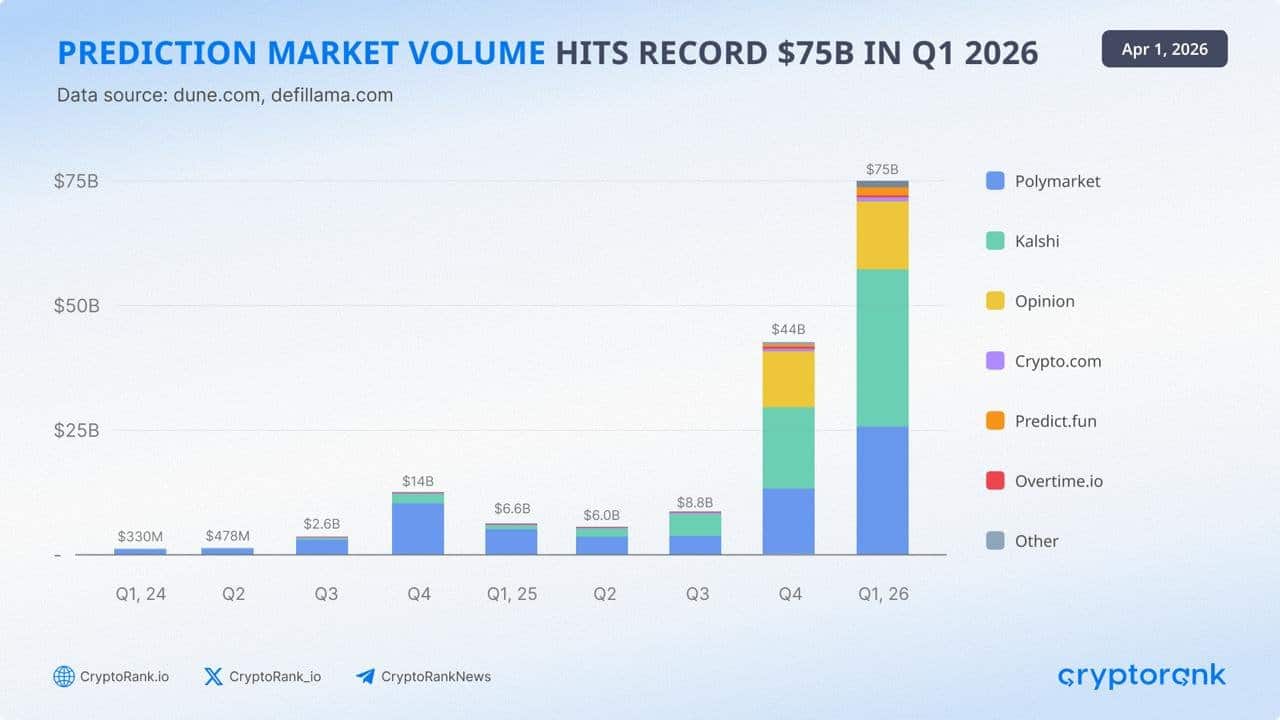
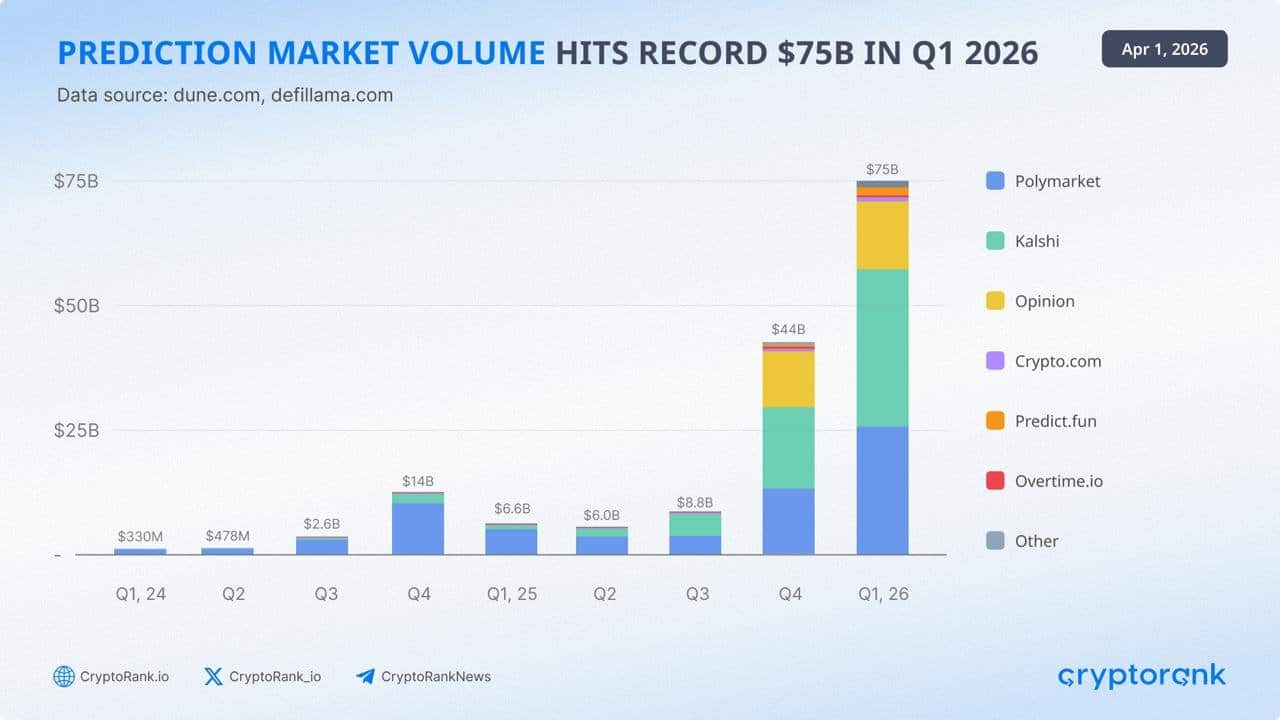
Data from CryptoRank and DeFiLlama shows total trading volume across platforms such as Polymarket and Kalshi reached $75 billion in Q1 2026, up sharply from just $330 million in Q1 2024.
Source: CryptoRank

The growth reflects increasing demand for event-based trading across political outcomes, macroeconomic indicators, and sports markets.

But with that expansion has come rising concern over market integrity, particularly around insider information and potential manipulation.

A shift in enforcement approach

The CFTC also outlined a broader shift in its enforcement approach.

While signaling an end to so-called “regulation by enforcement,” the agency identified five core priorities: insider trading, market manipulation, disruptive trading practices, retail fraud, and willful violations of AML and KYC rules.

At the same time, it plans to introduce a new cooperation framework that could offer declinations for firms that self-report, fully cooperate, and remediate misconduct.


Final Summary

  • Prediction markets have grown rapidly to $75 billion in quarterly volume, drawing increased regulatory scrutiny over insider-trading risks.
  • The CFTC has made clear that insider trading laws apply to these markets, signaling more active enforcement as the sector grows.


Preguntas relacionadas

QWhat is the CFTC's stance on insider trading in prediction markets according to the article?

AThe CFTC has made clear that insider trading laws apply to prediction markets, and it will 'aggressively detect, investigate, and prosecute' such activity, particularly the misuse of material non-public information.

QWhat was the total trading volume for prediction markets in Q1 2026, and how does it compare to Q1 2024?

AThe total trading volume across prediction market platforms reached $75 billion in Q1 2026, which is a sharp increase from just $330 million in Q1 2024.

QBesides individual traders, who else did the CFTC warn about compliance in its remarks?

AThe CFTC also warned exchanges, highlighting that platforms must maintain surveillance systems, enforce fair trading practices, and avoid listing contracts that are susceptible to manipulation.

QWhat legal framework did the CFTC's enforcement division say prediction market contracts fall under?

AThe CFTC's enforcement division emphasized that prediction market contracts fall under the existing anti-fraud provisions of U.S. commodities law.

QWhat are the five core enforcement priorities the CFTC identified?

AThe five core enforcement priorities identified by the CFTC are: insider trading, market manipulation, disruptive trading practices, retail fraud, and willful violations of AML and KYC rules.

Lecturas Relacionadas

Why Hasn't the U.S. Seen the Rise of 'Huabei' or 'Jiebei'?

The article explores why the U.S. lacks large-scale consumer credit products like China's "Huabei" and "Jiebei," despite having a developed financial sector. Key reasons include: 1. **Structural Barriers**: A fragmented federal and state regulatory system, reinforced by post-2008 reforms like the Dodd-Frank Act, raises compliance costs and protects traditional banks, stifling fintech innovation. 2. **Credit Card Dominance**: Credit cards, used by 70-80% of adults, form a $1.28 trillion debt market with high APRs (avg. 22.3%). This system cross-subsidizes users who pay in full with those carrying balances, creating a predatory yet entrenched ecosystem. 3. **Data Privacy Laws**: Strict regulations (e.g., FCRA, CCPA) prevent tech giants from leveraging behavioral data for credit scoring, unlike in China where such data fuels fintech models. 4. **Capital Market Disincentives**: Wall Street penalizes tech firms entering finance due to lower valuations associated with heavy regulation and risk, as seen in Apple’s failure with Apple Card. 5. **Banking Oligopoly**: Major banks control consumer lending, leveraging lobbying power and consumer habits to maintain high-cost credit, while alternatives like payday loans (400% APR) or "unbanked" services remain niche or exploitative. Ultimately, regulatory, structural, and corporate interests collectively block the emergence of accessible, low-cost digital lending in the U.S.

Odaily星球日报Hace 6 min(s)

Why Hasn't the U.S. Seen the Rise of 'Huabei' or 'Jiebei'?

Odaily星球日报Hace 6 min(s)

More and More 'Model Supermarkets' Are Opening: ByteDance, Alibaba, and Tencent Compete to Integrate

Chinese tech giants like ByteDance, Alibaba, and Tencent are accelerating the rollout of integrated AI model subscription services—dubbed “model supermarkets”—to provide developers with bundled access to multiple leading domestic large language models (LLMs). ByteDance’s Volcengine recently upgraded its "Coding Plan" by adding newer models like GLM-5.1, Minimax M2.7, and Kimi k2.6, allowing subscribers to use various top models under a single monthly fee starting at ¥40. However, user feedback reveals significant issues, including rapid consumption of usage limits (e.g., hitting caps within hours), frequent server errors (like HTTP 429), and slow response times during peak hours. Complaints about misleading deduction rates—where calls to advanced models consume more quota—are also common. The trend is industry-wide: Alibaba, Tencent, and Baidu have all launched similar multi-model coding plans. While these platforms reduce trial costs for developers, they also expose challenges in balancing affordability with service quality and computational stability. Amid this shift, independent AI companies like Zhipu, MiniMax, and Moonlight Face (Kimi) are developing strategies to avoid becoming mere “pipes” in this ecosystem—focusing on vertical applications, autonomous agents, and long-context models to retain competitiveness. Analysts suggest that, while platform aggregation may pressure model firms in the short term, specialized and vertical AI capabilities will remain differentiated in the long run.

marsbitHace 10 min(s)

More and More 'Model Supermarkets' Are Opening: ByteDance, Alibaba, and Tencent Compete to Integrate

marsbitHace 10 min(s)

Trading

Spot
Futuros
活动图片