CFTC pilot opens path for crypto as collateral in derivative markets

cointelegraphPublished on 2025-12-09Last updated on 2025-12-09

Abstract

The U.S. Commodity Futures Trading Commission (CFTC) has introduced updated guidance and a pilot program allowing futures commission merchants (FCMs) to accept Bitcoin, Ether, and USDC as collateral in derivatives trading. The initiative aims to integrate cryptocurrencies into regulated markets, enhance customer protection, reduce settlement friction through instant on-chain transfers, and improve risk management. The program includes strict reporting requirements for FCMs and withdraws outdated advisories. Industry leaders from firms like Circle, StarkWare, and Coinbase have praised the move as a significant step toward broader adoption of digital assets and more efficient, automated settlement processes in derivatives markets.

The US Commodity Futures Trading Commission (CFTC) has issued updated guidance for tokenized collateral in derivatives markets, paving the way for a pilot program to test how cryptocurrencies can be used as collateral in derivatives markets.

Collateral in derivatives markets serves as a security deposit, acting as a guarantee to ensure that a trader can cover any potential losses.

The digital asset pilot, announced by CFTC acting chairman Caroline Pham on Monday, will allow futures commission merchants (FCM) — a company that facilitates futures trades for clients — to accept Bitcoin (BTC), Ether (ETH) and Circle’s stablecoin USDC (USDC) for margin collateral.

The CFTC pilot is another step toward integrating crypto into regulated markets, and Circle CEO Heath Tarbert said it will also protect customers, reduce settlement frictions because tokenized collateral moves instantly onchain, and assist with risk reduction.

Pham said in a statement that the pilot program also “establishes clear guardrails to protect customer assets and provides enhanced CFTC monitoring and reporting.”

As part of the pilot, participating FCMs will be subject to strict reporting criteria, which require weekly reports on total customer holdings and any significant issues that may affect the use of crypto as collateral.
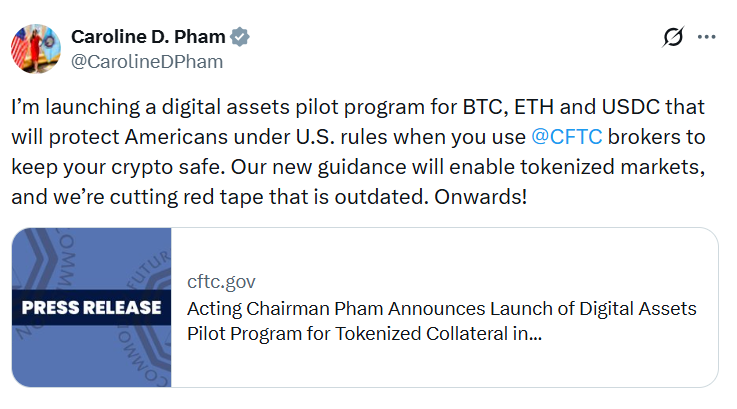
Source: Caroline Pham

Updated CFTC guidance for tokenized assets

The CFTC’s Market Participants Division, Division of Market Oversight, and Division of Clearing and Risk also issued updated guidance on the use of tokenized assets as collateral in the trading of futures and swaps.

The guidance covers tokenized real-world assets, including US Treasury’s money market funds, and topics such as eligible tokenized assets, legal enforceability, segregation, and control arrangements.

Pham said in an X post on Monday that the “guidance provides regulatory clarity and opens the door for more digital assets to be added as collateral by exchanges and brokers, in addition to US Treasurys and money market funds.”

The Market Participants Division also issued a “no-action position” on specific requirements regarding the use of payment stablecoins as customer margin collateral and the holding of certain proprietary payment stablecoins in segregated customer accounts.

A CFTC Staff Advisory that restricted FCMs’ ability to accept crypto as customer collateral, Staff Advisory 20-34, was also withdrawn because it is “outdated and no longer relevant,” in part due to the GENIUS Act.

Crypto execs back CFTC move

Several crypto executives applauded the move by the CFTC.

Katherine Kirkpatrick Bos, the general counsel at blockchain company StarkWare, said the use of “tokenized collateral in the derivatives markets is MASSIVE.”

Related: US regulators dismiss SEC-CFTC merger rumors, move to dispel crypto ‘FUD’

“Atomic settlement, transparency, automation, capital efficiency, savings. Feels abrupt but who recalls the tokenization summit in 2/24, a glimmer of hope in the darkness,” she said.

Coinbase chief legal officer Paul Grewal also supported the action, calling Staff Advisory 20-34 a “concrete ceiling on innovation.”

“It relied on outdated info, went well beyond the bounds of regulation and frustrated the goals of the PWG.”
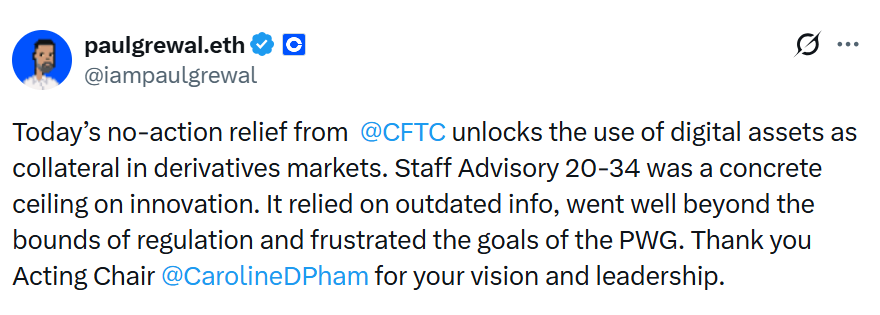
Source: Paul Grewal

Meanwhile, Salman Banaei, the general counsel at layer-1 blockchain, the Plume Network, said it was a “major move” by the CFTC, and another push toward wider adoption.

“This is a step toward the use of onchain infra to automate settlement for the biggest asset class in the world: OTC derivatives, swaps,” he added.

Magazine: XRP’s ‘now or never’ moment, Kalshi taps Solana: Hodler’s Digest, Nov. 30 – Dec. 6
Related Reads

Pump and Dump? Bitcoin and Ethereum Long-Short Squeeze, Direction to Be Decided Tonight! Best Time to Layout Altcoins: ZEC, FARTCOIN, TON Back to $8?

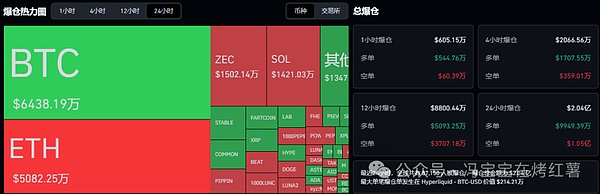
The cryptocurrency market is currently experiencing high volatility with significant liquidations, as Bitcoin and Ethereum remain in key consolidation zones. Over $204 million was liquidated in 24 hours, affecting over 87,000 traders. Bitcoin has been trading sideways since November 21st around $80,600, with a tightening Bollinger Band suggesting an imminent breakout. A move above $92,600 could signal a rally toward $94,185 and $96,012, while a drop below $87,600 may lead to a decline below $80,600. Post-Fed rate decision volatility is expected, and a "sell the news" scenario is possible. Ethereum continues to trade within a large range between $4,146 and $3,011. Key resistance lies at $3,138 and $3,260, while support levels are $3,050, $2,980, and $2,900. A bounce from $3,050–$3,020 could present a buying opportunity. The article emphasizes that fundamentals drive long-term trends, while technicals reflect market sentiment. Messaging and news only cause short-term fluctuations. Examples like SUI and HYPE show steady growth, whereas TON struggles despite positive news due to underlying issues. Several risky tokens have recently been listed, often a sign of low liquidity and potential market manipulation. Traders should be cautious. Two altcoins are highlighted: ZEC, which saw a 20% pump and is now above $400—consider taking partial gains; and FARTCOIN, which presents a buying opportunity in the $0.36–0.38 range with a stop loss at $0.342, targeting $0.55 upon breaking $0.42.

金色财经Hace 6 min(s)

Pump and Dump? Bitcoin and Ethereum Long-Short Squeeze, Direction to Be Decided Tonight! Best Time to Layout Altcoins: ZEC, FARTCOIN, TON Back to $8?

金色财经Hace 6 min(s)

Farcaster Shifts Course, 'Binance Square' and Others Take Over Crypto Social

Farcaster, a decentralized social protocol once seen as a flagship SocialFi project, has pivoted from its "social-first" strategy after four and a half years. Instead, it will now focus on building a consumer wallet to drive user growth, acknowledging that its previous approach lacked product-market fit. While Farcaster enjoyed support from top VCs and crypto influencers, it failed to retain users long-term. The platform struggled to compete with established Web2 social networks like Twitter and Telegram, where crypto communities are deeply embedded. Its shift aims to leverage wallet-based interactions to naturally spark social demand. However, this strategic turn may have come too late. Centralized exchanges, particularly Binance, have already successfully embedded social features into trading environments. Binance Square, originally Binance Feed, allows content creators to earn up to 50% commission from trades generated through their content. This incentive model, combined with Binance’s massive user base, has attracted influential traders and analysts, making it a dominant crypto social platform. Other exchanges like OKX and Gate are following suit, developing their own social features, indicating a broader trend of trading platforms expanding into social ecosystems. These platforms reduce compliance risks for creators and align naturally with crypto users’ financial motivations. The piece argues that crypto social products don’t necessarily need decentralization or heavy tokenization to succeed. Instead, they must serve real user needs: facilitating valuable information exchange, community building, and trust within crypto-native context. The success of exchange-based social platforms like Binance Square suggests that the future of crypto social may lie in utility-driven, scenario-specific networks rather than idealized decentralized social graphs.

Odaily星球日报Hace 31 min(s)

Farcaster Shifts Course, 'Binance Square' and Others Take Over Crypto Social

Odaily星球日报Hace 31 min(s)

A 'Headhunting Scheme' Disguised as a Beauty Pageant: How Huobi HTX Uses 'Her Power' to Reshape Its Ecosystem's Soft Power?

Summarizing the provided Chinese article about the HTX "First Lady" competition into a concise English abstract. **Abstract:** Beyond the Beauty Pageant: How HTX is Leveraging "Her Power" to Reshape Its Ecosystem In the crypto world, female leaders like Binance's He Yi, Bitget's Gracy Chen, and HTX's own Molly have proven to be pivotal forces. Against this backdrop, HTX's third "First Lady" competition has concluded, revealing itself to be far more than a traditional beauty contest. It functions as a strategic talent pipeline and "headhunting operation" for the exchange. Five winners were directly offered roles within the HTX ecosystem, moving from contestants to core builders. Their recent "debut" showcased their focus on solving real Web3 challenges: improving UX, community culture, and bridging cultural gaps. Their newly defined roles are highly practical: * **PP (Champion):** Ambassador for SunX, acting as a dedicated point of contact to simplify complex concepts for users. * **Olivia (Top 4):** HTX DAO Community Culture Ambassador, fostering engagement and breaking down barriers between the official platform and its users. * **Gun Gun:** Key Account Manager, providing warm, professional service and asset advice. * **Yiyi (Runner-up):** Cultural Ambassador, acting as a bilingual bridge between Chinese and global communities. * **Saki (Creativity Award):** Crypto Culture Ambassador, using creative content to make crypto more accessible. This initiative is validated by the "hardcore" career growth of past winners, who have evolved into essential roles such as official hosts, business development managers, and DAO philanthropy ambassadors, demonstrating a successful long-term strategy of converting visibility into value. Ultimately, HTX is redefining the role of women in Web3—from being seen to being indispensable builders. The program dismantles stereotypes, proving that "her power" is a crucial, resilient soft asset for the ecosystem.

深潮Hace 32 min(s)

A 'Headhunting Scheme' Disguised as a Beauty Pageant: How Huobi HTX Uses 'Her Power' to Reshape Its Ecosystem's Soft Power?

深潮Hace 32 min(s)

Trading

Spot
Futures
活动图片