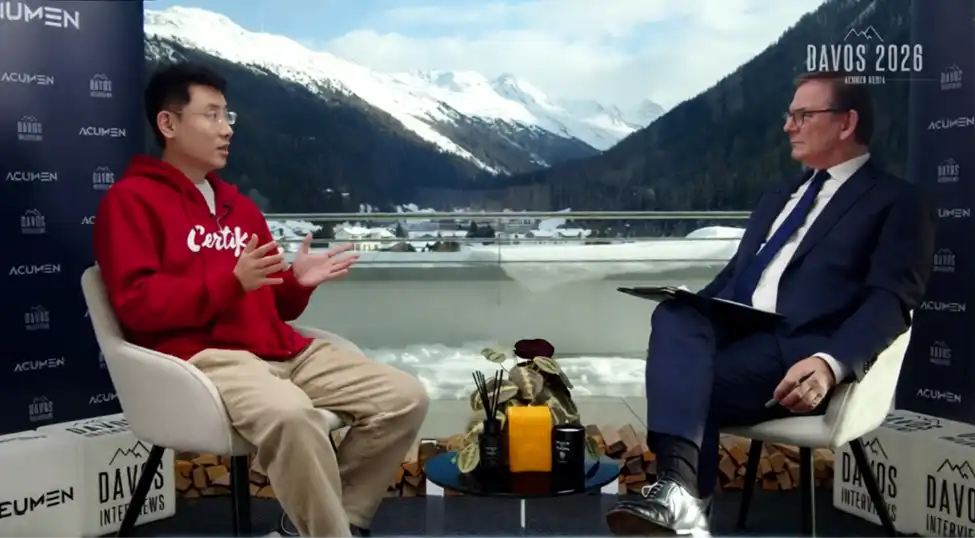
CertiK Founder Ronghui Gu Appears at Davos: Anchoring IPO Goals, Advancing into the Institutional Market

marsbitPublicado a 2026-01-23Actualizado a 2026-01-23

Resumen

CertiK founder Ronghui Gu announced at the 2026 World Economic Forum in Davos that the company is advancing its IPO plans, aiming to become the "first Web3 infrastructure stock." This signals both CertiK's corporate maturity and the Web3 industry's shift toward institutional adoption and standardization. Gu emphasized that a successful public listing would help mainstream markets better understand and adopt Web3 technology, reflecting recognition from traditional industries. CertiK has received significant strategic investment, including from YZi Labs (formerly Binance Labs), supporting its expansion into institutional markets. To meet growing institutional demand, CertiK launched Skynet Enterprise, a security platform offering real-time on-chain monitoring, risk visualization, and compliance-ready tools. The company is also integrating AI into its formal verification engine, Spoq, to enhance security scalability and efficiency—a approach validated at top academic conferences. Gu concluded that CertiK’s public market entry is a critical step for Web3's integration into the global financial system, marking the industry’s transition toward regulated, institution-friendly maturity.

During the 2026 World Economic Forum (WEF) Annual Meeting, CertiK Founder Ronghui Gu was interviewed by CBS in Davos. He revealed that as the world's largest Web3 security company, CertiK is actively advancing its IPO plans, striving to become the "first stock in Web3 infrastructure." This signal not only marks CertiK's own development entering a mature stage but is also seen by the industry as a significant indicator of the Web3 sector moving towards institutionalization and standardization.

"The market is still anticipating the listing of native Web3 enterprises, especially infrastructure companies like CertiK," Gu stated in the interview. "This will help the mainstream market better understand and adopt Web3 technology, and it also represents recognition from traditional enterprises and mainstream industries."

It is reported that CertiK's IPO plan has received support from strategic capital. Among them, YZi Labs (formerly Binance Labs) recently completed a milestone investment, establishing its position as CertiK's largest investor to date. The continuous injection of capital from such top-tier investors not only provides CertiK with ample momentum for expansion but also paves the way for its comprehensive penetration into the institutional market.

Web3 Infrastructure for Institutions

As more traditional financial institutions and large enterprises explore Web3, security, transparency, and risk visibility have become prerequisites for entering this field. Gu pointed out that Web3 is entering a new phase that requires "institutional-grade standards."

In this context, CertiK has focused on institutional needs and launched the enterprise-grade security platform Skynet Enterprise. This platform is designed to meet the demands of institutions and regulators for transparency, risk visibility, and data quality. Through real-time on-chain monitoring, alert systems, and analytical dashboards, it transforms complex on-chain activities into intuitive insights, helping to build a more resilient digital asset ecosystem. Currently, CertiK is working closely with multiple regulatory bodies to promote the platform's implementation, paving the way for Web3 industry compliance.

AI-Enhanced Formal Verification Security Framework

In the interview, Gu also emphasized the application of AI in Web3 security. Unlike basic automation tools, CertiK deeply integrates AI into its self-developed Spoq engine, significantly enhancing the scalability and execution efficiency of its core formal verification system through empowerment. This cutting-edge research has been validated at top academic conferences such as OSDI 2023 and ASPLOS 2026.

Relying on this system, CertiK can provide mathematical-grade security guarantees for institutional clients. This practice of translating academic rigor into production-ready tools highlights CertiK's core philosophy: security should be a matter of genuine technical depth, not just superficial "trust labels."

The Inevitable Path for Web3's Integration into the Global Financial System

Gu noted in the interview: "Many people hope to see CertiK's successful IPO because it is not only crucial for CertiK but also for the entire Web3 industry." In his view, moving towards the public market is not only a natural progression for corporate development but also an essential path for Web3 to integrate into the global financial system and win the trust of users worldwide.

In the global context of Davos, the signal sent by CertiK is increasingly clear: Web3 is moving away from fringe innovation and transitioning into a mature stage that can be regulated, adopted by institutions, and supervised by public markets.


Preguntas relacionadas

QWhat is the main goal of CertiK as announced by its founder at the World Economic Forum?

ACertiK is actively advancing its listing plan, aiming to become the 'first Web3 infrastructure stock' and targeting the institutional market.

QWhich investment firm is now the largest investor in CertiK?

AYZi Labs (formerly Binance Labs) is the largest investor in CertiK following a milestone investment.

QWhat enterprise-level security platform did CertiK launch to meet institutional needs?

ACertiK launched Skynet Enterprise, an enterprise-level security platform designed for institutional transparency, risk visibility, and data quality needs.

QHow does CertiK integrate AI into its Web3 security solutions?

ACertiK integrates AI into its self-developed Spoq engine to enhance the scalability and efficiency of its formal verification system, providing mathematical-level security for institutional clients.

QWhy is CertiK's potential IPO significant for the broader Web3 industry?

ACertiK's IPO is seen as a critical step for Web3 to integrate into the global financial system, gain trust, and be adopted by mainstream institutions and traditional enterprises.

Lecturas Relacionadas

Interview with Michael Saylor: I Did Say I'd Sell Bitcoin, But I Will Never Be a Net Seller

**Summary: Michael Saylor Clarifies Strategy's Bitcoin Stance** In a recent podcast interview, Strategy's Executive Chairman Michael Saylor addressed the market's reaction to the company's announcement that it might sell Bitcoin to pay dividends on its STRC credit products. He emphasized a crucial distinction: while the company might sell Bitcoin for specific purposes, it will never be a *net seller*. Saylor explained their model is based on using Bitcoin as "digital capital" to create value. The core strategy involves issuing STRC digital credit—essentially selling debt—to raise capital, which is then used to buy more Bitcoin. He estimates Bitcoin appreciates at roughly 40% annually. A small portion of these capital gains (e.g., ~2.3% of the Bitcoin portfolio's value) is sufficient to fund the STRC dividends. Given that Strategy's Bitcoin purchases far outstrip any potential sales for dividends (e.g., buying $3.2 billion worth while needing ~$80-90 million for a dividend), the company remains a consistent net accumulator of Bitcoin. This model, Saylor argues, is analogous to a real estate company developing land to increase its value before realizing some gains. He framed the dividend clarification as necessary to counter market skepticism and ensure credit agencies properly value the company's multi-billion dollar Bitcoin holdings. Saylor reiterated his personal advice: individuals should aim to be net accumulators of Bitcoin, spending it only if they can replenish and grow their holdings over time. Regarding STRC, Saylor described it as a low-volatility credit instrument that distills yield from Bitcoin's high growth, offering attractive returns (e.g., ~11-12% yield) for risk-averse investors. He noted that Strategy's STRC issuance now constitutes about 60% of the U.S. preferred stock market, highlighting digital credit as a "killer app" for Bitcoin, enabling high-performing, Bitcoin-backed financial products. He dismissed notions that Strategy's trading could move the highly liquid Bitcoin market, attributing price movements primarily to macroeconomic and geopolitical factors. Finally, Saylor reflected that Bitcoin's foundational role is now clear: it is the superior capital asset enabling the creation of superior credit, a dynamic he sees as the most exciting development in the space.

marsbitHace 4 min(s)

Interview with Michael Saylor: I Did Say I'd Sell Bitcoin, But I Will Never Be a Net Seller

marsbitHace 4 min(s)

380,000 Apps Exposed, 2,000+ Apps Leaked Secrets: AI Programming Turns 'Intranet' into Public Internet

Israeli cybersecurity firm RedAccess uncovered a severe data exposure trend linked to "vibe coding" or AI-powered software development tools. Their research found approximately 38,000 publicly accessible web applications built with platforms like Lovable, Base44, Netlify, and Replit. Of these, an estimated 2,000 apps exposed sensitive corporate and personal data, including medical records, financial information, internal strategic documents, and customer chat logs. In some cases, access even granted administrative privileges. The core issue stems from default privacy settings that make applications public by default, combined with a lack of built-in security controls (like authentication) in the AI-generated code. This allows employees without security expertise—"citizen developers"—to easily create and deploy applications that bypass standard corporate security reviews. The exposed apps, often indexed by search engines, are trivially discoverable. While some platform providers (Replit, Lovable, Wix/Base44) argue that security configuration is the user's responsibility and question the validity of some findings, security researchers confirm the widespread reality of such exposures. This pattern, also noted in prior studies, highlights a critical security gap as AI democratizes app creation, potentially leading to massive, unintentional data leaks.

marsbitHace 1 hora(s)

380,000 Apps Exposed, 2,000+ Apps Leaked Secrets: AI Programming Turns 'Intranet' into Public Internet

marsbitHace 1 hora(s)

Attracting Global Capital, Asia's New 'Super Cycle' Is Unfolding

Investors are turning to Asia as the next frontier for global equity growth, with a new "super cycle" unfolding across the region. Driven by the AI revolution, Asian markets, particularly South Korea, have seen significant rallies. According to Morgan Stanley analysis, the underlying drivers of Asia's industrial cycle are shifting from traditional sectors like real estate and manufacturing to massive investments in AI infrastructure, energy security and transition, and supply chain resilience. Fixed asset investment in Asia is projected to grow from around $11 trillion in 2025 to $16 trillion by 2030, with a 7% annual growth rate from 2026-2030. The AI wave is a primary catalyst, driving immense capital expenditure for chips, servers, data centers, and power systems. Asia is central to this hardware supply chain. In China, AI investment is focused on building a full-system domestic capability, with the local AI chip market potentially reaching $86 billion by 2030. Beyond AI, China's export story is expanding from EVs and batteries to robotics. The country already captures about half of new global industrial robot demand and over 90% of humanoid robot shipments. This growth phase mirrors the early stages of China's EV export boom. Simultaneously, energy security investments, spurred by AI's massive power needs, are rising, with China benefiting from its leadership in solar, batteries, and EVs. Regional defense spending is also increasing structurally, supporting demand for advanced manufacturing. The main beneficiaries are China, South Korea, and Japan, positioned in core supply chain areas. However, risks remain, including potential overcapacity, profit margin pressures from competition, persistent technological restrictions, geopolitical friction, and workforce displacement due to AI-driven automation. Market volatility is also expected to increase as investor expectations diverge on the realization of these capital investment and export themes.

marsbitHace 1 hora(s)

Attracting Global Capital, Asia's New 'Super Cycle' Is Unfolding

marsbitHace 1 hora(s)

Trading

Spot
Futuros
活动图片




