Centrifuge: Can CFG bulls break past $0.18 as TVL hits $1.6B? Examining…

ambcryptoPublicado a 2026-04-03Actualizado a 2026-04-03

Resumen

Over the past 24 hours, Centrifuge (CFG) was a top performer among altcoins, surging 12% following its announcement to expand to Base Chain and enable trading of tokenized S&P 500. This move into real-world asset tokenization appears to be a key driver behind the rally. From a technical perspective, CFG's price rebounded from a key Fibonacci retracement zone around $0.14, rallying to a daily high of $0.172. The MACD indicator confirmed a short-term bullish trend shift, though the $0.17 level is acting as resistance. The next major target is $0.1857, a zone that has triggered bearish reversals three times previously. Fundamentally, Centrifuge's ecosystem is experiencing strong growth. Its Total Value Locked (TVL) has increased to $1.6 billion, up from $1.2 billion, supported by four asset classes including treasuries, AAA CLOs, private credit, and now S&P 500. Network revenue also showed positive growth in March compared to February. Additionally, the number of unique addresses and token holders continues to grow steadily, reaching 19,699 and 9,111 respectively. In summary, CFG's price momentum is being driven by both robust network expansion and a favorable technical setup, though it faces a significant resistance test near the $0.18 level.

The past 24 hours have seen altcoins react differently, with the majority of them recording losses. Centrifuge [CFG] was one of the standout performers with a 12% increase, ranking among the top ten daily gainers.

Centrifuge’s announcement to expand to Base Chain, where it allowed the trading of tokenized S&P 500 as a new asset class, drove the rally. Is tokenization the main driver of CFG? Can bulls keep up with the pace?

CFG price bounces off KEY retracement level

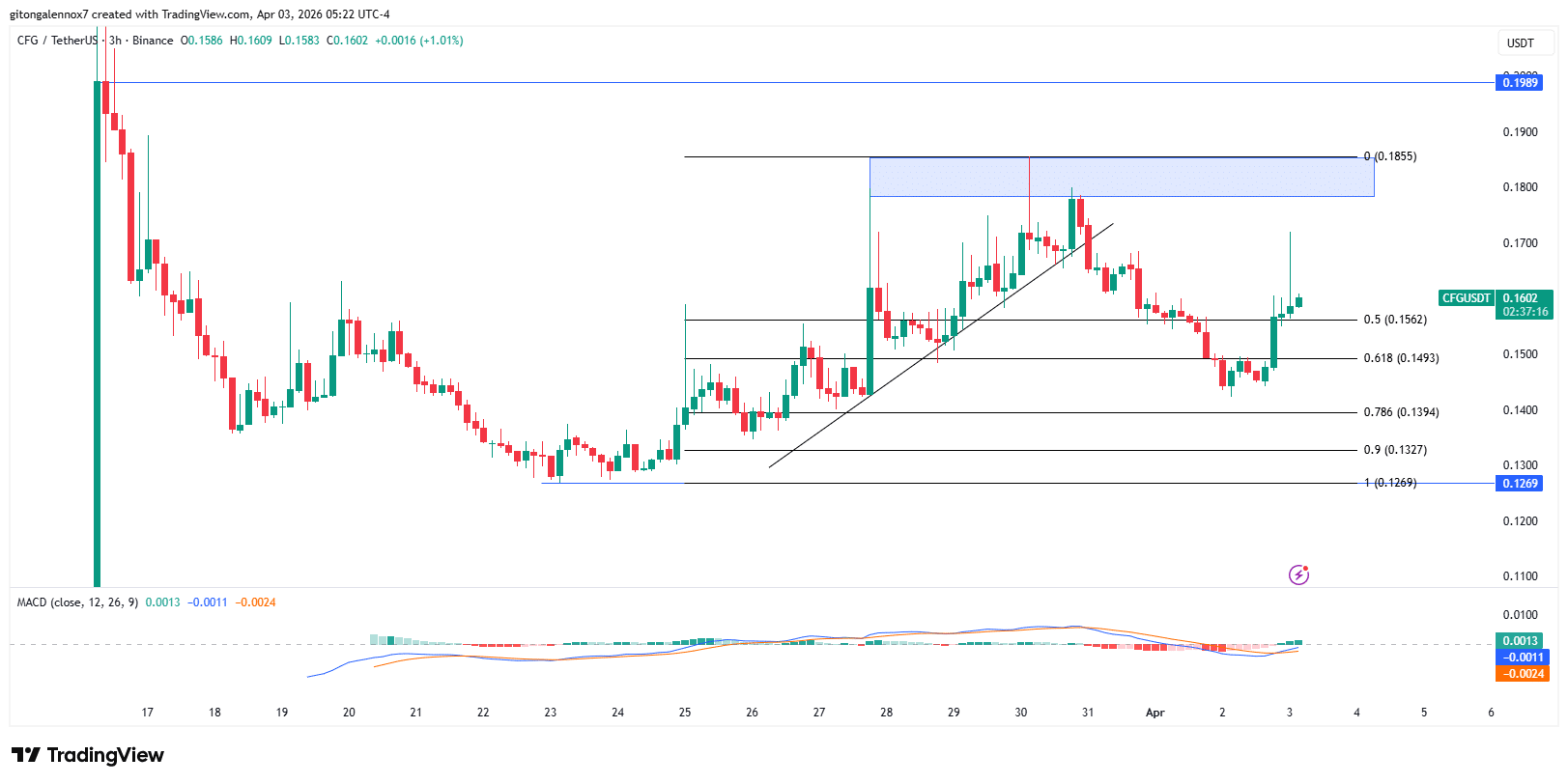
The charts clearly showed the current bullish momentum, with CFG rallying from a low of $0.14 to a daily high of $0.172. The altcoin lost its rising trendline support on the 31st of March but seemed to have ended the correction phase.

CFG bounced off the zone between 0.618 and 0.786 Fibonacci Retracement levels. To be specific, the altcoin respected the optimal zone at the 0.75 Fib level but seems to be seeing rejection around $0.17.

Holding through the premium zone, which is above the 0.5 Fib level, the altcoin increases the potential to hit $0.1857. However, this zone has sparked bearish reversals three times as CFG makes the fourth attempt.
Source: CFG/USDT on TradingView

Interestingly, bulls are showing strength, though it’s weak. The MACD lines have had a crossover confirming a short-term trend shift in the altcoin’s price action.

That puts $0.1857 as a potential reversal zone unless bulls can gather enough momentum past the resistance. This resistance zone was 18% away from $0.1561, which was a discount area considering the rally that started on the 23rd of March.

Growth in Centrifuge’s TVL, revenue, and holders

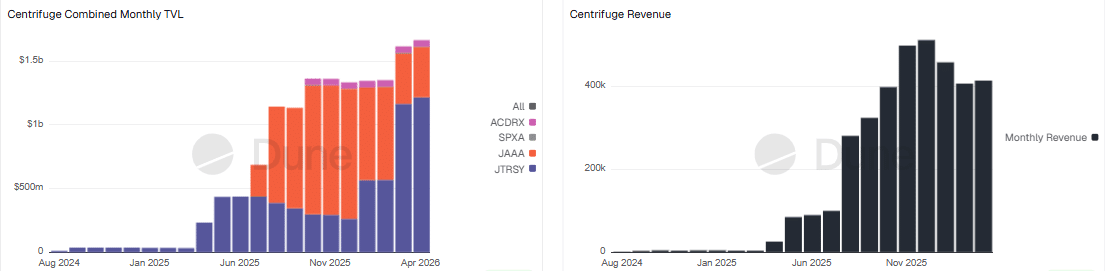
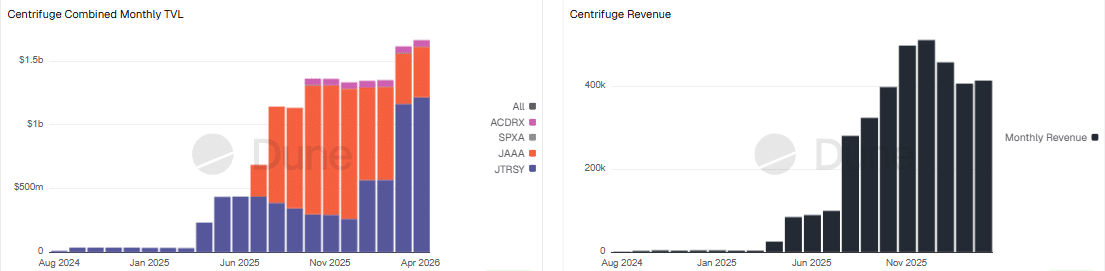
As Centrifuge continued to expand its chain, its Total Value Locked (TVL), revenue, and number of holders followed suit.

For instance, its TVL grew to $1.6 billion from $1.2 billion. This trend is continued as the asset classes have increased to four, which include treasuries, AAA CLOs, private credit, and now S&P 500. Treasuries accounted for the largest share of $1.2 billion.

Its revenue showed steady growth even though there was a slight dip since the year started. March recorded higher revenue than February, indicating the growth was back to positive territory.
Source: Dune Analytics

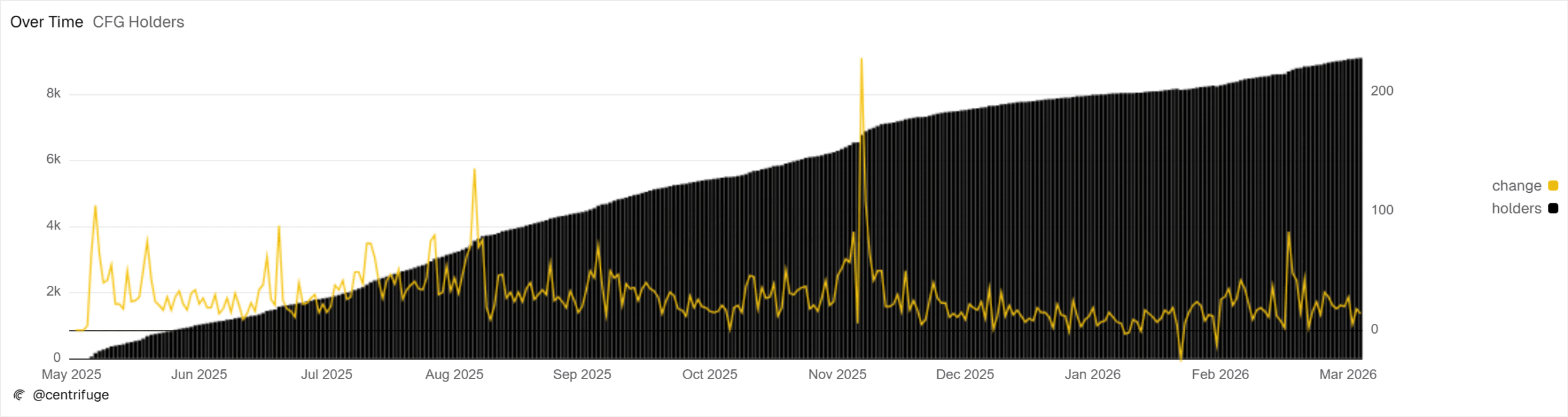
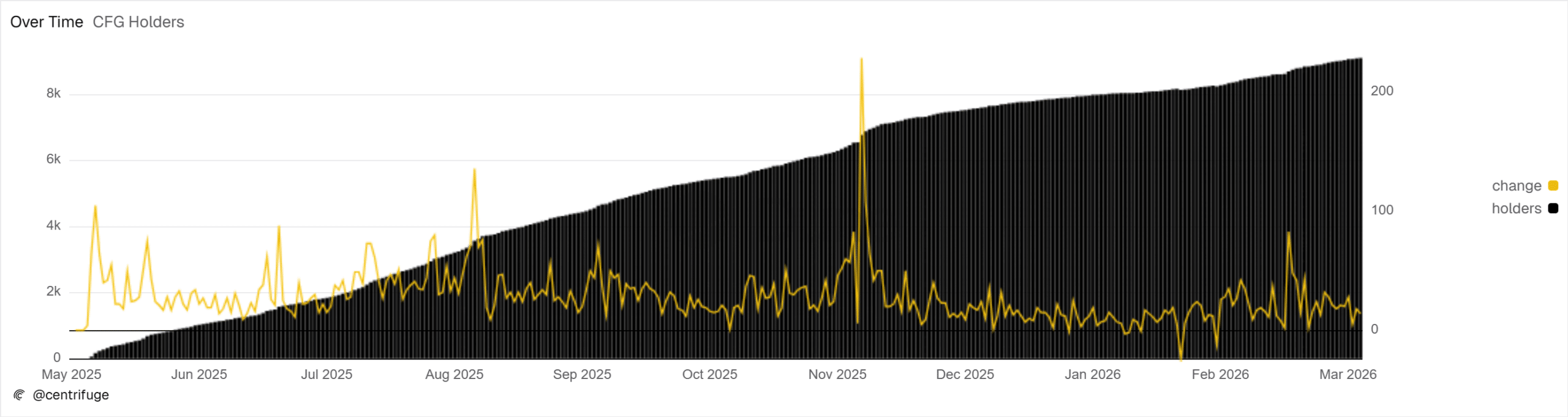
Dune Analytics recorded a total of 19,699 unique addresses interacting with CFG. Moreover, holders were growing steadily day by day since May 2025.

Only 14 new holders had been added in the past 24 hours, taking the total over time to 9,111.
Source: Dune Analytics

In summary, CFG prices were mainly driven by the network activity alongside a bullish technical setup.


Final Summary

  • Centrifuge surges 12% amid Base Chain integration to trade tokenized S&P 500, but CFG faces a key test at $0.18.
  • Centrifuge’s network activity was thriving, as seen in TVL, revenue, and number of holders.

Preguntas relacionadas

QWhat was the recent price performance of Centrifuge (CFG) and what drove its rally?

ACentrifuge (CFG) was one of the top ten daily gainers with a 12% increase in the past 24 hours. The rally was driven by its announcement to expand to Base Chain, allowing the trading of tokenized S&P 500 as a new asset class.

QWhat key technical level did CFG's price bounce from, and what is the next potential target?

ACFG's price bounced off the zone between the 0.618 and 0.786 Fibonacci Retracement levels, specifically respecting the 0.75 Fib level. The next potential target is $0.1857, provided bulls can gather enough momentum to break past the current resistance.

QHow has Centrifuge's Total Value Locked (TVL) changed recently, and what are its main asset classes?

ACentrifuge's TVL grew to $1.6 billion from $1.2 billion. Its main asset classes include treasuries (accounting for the largest share of $1.2 billion), AAA CLOs, private credit, and now S&P 500.

QWhat does the data from Dune Analytics show about the number of CFG holders?

ADune Analytics recorded a total of 19,699 unique addresses interacting with CFG. The number of holders has been growing steadily since May 2025, with a total of 9,111 holders over time, adding 14 new holders in the past 24 hours.

QWhat are the main factors driving CFG's price according to the article's summary?

ACFG's price is mainly driven by network activity, such as the expansion to Base Chain and the addition of new asset classes, alongside a bullish technical setup that includes a bounce from key Fibonacci levels.

Lecturas Relacionadas

L2 'Recalibration': When L1 Becomes Its Own Rollup, What Is Ethereum's Endgame?

The article discusses the evolving relationship between Ethereum's Layer 1 (L1) and Layer 2 (L2) solutions, moving beyond the initial "L2 for scaling" model. As Ethereum L1 itself scales (increasing Gas Limit, statelessness, zkEVM), the unique value proposition of L2s shifts from merely providing cheap execution to offering differentiated features like application-specific optimization, privacy, and flexible governance. The piece explores three key themes: 1. **L2's New Role:** L2s are transitioning from a pure scaling technology to a spectrum of execution environments with varying degrees of security inheritance from Ethereum L1. 2. **Interoperability as State Trust:** Solving L2 fragmentation is less about cross-chain bridges and more about enabling faster, trust-minimized state verification between environments. This involves initiatives like faster L1 finality, intent-based architectures (Open Intents Framework), and native account abstraction. 3. **Blurring Layers:** With the potential integration of zk-proofs into L1 validation (making L1 akin to its own "Rollup") and the concept of "Native Rollups," the rigid boundary between L1 and L2 may fade. The future could be a unified system with multiple execution domains (for DeFi, gaming, privacy, etc.) sharing a common security, settlement, and state framework. In conclusion, Ethereum's goal is not to abandon L2s or re-centralize everything on L1, but to re-integrate the fragmented user experience—liquidity, accounts, applications—while preserving the scaling benefits of a multi-environment ecosystem. The endgame is a cohesive "one chain" feeling for users, powered by diverse but securely interconnected execution layers.

marsbitHace 17 min(s)

L2 'Recalibration': When L1 Becomes Its Own Rollup, What Is Ethereum's Endgame?

marsbitHace 17 min(s)

The Encryption Bill Clarity's Challenge: A Thorny Path of Bipartisan Compromise in the U.S.

U.S. lawmakers are attempting to advance the Clarity Act, a significant crypto market structure bill, but its path is fraught with partisan hurdles. The process has been rocky since January, when a prior bipartisan deal in the Senate Banking Committee was upended. A key compromise in May on "yield" issues allowed the bill to move forward in committee, but only with the conditional support of two Democratic senators, Angela Alsobrooks and Ruben Gallego. They emphasized that their final vote depends on reaching an agreement on ethics provisions for elected officials. Ultimately, the Senate Agriculture Committee passed its version along party lines without Democratic support. As Republicans push for a full Senate vote in July, the demand for strong ethics language has expanded beyond Democrats. Additional controversies surround provisions related to yields (aligning some Republicans with large banks) and developer protections (opposed by enforcement agencies). Core concerns about illicit finance and consumer protection remain central to the debate. Despite consensus on the need for legislation, achieving the necessary bipartisan compromise is proving difficult. While momentum exists—including recent meetings between senators and White House officials—a reconciled bill text faces skepticism. Senator Gallego has stated that without ethics terms acceptable to Democrats, they will not provide the needed votes. The immediate goals for the crypto community in Congress are unclear: a symbolic Senate vote before the August recess, eventual passage into law by 2026, or forging a final compromise framework. The arduous, vote-by-vote effort to build bipartisan support continues, mirroring the traditional legislative grind the industry must now navigate.

Foresight NewsHace 1 hora(s)

The Encryption Bill Clarity's Challenge: A Thorny Path of Bipartisan Compromise in the U.S.

Foresight NewsHace 1 hora(s)

Trading

Spot
活动图片