Cash App Adds XRP, SOL, and ETH via Moonpay for 59 Million Users

cryptonews.ruPublicado a 2026-08-19Actualizado a 2026-08-19

Resumen

Cash App has integrated Cash App Pay into the MoonPay system, allowing eligible U.S. users to purchase XRP, Solana (SOL), Ether (ETH), and USDT directly from their Cash App balance. This integration is notable as Block, Cash App's parent company, has never directly listed these tokens within its own app; MoonPay handles the purchases and can send the assets to a user's external wallet of choice. This move effectively provides Cash App's 59 million active users access to a broader range of cryptocurrencies without the app needing to build its own listing and custody infrastructure for each asset. Cash App Pay becomes the third major payment method on MoonPay, joining PayPal and Venmo. After purchase, tokens can be sent to various external wallets, including Trust Wallet, MetaMask, and Ledger. MoonPay's co-founder noted the integration is a market expansion, giving tens of millions of users instant access to the digital asset ecosystem from a trusted app they already use. The integration also marks another step in expanding XRP's presence in mainstream financial apps in 2026, following earlier additions to platforms like SoFi and Rakuten Wallet. This development occurs after Block faced regulatory scrutiny, including a $40 million fine from New York regulators for past shortcomings in transaction monitoring within Cash App.

Cash App has integrated Cash App Pay as a payment method within the Moonpay system, allowing eligible U.S. users to purchase $XRP, Solana, Ether, and USDT by directing payment directly from their Cash App balance.

This move is notable because Block, Cash App's parent company, has never included these tokens directly in its app; instead, MoonPay handles the purchase and can send the assets to an external wallet of the user's choice. Thus, Cash App customers can now access tokens that the platform itself has never supported.
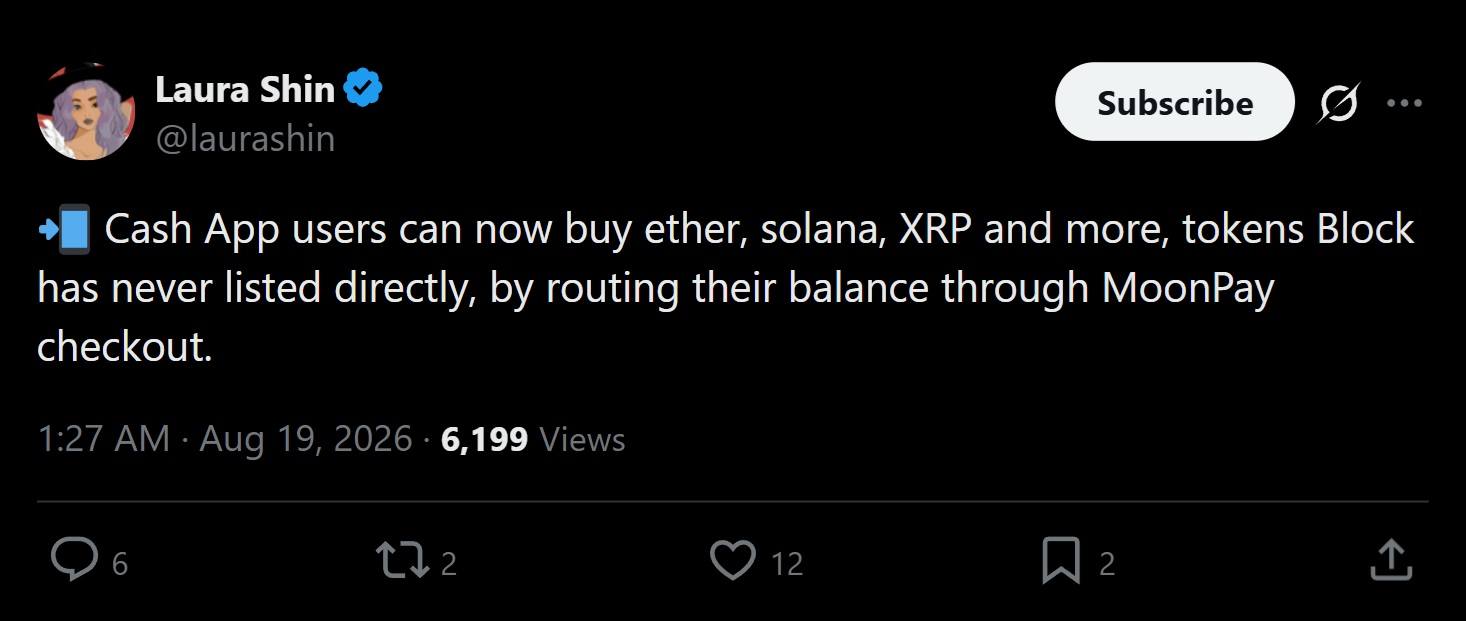
Image source: X

Bitcoin.com News has closely followed Cash App's cryptocurrency features over the years—from the launch of the "Paid in Bitcoin" paycheck conversion feature to BTC round-up tools and receiving payments via Lightning Network. However, until now, direct cryptocurrency purchases in Cash App have been limited to Bitcoin, with USDC only added earlier this year.

Consequently, the integration with Moonpay effectively allows Cash App to offer a much wider selection of tokens without needing to build its own infrastructure for listing and storing each asset.

Cash App Pay Joins a Growing List of Funding Methods

Cash App Pay is now the third major payment method supported by Moonpay for funding cryptocurrency purchases, joining PayPal, added in 2024, and Venmo. After completing a purchase, Moonpay can deliver tokens to a range of external wallets, including Trust Wallet, Bitcoin.com, Metamask, Moonshot, Ledger, Bitpay, Uniswap, Tangem, LOBSTR, and Edge, providing tens of millions of Cash App users with direct access to self-custody wallets, rather than holding funds within the Cash App itself.

Moonpay Co-founder and CEO Ivan Soto-Wright described this integration not so much as a product update but as a step to expand the market, adding:

"Cash App is an app where tens of millions of Americans already manage their money. This integration means those users will gain access to the digital asset ecosystem, funding accounts instantly from an app they already know and trust."

Given that as of June, Cash App has 59 million active users, this integration provides Moonpay with one of the country's largest fintech user bases as a channel for cryptocurrency purchases.

Growing List of Major Access Channels for $XRP

This innovation is also the latest example of expanding $XRP's presence in mainstream financial apps in 2026. Earlier this year, SoFi added support for $XRP deposits, with Ripple positioning the move as part of broader efforts to give more users direct access and practical utility.

$XRP also appeared in Rakuten Wallet, making it accessible to over 5 million merchants in Japan through that integration. Each new access channel adds a mass distribution channel independent of any single cryptocurrency exchange—a trend that began with the Moonpay integration in Cash App and is now extending to one of the largest peer-to-peer payment apps in the U.S.

Finally, it's worth noting that this expansion comes after a period that has not been entirely smooth for Cash App in terms of cryptocurrency regulatory compliance. Prior to this, Block was fined $40 million by New York regulators for violations related to monitoring Bitcoin and fiat currency transactions within Cash App, including reports that the company ignored approximately 169,000 warnings of misconduct.

end-content
Criptos en tendencia

Preguntas relacionadas

QWhat significant feature has Cash App integrated, and which payment processor is involved?

ACash App has integrated Cash App Pay as a payment method with the payment processor MoonPay.

QThrough this integration, which specific cryptocurrencies can eligible US users now purchase directly from their Cash App balance?

AEligible US users can purchase XRP, Solana (SOL), Ether (ETH), and USDT directly from their Cash App balance through MoonPay.

QAccording to the article, why is this integration significant for Block, Cash App's parent company?

AIt is significant because Block never listed these specific tokens (XRP, SOL, ETH, USDT) directly within the Cash App. The integration allows Cash App to offer a wider range of tokens without having to build its own infrastructure for listing and custoding each asset.

QHow does MoonPay's co-founder and CEO, Ivan Soto-Wright, characterize the integration with Cash App?

AIvan Soto-Wright characterized it not so much as a product update but as a market expansion move, giving Cash App's tens of millions of US users instant access to the digital assets ecosystem from an app they already know and trust.

QBesides Cash App Pay, which other major payment methods were already supported by MoonPay for funding cryptocurrency purchases, as mentioned in the article?

ABefore adding Cash App Pay, MoonPay already supported PayPal (added in 2024) and Venmo as major payment methods for funding cryptocurrency purchases.

Lecturas Relacionadas

China Pinches the Vital Point of CPO

The article "China Grips the Achilles' Heel of CPO" details how China holds a strategic position in the global indium phosphide (InP) supply chain, a critical material for high-speed optical modules and CPO (Co-Packaged Optics) technology used in AI data centers. China controls over 70% of global indium reserves and produces more than half of the world's primary indium, primarily as a by-product of zinc/tin smelting. It further refines 70-80% of the globe's refined indium. This upstream dominance is compounded by the fact that key InP wafer producer AXT operates its primary production through its Chinese subsidiary, Beijing Tongmei. Adding to this leverage are China's export controls, first on InP products and later extending to high-purity indium (6N+ grade). These restrictions have created supply bottlenecks and uncertainty, straining foreign manufacturers like Japan's Sumitomo and Dowa, who rely heavily on Chinese materials. The resulting shortage has led to intense demand, with industry figures like Lumentum's CEO warning of severe constraints and companies like Coherent seeking direct assurances from China. This situation benefits Chinese InP supply chain companies. Firms like Yunnan Chihong Zinc & Germanium (a leading domestic InP wafer producer) and Zhuzhou Keneng (high-purity indium) report surging domestic revenues and orders. They are also making progress in high-end product validation and capacity expansion. However, challenges remain, including lengthy customer qualification cycles and a significant capacity gap compared to foreign leaders. The article frames the current AI-driven demand surge as a pivotal moment for China's InP industry. It references a historical lesson where China, despite controlling indium resources, once ceded value-add and pricing power to Japanese processors. The current scenario is seen as an opportunity to leverage upstream resource control to develop advanced manufacturing capabilities and secure greater influence in the global semiconductor materials market.

marsbitHace 5 min(s)

China Pinches the Vital Point of CPO

marsbitHace 5 min(s)

Russian Suspected of Stealing Cryptocurrency from Cold Wallet Worth Almost 10 Million Rubles

Russian authorities are investigating a suspect accused of stealing nearly 10 million rubles worth of cryptocurrency from a cold wallet. According to investigators, the wallet belonged to an unnamed commercial company executive's assistant. In March, the suspect allegedly gained access to the victim's wallet by "an unidentified method" and transferred the digital assets to another address. During a search of the suspect's home, police seized three computers and three mobile phones for forensic examination, as they may contain important digital evidence. The case is being investigated as grand larceny under the Russian Criminal Code, carrying a potential sentence of up to ten years in prison. Police are also checking the suspect's possible involvement in other cryptocurrency thefts and identifying potential accomplices. The article notes that while cold wallets (hardware wallets storing private keys offline) are considered more secure against remote hacking, they remain vulnerable if a perpetrator gains physical or direct access to the keys. In a related case earlier in June, a court in Tomsk sentenced two men to 8 and 9.5 years in a strict-regime colony for a robbery and cryptocurrency theft. They forced an acquaintance at knifepoint to log into a crypto exchange account and transfer over 85 bitcoins, valued at approximately $5.1 million at the time.

cryptonews.ruHace 54 min(s)

Russian Suspected of Stealing Cryptocurrency from Cold Wallet Worth Almost 10 Million Rubles

cryptonews.ruHace 54 min(s)

Bitwise Names Three Mistakes Investors Make When Assessing the Cryptocurrency Market

Bitwise's chief investment officer, Matt Hougan, identifies three common mistakes investors make when evaluating the cryptocurrency market, all stemming from a disconnect between its current perception and potential evolution. First, investors often view crypto applications like Uniswap or Aave solely through the lens of the $2 trillion crypto market. However, with the tokenization of traditional assets (like $150 trillion in equities and $350 trillion in bonds), the potential market for these platforms could become 100 times larger. Second, there's an underestimation of crypto-native companies. Despite entry by major financial firms (e.g., PayPal in stablecoins, Fidelity in custody), native players like Tether, Circle, and Coinbase retain dominant market shares due to speed, focus, and established user bases (though exceptions like BlackRock's Bitcoin ETF success exist). Third, future blockchain transaction volumes are underestimated. Tokenized securities could trade 24/7, not just 33 hours per week, and the rise of AI agents managing portfolios could increase transaction activity by 50-100 times. Hougan concludes that investors assess the sector based on its present state while the underlying infrastructure is rapidly changing through tokenization, expanding use cases, and increased operational scale. This gap between current perception and future potential creates significant investment opportunities.

cryptonews.ruHace 56 min(s)

Bitwise Names Three Mistakes Investors Make When Assessing the Cryptocurrency Market

cryptonews.ruHace 56 min(s)

Grayscale Submits Fourth Amendment to Agreement for Zcash Trust, Whose Shares Will Be Listed on the NYSE Arca

Grayscale has submitted a fourth amendment to its S-3 registration form for the Grayscale Zcash Trust, a key step toward converting it into a U.S. exchange-traded fund (ETF) listed on NYSE Arca under the ticker ZCSH. This would be the first U.S. ETF providing regulated stock market access to the privacy-focused cryptocurrency ZEC ($ZEC). The amendment details the creation and redemption of shares, primarily through cash, though authorized participants can create shares in-kind by depositing ZEC. The trust is sponsored by Grayscale Investments, with Coinbase as the prime broker and custodian, and Bank of New York Mellon as administrator. The filing also notes non-binding discussions where Digital Currency Group's DCG International Investments could acquire shares by contributing 200,000 ZEC. A ZEC ETF is seen as a breakthrough due to regulatory caution around privacy-enhancing tokens. Following the filing, ZEC's price rose over 9% in 24 hours. Demand for the existing trust product has grown, with its average daily trading volume doubling from March to April, and shielded ZEC balances reaching a record ~30% of the circulating supply. Despite this momentum, Zcash has faced challenges in 2026, including a vulnerability discovered in its shielded Orchard pool that briefly caused its price to drop significantly. Developers quickly patched the issue. A regulated ETF would offer traditional investors exposure to this dual-faceted privacy asset.

cryptonews.ruHace 57 min(s)

Grayscale Submits Fourth Amendment to Agreement for Zcash Trust, Whose Shares Will Be Listed on the NYSE Arca

cryptonews.ruHace 57 min(s)

Trading

Spot

Artículos destacados

Qué es XRP 2.0

XRP 2.0: Una Nueva Frontera en el Panorama de las Criptomonedas Introducción a XRP 2.0 En el siempre cambiante ámbito de las criptomonedas, nuevos proyectos surgen continuamente, compitiendo por atención y adopción. Una de estas iniciativas prometedoras es XRP 2.0, un nuevo proyecto de criptomoneda diseñado para aprovechar la tecnología blockchain avanzada y metodologías de encriptación robustas. Aunque el nombre establece paralelismos con el XRP de Ripple, es crucial señalar que XRP 2.0 opera de manera independiente, enfocándose en mejorar la seguridad de las transacciones, la privacidad y la escalabilidad. A medida que el panorama financiero digital abraza cada vez más soluciones descentralizadas, XRP 2.0 busca contribuir de manera significativa a web3 y a la expansión general de los proyectos de criptomonedas. ¿Qué es XRP 2.0? En esencia, XRP 2.0 es un proyecto de criptomoneda que busca crear un ecosistema de moneda digital seguro y descentralizado. Su tecnología fundamental integra principios avanzados de blockchain con técnicas de encriptación de vanguardia. El objetivo principal de XRP 2.0 es establecerse como una plataforma confiable y eficiente que permita la ejecución rápida de transacciones mientras prioriza la protección de la privacidad de sus usuarios. El proyecto se promociona como una solución a muchas limitaciones enfrentadas por las criptomonedas existentes, proponiendo un sistema que puede manejar un mayor volumen de transacciones con mejor velocidad y privacidad. Esta versatilidad posiciona a XRP 2.0 como un competidor significativo en un mercado plagado de diversas monedas digitales. ¿Quién es el Creador de XRP 2.0? La identidad del creador detrás de XRP 2.0 ha sido señalada como 'Wilbur.' Sin embargo, los detalles completos sobre Wilbur o su entidad asociada siguen siendo elusivos. La anonimidad de muchos creadores de criptomonedas no es un fenómeno poco común en la industria, a menudo diseñado para mantener un grado de privacidad y seguridad. ¿Quiénes son los Inversores de XRP 2.0? Hasta ahora, la información específica relacionada con las fundaciones o organizaciones de inversión que apoyan a XRP 2.0 no está disponible públicamente. En el sector de las criptomonedas, el respaldo de inversores respetables puede influir significativamente en la credibilidad y el éxito de un proyecto, sin embargo, la transparencia sobre los patrocinadores financieros de XRP 2.0 no se ha establecido. ¿Cómo Funciona XRP 2.0? XRP 2.0 se destaca al emplear una combinación de tecnología blockchain y algoritmos de encriptación avanzados que aseguran transacciones seguras y descentralizadas. Su estructura innovadora incluye características únicas diseñadas para fomentar el compromiso del usuario y ampliar las funcionalidades más allá de las transacciones convencionales de criptomonedas. Entre estas características, XRP 2.0 incorpora capacidades impulsadas por IA, como funcionalidades de texto a imagen y de texto a voz. Estas adiciones están diseñadas para mejorar la experiencia interactiva de los usuarios, promoviendo una mayor aplicabilidad en diversos sectores. Al unir avances tecnológicos con un diseño centrado en el usuario, XRP 2.0 busca captar la atención de una amplia gama de individuos y empresas que buscan integrar soluciones de criptomonedas en sus marcos operativos. Cronología de XRP 2.0 Entender XRP 2.0 requiere examinar los hitos que han definido su viaje hasta ahora: 23 de julio de 2023: Se presenta XRP 2.0 como un nuevo proyecto de criptomonedas, con el objetivo de revolucionar las capacidades de transacciones seguras y descentralizadas en el ámbito de blockchain. 8 de septiembre de 2023: Se lanza otro proyecto, XRP20, marcando la aparición de un token ERC-20 en la blockchain de Ethereum que no guarda relación con XRP 2.0. 13 de noviembre de 2023: El Libro Mayor de XRP experimenta una actualización significativa con el lanzamiento de la versión 2.0.0 del software del servidor rippled. Es esencial señalar que este desarrollo está desconectado del proyecto de criptomonedas XRP 2.0. Puntos Clave sobre XRP 2.0 Para destilar la esencia de XRP 2.0, surgen varios factores críticos: Características Únicas: La inclusión de características como texto a imagen y texto a voz impulsadas por IA diversifica aún más las aplicaciones potenciales de XRP 2.0. Tecnología Blockchain: El marco utiliza mecanismos avanzados de blockchain y protocolos de encriptación, asegurando un entorno seguro y descentralizado para las transacciones. Escalabilidad y Privacidad: XRP 2.0 prioriza la protección mejorada de la privacidad en los procesos de transacción y la escalabilidad necesaria para acomodar una base de usuarios creciente. No Afiliación con Ripple: Es importante destacar que, a pesar de su nombre, XRP 2.0 no tiene ninguna lealtad ni colaboración con el XRP de Ripple, diferenciando su marco operativo y objetivos dentro del ecosistema de criptomonedas. Conclusión XRP 2.0 representa una ambiciosa aventura en la esfera de las criptomonedas, buscando ofrecer una combinación de seguridad, privacidad y eficiencia en las transacciones digitales. Al integrar tecnologías sofisticadas y características amigables para el usuario, el proyecto se propone ampliar los horizontes de lo que la criptomoneda puede lograr en la economía digital de hoy. Si bien la anonimidad de su creador y la falta de inversores revelados pueden generar cuestionamientos para algunos, el enfoque de XRP 2.0 en funcionalidades avanzadas y descentralización realza su atractivo en un mercado de criptomonedas cada vez más abarrotado. A medida que el paisaje de las criptomonedas sigue evolucionando, XRP 2.0 podría emerger como un jugador crucial en la expansión de soluciones blockchain seguras y escalables.

327 Vistas totalesPublicado en 2024.04.05Actualizado en 2024.12.03

Qué es XRP 2.0

Cómo comprar XRP

¡Bienvenido a HTX.com! Hemos hecho que comprar XRP (XRP) sea simple y conveniente. Sigue nuestra guía paso a paso para iniciar tu viaje de criptos.Paso 1: crea tu cuenta HTXUtiliza tu correo electrónico o número de teléfono para registrarte y obtener una cuenta gratuita en HTX. Experimenta un proceso de registro sin complicaciones y desbloquea todas las funciones.Obtener mi cuentaPaso 2: ve a Comprar cripto y elige tu método de pagoTarjeta de crédito/débito: usa tu Visa o Mastercard para comprar XRP (XRP) al instante.Saldo: utiliza fondos del saldo de tu cuenta HTX para tradear sin problemas.Terceros: hemos agregado métodos de pago populares como Google Pay y Apple Pay para mejorar la comodidad.P2P: tradear directamente con otros usuarios en HTX.Over-the-Counter (OTC): ofrecemos servicios personalizados y tipos de cambio competitivos para los traders.Paso 3: guarda tu XRP (XRP)Después de comprar tu XRP (XRP), guárdalo en tu cuenta HTX. Alternativamente, puedes enviarlo a otro lugar mediante transferencia blockchain o utilizarlo para tradear otras criptomonedas.Paso 4: tradear XRP (XRP)Tradear fácilmente con XRP (XRP) en HTX's mercado spot. Simplemente accede a tu cuenta, selecciona tu par de trading, ejecuta tus trades y monitorea en tiempo real. Ofrecemos una experiencia fácil de usar tanto para principiantes como para traders experimentados.

1.7k Vistas totalesPublicado en 2024.12.10Actualizado en 2026.06.02

Cómo comprar XRP

Discusiones

Bienvenido a la comunidad de HTX. Aquí puedes mantenerte informado sobre los últimos desarrollos de la plataforma y acceder a análisis profesionales del mercado. A continuación se presentan las opiniones de los usuarios sobre el precio de XRP (XRP).

活动图片