Cardano Sentiment Turns Cautious as NIGHT Token Fallout and $0.45 Resistance Cap Price Action

bitcoinistPublicado a 2025-12-13Actualizado a 2025-12-13

Resumen

Cardano (ADA) faces a complex mix of technical and sentiment-driven challenges, struggling to break the $0.45 resistance and declining 2% to around $0.42. The drop was influenced by broader market reactions to a Federal Reserve rate cut and exacerbated by the sharp 90% crash of Midnight Network’s NIGHT token, which amplified negative sentiment. With 54% of active positions short, traders expect further downside. Key support lies at $0.42–$0.43, with a potential fall toward $0.38–$0.39 if broken. Technical indicators like MACD and RSI remain bearish. Despite a $750 million inflow to Binance, demand remains modest. Social sentiment has turned cautious due to ADA’s repeated failure at $0.45 and a lack of major ecosystem updates. With no clear internal catalysts, ADA’s near-term direction depends heavily on broader market trends and Bitcoin’s price action.

Cardano is about to end the week with a complex mix of technical pressure, token fallout, and shifting sentiment, as ADA struggles to break beyond its familiar resistance zone.

The market is attempting to digest a sharp correction triggered by wider macro moves, while internal ecosystem developments offer little support. For now, ADA’s direction continues to depend on how well it can hold established support, particularly as market mood turns more cautious.
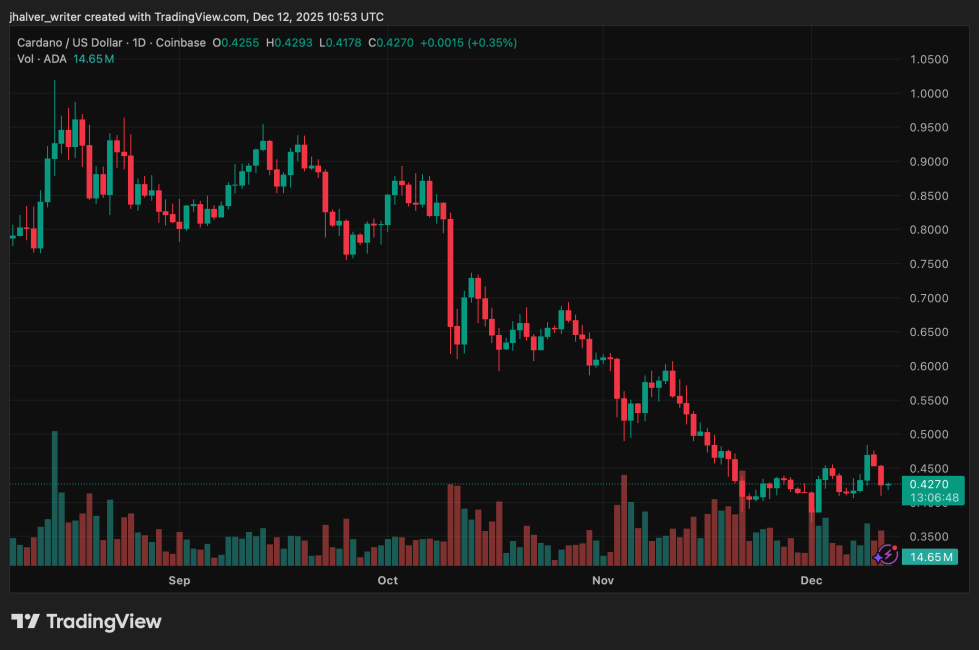
ADA's price trends to the downside on the daily chart. Source: ADAUSD on Tradingview

NIGHT Token Crash Adds Pressure to ADA’s Decline

ADA’s 2% drop to around $0.42 arrived just as the broader market reacted to the recent Federal Reserve rate cut. The decline pushed Cardano below the $0.45 level, a zone it has struggled to reclaim, placing renewed focus on its next support levels.

A major driver of the negative sentiment was the steep decline of Midnight Network’s NIGHT token, which fell roughly 90% from an early surge to $1.50 before settling near $0.05. The sell-off was largely driven by airdrop recipients offloading their allocations immediately after launch.

Despite earlier expectations around Midnight’s debut, the rapid reversal highlighted the speculative nature of the event. Market data also shows that 54% of active positions are leaning short, signaling that traders expect further downside.

Key Support Levels Hold, but Momentum Remains Weak

Cardano’s ADA is now trading near the lower edge of its established range, testing support between $0.42 and $0.43.

Analysts note that this area aligns with a broader weekly support cluster that stretches toward the $0.38–$0.39 region. Technical readings reinforce a cautious outlook, the MACD continues to trend bearish, while the RSI sits near 40, approaching oversold territory.

Traders are watching to see if ADA can stabilize above $0.42. A breakdown could expose the next lower supports, while a reclaim of the $0.45 zone would be required to shift momentum toward $0.48–$0.50.

Despite a recent $750 million inflow to Binance, the market absorbed the volume with limited price reaction, suggesting demand remains modest.

Sentiment Softens as Cardano Repeatedly Fails at $0.45

Social sentiment across major crypto forums has turned noticeably cautious. Conversations remain active, but the tone reflects trader fatigue as ADA continues to struggle against the same resistance.

With no new updates from core Cardano development efforts, including Hydra scaling, Mithril upgrades, or governance milestones, market participants have shifted their focus to external forces, such as BTC’s price direction and overall risk appetite.

ADA trades around $0.41–$0.42 at the time of writing, holding its range but without clear signs of a breakout. Until a fresh catalyst emerges, Cardano is likely to remain in a consolidation phase, with sentiment triggered more by broader market trends than internal progress.

Cover image from ChatGPT, ADAUSD chart from Tradingview

Lecturas Relacionadas

Computing Power Constrained, Why Did DeepSeek-V4 Open Source?

DeepSeek-V4 has been released as a preview open-source model, featuring 1 million tokens of context length as a baseline capability—previously a premium feature locked behind enterprise paywalls by major overseas AI firms. The official announcement, however, openly acknowledges computational constraints, particularly limited service throughput for the high-end DeepSeek-V4-Pro version due to restricted high-end computing power. Rather than competing on pure scale, DeepSeek adopts a pragmatic approach that balances algorithmic innovation with hardware realities in China’s AI ecosystem. The V4-Pro model uses a highly sparse architecture with 1.6T total parameters but only activates 49B during inference. It performs strongly in agentic coding, knowledge-intensive tasks, and STEM reasoning, competing closely with top-tier closed models like Gemini Pro 3.1 and Claude Opus 4.6 in certain scenarios. A key strategic product is the Flash edition, with 284B total parameters but only 13B activated—making it cost-effective and accessible for mid- and low-tier hardware, including domestic AI chips from Huawei (Ascend), Cambricon, and Hygon. This design supports broader adoption across developers and SMEs while stimulating China's domestic semiconductor ecosystem. Despite facing talent outflow and intense competition in user traffic—with rivals like Doubao and Qianwen leading in monthly active users—DeepSeek has maintained technical momentum. The release also comes amid reports of a new funding round targeting a valuation exceeding $10 billion, potentially setting a new record in China’s LLM sector. Ultimately, DeepSeek-V4 represents a shift toward open yet realistic infrastructure development in the constrained compute landscape of Chinese AI, emphasizing engineering efficiency and domestic hardware compatibility over pure model scale.

marsbitHace 31 min(s)

Computing Power Constrained, Why Did DeepSeek-V4 Open Source?

marsbitHace 31 min(s)

Trading

Spot
Futuros

Artículos destacados

Cómo comprar ADA

¡Bienvenido a HTX.com! Hemos hecho que comprar Cardano (ADA) sea simple y conveniente. Sigue nuestra guía paso a paso para iniciar tu viaje de criptos.Paso 1: crea tu cuenta HTXUtiliza tu correo electrónico o número de teléfono para registrarte y obtener una cuenta gratuita en HTX. Experimenta un proceso de registro sin complicaciones y desbloquea todas las funciones.Obtener mi cuentaPaso 2: ve a Comprar cripto y elige tu método de pagoTarjeta de crédito/débito: usa tu Visa o Mastercard para comprar Cardano (ADA) al instante.Saldo: utiliza fondos del saldo de tu cuenta HTX para tradear sin problemas.Terceros: hemos agregado métodos de pago populares como Google Pay y Apple Pay para mejorar la comodidad.P2P: tradear directamente con otros usuarios en HTX.Over-the-Counter (OTC): ofrecemos servicios personalizados y tipos de cambio competitivos para los traders.Paso 3: guarda tu Cardano (ADA)Después de comprar tu Cardano (ADA), guárdalo en tu cuenta HTX. Alternativamente, puedes enviarlo a otro lugar mediante transferencia blockchain o utilizarlo para tradear otras criptomonedas.Paso 4: tradear Cardano (ADA)Tradear fácilmente con Cardano (ADA) en HTX's mercado spot. Simplemente accede a tu cuenta, selecciona tu par de trading, ejecuta tus trades y monitorea en tiempo real. Ofrecemos una experiencia fácil de usar tanto para principiantes como para traders experimentados.

1.2k Vistas totalesPublicado en 2024.12.10Actualizado en 2025.03.21

Cómo comprar ADA

Discusiones

Bienvenido a la comunidad de HTX. Aquí puedes mantenerte informado sobre los últimos desarrollos de la plataforma y acceder a análisis profesionales del mercado. A continuación se presentan las opiniones de los usuarios sobre el precio de ADA (ADA).

活动图片