Can the Open-Source AI Platform Sentient Truly Challenge OpenAI's Dominance?

比推Publicado a 2025-12-19Actualizado a 2025-12-19

Resumen

The open-source AI platform Sentient is positioning itself as a direct challenger to OpenAI and other AI giants. Backed by $85 million in seed funding from prominent investors like Founders Fund and Pantera Capital, Sentient advocates for a decentralized, open-source path to AGI, contrasting with the closed, centralized models of companies like OpenAI and Anthropic. Its core advantages include ensuring AI diversity and interoperability, avoiding centralized censorship and single points of failure, disintermediating AI development, and providing a native monetization model via its SENT token. Sentient has built an ecosystem called GRID, which includes over 110 partners, ranging from AI agents and data providers to computational infrastructure. A key product highlight is SERA-Crypto, an open-source AI research agent that reportedly outperformed models like GPT-5 in real-time crypto market analysis. The SENT token acts as the economic engine for this ecosystem, incentivizing developers and users. Recently listed on major exchanges, it fuels a flywheel where better AI models attract more users and developers, fostering a self-sustaining, community-driven AI network. Sentient’s vision is a more transparent, equitable, and evolutionary future for AI.

Author: Wenser

Original Title: Taking Down OpenAI? The Ambitions of Open-Source AI Platform Sentient Go Beyond That


AI is devouring the world at an unprecedented pace, but the timeline has quietly diverged into two distinct paths.

One path is the expansion of the AI landscape monopolized by tech giants: NVIDIA, leveraging its chip and graphics card resources, has become the world's first publicly traded company with a market capitalization of $5 trillion; Google and Amazon have successively entered the chip manufacturing arena, striving to secure advantageous positions; OpenAI, Anthropic, and other AI giants have seen their valuations soar to hundreds of billions of dollars. The other path is the rapid development at the micro-level of the AI industry: NVIDIA founder Jensen Huang's mention at CES 2025 earlier this year that "AI Agents are poised to become the next robotics industry, with a market scale reaching trillions of dollars" is gradually coming to fruition. Tens of millions of AI Agents are permeating every aspect of human society daily, which also means that tech giants are gradually becoming the "key holders to the gates of the AI world." Based on the development trajectory of the internet industry, many might wonder: Is AI about to become "just another game for tech giants?"

To this, Sentient's answer is—"No."

As an open-source AI platform adhering to internet fundamentalism, it previously secured $85 million in seed funding, led by prominent institutions including Peter Thiel's Founders Fund, Pantera Capital, and Framework Ventures. On the inevitable path of AI consuming the world, Sentient has chosen a route starkly different from that of the giant corporations. And this is precisely the "Prologue to Open-Source AGI" that Odaily Planet Daily will systematically deconstruct today.

First Look at Sentient: Raising the Banner of Open-Source AI, Challenging Trillion-Dollar Monopoly Giants Head-On

Last July, Sentient announced the completion of an $85 million seed funding round, with its backing investors堪称豪华 (can be described as豪华 -豪华 means luxurious/impressive here, implying a very strong lineup) — lead investors included Peter Thiel's Founders Fund, Pantera Capital, and Framework Ventures; participating investors则包括 (then included) Ethereal Ventures, Robot Ventures, Symbolic Capital, Delphi Ventures, Hack VC, Arrington Capital, HashKey Capital, Canonical Crypto, LD Capital, and Foresight Ventures, among a series of well-known VC investment institutions in the crypto industry.

It's important to note that crypto projects securing this amount in seed funding have always been few and far between, let alone with the strong backing of such a series of star capital behind this investment. Previously, only a few top-tier L1 public chain projects could receive such powerful support. For a time, "What did Sentient possess to gain such favor from capital?" became one of the hot topics in the crypto circle. Soon, the answer emerged.

Targeting OpenAI, Sentient Team Faces Giant Competition Head-On

In subsequent media interviews, several partners from Sentient's lead investment institutions provided their answers—

Founders Fund partner Joey Krug stated that the primary reason for investing in Sentient was its team, praising the technical acumen of co-founders Sandeep (founder of Polygon) and Pramod (professor at Princeton University), among others; Pantera Capital managing partner Paul Veradittakit expressed that if AI development remains closed-source, many critical aspects of society will be vulnerable to the集中效应 (centralized effects) of censorship and rent-seeking. Sentient's open, monetizable, and loyal (OML) AI model "has enormous potential to disrupt the AI development industry"; Framework Ventures partner Brandon Potts also gave high praise regarding the team and technology,直言 (stating bluntly) that "the Sentient team is the most capable team to solve the economic problems of open-source AI."

In Sentient's impressive seed funding round, the golden rule of "investing in people" was vividly demonstrated, and the team members behind the Sentient project can indeed be called a "founding dream team" (compiled from Grok)—
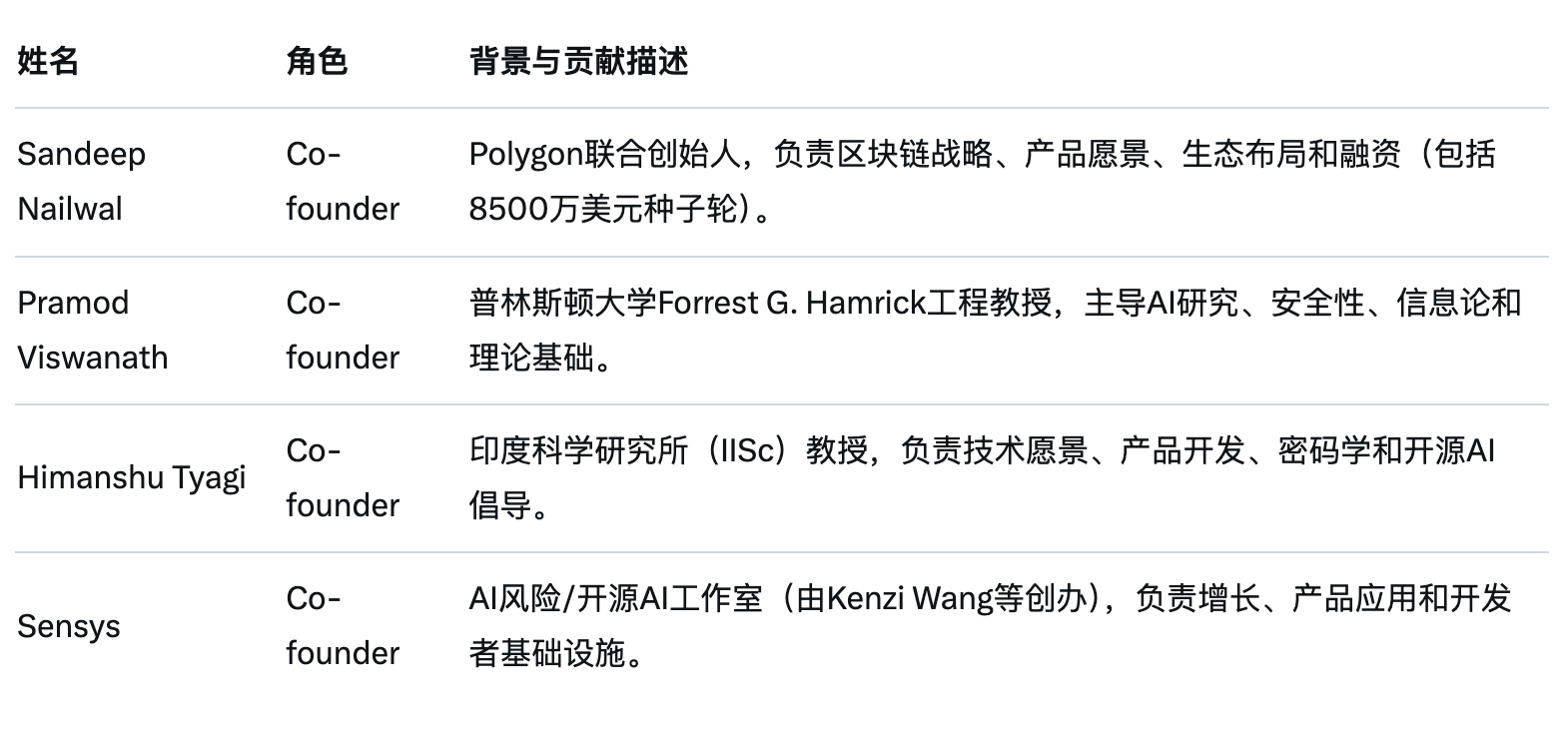
Sentient's 4 Co-Founders

More importantly, during this interview, Sentient's ambition was emphasized once again—to compete head-on with the AI giant, OpenAI, the company behind ChatGPT, with its main competitive strategy being to build open-source AI models leveraging community contributions.

The Universal Value of an Open-Source AI Platform: Decentralization, Censorship Resistance, Monetary Quantification

Different from the closed-source models of AI giants like OpenAI, Anthropic, and Google, Sentient has chosen a "difficult yet correct" path for AGI development—an open-source AI platform.

Using "hailing a ride" as an analogy, the AI models and applications provided by commercial companies like OpenAI and Anthropic are like "centralized AI platforms" that put a hood over the passenger's head. Users, as passengers, don't know the route, let alone whether the charges are reasonable; everything is subject to the "black box arrangements" of the commercial company. In contrast, Sentient's open-source AI approach chooses to lay out the route, specific costs, and diverse options in front of users for them to choose freely. Users can even "join the platform" to provide corresponding "solutions" for more users. Specifically, compared to the products of existing AI monopoly giants on the market, Sentient's open-source AI platform possesses the following advantages:

1. Ensures diversity and interoperability of AI products. Unlike the single AI models of various giant companies, the Sentient platform offers users more AI models to choose from, and various AI models can achieve a certain level of collaborative effect and interoperability, allowing users to enjoy a one-stop AI experience.

2. Avoids downtime and malicious behavior issues of centralized AI applications and models. Previously, OpenAI's model training data involved copyright infringement issues with news media. It's also an indisputable fact that AI models avoid sensitive information of their parent companies and are subject to centralized censorship mechanisms. The recent Cloudflare outage that caused ChatGPT to go offline also reflects the "fragility" of centralized AI models from the side. In these aspects, Sentient's open-source AI can provide certain technical guarantees for the censorship resistance and security redundancy of output content, as well as stable service.

3. Disintermediation and efficiency improvement in the AI field. The main advantage of an open-source AI platform comes from "from the masses, to the masses." A decentralized architecture builds a multi-sided network that can directly connect developers and users, matching supply and demand more efficiently, allowing AI models to truly serve real market needs.

4. Monetization platform tools for the AI application and development process. Sentient's OML (Open, Monetizable, Loyal) AI model and the already launched open-source AGI network GRID can help AI models and applications use the SENT token economy to reward development, feedback the ecosystem, and quantify growth. While ensuring ownership, control, and alignment, Sentient has thus established a monetized platform network that balances AI development and commercial operation.

Based on the above unique advantages,时至今日 (to this day), Sentient has already established a mature open-source AI ecosystem network.

Entering Sentient: Starting with Applications, Going Beyond Applications, Using Ecology to Fuel Network Growth

After about a year of development, Sentient has successively launched a series of self-developed products like Dobby, the Model Fingerprinting library, and Open Deep Search; the open-source AGI network GRID (Global Research & Intelligence Directory); ROMA (Recursive Open Meta AI Agent); and diverse network applications like the开源 AI research agent SERA-Crypto.

Not only that, with the emergence of GRID and the construction and gradual improvement of the SENT token economic model, the "AI Ecosystem Map" built around the Sentient open-source AI platform is also rapidly taking shape.
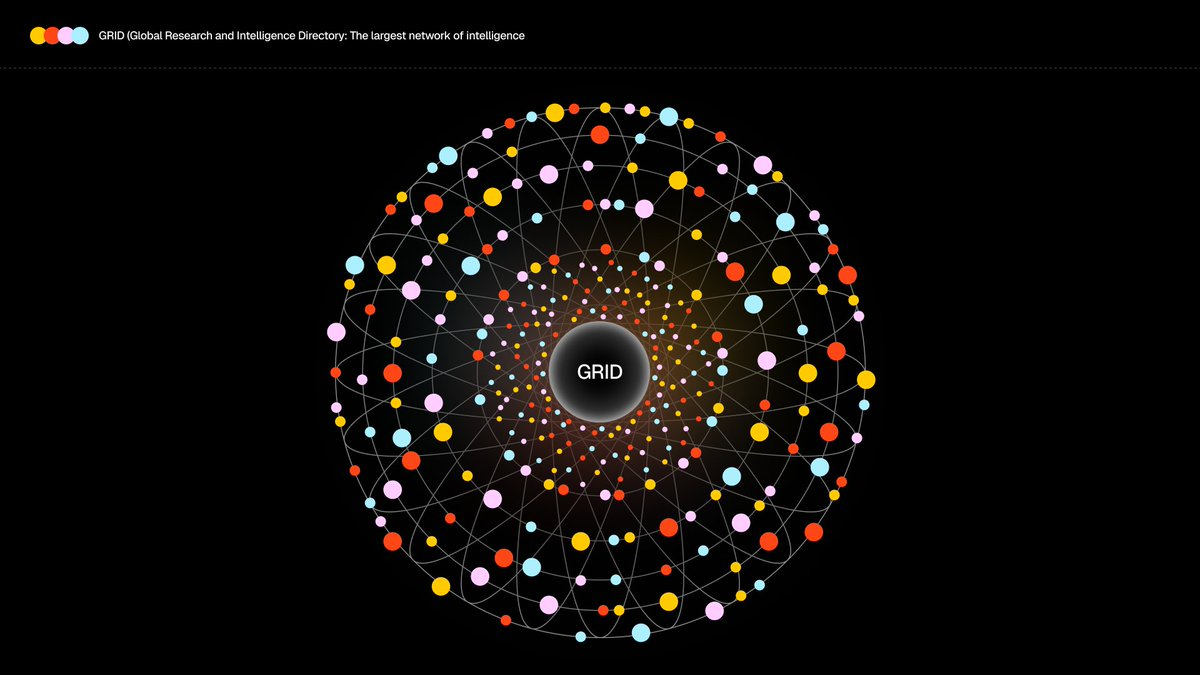
According to official news, the open-source AGI network GRID currently includes over 110 partners,其中包括 (including):

  • Over 50 specialized AI agents;

  • Over 50 specialized data providers;

  • 6 AI models;

  • Over 10 computing and verifiable AI infrastructure suppliers.
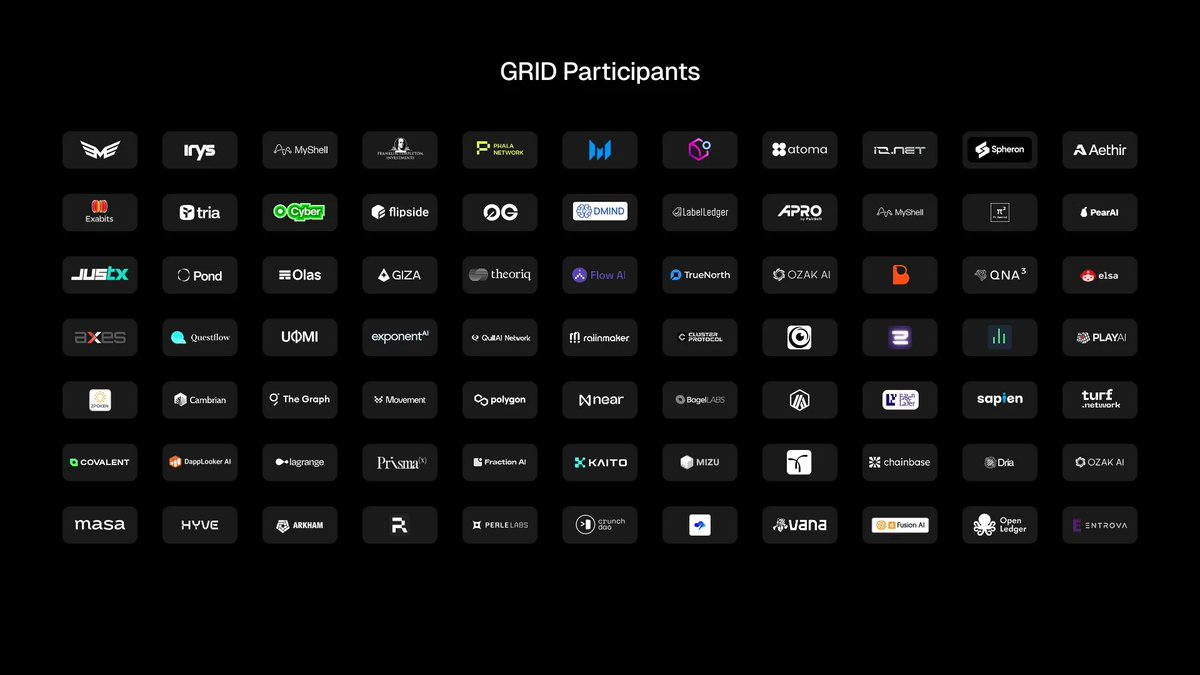
Overview of GRID Network Partners

Representative partners include the following projects: AI chart generation project Napkin, LLM (Large Language Model) search engine Exa, AI-driven people search platform Caldo, on-chain data tracking platform Arkham, enterprise-grade decentralized computing power platform Aethir,加密社交数据平台 (encrypted social data platform) Kaito,加密洞察代理平台 (crypto insights agent platform) Messari Co-Pilot, blockchain indexing data platform The Graph, cryptocurrency exchange Crypto.com, Polygon public chain, and the Dobby Judge AI arbitration system EigenLayer network, etc. Based on the development of ecological synergy effects, the value of Sentient as an open-source AI platform is mainly reflected in two aspects: first, it can attract builders such as developers, computing power, and data to participate in ecological construction; second, through token incentives and staking models, it can feedback the development of the open-source AI ecosystem, especially vertical AI models and applications closely integrated with the needs of the cryptocurrency industry, which are expected to experience a period of explosive growth.

The recently launched open-source AI research agent SERA-Crypto by Sentient is a prime example. Here we有必要多展开一下 (it's necessary to elaborate a bit more)—For a long time, combining AI with cryptocurrency market conditions to assist trading decisions has been a real need for countless people and a direction many developers have been striving to research. However, limited by the hallucinations of large models, difficulty in real-time market data updates, and the complexity of querying on-chain status and operating wallet accounts, "the AI Agent born for crypto research and investment" has always been absent.

SERA Crypto emerged in response to this need. This AI Agent,主打 (focusing on) "Semantic Embedding & Reasoning Agent Architecture," upon its debut, won the accolade of "the number one open-source agent on DMind"; in real-time crypto benchmark tests包含 (including) temporal relevance, data consistency, research depth, and relevance, SERA Crypto ranked first with a score of 34.3 points,其整体表现甚至优于 (its overall performance even surpassed) GPT-5, Grok 4, Gemini 3 Pro, and Perplexity Finance and other mainstream AI models, with all operations completed within 45 seconds.

After integrating advantages such as routing definition, data clarity, architectural optimization, and structured reasoning, SERA can筛选出 (filter out) real-time, usable, and instructive reasoning information from the flood of "large and comprehensive but useless" and "small and beautiful but虚假 (false)" information. Thus, the Sentient team successfully created an "AI Agent that understands cryptocurrency better," rather than the previous assistants that seemed more like rigid machines incapable of thought, only capable of summarizing clichés. Of course, the creation of SERA also离不开 (could not be separated from) the nearly 300,000 users of the Sentient community and over 22 million user queries.
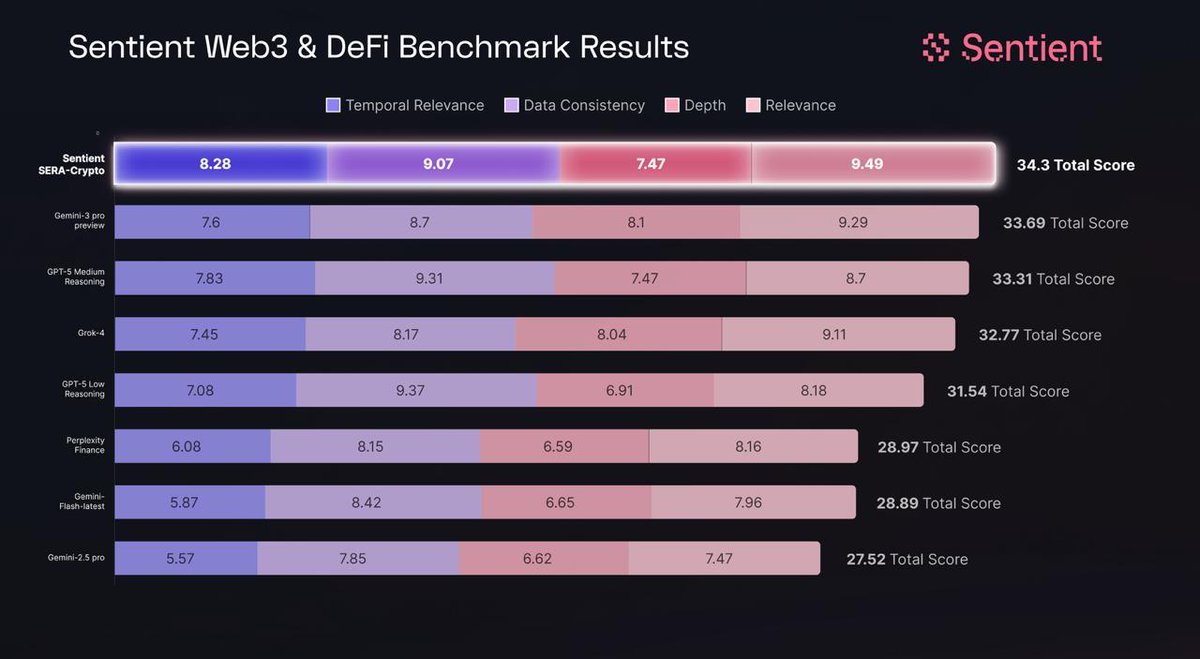
SERA Crypto Model Ranks First in Comprehensive Performance

From now on, users can use SENT tokens to access various AI applications (including various platform agent units) through the Sentient open-source platform to meet their real AI application reasoning needs; Sentient生态开发者 (ecosystem developers) can receive SENT token incentives through user-paid fees; additionally, the SENT token staking model can, to a certain extent, ensure the smooth operation of the economic循环体系 (circulation system) within the ecosystem.
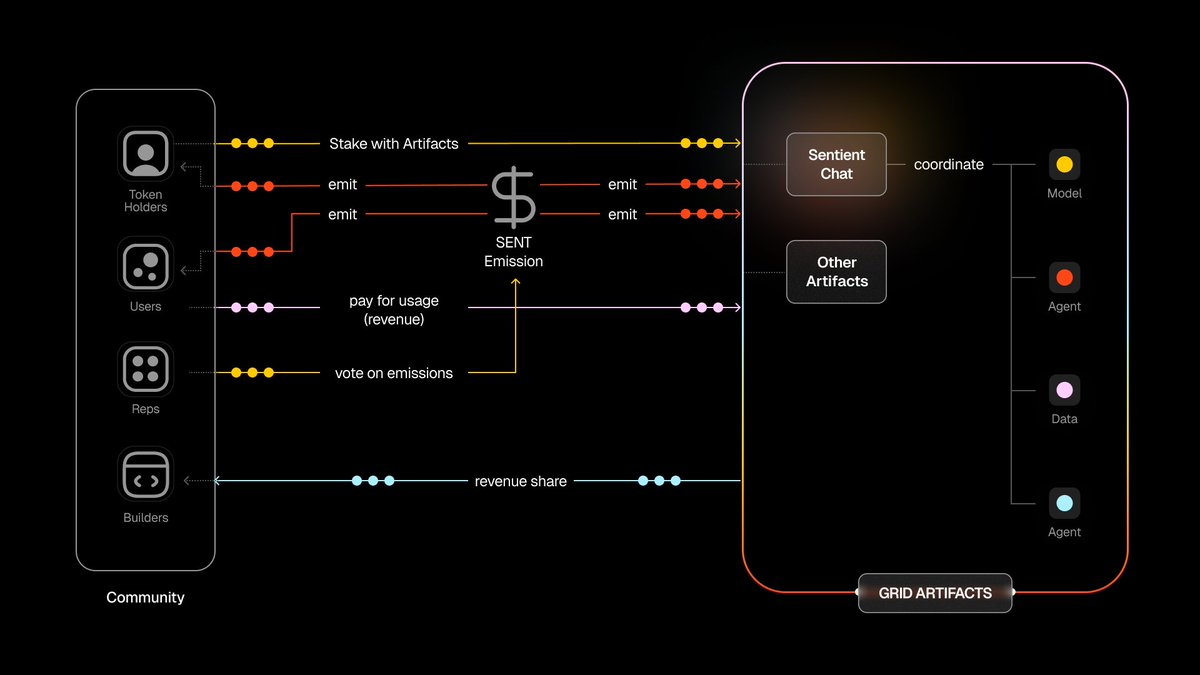
GRID Network and Sentient Community Ecological Flywheel Diagram

Ultimately, the monetized AI ecological economy built on the Sentient open-source AI platform takes full form. The subsequent optimization direction evolves into—better AI models and applications attract more AI users and developers to participate and join, which in turn催生 (catalyzes) the generation of more high-quality AI models and applications,共同构筑起 (jointly building) a development flywheel integrating "users-tokens-developers-products" into one.

SENT Token Introduction: The "Core Energy" Driving the Open-Source AI Platform

As the "engine fuel" supporting the continuous operation of Sentient's vast ecosystem, the role of the SENT token is crucial.

Previously, the SENT token was listed on OKX Pre-Market and Binance Futures; on December 6th, Coinbase officially announced adding SENT to its listing roadmap. Since then, as the core token of the Sentient ecosystem, SENT successfully achieved the feat of "listing on 3 major CEXs."

Previously, Sentient官方曾于 (officially had on) November 17th announced the official end of the first season activity. At that time, the token airdrop was mainly面向 (targeted at) Sentient community members (including Discord community members), AI chat users, crypto KOLs, open-source researchers, etc. On November 18th, its official airdrop registration link officially opened, with the original planned deadline of November 29th. Subsequently, the official delayed the registration deadline to December 5th.

According to subsequently released official information and messages from official personnel, more SENT token incentives for the community will be closely related to content contributions on social media platforms like X and the AI mind share占比份额 (proportion share) on加密社交数据平台 (encrypted social data platforms) like Kaito.

Apart from常规的 (conventional) paths like participating in Sentient Chat platform and application usage, AI model, AI Agent, and application development, helping the Sentient ecosystem expand its宣传营销 (promotion and marketing) might be the main theme of the SENT token second season airdrop activity. For more detailed information, you can follow the official X account or check the official website.
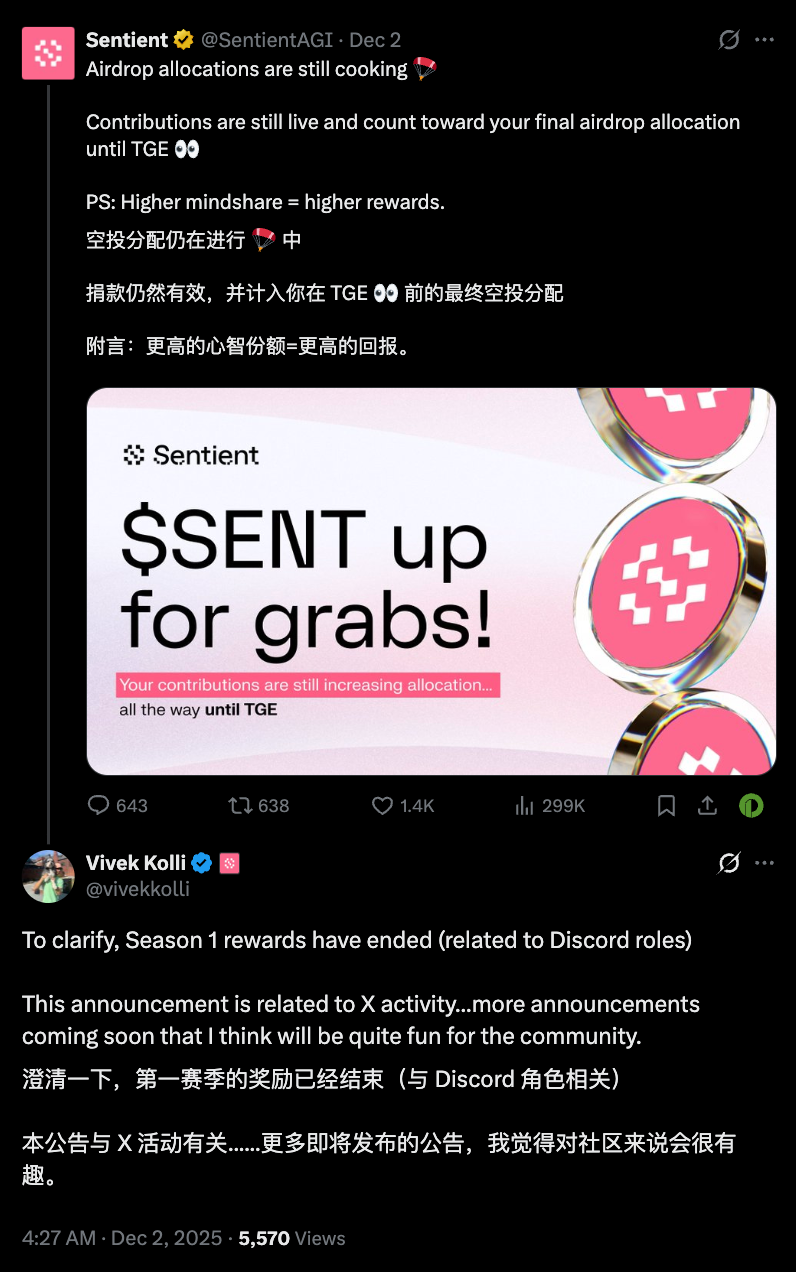
Official Personnel Hinting Clearly

Conclusion: The Limits of Open-Source AI's Self-Evolution Far Exceed Human Imagination

As the development of closed-source large AI models gradually陷入同质化僵局 (falls into a homogenization僵局 -僵局 means deadlock/impasse), open-source AI may become an important force pushing artificial intelligence into deeper waters. Just as the open-source Android system once led to the rapid development of smartphone devices and the advent of the mobile internet, open-source AI platforms represented by Sentient are not merely creating an AI chat application, but an entire open-source AI ecosystem—including underlying protocols, system architecture, as well as specific models and AI Agent applications.

More importantly, unlike the closed-door development of closed-source AI models and applications, open-source AI can achieve a certain degree of "self-evolution," which was the direction Sentient decided upon from the very beginning when it chose this "difficult yet correct" path.

While OpenAI is still troubled by the endless stream of new products from competitors and不得不 (has to) shut down Sora, Sentient is determined to forge a more universal AI development path that aligns with the pursuit of the open-source community. In the哨兵时代 (vanguard era) of carbon-based life guiding silicon-based life, the open-source AI platform brings not only the dawn of an AGI network but also an open-source AI ecological network that places greater emphasis on loyalty, monetary incentives, consistent service, and fewer "AI hallucinations."


Twitter:https://twitter.com/BitpushNewsCN

BitPush TG Discussion Group:https://t.me/BitPushCommunity

BitPush TG Subscription: https://t.me/bitpush

Original Article Link:https://www.bitpush.news/articles/7597075

Preguntas relacionadas

QWhat is Sentient and how does it aim to challenge OpenAI?

ASentient is an open-source AI platform that aims to challenge OpenAI's dominance by building community-contributed, open-source AI models. It focuses on decentralization, anti-censorship, and monetization through its token economy, offering an alternative to the closed-source models of giants like OpenAI and Anthropic.

QWhat are the key advantages of Sentient's open-source AI platform compared to closed-source models?

ASentient's open-source platform ensures AI product diversity and interoperability, avoids centralization issues like downtime and censorship, enhances efficiency through disintermediation, and provides monetization tools via its OML (Open, Monetizable, Loyal) AI models and SENT token economy.

QWhat significant funding did Sentient receive, and which investors were involved?

ASentient raised $85 million in seed funding, led by Peter Thiel's Founders Fund, Pantera Capital, and Framework Ventures. Other investors included Ethereal Ventures, Robot Ventures, Symbolic Capital, Delphi Ventures, Hack VC, Arrington Capital, HashKey Capital, Canonical Crypto, LD Capital, and Foresight Ventures.

QWhat is SERA-Crypto, and how does it perform compared to other AI models?

ASERA-Crypto is an open-source AI research agent developed by Sentient, designed for cryptocurrency market analysis. It ranked first in real-time crypto benchmarks with a score of 34.3, outperforming models like GPT-5, Grok 4, Gemini 3 Pro, and Perplexity Finance, while completing tasks in under 45 seconds.

QHow does the SENT token function within the Sentient ecosystem?

AThe SENT token is the core currency of the Sentient ecosystem, used to access AI applications, incentivize developers, and support the platform's economy through staking and rewards. It has been listed on major exchanges like OKX, Binance Futures, and Coinbase, facilitating broader adoption and utility.

Lecturas Relacionadas

Interview with Jeff Hoffman: How Web3 and AI Are Reshaping the Trillion-Dollar Social Travel Market

Interview with Jeff Hoffman: Web3 and AI Reshaping the Trillion-Dollar Social Travel Market Jeff Hoffman, co-founder of Priceline, discusses how Web3 and AI are transforming the social travel industry. He highlights that the current travel market is fragmented and inefficient, dominated by traditional online travel agencies (OTAs) that act as intermediaries with opaque models. Web3 introduces direct connections, transparency, and faster settlements, shifting value back to travelers. Key trends driving this change include demand for flexible rewards, digital payments, and trust in communities over ads. Hoffman joined Staynex not for its Web3 label, but because it addresses industry inefficiencies by integrating booking, payments, AI-driven itineraries, and rewards into a single ecosystem. This Web2.5 model combines Web2 scale with Web3 incentives. He emphasizes the team’s focus on execution over hype as a key reason for his involvement. Looking ahead, blockchain will enable transparent rewards and seamless cross-border payments, while AI provides personalization. Together, they will turn travel into a continuous relationship rather than a transaction. Hoffman predicts traditional OTAs will persist, but value will shift to platforms that own payment, loyalty, and community networks. Social travel represents a significant, underestimated opportunity in Web3.

marsbitHace 28 min(s)

Interview with Jeff Hoffman: How Web3 and AI Are Reshaping the Trillion-Dollar Social Travel Market

marsbitHace 28 min(s)

Trading

Spot
Futuros

Artículos destacados

Qué es $S$

Entendiendo SPERO: Una Visión General Completa Introducción a SPERO A medida que el panorama de la innovación continúa evolucionando, la aparición de tecnologías web3 y proyectos de criptomonedas juega un papel fundamental en la configuración del futuro digital. Un proyecto que ha atraído la atención en este campo dinámico es SPERO, denotado como SPERO,$$s$. Este artículo tiene como objetivo reunir y presentar información detallada sobre SPERO, para ayudar a entusiastas e inversores a comprender sus fundamentos, objetivos e innovaciones dentro de los dominios web3 y cripto. ¿Qué es SPERO,$$s$? SPERO,$$s$ es un proyecto único dentro del espacio cripto que busca aprovechar los principios de descentralización y tecnología blockchain para crear un ecosistema que promueva la participación, la utilidad y la inclusión financiera. El proyecto está diseñado para facilitar interacciones de igual a igual de nuevas maneras, proporcionando a los usuarios soluciones y servicios financieros innovadores. En su esencia, SPERO,$$s$ tiene como objetivo empoderar a los individuos al proporcionar herramientas y plataformas que mejoren la experiencia del usuario en el espacio de las criptomonedas. Esto incluye habilitar métodos de transacción más flexibles, fomentar iniciativas impulsadas por la comunidad y crear caminos para oportunidades financieras a través de aplicaciones descentralizadas (dApps). La visión subyacente de SPERO,$$s$ gira en torno a la inclusividad, buscando cerrar brechas dentro de las finanzas tradicionales mientras aprovecha los beneficios de la tecnología blockchain. ¿Quién es el Creador de SPERO,$$s$? La identidad del creador de SPERO,$$s$ sigue siendo algo oscura, ya que hay recursos públicos limitados que proporcionan información de fondo detallada sobre su(s) fundador(es). Esta falta de transparencia puede derivarse del compromiso del proyecto con la descentralización, una ética que muchos proyectos web3 comparten, priorizando las contribuciones colectivas sobre el reconocimiento individual. Al centrar las discusiones en torno a la comunidad y sus objetivos colectivos, SPERO,$$s$ encarna la esencia del empoderamiento sin señalar a individuos específicos. Como tal, comprender la ética y la misión de SPERO sigue siendo más importante que identificar a un creador singular. ¿Quiénes son los Inversores de SPERO,$$s$? SPERO,$$s$ cuenta con el apoyo de una diversa gama de inversores que van desde capitalistas de riesgo hasta inversores ángeles dedicados a fomentar la innovación en el sector cripto. El enfoque de estos inversores generalmente se alinea con la misión de SPERO, priorizando proyectos que prometen avances tecnológicos sociales, inclusión financiera y gobernanza descentralizada. Estas fundaciones de inversores suelen estar interesadas en proyectos que no solo ofrecen productos innovadores, sino que también contribuyen positivamente a la comunidad blockchain y sus ecosistemas. El respaldo de estos inversores refuerza a SPERO,$$s$ como un contendiente notable en el dominio de proyectos cripto que evoluciona rápidamente. ¿Cómo Funciona SPERO,$$s$? SPERO,$$s$ emplea un marco multifacético que lo distingue de los proyectos de criptomonedas convencionales. Aquí hay algunas de las características clave que subrayan su singularidad e innovación: Gobernanza Descentralizada: SPERO,$$s$ integra modelos de gobernanza descentralizada, empoderando a los usuarios para participar activamente en los procesos de toma de decisiones sobre el futuro del proyecto. Este enfoque fomenta un sentido de propiedad y responsabilidad entre los miembros de la comunidad. Utilidad del Token: SPERO,$$s$ utiliza su propio token de criptomoneda, diseñado para servir diversas funciones dentro del ecosistema. Estos tokens permiten transacciones, recompensas y la facilitación de servicios ofrecidos en la plataforma, mejorando la participación y la utilidad general. Arquitectura en Capas: La arquitectura técnica de SPERO,$$s$ apoya la modularidad y escalabilidad, permitiendo la integración fluida de características y aplicaciones adicionales a medida que el proyecto evoluciona. Esta adaptabilidad es fundamental para mantener la relevancia en el cambiante paisaje cripto. Participación de la Comunidad: El proyecto enfatiza iniciativas impulsadas por la comunidad, empleando mecanismos que incentivan la colaboración y la retroalimentación. Al nutrir una comunidad sólida, SPERO,$$s$ puede abordar mejor las necesidades de los usuarios y adaptarse a las tendencias del mercado. Enfoque en la Inclusión: Al ofrecer tarifas de transacción bajas e interfaces amigables para el usuario, SPERO,$$s$ busca atraer a una base de usuarios diversa, incluyendo a individuos que anteriormente pueden no haber participado en el espacio cripto. Este compromiso con la inclusión se alinea con su misión general de empoderamiento a través de la accesibilidad. Cronología de SPERO,$$s$ Entender la historia de un proyecto proporciona información crucial sobre su trayectoria de desarrollo y hitos. A continuación se presenta una cronología sugerida que mapea eventos significativos en la evolución de SPERO,$$s$: Fase de Conceptualización e Ideación: Las ideas iniciales que forman la base de SPERO,$$s$ fueron concebidas, alineándose estrechamente con los principios de descentralización y enfoque comunitario dentro de la industria blockchain. Lanzamiento del Whitepaper del Proyecto: Tras la fase conceptual, se lanzó un whitepaper completo que detalla la visión, los objetivos y la infraestructura tecnológica de SPERO,$$s$ para generar interés y retroalimentación de la comunidad. Construcción de Comunidad y Primeras Interacciones: Se realizaron esfuerzos de divulgación activa para construir una comunidad de primeros adoptantes y posibles inversores, facilitando discusiones en torno a los objetivos del proyecto y obteniendo apoyo. Evento de Generación de Tokens: SPERO,$$s$ llevó a cabo un evento de generación de tokens (TGE) para distribuir sus tokens nativos a los primeros seguidores y establecer liquidez inicial dentro del ecosistema. Lanzamiento de la dApp Inicial: La primera aplicación descentralizada (dApp) asociada con SPERO,$$s$ se puso en marcha, permitiendo a los usuarios interactuar con las funcionalidades centrales de la plataforma. Desarrollo Continuo y Alianzas: Actualizaciones y mejoras continuas a las ofertas del proyecto, incluyendo alianzas estratégicas con otros actores en el espacio blockchain, han moldeado a SPERO,$$s$ en un jugador competitivo y en evolución en el mercado cripto. Conclusión SPERO,$$s$ se erige como un testimonio del potencial de web3 y las criptomonedas para revolucionar los sistemas financieros y empoderar a los individuos. Con un compromiso con la gobernanza descentralizada, la participación comunitaria y funcionalidades diseñadas de manera innovadora, allana el camino hacia un paisaje financiero más inclusivo. Como con cualquier inversión en el espacio cripto que evoluciona rápidamente, se anima a los posibles inversores y usuarios a investigar a fondo y participar de manera reflexiva con los desarrollos en curso dentro de SPERO,$$s$. El proyecto muestra el espíritu innovador de la industria cripto, invitando a una mayor exploración de sus innumerables posibilidades. Mientras el viaje de SPERO,$$s$ aún se desarrolla, sus principios fundamentales pueden, de hecho, influir en el futuro de cómo interactuamos con la tecnología, las finanzas y entre nosotros en ecosistemas digitales interconectados.

72 Vistas totalesPublicado en 2024.12.17Actualizado en 2024.12.17

Qué es $S$

Qué es AGENT S

Agent S: El Futuro de la Interacción Autónoma en Web3 Introducción En el paisaje en constante evolución de Web3 y las criptomonedas, las innovaciones están redefiniendo constantemente cómo los individuos interactúan con las plataformas digitales. Uno de estos proyectos pioneros, Agent S, promete revolucionar la interacción humano-computadora a través de su marco agente abierto. Al allanar el camino para interacciones autónomas, Agent S busca simplificar tareas complejas, ofreciendo aplicaciones transformadoras en inteligencia artificial (IA). Esta exploración detallada profundizará en las complejidades del proyecto, sus características únicas y las implicaciones para el dominio de las criptomonedas. ¿Qué es Agent S? Agent S se presenta como un marco agente abierto innovador, diseñado específicamente para abordar tres desafíos fundamentales en la automatización de tareas informáticas: Adquisición de Conocimiento Específico del Dominio: El marco aprende inteligentemente de diversas fuentes de conocimiento externas y experiencias internas. Este enfoque dual le permite construir un rico repositorio de conocimiento específico del dominio, mejorando su rendimiento en la ejecución de tareas. Planificación a Largo Plazo de Tareas: Agent S emplea planificación jerárquica aumentada por la experiencia, un enfoque estratégico que facilita la descomposición y ejecución eficiente de tareas complejas. Esta característica mejora significativamente su capacidad para gestionar múltiples subtareas de manera eficiente y efectiva. Manejo de Interfaces Dinámicas y No Uniformes: El proyecto introduce la Interfaz Agente-Computadora (ACI), una solución innovadora que mejora la interacción entre agentes y usuarios. Utilizando Modelos de Lenguaje Multimodal de Gran Escala (MLLMs), Agent S puede navegar y manipular diversas interfaces gráficas de usuario sin problemas. A través de estas características pioneras, Agent S proporciona un marco robusto que aborda las complejidades involucradas en la automatización de la interacción humana con las máquinas, preparando el terreno para una multitud de aplicaciones en IA y más allá. ¿Quién es el Creador de Agent S? Si bien el concepto de Agent S es fundamentalmente innovador, la información específica sobre su creador sigue siendo elusiva. El creador es actualmente desconocido, lo que resalta ya sea la etapa incipiente del proyecto o la elección estratégica de mantener a los miembros fundadores en el anonimato. Independientemente de la anonimidad, el enfoque sigue siendo en las capacidades y el potencial del marco. ¿Quiénes son los Inversores de Agent S? Dado que Agent S es relativamente nuevo en el ecosistema criptográfico, la información detallada sobre sus inversores y patrocinadores financieros no está documentada explícitamente. La falta de información disponible públicamente sobre las bases de inversión u organizaciones que apoyan el proyecto plantea preguntas sobre su estructura de financiamiento y hoja de ruta de desarrollo. Comprender el respaldo es crucial para evaluar la sostenibilidad del proyecto y su posible impacto en el mercado. ¿Cómo Funciona Agent S? En el núcleo de Agent S se encuentra una tecnología de vanguardia que le permite funcionar de manera efectiva en diversos entornos. Su modelo operativo se basa en varias características clave: Interacción Humano-Computadora Similar a la Humana: El marco ofrece planificación avanzada de IA, esforzándose por hacer que las interacciones con las computadoras sean más intuitivas. Al imitar el comportamiento humano en la ejecución de tareas, promete elevar las experiencias de los usuarios. Memoria Narrativa: Empleada para aprovechar experiencias de alto nivel, Agent S utiliza memoria narrativa para hacer un seguimiento de las historias de tareas, mejorando así sus procesos de toma de decisiones. Memoria Episódica: Esta característica proporciona a los usuarios una guía paso a paso, permitiendo que el marco ofrezca apoyo contextual a medida que se desarrollan las tareas. Soporte para OpenACI: Con la capacidad de ejecutarse localmente, Agent S permite a los usuarios mantener el control sobre sus interacciones y flujos de trabajo, alineándose con la ética descentralizada de Web3. Fácil Integración con APIs Externas: Su versatilidad y compatibilidad con varias plataformas de IA aseguran que Agent S pueda encajar sin problemas en ecosistemas tecnológicos existentes, convirtiéndolo en una opción atractiva para desarrolladores y organizaciones. Estas funcionalidades contribuyen colectivamente a la posición única de Agent S dentro del espacio cripto, ya que automatiza tareas complejas y de múltiples pasos con una intervención humana mínima. A medida que el proyecto evoluciona, sus posibles aplicaciones en Web3 podrían redefinir cómo se desarrollan las interacciones digitales. Cronología de Agent S El desarrollo y los hitos de Agent S pueden encapsularse en una cronología que resalta sus eventos significativos: 27 de septiembre de 2024: El concepto de Agent S fue lanzado en un documento de investigación integral titulado “Un Marco Agente Abierto que Usa Computadoras Como un Humano”, mostrando las bases del proyecto. 10 de octubre de 2024: El documento de investigación fue puesto a disposición del público en arXiv, ofreciendo una exploración profunda del marco y su evaluación de rendimiento basada en el benchmark OSWorld. 12 de octubre de 2024: Se lanzó una presentación en video, proporcionando una visión visual de las capacidades y características de Agent S, involucrando aún más a posibles usuarios e inversores. Estos marcadores en la cronología no solo ilustran el progreso de Agent S, sino que también indican su compromiso con la transparencia y la participación comunitaria. Puntos Clave Sobre Agent S A medida que el marco Agent S continúa evolucionando, varios atributos clave destacan, subrayando su naturaleza innovadora y potencial: Marco Innovador: Diseñado para proporcionar un uso intuitivo de las computadoras similar a la interacción humana, Agent S aporta un enfoque novedoso a la automatización de tareas. Interacción Autónoma: La capacidad de interactuar de manera autónoma con las computadoras a través de GUI significa un salto hacia soluciones informáticas más inteligentes y eficientes. Automatización de Tareas Complejas: Con su metodología robusta, puede automatizar tareas complejas y de múltiples pasos, haciendo que los procesos sean más rápidos y menos propensos a errores. Mejora Continua: Los mecanismos de aprendizaje permiten a Agent S mejorar a partir de experiencias pasadas, mejorando continuamente su rendimiento y eficacia. Versatilidad: Su adaptabilidad en diferentes entornos operativos como OSWorld y WindowsAgentArena asegura que pueda servir a una amplia gama de aplicaciones. A medida que Agent S se posiciona en el paisaje de Web3 y criptomonedas, su potencial para mejorar las capacidades de interacción y automatizar procesos significa un avance significativo en las tecnologías de IA. A través de su marco innovador, Agent S ejemplifica el futuro de las interacciones digitales, prometiendo una experiencia más fluida y eficiente para los usuarios en diversas industrias. Conclusión Agent S representa un audaz avance en la unión de la IA y Web3, con la capacidad de redefinir cómo interactuamos con la tecnología. Aunque aún se encuentra en sus primeras etapas, las posibilidades para su aplicación son vastas y atractivas. A través de su marco integral que aborda desafíos críticos, Agent S busca llevar las interacciones autónomas al primer plano de la experiencia digital. A medida que nos adentramos más en los reinos de las criptomonedas y la descentralización, proyectos como Agent S sin duda desempeñarán un papel crucial en la configuración del futuro de la tecnología y la colaboración humano-computadora.

331 Vistas totalesPublicado en 2025.01.14Actualizado en 2025.01.14

Qué es AGENT S

Cómo comprar S

¡Bienvenido a HTX.com! Hemos hecho que comprar Sonic (S) sea simple y conveniente. Sigue nuestra guía paso a paso para iniciar tu viaje de criptos.Paso 1: crea tu cuenta HTXUtiliza tu correo electrónico o número de teléfono para registrarte y obtener una cuenta gratuita en HTX. Experimenta un proceso de registro sin complicaciones y desbloquea todas las funciones.Obtener mi cuentaPaso 2: ve a Comprar cripto y elige tu método de pagoTarjeta de crédito/débito: usa tu Visa o Mastercard para comprar Sonic (S) al instante.Saldo: utiliza fondos del saldo de tu cuenta HTX para tradear sin problemas.Terceros: hemos agregado métodos de pago populares como Google Pay y Apple Pay para mejorar la comodidad.P2P: tradear directamente con otros usuarios en HTX.Over-the-Counter (OTC): ofrecemos servicios personalizados y tipos de cambio competitivos para los traders.Paso 3: guarda tu Sonic (S)Después de comprar tu Sonic (S), guárdalo en tu cuenta HTX. Alternativamente, puedes enviarlo a otro lugar mediante transferencia blockchain o utilizarlo para tradear otras criptomonedas.Paso 4: tradear Sonic (S)Tradear fácilmente con Sonic (S) en HTX's mercado spot. Simplemente accede a tu cuenta, selecciona tu par de trading, ejecuta tus trades y monitorea en tiempo real. Ofrecemos una experiencia fácil de usar tanto para principiantes como para traders experimentados.

706 Vistas totalesPublicado en 2025.01.15Actualizado en 2025.03.21

Cómo comprar S

Discusiones

Bienvenido a la comunidad de HTX. Aquí puedes mantenerte informado sobre los últimos desarrollos de la plataforma y acceder a análisis profesionales del mercado. A continuación se presentan las opiniones de los usuarios sobre el precio de S (S).

活动图片