Can RAIN crypto recover as $10M sell-off sparks downside fears?

ambcryptoPublicado a 2026-03-28Actualizado a 2026-03-28

Resumen

RAIN Protocol (RAIN) experienced a sharp decline of over 17% in 24 hours, significantly underperforming the broader crypto market. Despite support from Enlivex as its Digital Asset Treasury, the token faced heavy selling pressure, including a $10 million sell-off by a large holder. RAIN broke below a key support level at $0.0082, with high volatility and increased sell volume raising concerns of a further drop toward a $3.5 billion market cap. However, a swift recovery followed, and a reclaim of $0.0082—or a break above $0.0092—could invalidate the bearish outlook. Institutional buying contrasted with retail and whale selling, highlighting mixed market sentiment.

Rain Protocol [RAIN], a decentralized prediction markets protocol, has lost more than 17% in the past 24 hours as of writing. This was the case even though the protocol was supported by Enlivex [Nasdaq: ENLV] as the Digital Asset Treasury (DAT), which aided in the shift to capital markets.

Historical performance of RAIN crypto

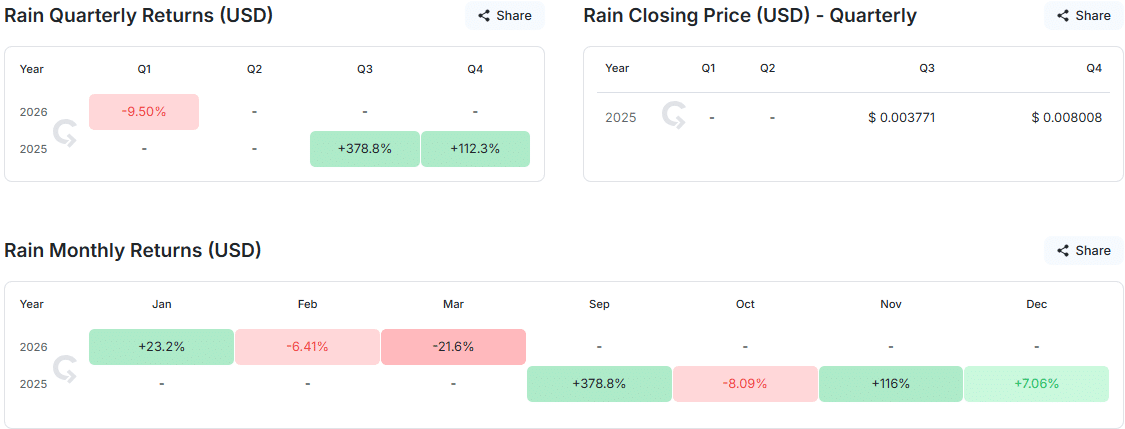
While the overall market fell by around 3%, RAIN fell by double digits. The altcoin fell by 9.5% in Q1 2026, after rising in the third and fourth quarters of 2025.

In Q3, the altcoin rose by more than 378% as Q4 closed 112% higher. For the first quarter of 2026, only January has been bullish, where RAIN recorded 23% in gains, as February and March lost 6.41% and 21.6%, respectively.
Source: CryptoRank

While the altcoin’s price continues to crash, it still commands a significant market cap of around $3.89 billion. Will the market cap continue to fall as sell volume rises to $46 million?

RAIN price loses a KEY support level

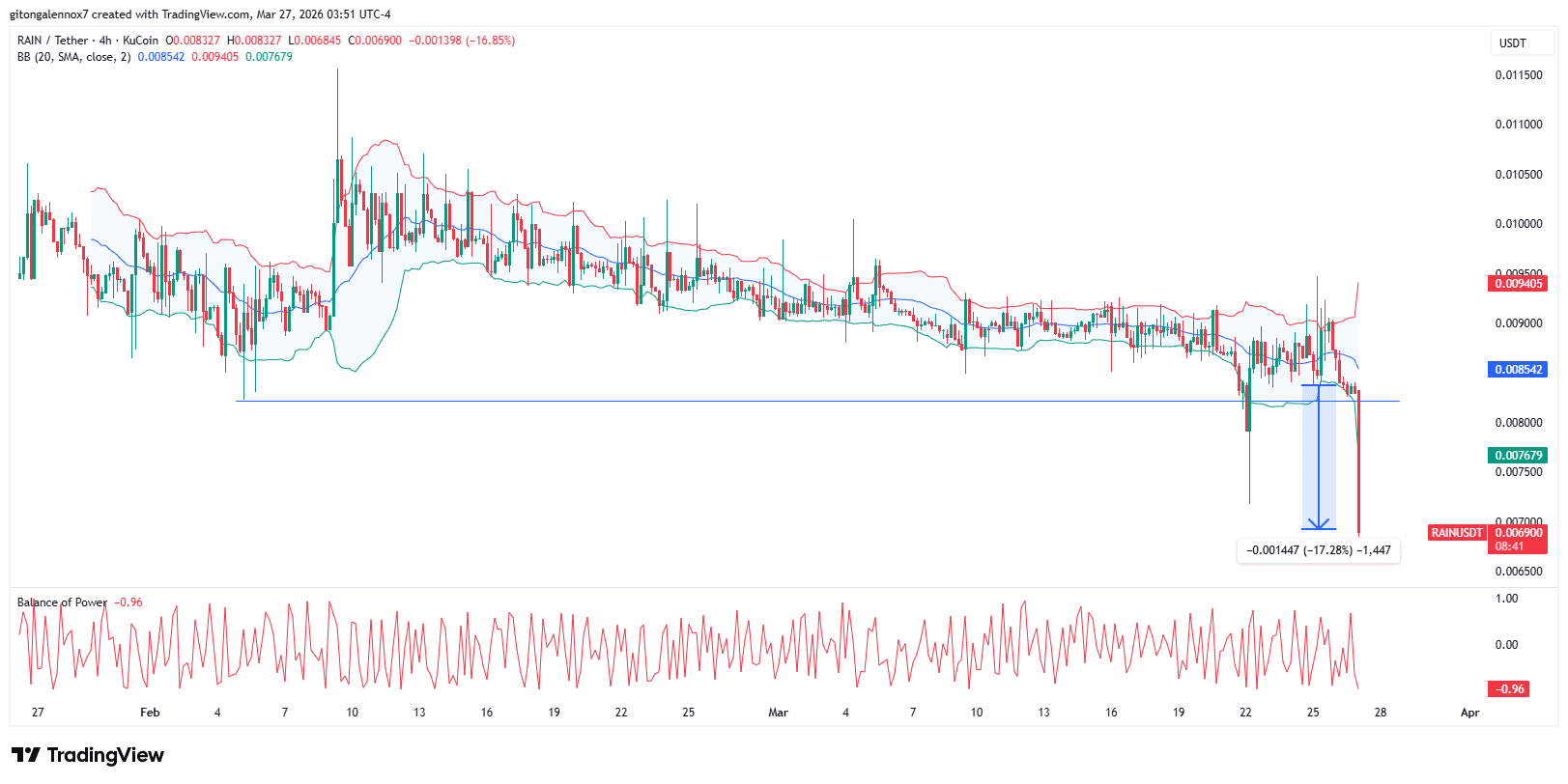
On the charts, the altcoin has been trading inside a consolidation since the beginning of February. The Bollinger Bands (BB) had been tight during this period and expanded upon breakdown below $0.0082.

The Balance of Power indicator was choppy and in the negative territory with a reading of 0.96. This reading was an indication that sellers were the stronger force at the time of writing.

Now, holding below the key support level at $0.0082 while volatility stays high would push the cap toward $3.5 billion.

Conversely, a reclaim of this level alongside the middle band of the BB would invalidate the outlook. Therefore, it would be deemed a fakeout, turning the structure bullish if RAIN breaks above $0.0092.
Source: RAIN/USDT on TradingView

This is because bulls rejected the breakdown, resulting in a strong green candle. However, RAIN had to maintain the rebound momentum to invalidate the structure break.

What accelerated selling pressure?

Meanwhile, it’s worth noting what was behind this sharp drop that was swiftly recovered. For instance, the daily token volume has been rising for the past week, with the high being $28.84 million.

The data showed that the volume came from sellers as the price dropped. For its Total Value Locked (TVL), it remained flat around $4 million since the start of February.
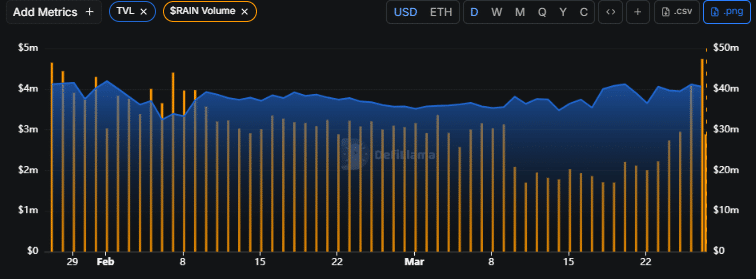
Source: DefiLlama

To be specific, the selling of tokens was driven mainly by the Token Millionaire wallet. As per Nansen AI, more than $10 million in RAIN was offloaded as the portfolio’s valuation dropped from $80 million to $69 million.
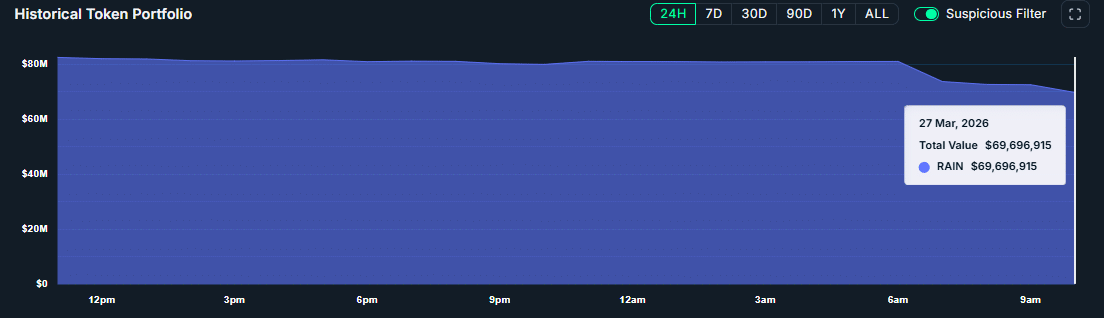
Source: Nansen AI

The volume data showed that the selling pressure came from big holders and retailers. However, institutions like Enlivex were buying, even reporting profits of $1.23 billion following their treasury around the Rain Protocol.


Final Summary

  • RAIN loses 17% of its market cap, but price action recovers swiftly shortly after.
  • The next price move for RAIN depended on its reaction around $0.0082 and $0.0092.

Preguntas relacionadas

QWhat was the percentage decrease in RAIN crypto's value in the past 24 hours as mentioned in the article?

ARain Protocol [RAIN] lost more than 17% in the past 24 hours.

QAccording to the article, what was the key support level that RAIN's price lost on the charts?

AThe key support level that RAIN lost was $0.0082.

QWhat specific event accelerated the selling pressure, causing a sharp drop in RAIN's price?

AThe selling pressure was accelerated by a Token Millionaire wallet offloading more than $10 million worth of RAIN tokens.

QDespite the sell-off, which institution was reported to be buying RAIN and even making a profit?

AInstitutions like Enlivex were buying RAIN and reported profits of $1.23 billion from their treasury involvement with the Rain Protocol.

QWhat are the two critical price levels that will determine RAIN's next price move, as per the article's analysis?

AThe next price move for RAIN depends on its reaction around the $0.0082 and $0.0092 price levels.

Lecturas Relacionadas

Bitcoin Withdrawals Continue: 8 Years of Storage in a Coldcard Cold Wallet Ended in Zero

Coldcard Hardware Wallet Hacked: Losses Mount Due to Vulnerable Seed Generation A critical vulnerability in Coldcard hardware wallets has led to a continued wave of fund thefts. According to Galaxy Research, the total stolen has reached 1,367.05 BTC (approx. $88.6 million) from 4,585 addresses, a significant increase from the initial 594.5 BTC reported on July 30, 2026. Most of the stolen funds remain on the attackers' addresses. The issue is not with the current firmware, which Coinkite has updated, but with seed phrases generated on vulnerable devices between March 2021 and the release of fixed firmware versions. Due to a programmer error, devices switched from using a hardware random number generator to the software-based Yasmarang generator, which was initialized with publicly accessible data like the chip's serial number. This made the seed phrases predictable through offline brute-force attacks, meaning wallets remain at risk until funds are moved to a new wallet generated with the patched firmware. Affected devices include Mk2/Mk3 with firmware 4.0.1–4.1.9 (and up to 5.0.3), Mk4/Mk5 up to version 5.6.0, and Q models up to 1.5.0Q. The only exceptions are seeds created with a high-entropy method like at least 50 independent dice rolls or a strong unique BIP-39 passphrase. All other owners must generate a new seed on the fixed firmware and transfer their assets. A case highlighting the human impact involves a 39-year-old long-term investor who lost 2 BTC (approx. $130,000) in minutes. He had accumulated the Bitcoin over eight years through physical labor, viewing it as a financial lifeline and a retirement plan in a country suffering from hyperinflation. His story underscores that even conservative "buy and hold in cold storage" strategies can be compromised by such underlying technical flaws. From a technical perspective, this incident echoes historical failures where weak random number generators undermined cryptographic security, challenging the assumption that offline storage is automatically foolproof.

cryptonews.ruHace 8 min(s)

Bitcoin Withdrawals Continue: 8 Years of Storage in a Coldcard Cold Wallet Ended in Zero

cryptonews.ruHace 8 min(s)

Trading

Spot
活动图片





