Can $12 Really Turn into 8300 Times? The Demise of a Polymarket Trading Myth

比推Publicado a 2026-01-21Actualizado a 2026-01-21

Resumen

A user known as @ascetic0x on Polymarket claimed to have turned $12 into over $100,000—an 8,300x return—through a series of highly leveraged, all-in bets on Bitcoin price movements. The story went viral, attracting millions of views and widespread admiration. However, the narrative was soon challenged. Twitter user Moses alleged that @ascetic0x operated multiple accounts (Sybil farming), funding each with small amounts. Only the single successful account—which reached around $2,900—was publicized, while many others failed. Moses also accused the user of wash trading to artificially inflate results. In response, @ascetic0x denied the allegations, stating that the claims were false and part of a targeted harassment campaign. He admitted his strategy was extremely high-risk and advised others from copying it. The incident highlights the risks of blindly following influencers in speculative markets and serves as a reminder that extraordinary gains often come with untold or unverified backstories.

Written by: Ma He, Foresight News

Original title: What's It Like to Turn $12 into 8300 Times on Polymarket?


The arena for acquiring wealth through trading is no longer confined to exchanges and DEXs. Imagine opening the Polymarket page, sitting in front of your computer, watching the Bitcoin price chart. On the screen, the Polymarket platform interface flashes with an orange Bitcoin icon. You bet your entire fortune—just $12—wagering that Bitcoin will rise within a certain period. The market odds are highly uncertain, but relying on your analysis of on-chain data, news trends, and candlestick patterns, a few hours later, the market settles, and you win. Your account balance doubles to $24.31. But this is just the beginning. You take a deep breath and go all-in on the next bet. You win again, and the balance becomes $40.35. Just like that, going all-in each time, you accumulate victories like a snowball.
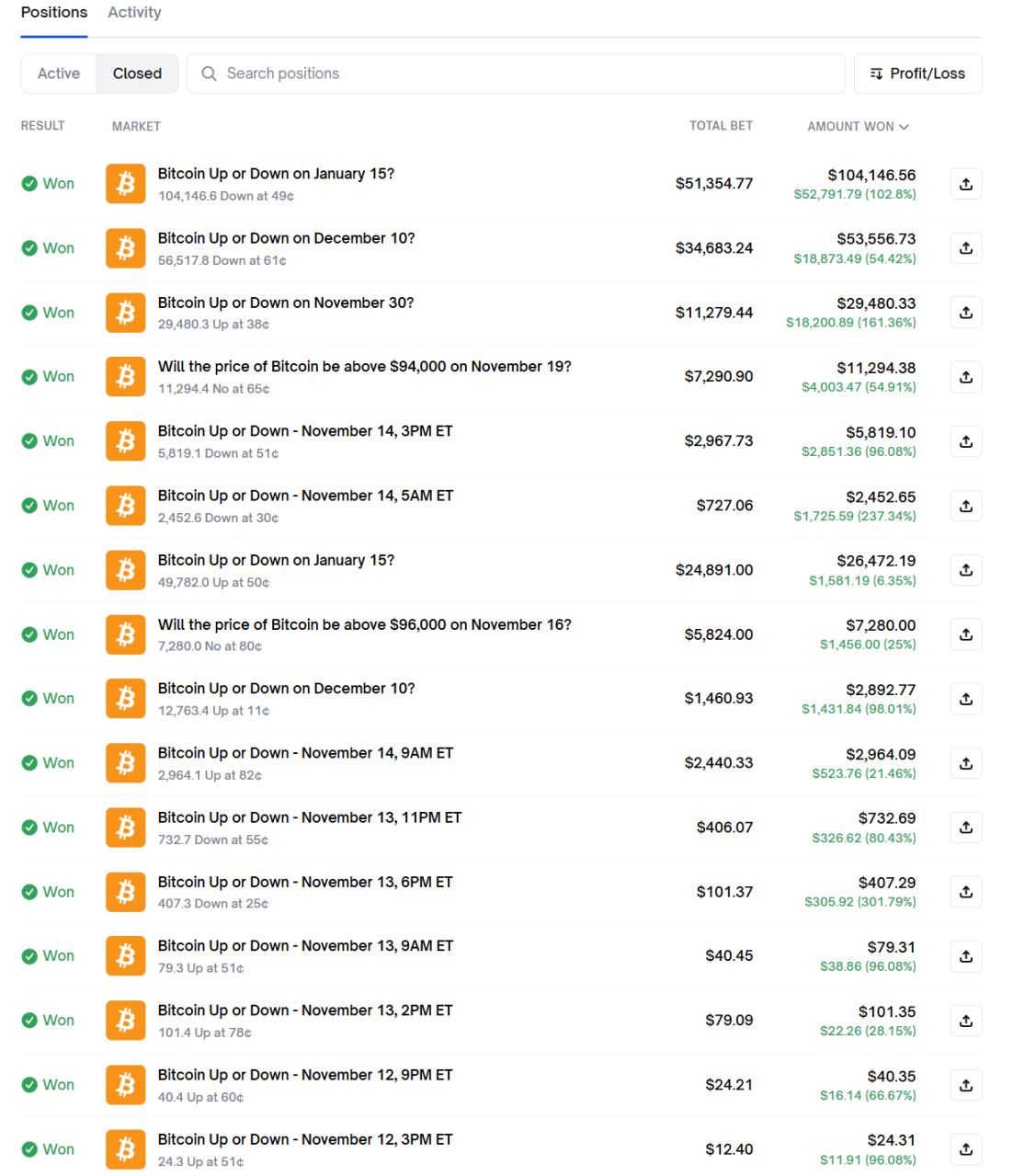
Starting with tens of dollars, then going all-in, winning big again and again, and finally earning over $100,000—this isn't a dream but the masterstroke of the account @ascetic0x.

Ascetic's wealth story quickly went viral, with 4.21 million views, 13,000 likes, and 8,000 bookmarks. In the comments, some exclaimed "legend," while others sighed, "Only Polymarket can let small retail investors turn the tables."

Perhaps, in the heart of every Polymarket player, there has been a dream of making a fortune quickly with a small stake. Ascetic's wealth story was like a shot of adrenaline, giving endless hope to every player hoping to "change their destiny."

But the truth of the story is far from just the surface glamour.

Just one day after his highlight tweet, Twitter user Moses posted to reveal the truth: creating multiple Polymarket accounts and then publicizing the most successful one.
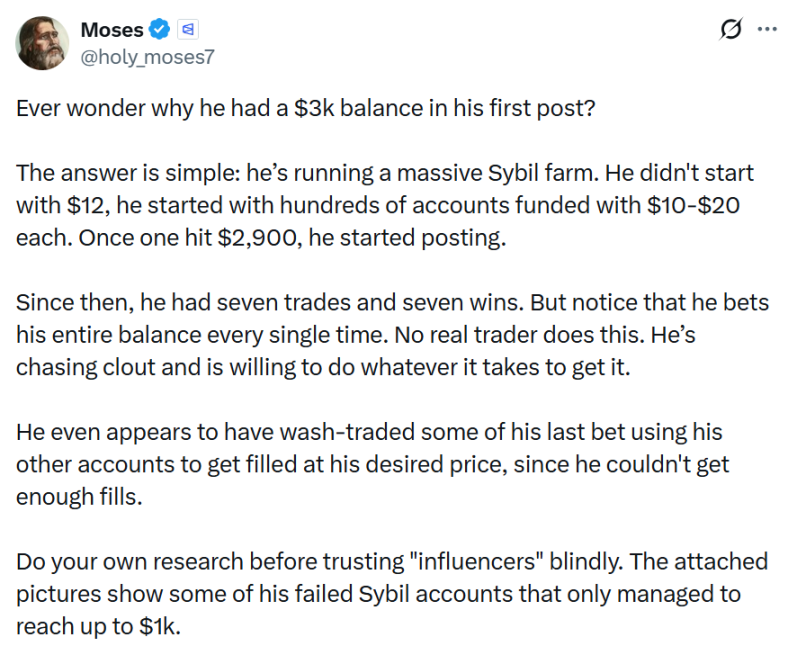
Moses questioned: "Why did his first post already have a $3k balance? The answer is simple: he was operating a large-scale Sybil account. He didn't start with $12; he raised hundreds of accounts simultaneously, each pre-loaded with $10–20. When one account grew to $2,900, he immediately started posting. After that, he made a total of 7 trades, all of which he won. But note: every time, he went all-in with the entire balance. No real trader would play like this.

Moses criticized him for chasing clout and刷存在感 (seeking attention), willing to do anything to become famous. Ascetic even疑似 (suspectedly) used other small accounts to wash trade his last transaction, forcibly taking the order at his desired price because normal orders couldn't get enough volume. Moses advised not to blindly believe these so-called 'influencer big Vs'; do your own homework before deciding what to believe.
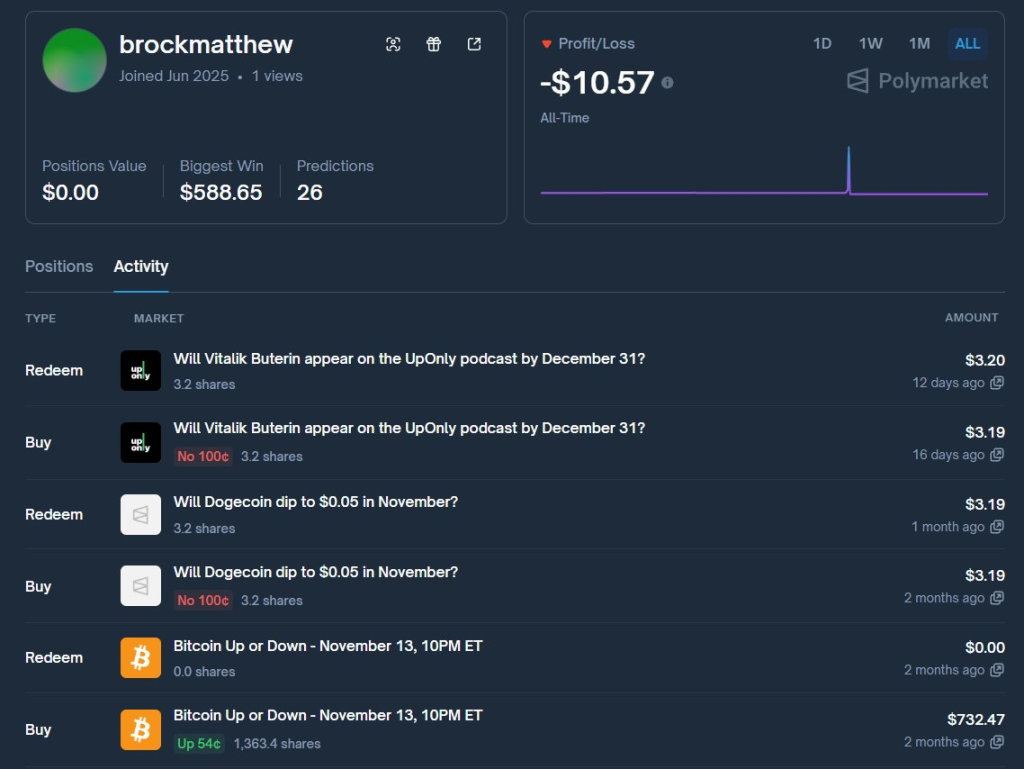
He also posted some of ascetic's failed Sybil small accounts, which at most only reached around $1,000 before collapsing.

These accounts were created 7 months ago, first绑定 (binding) to random markets for 5 months, then simultaneously started going all-in on Bitcoin short-term markets 2 months ago.
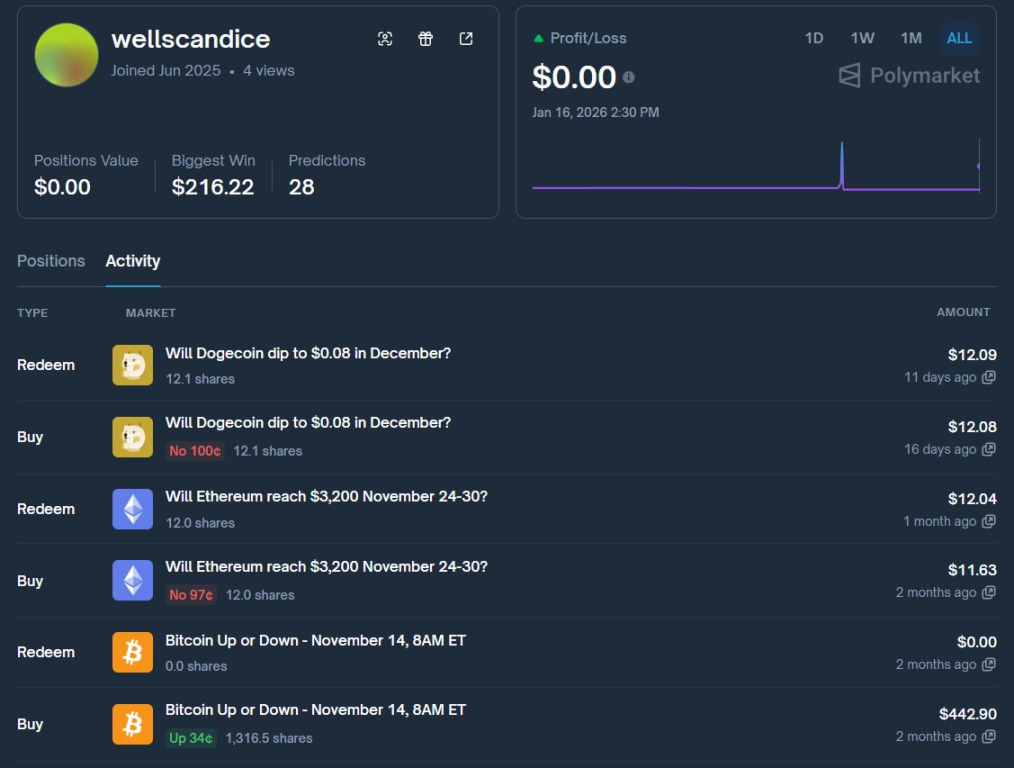
Some accounts quickly lost everything, some reached hundreds or nearly $1k, but only one 'survived' to $2,900 and was made public.
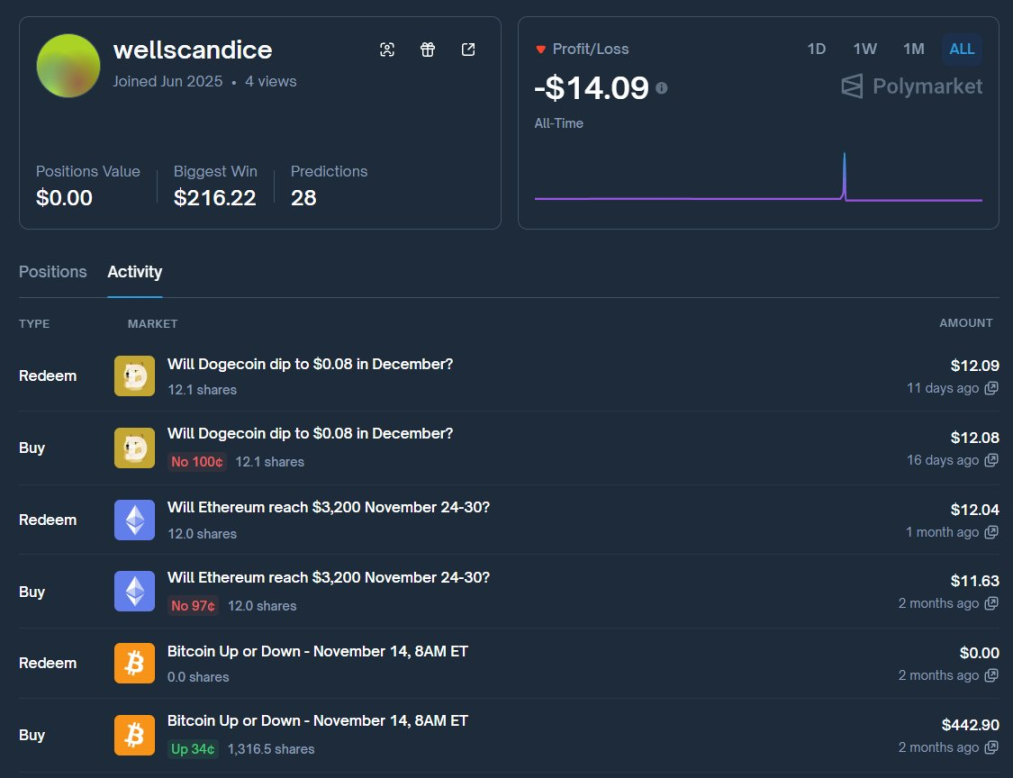
This tactic is very similar to some crypto market analysts who open both long and short positions, trade with multiple accounts, and no matter how the market moves, they can always dig out screenshots of profitable orders, harvesting traffic and attention amidst exclamations of "又麻了" (winning big again).
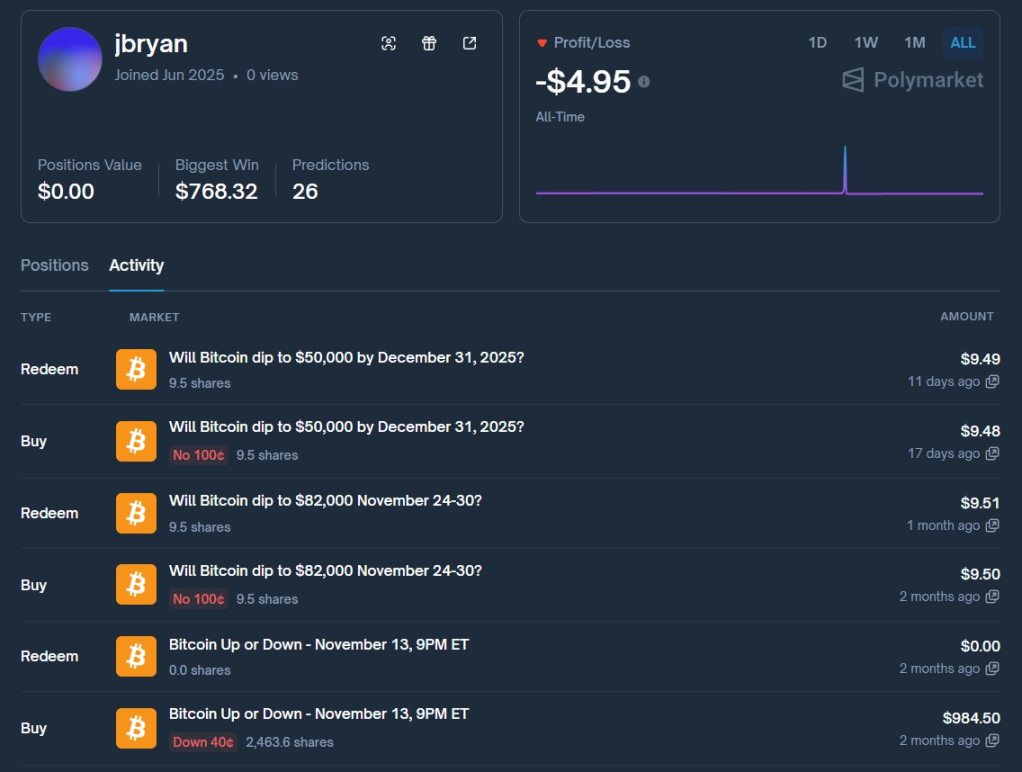
The controversy quickly escalated.

On January 18, facing overwhelming质疑 (skepticism), ascetic tweeted again in response, saying, "In the past 24 hours, I've received more hate and threats than ever before in my life. Some KOLs, to蹭热度 (ride the trend) and刷流量 (boost traffic), deliberately spread false information about me, organizing hate raids under my posts. Some people didn't even bother to check my homepage before喷 (trashing), completely missing that I've been publicly logging my trades on X for the past two months. They accuse me of operating a bunch of small accounts, but they can't produce any accounts or provide any evidence that these accounts ever existed. I have no connection to Sybil farms; this is pure nonsense."

Ascetic also warned users not to copy trades because the strategy is extremely high-risk, and trading like this long-term will almost certainly lead to liquidation. The individual used such an aggressive approach only because they believed they were a good trader, wanting to prove their skills and establish themselves in the Polymarket Trade community.

What is the truth? It might be an unsolvable mystery, but this incident still offers profound lessons for ordinary players.

Don't blindly follow KOLs. Others' success is often hard to replicate, and there are no real big shots in the market acting like Guanyin (the Goddess of Mercy) to make people rich. In the trading market, the wealth you think is within reach is, most of the time, far beyond your grasp.


Twitter:https://twitter.com/BitpushNewsCN

Bitpush TG Discussion Group:https://t.me/BitPushCommunity

Bitpush TG Subscription: https://t.me/bitpush

Original link:https://www.bitpush.news/articles/7604842

Preguntas relacionadas

QWhat was the initial claim made by the Twitter user @ascetic0x regarding their Polymarket trading?

AThe user @ascetic0x claimed to have turned $12 into over $100,000 by making a series of successful all-in bets on Bitcoin price movements on Polymarket, achieving an 8300x return.

QHow did Moses on Twitter challenge @ascetic0x's trading success story?

AMoses alleged that @ascetic0x was operating a large number of Sybil accounts (hundreds of wallets), each funded with $10-20, and only publicized the one account that succeeded, while the vast majority of the accounts failed.

QWhat specific trading behavior did Moses point to as evidence that the story was not genuine?

AMoses pointed out that a real trader would not consistently go all-in on every single bet, as @ascetic0x claimed to have done. He also suggested wash trading, where the user allegedly used other accounts to fill their own orders to create the illusion of success.

QHow did @ascetic0x respond to the accusations made against them?

A@ascetic0x denied the allegations, stating they had no connection to any Sybil farm and that the claims were false information spread by KOLs for clout. They also warned others not to copy their high-risk strategy.

QWhat is the key lesson for ordinary users from this Polymarket event, as suggested by the article?

AThe key lesson is not to blindly follow Key Opinion Leaders (KOLs) or their trading strategies, as their success is often not replicable, and the market does not have 'gurus' who can reliably make others rich.

Lecturas Relacionadas

Annual Salary of Millions Competing for Electricians, Meta Rushes to Open Its Own Technical School

The AI boom is facing an unexpected bottleneck: a severe shortage of skilled construction workers and electricians. As tech giants like Meta, OpenAI, and Alphabet race to build massive data centers—such as OpenAI's $16 billion "Stargate" project—they are hitting a critical labor wall. The U.S. needs an estimated 130,000 more electricians, 240,000 construction workers, and 150,000 supervisors by 2030 for AI infrastructure alone, but tens of thousands of electrician jobs go unfilled each year. While AI companies offer high premiums, with electricians earning up to $280,000 annually, worker scarcity still causes massive losses—delays on a single project can cost $14.2 million per month. The complexity of building AI data centers, which require immense power (equivalent to powering hundreds of thousands of homes), sophisticated electrical systems, and advanced liquid cooling solutions, demands highly skilled technicians who are in short supply. To combat this, companies are investing heavily in training. Meta has committed $115 million to a free training school offering tuition, housing, and stipends, targeting 5,000 new workers. OpenAI is partnering with unions to secure skilled labor. These efforts are paying off, with a significant rise in Gen Z interest in trade schools over college. However, the power demands are staggering. AI data centers are driving a rapid surge in electricity consumption, projected to account for up to 12% of U.S. power use by 2028 and raising costs for consumers. Furthermore, the construction boom is project-based, leading to a potential future glut of trained workers once building peaks, which could depress wages industry-wide. The race for AI supremacy now depends as much on skilled hands as on advanced chips.

marsbitHace 57 min(s)

Annual Salary of Millions Competing for Electricians, Meta Rushes to Open Its Own Technical School

marsbitHace 57 min(s)

OpenAI No Longer Sells Its Most Expensive Model for Profit

OpenAI is shifting its business strategy away from promoting its most expensive, flagship models for every task. Recent price cuts—80% for GPT-5.6 Luna and 20% for Terra—signal a deeper change: the company now actively advises users that many tasks don't require the most powerful model. Instead, OpenAI recommends a tiered approach: use the high-end GPT-5.6 Sol for complex planning and analysis, then delegate execution to cheaper models like Luna. This mirrors moves by Anthropic, which recently launched Claude Opus 5 at half the price of its top model, Fable 5. Both companies are de-emphasizing flagship models as primary revenue drivers, using them instead for brand prestige and technological showcases. The industry is entering a "mass-market" phase, similar to automotive, where high-volume, cost-effective models handle daily operations and drive scale. OpenAI's price reductions are partly enabled by AI models themselves optimizing underlying code and infrastructure, creating a self-reinforcing cycle of efficiency gains and cost reduction. Competition is shifting from "who is smartest" to "who offers the best value." The goal is no longer selling individual models but fostering widespread API adoption and ecosystem lock-in. By making AI calls cheap and ubiquitous, companies like OpenAI aim to become the indispensable, utility-like infrastructure powering automated workflows—the "water and electricity" of software, quietly embedded everywhere.

marsbitHace 57 min(s)

OpenAI No Longer Sells Its Most Expensive Model for Profit

marsbitHace 57 min(s)

Will the Fed Definitely Raise Interest Rates in September? How Will Crypto and U.S. Stocks Withstand the Pressure?

The market's expectation for a September Fed rate hike surged dramatically in early August, jumping from under 50% to over 80% within a week. This shift followed a contentious July FOMC meeting, where a 9-3 vote to hold rates revealed growing dissent from hawkish members advocating for an immediate hike to combat persistent inflation. The primary catalyst for this repricing is rising oil prices, driven by renewed geopolitical tensions around the Strait of Hormuz, which threaten global supply. Energy costs directly influence inflation metrics, making the upcoming July CPI report (due August 12th) a critical data point. If it shows inflation reaccelerating, the probability of a September hike will solidify. For Bitcoin and crypto assets, this is typically bearish news. Bitcoin continues to behave as a high-beta, liquidity-sensitive risk asset. A rate hike raises the opportunity cost of holding non-yielding assets and could drive capital toward money markets, pressuring crypto prices in the short term. However, historical patterns suggest that if a hike is perceived as the end of a tightening cycle rather than the start, any negative price impact may be brief. U.S. stocks, particularly crypto-linked equities like Coinbase and growth-oriented tech stocks, are also vulnerable. Higher rates increase discount rates in valuation models, putting pressure on high-multiple companies. This coincides with a pivotal tech earnings season where investor focus has shifted from massive AI capital expenditure to tangible revenue and cash flow generation. Companies with negative cash flow and weak growth narratives could face heightened volatility if borrowing costs rise in September. In summary, a September Fed hike has evolved into a mainstream market scenario. Key factors to watch are oil prices, the July CPI report, and Fed communications, which will determine the final decision and its impact on volatile crypto and equity markets.

marsbitHace 1 hora(s)

Will the Fed Definitely Raise Interest Rates in September? How Will Crypto and U.S. Stocks Withstand the Pressure?

marsbitHace 1 hora(s)

Trading

Spot
活动图片





