Can $12 Really Turn into 8300 Times? The Demise of a Polymarket Trading Myth

比推Publicado a 2026-01-21Actualizado a 2026-01-21

Resumen

A user known as @ascetic0x on Polymarket claimed to have turned $12 into over $100,000—an 8,300x return—through a series of highly leveraged, all-in bets on Bitcoin price movements. The story went viral, attracting millions of views and widespread admiration. However, the narrative was soon challenged. Twitter user Moses alleged that @ascetic0x operated multiple accounts (Sybil farming), funding each with small amounts. Only the single successful account—which reached around $2,900—was publicized, while many others failed. Moses also accused the user of wash trading to artificially inflate results. In response, @ascetic0x denied the allegations, stating that the claims were false and part of a targeted harassment campaign. He admitted his strategy was extremely high-risk and advised others from copying it. The incident highlights the risks of blindly following influencers in speculative markets and serves as a reminder that extraordinary gains often come with untold or unverified backstories.

Written by: Ma He, Foresight News

Original title: What's It Like to Turn $12 into 8300 Times on Polymarket?


The arena for acquiring wealth through trading is no longer confined to exchanges and DEXs. Imagine opening the Polymarket page, sitting in front of your computer, watching the Bitcoin price chart. On the screen, the Polymarket platform interface flashes with an orange Bitcoin icon. You bet your entire fortune—just $12—wagering that Bitcoin will rise within a certain period. The market odds are highly uncertain, but relying on your analysis of on-chain data, news trends, and candlestick patterns, a few hours later, the market settles, and you win. Your account balance doubles to $24.31. But this is just the beginning. You take a deep breath and go all-in on the next bet. You win again, and the balance becomes $40.35. Just like that, going all-in each time, you accumulate victories like a snowball.
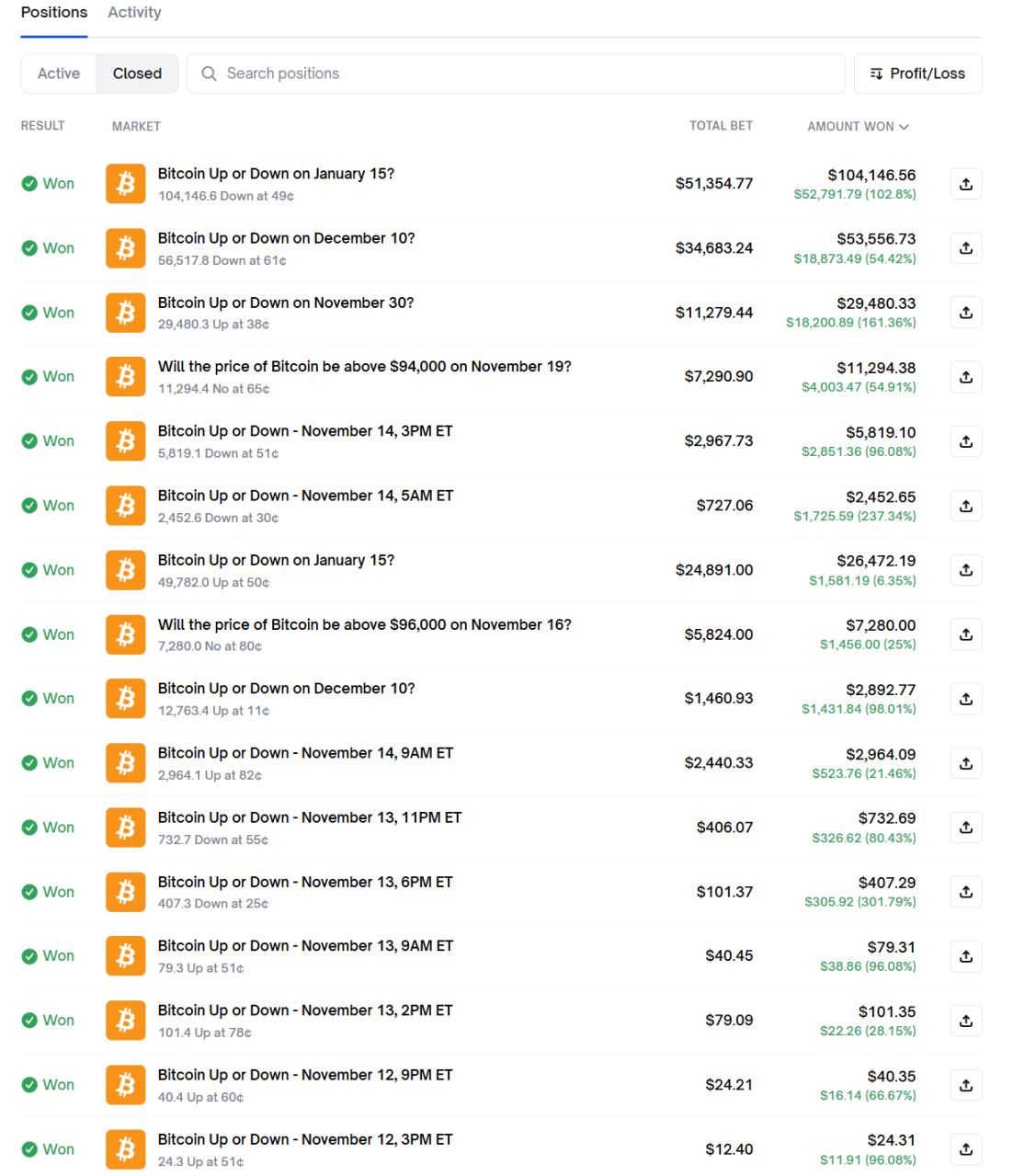
Starting with tens of dollars, then going all-in, winning big again and again, and finally earning over $100,000—this isn't a dream but the masterstroke of the account @ascetic0x.

Ascetic's wealth story quickly went viral, with 4.21 million views, 13,000 likes, and 8,000 bookmarks. In the comments, some exclaimed "legend," while others sighed, "Only Polymarket can let small retail investors turn the tables."

Perhaps, in the heart of every Polymarket player, there has been a dream of making a fortune quickly with a small stake. Ascetic's wealth story was like a shot of adrenaline, giving endless hope to every player hoping to "change their destiny."

But the truth of the story is far from just the surface glamour.

Just one day after his highlight tweet, Twitter user Moses posted to reveal the truth: creating multiple Polymarket accounts and then publicizing the most successful one.
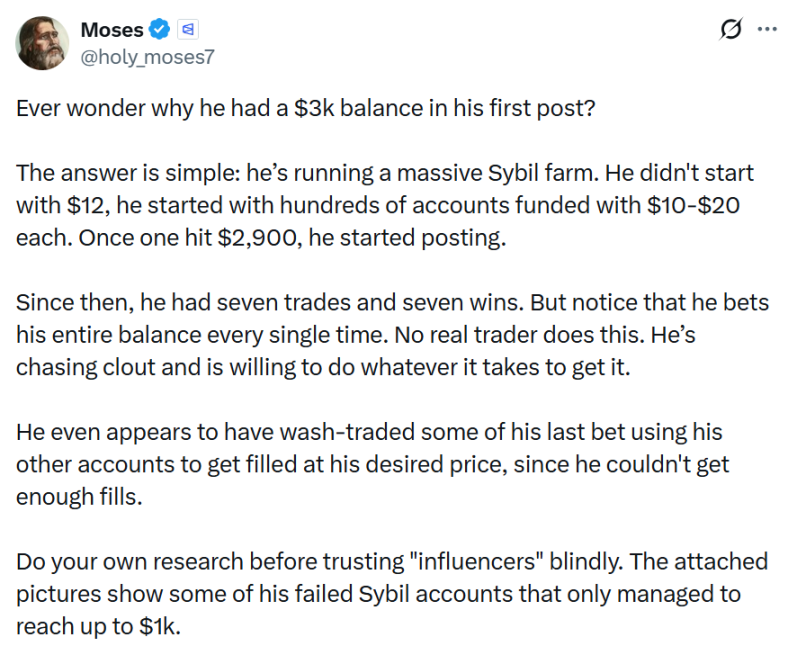
Moses questioned: "Why did his first post already have a $3k balance? The answer is simple: he was operating a large-scale Sybil account. He didn't start with $12; he raised hundreds of accounts simultaneously, each pre-loaded with $10–20. When one account grew to $2,900, he immediately started posting. After that, he made a total of 7 trades, all of which he won. But note: every time, he went all-in with the entire balance. No real trader would play like this.

Moses criticized him for chasing clout and刷存在感 (seeking attention), willing to do anything to become famous. Ascetic even疑似 (suspectedly) used other small accounts to wash trade his last transaction, forcibly taking the order at his desired price because normal orders couldn't get enough volume. Moses advised not to blindly believe these so-called 'influencer big Vs'; do your own homework before deciding what to believe.
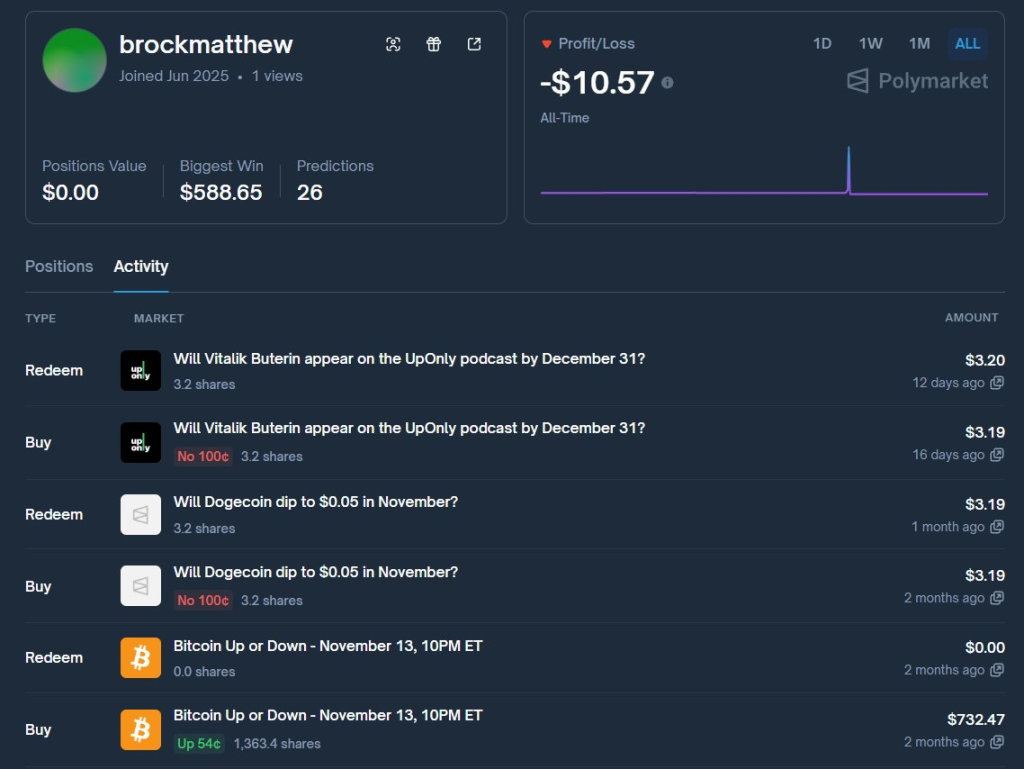
He also posted some of ascetic's failed Sybil small accounts, which at most only reached around $1,000 before collapsing.

These accounts were created 7 months ago, first绑定 (binding) to random markets for 5 months, then simultaneously started going all-in on Bitcoin short-term markets 2 months ago.
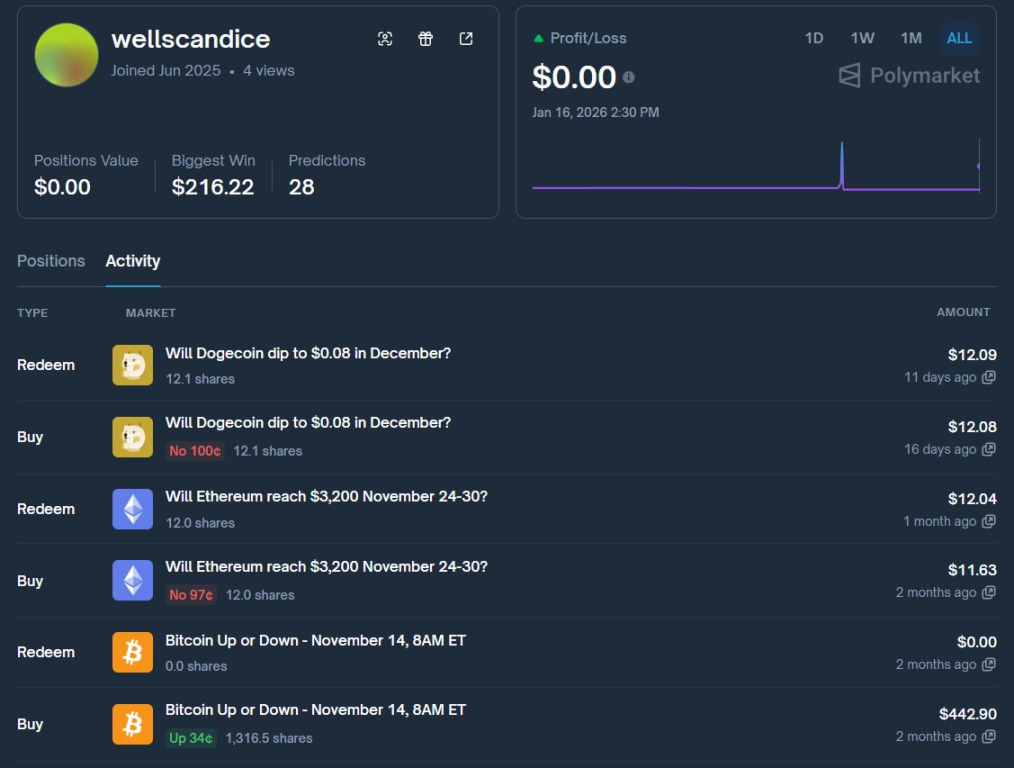
Some accounts quickly lost everything, some reached hundreds or nearly $1k, but only one 'survived' to $2,900 and was made public.
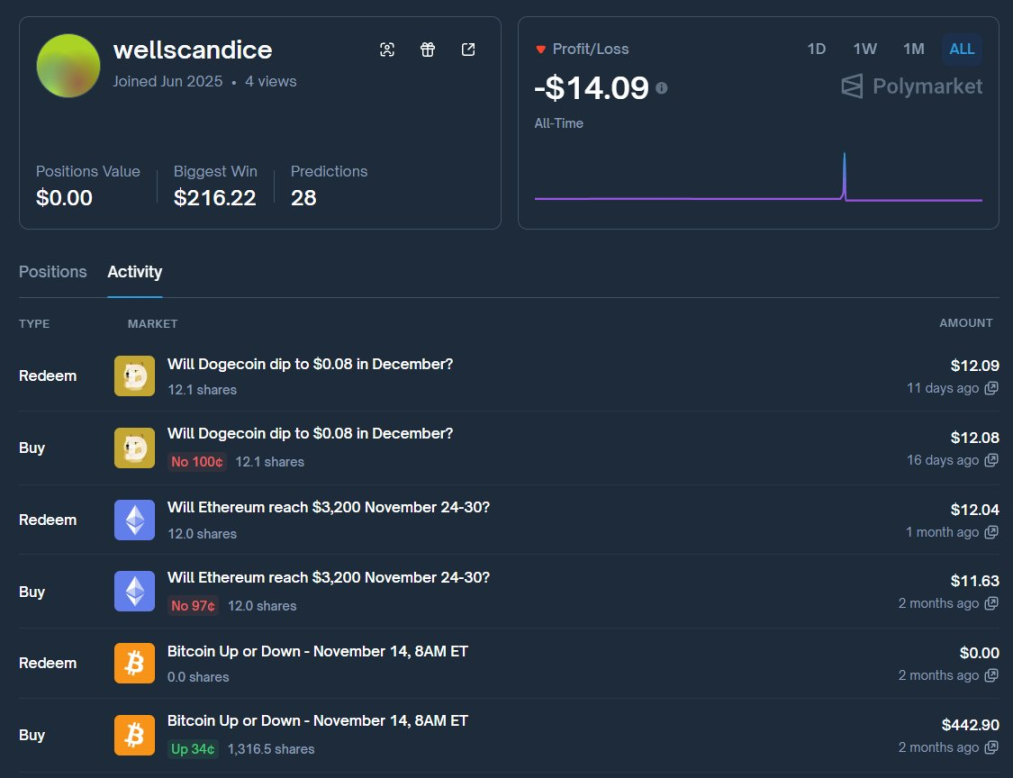
This tactic is very similar to some crypto market analysts who open both long and short positions, trade with multiple accounts, and no matter how the market moves, they can always dig out screenshots of profitable orders, harvesting traffic and attention amidst exclamations of "又麻了" (winning big again).
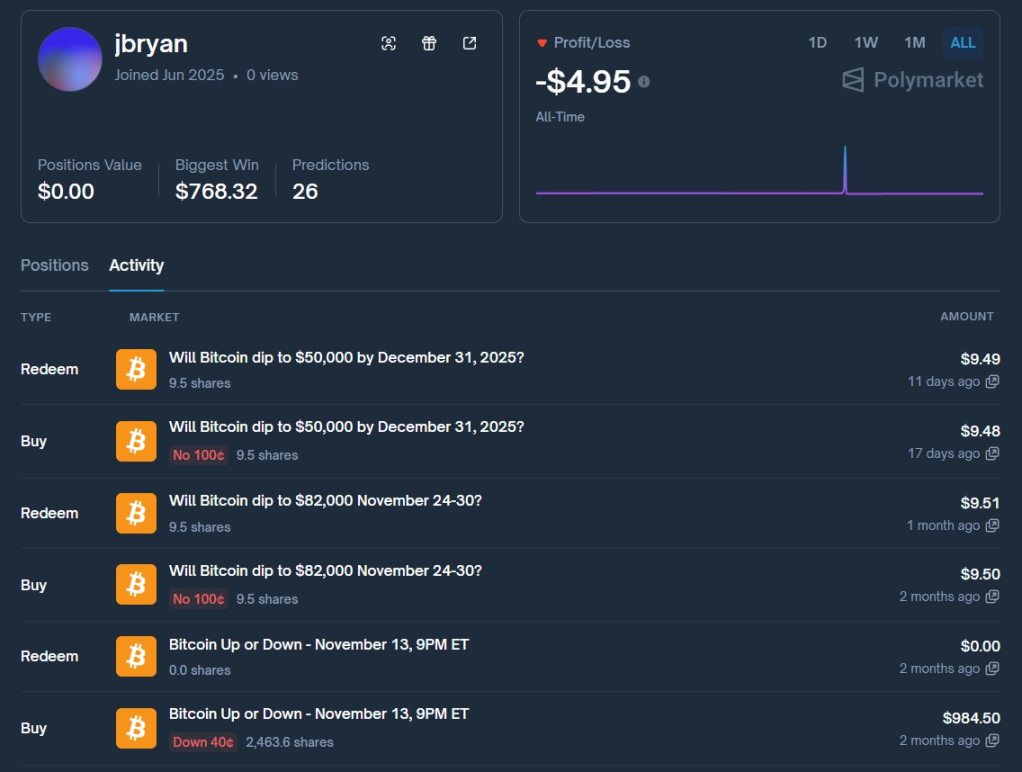
The controversy quickly escalated.

On January 18, facing overwhelming质疑 (skepticism), ascetic tweeted again in response, saying, "In the past 24 hours, I've received more hate and threats than ever before in my life. Some KOLs, to蹭热度 (ride the trend) and刷流量 (boost traffic), deliberately spread false information about me, organizing hate raids under my posts. Some people didn't even bother to check my homepage before喷 (trashing), completely missing that I've been publicly logging my trades on X for the past two months. They accuse me of operating a bunch of small accounts, but they can't produce any accounts or provide any evidence that these accounts ever existed. I have no connection to Sybil farms; this is pure nonsense."

Ascetic also warned users not to copy trades because the strategy is extremely high-risk, and trading like this long-term will almost certainly lead to liquidation. The individual used such an aggressive approach only because they believed they were a good trader, wanting to prove their skills and establish themselves in the Polymarket Trade community.

What is the truth? It might be an unsolvable mystery, but this incident still offers profound lessons for ordinary players.

Don't blindly follow KOLs. Others' success is often hard to replicate, and there are no real big shots in the market acting like Guanyin (the Goddess of Mercy) to make people rich. In the trading market, the wealth you think is within reach is, most of the time, far beyond your grasp.


Twitter:https://twitter.com/BitpushNewsCN

Bitpush TG Discussion Group:https://t.me/BitPushCommunity

Bitpush TG Subscription: https://t.me/bitpush

Original link:https://www.bitpush.news/articles/7604842

Preguntas relacionadas

QWhat was the initial claim made by the Twitter user @ascetic0x regarding their Polymarket trading?

AThe user @ascetic0x claimed to have turned $12 into over $100,000 by making a series of successful all-in bets on Bitcoin price movements on Polymarket, achieving an 8300x return.

QHow did Moses on Twitter challenge @ascetic0x's trading success story?

AMoses alleged that @ascetic0x was operating a large number of Sybil accounts (hundreds of wallets), each funded with $10-20, and only publicized the one account that succeeded, while the vast majority of the accounts failed.

QWhat specific trading behavior did Moses point to as evidence that the story was not genuine?

AMoses pointed out that a real trader would not consistently go all-in on every single bet, as @ascetic0x claimed to have done. He also suggested wash trading, where the user allegedly used other accounts to fill their own orders to create the illusion of success.

QHow did @ascetic0x respond to the accusations made against them?

A@ascetic0x denied the allegations, stating they had no connection to any Sybil farm and that the claims were false information spread by KOLs for clout. They also warned others not to copy their high-risk strategy.

QWhat is the key lesson for ordinary users from this Polymarket event, as suggested by the article?

AThe key lesson is not to blindly follow Key Opinion Leaders (KOLs) or their trading strategies, as their success is often not replicable, and the market does not have 'gurus' who can reliably make others rich.

Lecturas Relacionadas

The Essence of AI Layoffs: Why More AI Adoption Leads to More Corporate Anxiety?

The author, awaiting potential inclusion on an 8000-person layoff list, analyzes the true nature of recent "AI-driven" layoffs. They argue that while AI use, particularly tools like Claude for code generation, has skyrocketed and boosted developer output (e.g., 2-5x more code commits), this has not translated into proportional business growth or revenue. The core issue is a misalignment between increased "Input" (code) and tangible "Outcomes" (user value, revenue). AI acts as a costly B2B SaaS, inflating operational expenses without guaranteed returns. Two key problems emerge: 1) The friction that once filtered out bad ideas is gone, as AI allows cheap pursuit of even weak concepts. 2) Organizational "alignment tax"—the difficulty of coordinating across teams—becomes crippling when development velocity outpaces consensus-building. Thus, layoffs serve two immediate purposes: 1) To offset ballooning AI costs (Token consumption) and maintain cash flow, as rising input costs without outcome growth destroys unit economics. 2) To reduce organizational bloat and alignment friction by simply removing teams, thereby speeding up execution in the short term. Therefore, these layoffs are fundamentally caused by AI, even if AI doesn't directly replace roles. They represent a painful correction until companies learn to convert AI-driven productivity into real business outcomes and streamline organizational coordination to match the new pace of work. The cycle will continue until this learning curve is mastered.

marsbitHace 31 min(s)

The Essence of AI Layoffs: Why More AI Adoption Leads to More Corporate Anxiety?

marsbitHace 31 min(s)

Can the Solana Foundation and Google's Collaboration on Pay.sh Bridge the Payment Link Between Web2 and Web3 in the Agent Economy?

Solana Foundation, in collaboration with Google Cloud, has launched Pay.sh, a payment gateway designed to bridge the gap between AI agents and enterprise-grade service infrastructure. The initiative aims to solve a key bottleneck in the "agent economy": existing payment systems are ill-suited for autonomous AI agents. Traditional methods like credit cards require human verification, while newer on-chain protocols like x402 and MPP create a separate, Web3-native system that raises barriers for service providers. Pay.sh functions as a universal payment layer. It allows users to fund a Solana wallet via credit card or stablecoin, which then acts as an identity and payment proxy for AI agents. When an agent needs to access a paid API service (e.g., Google Cloud, Alibaba Cloud), Pay.sh handles the transaction seamlessly. It leverages the HTTP 402 status code ("Payment Required") to initiate payments, intelligently choosing between one-time transfers (x402-style) or session-based authorizations (MPC-style) based on the service's billing model. This spares agents from manual account registration and API key management. A key feature for service providers is low integration effort. They can adopt Pay.sh by providing a declarative configuration file, enabling features like tiered pricing, free tiers, and automatic revenue splitting to multiple addresses (e.g., for royalties, cloud costs). Providers can also list their APIs in a central Pay Skill Registry for agent discovery. The collaboration with Google Cloud provides crucial infrastructure for API proxying, traffic routing, and compliance logging, aiming to keep agent activities within regulated boundaries. By connecting Web2 services with Web3 payment rails, Pay.sh positions the Solana wallet as a foundational identity and payment tool for AI agents, potentially driving more transaction volume to the Solana ecosystem. However, the report notes challenges. The service registry currently lacks robust vetting, risking exposure to unauthorized or malicious third-party APIs. Pay.sh also inherits security and compatibility risks from its underlying payment protocols (x402, MPC). Furthermore, adoption may be hindered by varying regional data privacy and payment compliance regulations among API providers. Despite these hurdles, Pay.sh represents a significant step towards integrating Web2 and Web3 for autonomous agent commerce.

marsbitHace 38 min(s)

Can the Solana Foundation and Google's Collaboration on Pay.sh Bridge the Payment Link Between Web2 and Web3 in the Agent Economy?

marsbitHace 38 min(s)

Bitcoin's Bull-Bear Cycle Indicator Turns Positive for the First Time in 7 Months: End of Bear Market or False Breakout?

Bitcoin's "Bull-Bear Market Cycle Indicator" from CryptoQuant has turned positive for the first time since October 2025. This gauge, based on the P&L Index relative to its 365-day moving average, suggests a potential shift from a bear market phase. Concurrently, the Bull Score Index rose to a neutral reading of 50 in late April. The indicator's move into positive territory follows a roughly 35% price rebound from a low near $60,000 in February to above $81,000. The recovery over approximately three months was faster than the 12-month period observed during the 2022 bear market. However, analysts caution against premature optimism, citing a historical precedent from March 2022. Back then, the Bull Score Index briefly hit 50, but it proved to be a false signal as Bitcoin's price subsequently plunged further. Structural differences exist in the current cycle, including consistent inflows into spot Bitcoin ETFs and an increase in large holder addresses. Yet, some models, referencing the four-year halving cycle, suggest a potential deeper bottom near $50,000 might still be possible around late 2026. In summary, while on-chain data shows marked improvement and the worst panic may be over, market participants remain cautious. A convincing trend reversal confirmation likely requires Bitcoin to sustainably break above key resistance, such as the 200-day moving average near $82,000.

marsbitHace 45 min(s)

Bitcoin's Bull-Bear Cycle Indicator Turns Positive for the First Time in 7 Months: End of Bear Market or False Breakout?

marsbitHace 45 min(s)

How to Automate Any Workflow with Claude Skills (Complete Tutorial)

This is a comprehensive guide to mastering Claude Skills, a feature for creating permanent, reusable instruction sets that automate specific workflows. Unlike simple saved prompts, Skills function like trained employees, delivering consistent, high-quality outputs by defining the entire task process, standards, error handling, and output format. The guide is structured in four phases: **Phase 1: Installation (5 minutes).** Skills are folders containing a `SKILL.md` file. The user is instructed to find a relevant Skill online, install it, test it on a real task, and compare its performance to one-off prompts. **Phase 2: Building Your First Custom Skill.** Start by rigorously defining the Skill's purpose, trigger phrases, and providing a concrete example of perfect output. The `SKILL.md` file has two parts: a YAML frontmatter with a specific name/description/triggers, and a detailed, step-by-step workflow written in natural language with examples and quality standards. **Phase 3: Testing & Optimization for Production.** Test the Skill in three scenarios: 1) a standard, common task; 2) edge cases with missing or conflicting data; and 3) a pressure test with maximum complexity. Any failure indicates a needed instruction. Implement a weekly optimization cycle to continuously refine the Skill based on real usage. **Phase 4: Building a Complete Skill Library.** The goal is to create a team of Skills for all repetitive tasks. Examples are given for industries like real estate, marketing, finance, consulting, and e-commerce. The user should list their tasks, prioritize them, and build one new Skill per week, maintaining a master document to track their library. The conclusion emphasizes the compounding time savings: ten Skills saving 30 minutes each per week reclaims over 260 hours (6.5 work weeks) per year, fundamentally transforming one's work system.

marsbitHace 1 hora(s)

How to Automate Any Workflow with Claude Skills (Complete Tutorial)

marsbitHace 1 hora(s)

Trading

Spot
Futuros
活动图片