Can $12 Really Turn into 8300 Times? The Demise of a Polymarket Trading Myth

比推Publicado a 2026-01-21Actualizado a 2026-01-21

Resumen

A user known as @ascetic0x on Polymarket claimed to have turned $12 into over $100,000—an 8,300x return—through a series of highly leveraged, all-in bets on Bitcoin price movements. The story went viral, attracting millions of views and widespread admiration. However, the narrative was soon challenged. Twitter user Moses alleged that @ascetic0x operated multiple accounts (Sybil farming), funding each with small amounts. Only the single successful account—which reached around $2,900—was publicized, while many others failed. Moses also accused the user of wash trading to artificially inflate results. In response, @ascetic0x denied the allegations, stating that the claims were false and part of a targeted harassment campaign. He admitted his strategy was extremely high-risk and advised others from copying it. The incident highlights the risks of blindly following influencers in speculative markets and serves as a reminder that extraordinary gains often come with untold or unverified backstories.

Written by: Ma He, Foresight News

Original title: What's It Like to Turn $12 into 8300 Times on Polymarket?


The arena for acquiring wealth through trading is no longer confined to exchanges and DEXs. Imagine opening the Polymarket page, sitting in front of your computer, watching the Bitcoin price chart. On the screen, the Polymarket platform interface flashes with an orange Bitcoin icon. You bet your entire fortune—just $12—wagering that Bitcoin will rise within a certain period. The market odds are highly uncertain, but relying on your analysis of on-chain data, news trends, and candlestick patterns, a few hours later, the market settles, and you win. Your account balance doubles to $24.31. But this is just the beginning. You take a deep breath and go all-in on the next bet. You win again, and the balance becomes $40.35. Just like that, going all-in each time, you accumulate victories like a snowball.
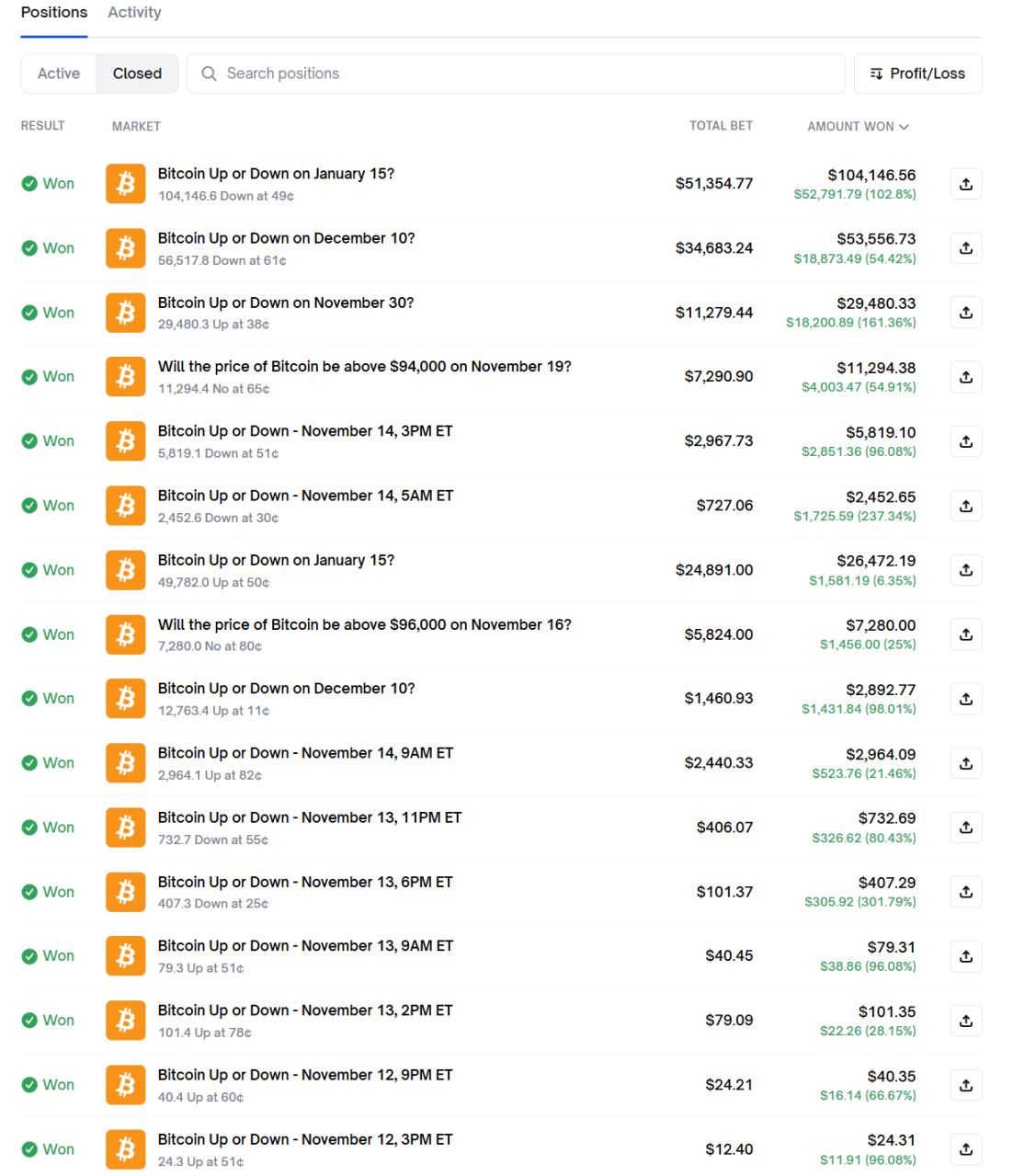
Starting with tens of dollars, then going all-in, winning big again and again, and finally earning over $100,000—this isn't a dream but the masterstroke of the account @ascetic0x.

Ascetic's wealth story quickly went viral, with 4.21 million views, 13,000 likes, and 8,000 bookmarks. In the comments, some exclaimed "legend," while others sighed, "Only Polymarket can let small retail investors turn the tables."

Perhaps, in the heart of every Polymarket player, there has been a dream of making a fortune quickly with a small stake. Ascetic's wealth story was like a shot of adrenaline, giving endless hope to every player hoping to "change their destiny."

But the truth of the story is far from just the surface glamour.

Just one day after his highlight tweet, Twitter user Moses posted to reveal the truth: creating multiple Polymarket accounts and then publicizing the most successful one.
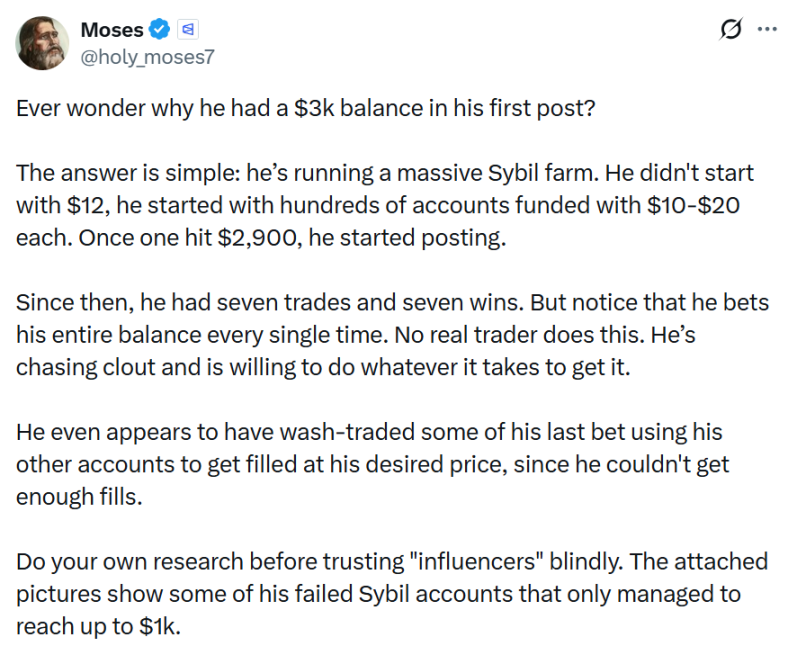
Moses questioned: "Why did his first post already have a $3k balance? The answer is simple: he was operating a large-scale Sybil account. He didn't start with $12; he raised hundreds of accounts simultaneously, each pre-loaded with $10–20. When one account grew to $2,900, he immediately started posting. After that, he made a total of 7 trades, all of which he won. But note: every time, he went all-in with the entire balance. No real trader would play like this.

Moses criticized him for chasing clout and刷存在感 (seeking attention), willing to do anything to become famous. Ascetic even疑似 (suspectedly) used other small accounts to wash trade his last transaction, forcibly taking the order at his desired price because normal orders couldn't get enough volume. Moses advised not to blindly believe these so-called 'influencer big Vs'; do your own homework before deciding what to believe.
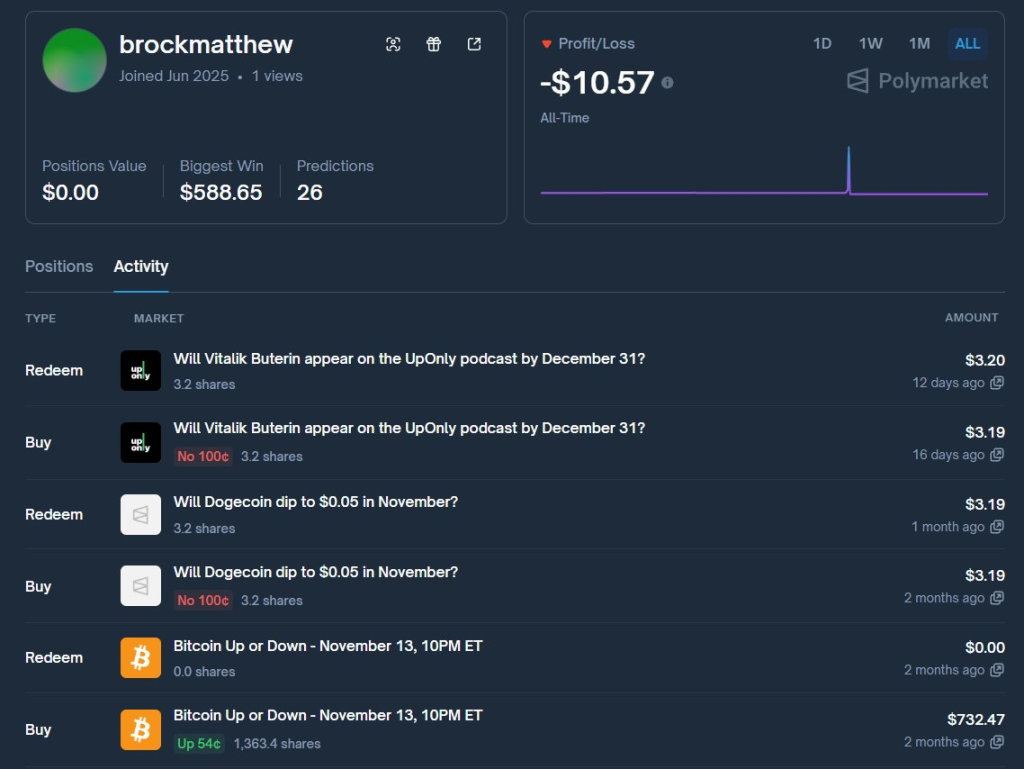
He also posted some of ascetic's failed Sybil small accounts, which at most only reached around $1,000 before collapsing.

These accounts were created 7 months ago, first绑定 (binding) to random markets for 5 months, then simultaneously started going all-in on Bitcoin short-term markets 2 months ago.
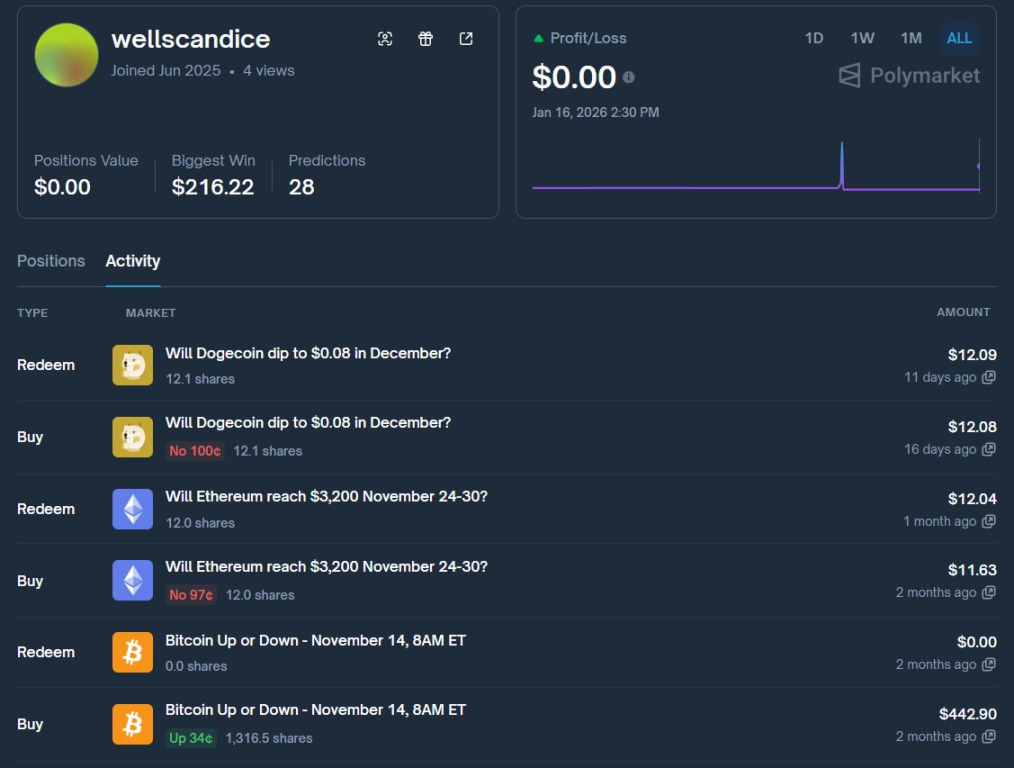
Some accounts quickly lost everything, some reached hundreds or nearly $1k, but only one 'survived' to $2,900 and was made public.
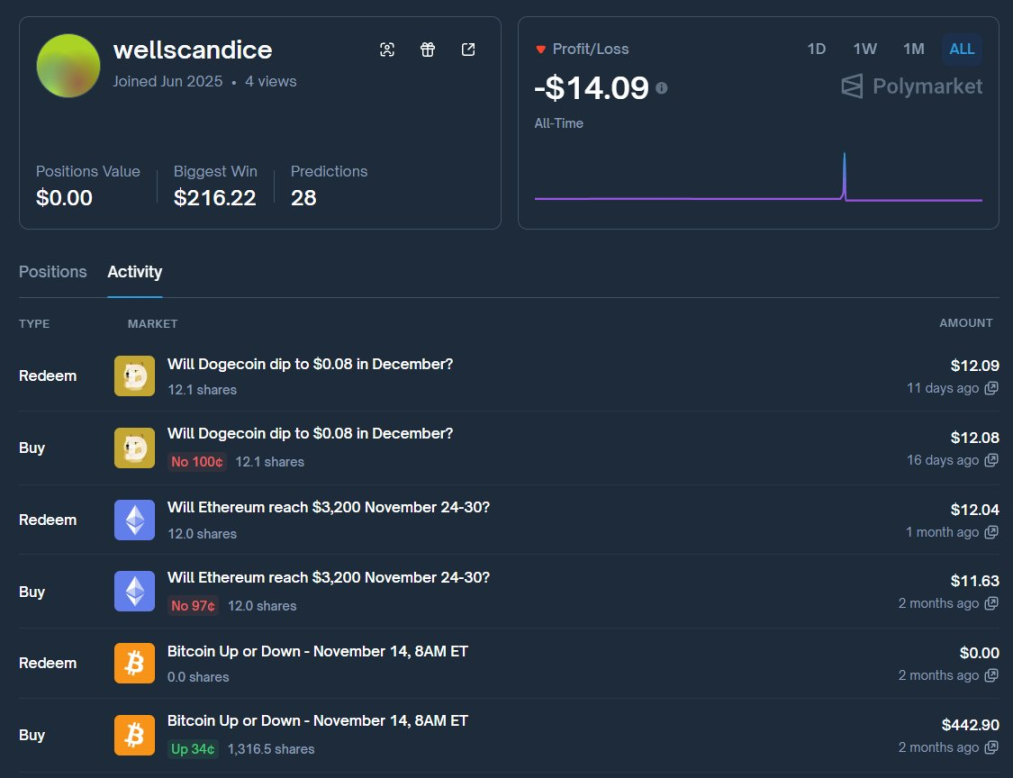
This tactic is very similar to some crypto market analysts who open both long and short positions, trade with multiple accounts, and no matter how the market moves, they can always dig out screenshots of profitable orders, harvesting traffic and attention amidst exclamations of "又麻了" (winning big again).
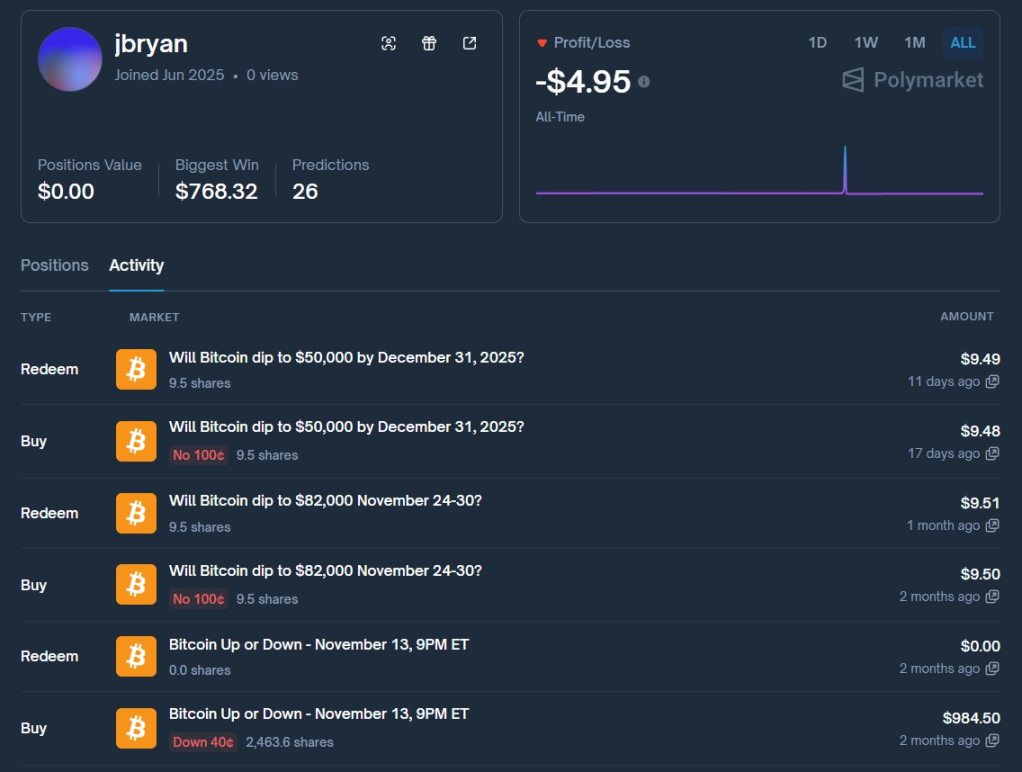
The controversy quickly escalated.

On January 18, facing overwhelming质疑 (skepticism), ascetic tweeted again in response, saying, "In the past 24 hours, I've received more hate and threats than ever before in my life. Some KOLs, to蹭热度 (ride the trend) and刷流量 (boost traffic), deliberately spread false information about me, organizing hate raids under my posts. Some people didn't even bother to check my homepage before喷 (trashing), completely missing that I've been publicly logging my trades on X for the past two months. They accuse me of operating a bunch of small accounts, but they can't produce any accounts or provide any evidence that these accounts ever existed. I have no connection to Sybil farms; this is pure nonsense."

Ascetic also warned users not to copy trades because the strategy is extremely high-risk, and trading like this long-term will almost certainly lead to liquidation. The individual used such an aggressive approach only because they believed they were a good trader, wanting to prove their skills and establish themselves in the Polymarket Trade community.

What is the truth? It might be an unsolvable mystery, but this incident still offers profound lessons for ordinary players.

Don't blindly follow KOLs. Others' success is often hard to replicate, and there are no real big shots in the market acting like Guanyin (the Goddess of Mercy) to make people rich. In the trading market, the wealth you think is within reach is, most of the time, far beyond your grasp.


Twitter:https://twitter.com/BitpushNewsCN

Bitpush TG Discussion Group:https://t.me/BitPushCommunity

Bitpush TG Subscription: https://t.me/bitpush

Original link:https://www.bitpush.news/articles/7604842

Preguntas relacionadas

QWhat was the initial claim made by the Twitter user @ascetic0x regarding their Polymarket trading?

AThe user @ascetic0x claimed to have turned $12 into over $100,000 by making a series of successful all-in bets on Bitcoin price movements on Polymarket, achieving an 8300x return.

QHow did Moses on Twitter challenge @ascetic0x's trading success story?

AMoses alleged that @ascetic0x was operating a large number of Sybil accounts (hundreds of wallets), each funded with $10-20, and only publicized the one account that succeeded, while the vast majority of the accounts failed.

QWhat specific trading behavior did Moses point to as evidence that the story was not genuine?

AMoses pointed out that a real trader would not consistently go all-in on every single bet, as @ascetic0x claimed to have done. He also suggested wash trading, where the user allegedly used other accounts to fill their own orders to create the illusion of success.

QHow did @ascetic0x respond to the accusations made against them?

A@ascetic0x denied the allegations, stating they had no connection to any Sybil farm and that the claims were false information spread by KOLs for clout. They also warned others not to copy their high-risk strategy.

QWhat is the key lesson for ordinary users from this Polymarket event, as suggested by the article?

AThe key lesson is not to blindly follow Key Opinion Leaders (KOLs) or their trading strategies, as their success is often not replicable, and the market does not have 'gurus' who can reliably make others rich.

Lecturas Relacionadas

Within Strategy's Framework, STRC's Dividend Yield Remains at 12% as Share Price Stays Below Par Value

Michael Saylor, Executive Chairman of Strategy (MSTR), confirmed that the dividend rate for its STRC perpetual preferred shares will remain at 12.00% through August 2026. The rate has increased from 9% at its July 2025 launch to the current high via a "ratchet" mechanism, which permanently raises the rate by 0.5% whenever the share price falls below $95. This mechanism is intended to push the price back toward its $100 par value and support Strategy's "at-the-market" (ATM) program for issuing new shares to fund Bitcoin purchases. However, the mechanism has not worked as intended. STRC shares closed at $89.46 on July 31, remaining about 10-11% below par value despite the record-high dividend. Competition from rival Strive's higher-yielding SATA securities has pressured demand. The persistent discount has forced Strategy to suspend new STRC issuances via its ATM program, limiting this funding channel for Bitcoin acquisitions. STRC's struggles reflect Bitcoin's own volatility, as the preferred shares historically move in tandem. Analysts have warned the ratchet structure carries long-term, one-way risk. A law firm is investigating Strategy's ability to maintain dividend payments if Bitcoin's price stays low. Retail investors own roughly 83% of outstanding STRC shares, a group seen as prone to panic selling during downturns. In response, Strategy has established financial reserves, including a liquidity cushion covering about 26 months of dividend/interest obligations, and a $2 billion share buyback program alongside a Bitcoin monetization framework, though the company emphasized it is not obligated to sell any Bitcoin.

cryptonews.ruHace 3 min(s)

Within Strategy's Framework, STRC's Dividend Yield Remains at 12% as Share Price Stays Below Par Value

cryptonews.ruHace 3 min(s)

Analyst: Bitcoin's Price Will Drop to $60k in August, Then Rebound to $70k

Financial analyst Andrey Poroshin has provided a new forecast for Bitcoin's price dynamics in August. Poroshin, an analyst at the Bitbanker exchange, expects the cryptocurrency market to experience a downturn this month, with prices retesting the $60,000 level due to a lack of supportive macroeconomic catalysts. He noted that the recent US Federal Reserve decision to hold interest rates did not significantly impact the market, while inflation remains above the 2% target. Poroshin stated that Bitcoin is ending July under pressure from moderate volatility and a lack of new macroeconomic stimuli, leading to continued market caution. According to his base scenario, Bitcoin will drop to a range of $60,000 to $62,000 before recovering to $70,000. He pointed out that even $70,000 remains below the cost of mining in the US, which has prompted some miners to shift towards AI data center operations. Poroshin cited the winding down of BitMEX's operations as a potential catalyst for a price rebound, suggesting the exit of weaker players often coincides with market reversals and reduced short-term selling pressure. He believes Bitcoin is currently less susceptible to geopolitical shocks, such as the Iran-US conflict, and does not expect significant market changes in August related to the pending CLARITY Act. Looking ahead, Poroshin forecasts that September will bring more active price fluctuations driven by potential Fed rate decisions and possible discussions or approval of the CLARITY Act.

cryptonews.ruHace 3 min(s)

Analyst: Bitcoin's Price Will Drop to $60k in August, Then Rebound to $70k

cryptonews.ruHace 3 min(s)

In Jinjiang, Fujian, a Storage Super Unicorn Lies Quiet

In Fujian's Jinjiang, a city known for sportswear, lies a quiet semiconductor giant: Fujian Jinhua Integrated Circuit Co. (JHICC). Once a promising domestic DRAM manufacturer alongside Yangtze Memory and ChangXin Memory Technologies (CXMT), its journey was derailed in 2018 when the U.S. placed it on an Entity List and filed criminal charges for alleged trade secret theft. This halted production for years. A turning point came in February 2024 when a U.S. federal court found JHICC not guilty. However, it had lost crucial time. While CXMT soared to become a top-valued A-share company in 2024, JHICC, with an estimated valuation of 80 billion RMB, was just restarting. Its current output is primarily customized DDR4 chips, not the advanced DDR5/HBM demanded for AI, but it still benefits from the broader memory chip upcycle. JHICC's story is tied to Chen Zhengkun, a veteran engineer who left Micron to lead the venture. Founded in 2016 with state-backed funding, JHICC partnered with Taiwan's UMC to develop DRAM technology. Rapid progress was cut short by the U.S. actions, which Micron initiated, partly due to its heavy reliance on the Chinese market. Post-sanctions, Chen's team worked to rebuild the production line with reduced reliance on U.S. technology. According to its records, JHICC achieved small-scale production and revenue growth under immense pressure. It now focuses on the stable "niche" DRAM market (e.g., TVs, routers) with a monthly capacity of ~40,000 wafers, aiming for 60,000 by 2026. It holds over 1,000 patents but remains on the Entity List. For Jinjiang, investing in JHICC was a bold industrial leap. The local government provided unwavering financial and logistical support during the crisis, helping the company survive. JHICC has become the anchor for a growing local semiconductor cluster. Though its scale lags behind domestic peers, JHICC's persistence symbolizes a hard-won foothold in a global market long dominated by Samsung, SK Hynix, and Micron. Having missed one boom, it seeks a place in the new AI-driven memory supercycle.

marsbitHace 2 hora(s)

In Jinjiang, Fujian, a Storage Super Unicorn Lies Quiet

marsbitHace 2 hora(s)

Trading

Spot
活动图片





