Buying BTC is Not as Good as Buying Nasdaq, and This Statement Has an Expiration Date

marsbitPublicado a 2026-05-14Actualizado a 2026-05-14

Resumen

The article, titled "Investing in Bitcoin Has an Expiration Date", discusses the recent narrative on social media that investing in U.S. tech stocks (like the Nasdaq 100) has been far superior to investing in Bitcoin. This sentiment is fueled by performance comparisons showing the Nasdaq 100 significantly outperforming Bitcoin over a specific five-year window starting in late 2021. However, the author argues that such comparisons are highly sensitive to the chosen timeframe. By shifting the starting point to other key market moments—like the COVID-19 bottom (March 2020), the FTX collapse bottom (November 2022), or the pre-Bitcoin ETF approval period (January 2024)—Bitcoin's returns often match or dramatically exceed those of the Nasdaq 100. The popular Reddit chart essentially cherry-picks a period that started near a Bitcoin cycle high and just before the massive AI-driven rally in tech stocks. The core difference lies in their asset structures. The Nasdaq 100, backed by corporate earnings, exhibits a steadier long-term upward trend. Bitcoin is a highly cyclical asset with extreme volatility, where returns are drastically different depending on where in its bull/bear cycle an investment is made. The article notes Bitcoin often acts like a leveraged version of the S&P 500, magnifying both gains and losses. Currently, Bitcoin is in a "cyclically undervalued zone," having corrected ~37% from its October 2025 peak while the Nasdaq hits new highs. Historically, peak narratives...

Author: Curry, TechFlow

Respected U.S. stock traders have been living quite comfortably over the past half year.

The S&P 500 and Nasdaq 100 have taken turns hitting record highs, the story of AI capital expenditure keeps getting bigger, and net account values have risen accordingly. In contrast, Bitcoin has retreated from about $126,000 in October last year to around $80,000, a drop of 37%. The feeling for coin holders can probably be summed up in two words:

Agony.

This emotional gap is fermenting into a new narrative on social media: Buying U.S. tech stocks is better than buying Bitcoin, and has been for most of the time.

In today's crypto subreddit, a post even gave this sentiment a concrete form. A user posted a comparison chart showing that over the past 5 years, the Nasdaq 100 rose by 132.8%, while Bitcoin rose by only 43.8%.

It is important to note that this chart uses the European DD/MM/YYYY date format. The actual window is from May 12, 2021, to May 12, 2026, and it is based on Euro-denominated ETFs.

The US dollar has appreciated about 18% against the Euro since 2021, further amplifying the gains of USD assets from a Euro perspective due to exchange rate effects. Converted to USD spot prices, the Nasdaq 100's gain over the same period is about 121%, and Bitcoin's is about 43%. The gap remains significant.
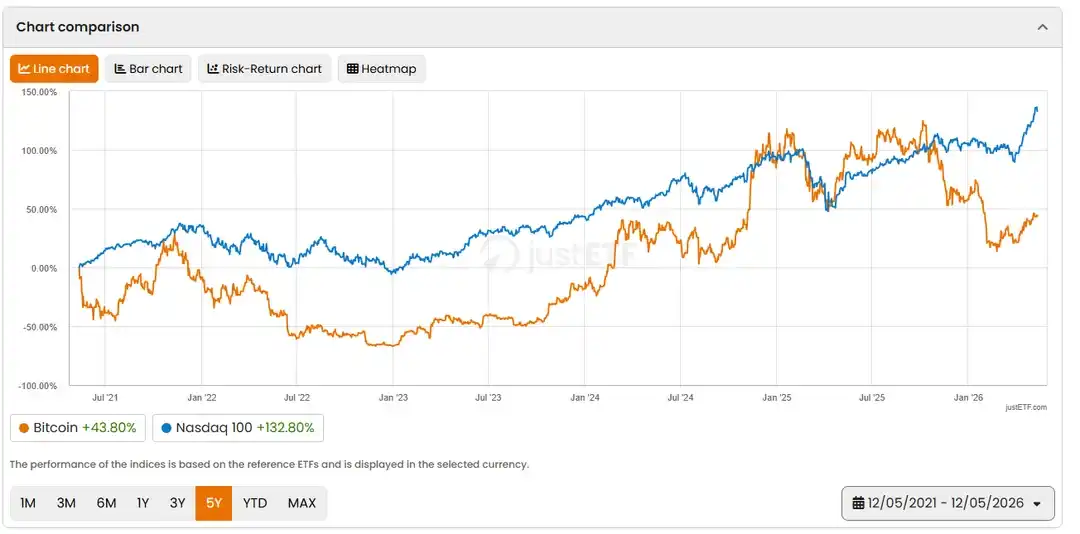
The poster's own summary is even more poignant: "What exactly is going on? I guess the answer is that AI has changed everything."

Bloomberg published a similar report in February this year with an even more merciless title: "Bitcoin's Five-Year Return Lags S&P 500, Nasdaq 100, and Gold."

Investments Have an Expiration Date

The starting point for the 5-year window in the above chart is December 2021.

At that time, Bitcoin had just retreated from its cycle high of $69,000 to around $48,000, while the Nasdaq 100 was around 16,300 points, and the AI narrative had not yet taken off. This means Bitcoin's starting line was set on a high plateau at the end of a bull market, while Nasdaq's starting line was set on the eve of the AI super rally.

Emotionally, it's understandable to promote that U.S. stocks are better than BTC; but is it really the case when looking at longer-term data? If we shift the starting point forward or backward by a few months or years, the winning relationship flips dramatically.

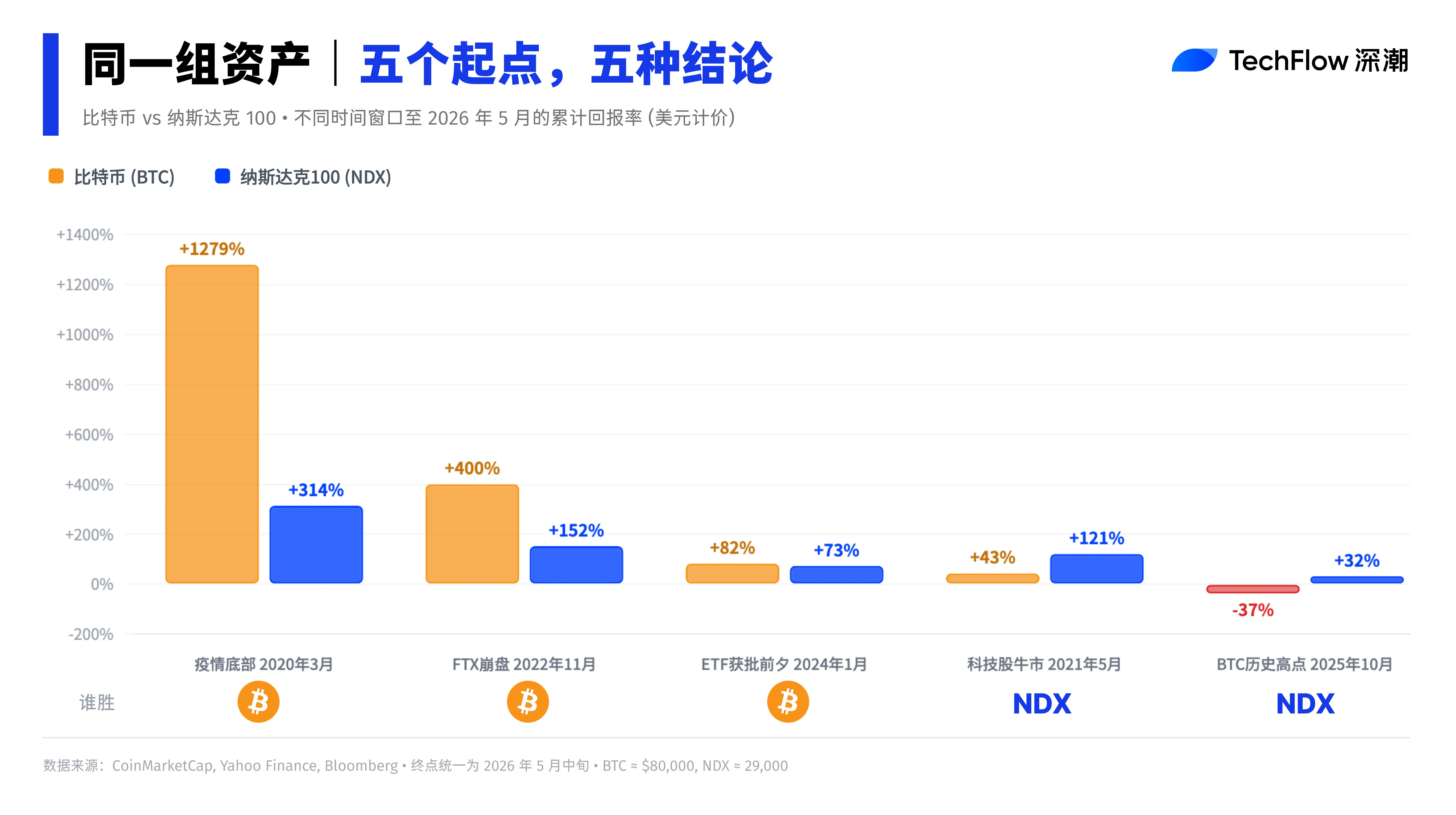
We conducted a simple small analysis. For the following five time windows, with the end point uniformly set as May 2026 (BTC ~$80,000, Nasdaq 100 ~29,000 points), the starting points correspond to five key nodes in crypto and macro markets:
COVID-19 Bottom (March 2020) → Now:

Bitcoin rose from ~$5,800 to $80,000, a gain of ~1,279%. Nasdaq 100 rose from ~7,000 points to 29,000 points, a gain of ~314%. Bitcoin's return was over 4 times that of Nasdaq.

FTX Collapse Bottom (November 2022) → Now:

Bitcoin rose from ~$16,000 to $80,000, a gain of ~400%. Nasdaq 100 rose from ~11,500 points to 29,000 points, a gain of ~152%. Bitcoin's return was still 2.6 times that of Nasdaq.

On the Eve of Bitcoin ETF Approval (January 2024) → Now:

Bitcoin rose from ~$44,000 to $80,000, a gain of ~82%. Nasdaq 100 rose from ~16,800 points to 29,000 points, a gain of ~73%. They were basically tied, with Bitcoin slightly ahead.

This Tech Stock Cycle (May 2021) → Now:

Bitcoin rose from ~$48,000 to $80,000, a gain of ~67%. Nasdaq 100 rose from ~16,300 points to 29,000 points, a gain of ~78%. Nasdaq led.

Bitcoin's All-Time High (October 2025) → Now:

Bitcoin fell from ~$126,000 to $80,000, a loss of ~37%. Nasdaq 100 rose from ~22,000 points to 29,000 points, a gain of ~32%. Nasdaq led significantly, and the directions were completely opposite.

Therefore, the conclusion is: Out of five windows, Bitcoin wins in three, Nasdaq wins in two. The Reddit post happened to select one of the windows where Nasdaq has the biggest advantage.

Cyclical Asset vs. Trend Asset

The difference in sensitivity to the starting point between Bitcoin and the Nasdaq 100 stems from the two assets' fundamentally different volatility structures.

The Nasdaq 100 is composed of 500 large non-financial companies, backed by cash flows and earnings, exhibiting a long-term upward trend. Even after the 33% pullback in 2022, its recovery was relatively steady.

Choosing any non-extreme starting point results in long-term returns falling within a relatively stable range.

Bitcoin is a typical cyclical asset. Historically, in each bull-bear cycle, the drawdown from peak to trough has ranged between 75% and 85% (as seen in 2014, 2018, and 2022). The pullback from October 2025 to early 2026 also reached about 50%.

This intense volatility means that where the starting point falls within the cycle almost determines the final return figure.

A Nasdaq.com analysis put it more bluntly: Bitcoin is essentially a leveraged version of the S&P 500.

In 2024, the S&P rose 24%, Bitcoin rose 135%; in 2023, the S&P rose 26%, Bitcoin rose 147%; in 2022, the S&P fell 19%, Bitcoin fell 65%. Same direction, magnitude amplified 3 to 5 times.

This means that choosing a starting point that coincides exactly with a Bitcoin cycle peak for comparison, and concluding that "stocks completely beat Bitcoin," is almost statistically inevitable. The opposite is also true.

The Current BTC is Possibly in a "Cyclical Undervaluation Zone"

Setting aside the starting point game, the current market structure itself warrants attention.

After peaking in October 2025, Bitcoin underwent a typical cyclical correction. It fell to around $65,000 in February 2026, then rebounded to around $80,000, still down about 37% from its high. Meanwhile, the Nasdaq 100 repeatedly hit new highs driven by continued expansion in AI capital expenditure.

This divergence is not uncommon in history. In 2019, while Bitcoin rallied from $3,000 to $12,000, it was almost decoupled from the S&P 500. In 2022, both plummeted in sync, with correlation once soaring to 0.92. The correlation between the crypto market and U.S. stocks is dynamic and cyclical, not a fixed positive correlation.

Galaxy Digital's Head of Research, Alex Thorn, proposed an interesting perspective in December 2025:

If measured in terms of 2020 US dollar purchasing power, Bitcoin's nominal high of $126,000 never actually broke through $100,000. Cumulative inflation from 2020 to 2025 is about 24%, which introduces a systematic bias in cross-year nominal price comparisons.

At a time when Bitcoin is down 37% from its all-time high while U.S. stock indices are simultaneously hitting record highs, the narrative of "stocks outperforming Bitcoin" naturally dominates social media.

However, in the past, every time this narrative was loudest, it usually coincided with Bitcoin nearing the bottom of its cycle. After the FTX collapse in late 2022, similar "Bitcoin is dead" rhetoric was also rampant, yet Bitcoin subsequently rose from $16,000 to $126,000 over the next 18 months.

Hindsight is easy; placing bets ahead of time is hard. Arguing about which asset has higher returns has little practical meaning at the micro level. Any conclusion based on a single time window that "A is forever superior to B" cannot withstand the test of shifting the starting point.

Each era has its champion. The difficult part across all eras is timing the market and taking profits.


Preguntas relacionadas

QBased on the article, why does the claim 'Buying Nasdaq is better than buying BTC' have a 'shelf life'?

ABecause the comparison outcome heavily depends on the selected starting point due to Bitcoin's extreme cyclical volatility and Nasdaq's steadier trend. Choosing a starting point near a Bitcoin cycle peak makes Nasdaq look better, while starting near a Bitcoin cycle low makes Bitcoin's returns vastly superior. The conclusion is not universally true across all timeframes.

QHow did Bitcoin's performance compare to Nasdaq 100 from the COVID-19 market bottom in March 2020 to May 2026, according to the article's data?

AFrom March 2020 to May 2026, Bitcoin rose from approximately $5,800 to $80,000, a gain of about 1,279%. The Nasdaq 100 rose from about 7,000 points to 29,000 points, a gain of about 314%. Bitcoin's return was over 4 times that of the Nasdaq 100.

QWhat is the fundamental difference in the 'volatility structure' between Bitcoin and the Nasdaq 100 as explained in the article?

AThe Nasdaq 100, backed by company cash flows and earnings, exhibits a long-term upward trend with relatively stable returns from most non-extreme starting points. Bitcoin is a typical cyclical asset with extreme volatility, experiencing drawdowns of 75-85% in past bear markets. Its final return is almost entirely determined by the cycle phase at the starting point.

QAccording to the article, what is one reason the current narrative of 'stocks outperforming Bitcoin' is so prevalent in mid-2026?

AIn mid-2026, Bitcoin is down about 37% from its October 2025 all-time high of $126,000, trading around $80,000. Meanwhile, the Nasdaq 100 is hitting new all-time highs driven by AI capital expenditure stories. This significant performance divergence makes the 'stocks are better' narrative naturally dominate social media.

QWhat historical pattern does the article suggest often occurs when the 'Bitcoin is dead' or 'stocks outperform Bitcoin' narrative is loudest?

AThe article suggests that in the past, when narratives claiming 'Bitcoin is dead' or that stocks are definitively better than Bitcoin were at their loudest (e.g., after the FTX crash in late 2022), it often coincided with Bitcoin being near a cyclical bottom region. Subsequently, Bitcoin experienced massive rallies, such as rising from $16,000 to $126,000 in the 18 months following the FTX collapse.

Lecturas Relacionadas

Winter for Crypto IPOs: Consensys and Ledger Withdraw Applications

The crypto IPO window is tightening significantly in 2026, marked by prominent companies delaying or pausing their public listing plans. Following a successful 2025 "harvest year" that saw Circle, Bullish, and Gemini go public amidst a bull market, the tide has turned. Consensys, developer of MetaMask, recently postponed its IPO until at least fall 2026. Hardware wallet leader Ledger also suspended its planned US listing due to unfavorable market conditions, with Kraken having previously delayed its own plans. This shift is driven by a cooling market in 2026, characterized by a significant Bitcoin price correction, declining trading volumes, and reduced investor risk appetite for crypto stocks. The poor post-IPO performance of 2025 listings like Circle and Bullish, which saw major share price declines, has heightened investor caution. This contrasts sharply with the current AI sector, where companies like SpaceX, OpenAI, and Anthropic are commanding massive valuations and investor enthusiasm based on narratives of stable, exponential growth. Crypto companies now face pressure to transition from hype-driven models to demonstrating reliable cash flows and robust compliance. While the paused IPO plans may lead to valuation resets and affect ecosystem liquidity, they also accelerate industry consolidation toward stronger, more compliant infrastructure players. A potential recovery in Bitcoin's price and clearer regulations could reopen the IPO window in the latter half of 2026.

marsbitHace 53 min(s)

Winter for Crypto IPOs: Consensys and Ledger Withdraw Applications

marsbitHace 53 min(s)

ChatGPT Can Manage Your Money for You. Would You Trust It with Your Bank Account?

OpenAI has launched a personal finance tool for ChatGPT, currently in preview for US-based ChatGPT Pro users. This feature allows users to connect their bank and investment accounts (via Plaid, supporting over 12,000 institutions) directly to ChatGPT. It analyzes transactions, generates visual dashboards, and offers conversational financial advice—such as budgeting or planning for major purchases—based on the user's actual data. This move follows OpenAI's acquisitions of fintech startups Roi and Hiro Finance, signaling a strategic push into vertical "super assistant" applications, similar to its earlier health-focused feature. However, the launch has sparked significant privacy concerns. Critics question the safety of granting such sensitive financial access to an AI, especially amid ongoing lawsuits alleging OpenAI shared user chat data with third parties like Meta and Google. OpenAI emphasizes that ChatGPT only reads data (no transaction capabilities), deletes it within 30 days if disconnected, and offers opt-out options for model training. Yet, trust remains a major hurdle. The trend reflects a broader industry shift: AI companies like Anthropic and Perplexity are also targeting high-value, data-rich domains like finance and health. While technically promising, the tool operates in a regulatory gray area—it provides personalized guidance but disclaims formal financial advice or liability. Ultimately, OpenAI's challenge is convincing users to trust an AI with their most private financial information.

marsbitHace 54 min(s)

ChatGPT Can Manage Your Money for You. Would You Trust It with Your Bank Account?

marsbitHace 54 min(s)

Trading

Spot
Futuros

Artículos destacados

Qué es BITCOIN

Entendiendo HarryPotterObamaSonic10Inu (ERC-20) y Su Posición en el Espacio Cripto En los últimos años, el mercado de criptomonedas ha sido testigo de un aumento en la popularidad de las monedas meme, capturando el interés no solo de los comerciantes, sino también de aquellos que buscan compromiso comunitario y valor de entretenimiento. Entre estos tokens únicos se encuentra HarryPotterObamaSonic10Inu (ERC-20), un proyecto intrigante que mezcla referencias culturales en el tejido de las criptomonedas. Este artículo profundiza en los aspectos clave de HarryPotterObamaSonic10Inu, explorando sus mecanismos, ethos impulsado por la comunidad y su relación con el paisaje cripto más amplio. ¿Qué es HarryPotterObamaSonic10Inu (ERC-20)? Como su nombre sugiere, HarryPotterObamaSonic10Inu es una moneda meme construida sobre la blockchain de Ethereum, clasificada bajo el estándar ERC-20. A diferencia de las criptomonedas tradicionales que pueden enfatizar la utilidad práctica o el potencial de inversión, este token prospera en el valor de entretenimiento y la fuerza de su comunidad. El proyecto tiene como objetivo fomentar un entorno donde los usuarios comprometidos puedan reunirse, compartir ideas y participar en actividades inspiradas por diversos fenómenos culturales. Una característica notable de HarryPotterObamaSonic10Inu es su cero impuestos en las transacciones. Este atractivo elemento tiene como objetivo incentivar el comercio y la participación comunitaria, sin cargos adicionales que puedan disuadir a los comerciantes de pequeña escala. El suministro total de la moneda está establecido en mil millones de tokens, una cifra que marca su intención de mantener una circulación sustancial dentro de la comunidad. Creador de HarryPotterObamaSonic10Inu (ERC-20) Los orígenes de HarryPotterObamaSonic10Inu están algo envueltos en misterio; los detalles sobre el creador siguen siendo desconocidos. El desarrollo de este token carece de un equipo identificable o de un plan explícito, lo cual no es inusual dentro del sector de monedas meme. En cambio, el proyecto ha surgido de manera orgánica, con su progreso muy dependiente del entusiasmo y la participación de su comunidad. Inversores de HarryPotterObamaSonic10Inu (ERC-20) En cuanto a inversiones externas y respaldo, HarryPotterObamaSonic10Inu también sigue siendo ambiguo. El token no lista ninguna fundación de inversión conocida o apoyo organizacional significativo. En cambio, la savia del proyecto es su comunidad de base, que informa su crecimiento y sostenibilidad a través de la acción colectiva y el compromiso en el espacio cripto. ¿Cómo Funciona HarryPotterObamaSonic10Inu (ERC-20)? Como una moneda meme, HarryPotterObamaSonic10Inu opera principalmente fuera de los marcos tradicionales que a menudo rigen el valor de los activos. Hay varios aspectos distintivos que definen cómo funciona el proyecto: Transacciones Sin Impuestos: Sin tarifas impositivas en las transacciones, los usuarios pueden comprar y vender el token libremente sin preocuparse por costos ocultos. Compromiso Comunitario: El proyecto prospera en la interacción comunitaria, aprovechando plataformas de redes sociales para crear entusiasmo y facilitar la participación. Las discusiones, el intercambio de contenido y el compromiso son elementos cruciales que ayudan a expandir su alcance y fomentar la lealtad entre los seguidores. Sin Utilidad Práctica: Cabe señalar que HarryPotterObamaSonic10Inu no ofrece utilidad concreta dentro del ecosistema financiero. Más bien, se clasifica como un token principalmente para actividades de entretenimiento y comunitarias. Referencia Cultural: El token incorpora astutamente elementos de la cultura popular para atraer interés, conectando con entusiastas de los memes y seguidores de las criptomonedas por igual. HarryPotterObamaSonic10Inu ejemplifica cómo las monedas meme operan de manera diferente a los proyectos de criptomonedas más tradicionales, ingresando al mercado como construcciones sociales innovadoras en lugar de activos utilitarios. Cronología de HarryPotterObamaSonic10Inu (ERC-20) La historia de HarryPotterObamaSonic10Inu está marcada por varios hitos notables: Creación: El token surgió de un meme viral, capturando la imaginación de muchos entusiastas de las criptomonedas. Las fechas específicas de creación no están disponibles, subrayando su ascenso orgánico. Listado en Exchanges: HarryPotterObamaSonic10Inu ha llegado a varios exchanges, permitiendo un acceso y comercio más fácil por parte de la comunidad. Iniciativas de Compromiso Comunitario: Actividades continuas destinadas a mejorar la interacción comunitaria, incluyendo concursos, campañas en redes sociales y generación de contenido por parte de fanáticos y defensores. Planes de Expansión Futuros: La hoja de ruta del proyecto incluye el lanzamiento de una colección de NFT, mercancía y un sitio de comercio electrónico relacionado con sus temas culturales, involucrando aún más a la comunidad e intentando añadir más dimensiones a su ecosistema. Puntos Clave Sobre HarryPotterObamaSonic10Inu (ERC-20) Naturaleza Impulsada por la Comunidad: El proyecto prioriza la participación colectiva y la creatividad, asegurando que la involucración de los usuarios esté a la vanguardia de su desarrollo. Clasificación como Moneda Meme: Representa la epítome de las criptomonedas basadas en el entretenimiento, diferenciándose de los vehículos de inversión tradicionales. Sin Afiliación Directa con Bitcoin: A pesar de la similitud en el nombre del ticker, HarryPotterObamaSonic10Inu es distinto y no tiene relación con Bitcoin u otras criptomonedas establecidas. Enfoque en la Colaboración: HarryPotterObamaSonic10Inu está diseñado para crear un espacio para la colaboración y el intercambio de historias entre sus poseedores, proporcionando una vía para la creatividad y el vínculo comunitario. Perspectivas Futuras: La ambición de expandirse más allá de su premisa inicial hacia NFTs y mercancías describe un camino para que el proyecto potencialmente ingrese a avenidas más tradicionales dentro de la cultura digital. A medida que las monedas meme continúan capturando la imaginación de la comunidad de criptomonedas, HarryPotterObamaSonic10Inu (ERC-20) se destaca debido a sus lazos culturales y su enfoque centrado en la comunidad. Si bien puede no encajar en el molde típico de un token impulsado por la utilidad, su esencia radica en la alegría y la camaradería fomentadas entre sus seguidores, destacando la naturaleza en evolución de las criptomonedas en una era cada vez más digital. A medida que el proyecto continúa desarrollándose, será importante observar cómo las dinámicas comunitarias influyen en su trayectoria en el cambiante paisaje de la tecnología blockchain.

1.5k Vistas totalesPublicado en 2024.04.01Actualizado en 2024.12.03

Qué es BITCOIN

Cómo comprar BTC

¡Bienvenido a HTX.com! Hemos hecho que comprar Bitcoin (BTC) sea simple y conveniente. Sigue nuestra guía paso a paso para iniciar tu viaje de criptos.Paso 1: crea tu cuenta HTXUtiliza tu correo electrónico o número de teléfono para registrarte y obtener una cuenta gratuita en HTX. Experimenta un proceso de registro sin complicaciones y desbloquea todas las funciones.Obtener mi cuentaPaso 2: ve a Comprar cripto y elige tu método de pagoTarjeta de crédito/débito: usa tu Visa o Mastercard para comprar Bitcoin (BTC) al instante.Saldo: utiliza fondos del saldo de tu cuenta HTX para tradear sin problemas.Terceros: hemos agregado métodos de pago populares como Google Pay y Apple Pay para mejorar la comodidad.P2P: tradear directamente con otros usuarios en HTX.Over-the-Counter (OTC): ofrecemos servicios personalizados y tipos de cambio competitivos para los traders.Paso 3: guarda tu Bitcoin (BTC)Después de comprar tu Bitcoin (BTC), guárdalo en tu cuenta HTX. Alternativamente, puedes enviarlo a otro lugar mediante transferencia blockchain o utilizarlo para tradear otras criptomonedas.Paso 4: tradear Bitcoin (BTC)Tradear fácilmente con Bitcoin (BTC) en HTX's mercado spot. Simplemente accede a tu cuenta, selecciona tu par de trading, ejecuta tus trades y monitorea en tiempo real. Ofrecemos una experiencia fácil de usar tanto para principiantes como para traders experimentados.

4.9k Vistas totalesPublicado en 2024.12.12Actualizado en 2025.03.21

Cómo comprar BTC

Qué es $BITCOIN

ORO DIGITAL ($BITCOIN): Un Análisis Integral Introducción al ORO DIGITAL ($BITCOIN) ORO DIGITAL ($BITCOIN) es un proyecto basado en blockchain que opera en la red Solana, cuyo objetivo es combinar las características de los metales preciosos tradicionales con la innovación de las tecnologías descentralizadas. Aunque comparte un nombre con Bitcoin, a menudo referido como “oro digital” debido a su percepción como un refugio de valor, ORO DIGITAL es un token separado diseñado para crear un ecosistema único dentro del paisaje Web3. Su meta es posicionarse como un activo digital alternativo viable, aunque los detalles sobre sus aplicaciones y funcionalidades aún están en desarrollo. ¿Qué es ORO DIGITAL ($BITCOIN)? ORO DIGITAL ($BITCOIN) es un token de criptomoneda diseñado explícitamente para su uso en la blockchain de Solana. A diferencia de Bitcoin, que proporciona un papel de almacenamiento de valor ampliamente reconocido, este token parece centrarse en aplicaciones y características más amplias. Aspectos notables incluyen: Infraestructura Blockchain: El token está construido sobre la blockchain de Solana, conocida por su capacidad para manejar transacciones de alta velocidad y bajo costo. Dinámicas de Suministro: ORO DIGITAL tiene un suministro máximo limitado a 100 cuatrillones de tokens (100P $BITCOIN), aunque los detalles sobre su suministro circulante no se han divulgado actualmente. Utilidad: Si bien las funcionalidades precisas no están delineadas explícitamente, hay indicios de que el token podría ser utilizado para diversas aplicaciones, potencialmente involucrando aplicaciones descentralizadas (dApps) o estrategias de tokenización de activos. ¿Quién es el Creador de ORO DIGITAL ($BITCOIN)? En la actualidad, la identidad de los creadores y el equipo de desarrollo detrás de ORO DIGITAL ($BITCOIN) sigue siendo desconocida. Esta situación es típica entre muchos proyectos innovadores dentro del espacio blockchain, particularmente aquellos alineados con las finanzas descentralizadas y fenómenos de monedas meme. Si bien tal anonimato puede fomentar una cultura impulsada por la comunidad, intensifica las preocupaciones sobre la gobernanza y la responsabilidad. ¿Quiénes son los Inversores de ORO DIGITAL ($BITCOIN)? La información disponible indica que ORO DIGITAL ($BITCOIN) no tiene patrocinadores institucionales conocidos ni inversiones destacadas de capital de riesgo. El proyecto parece operar en un modelo de peer-to-peer centrado en el apoyo y la adopción de la comunidad en lugar de rutas de financiamiento tradicionales. Su actividad y liquidez se sitúan principalmente en intercambios descentralizados (DEX), como PumpSwap, en lugar de plataformas de trading centralizadas establecidas, lo que resalta aún más su enfoque de base. Cómo Funciona ORO DIGITAL ($BITCOIN) Los mecanismos operativos de ORO DIGITAL ($BITCOIN) pueden elaborarse en función de su diseño blockchain y atributos de red: Mecanismo de Consenso: Al aprovechar el único proof-of-history (PoH) de Solana combinado con un modelo de proof-of-stake (PoS), el proyecto asegura una validación de transacciones eficiente que contribuye al alto rendimiento de la red. Tokenómica: Si bien los mecanismos deflacionarios específicos no se han detallado extensamente, el vasto suministro máximo de tokens implica que podría atender microtransacciones o casos de uso nicho que aún están por definirse. Interoperabilidad: Existe el potencial de integración con el ecosistema más amplio de Solana, incluyendo varias plataformas de finanzas descentralizadas (DeFi). Sin embargo, los detalles sobre integraciones específicas permanecen no especificados. Cronología de Eventos Clave Aquí hay una cronología que destaca hitos significativos relacionados con ORO DIGITAL ($BITCOIN): 2023: El despliegue inicial del token ocurre en la blockchain de Solana, marcado por su dirección de contrato. 2024: ORO DIGITAL gana visibilidad al estar disponible para trading en intercambios descentralizados como PumpSwap, permitiendo a los usuarios comerciar contra SOL. 2025: El proyecto presencia actividad de trading esporádica y potencial interés en compromisos liderados por la comunidad, aunque no se han documentado asociaciones notables o avances técnicos hasta el momento. Análisis Crítico Fortalezas Escalabilidad: La infraestructura subyacente de Solana soporta altos volúmenes de transacciones, lo que podría mejorar la utilidad de $BITCOIN en varios escenarios de transacción. Accesibilidad: El potencial bajo precio de trading por token podría atraer a inversores minoristas, facilitando una participación más amplia debido a oportunidades de propiedad fraccionada. Riesgos Falta de Transparencia: La ausencia de patrocinadores, desarrolladores o un proceso de auditoría conocidos públicamente puede generar escepticismo sobre la sostenibilidad y confiabilidad del proyecto. Volatilidad del Mercado: La actividad de trading depende en gran medida del comportamiento especulativo, lo que puede resultar en una volatilidad de precios significativa y en incertidumbre para los inversores. Conclusión ORO DIGITAL ($BITCOIN) surge como un proyecto intrigante pero ambiguo dentro del ecosistema de Solana en rápida evolución. Si bien intenta aprovechar la narrativa del “oro digital”, su alejamiento del papel establecido de Bitcoin como refugio de valor subraya la necesidad de una diferenciación más clara de su utilidad y estructura de gobernanza previstas. La aceptación y adopción futura dependerán probablemente de abordar la actual opacidad y de definir sus estrategias operativas y económicas de manera más explícita. Nota: Este informe abarca información sintetizada disponible hasta octubre de 2023, y pueden haber ocurrido desarrollos más allá del período de investigación.

83 Vistas totalesPublicado en 2025.05.13Actualizado en 2025.05.13

Qué es $BITCOIN

Discusiones

Bienvenido a la comunidad de HTX. Aquí puedes mantenerte informado sobre los últimos desarrollos de la plataforma y acceder a análisis profesionales del mercado. A continuación se presentan las opiniones de los usuarios sobre el precio de BTC (BTC).

活动图片