Bullish Reports Massive Q4 Loss; Investors Pivot to $BMIC Presale

bitcoinistPublicado a 2026-02-05Actualizado a 2026-02-05

Resumen

Bullish shares tumbled after the company reported a massive Q4 net loss of $563 million, a sharp reversal from its profit a year earlier. This occurred amid a broader tech and crypto market downturn, prompting investors to seek safer, long-term infrastructure plays. Attention has shifted to the $BMIC presale, a quantum-secure wallet project built on Ethereum. BMIC offers post-quantum cryptography to protect against future decryption threats, positioning itself as a defensive solution for asset security. With over $433K raised, the project addresses growing concerns over quantum computing risks. However, it faces execution challenges and market volatility. The article cautions that this is not financial advice and presale investments carry high risk.

Shares of Bullish tumbled after the firm disclosed a staggering Q4 net loss of $563M, a brutal reversal from the $104.8M profit booked just a year earlier. The timing couldn’t be worse.

The report landed while tech and crypto sectors were already reeling, dragging broader equities down with them. It’s a harsh reminder: even heavyweight, institutional-grade platforms aren’t immune to macro pressure.

Amid the fallout, attention has quietly shifted to BMIC, a quantum-secure wallet project currently in presale. Why? Investors seem to be repositioning toward infrastructure that promises long-term safety rather than just short-term gains.

Frankly, if established platforms like Bullish can stumble on financials, securing assets with post-quantum cryptography suddenly feels less like a luxury and more like insurance.

The context is undeniable: the market is in correction mode. Bitcoin has plunged below $70K (down roughly 20% since January), while Ethereum is off more than 10%, both caught in a wave of tech-sector weakness and policy uncertainty. When majors slip this hard, capital often rotates toward protocols addressing deeper structural risks, like the looming threat of quantum decryption.

BMIC Brings Quantum-Proof Security to Crypto Finance

BMIC ($BMIC) isn’t just another wallet and token. It positions itself as the only Post‐Quantum‐Cryptography (PQC)-backed ecosystem for staking and payments on Ethereum.

Its full-stack, RSA-resistant design tackles ‘harvest now, decrypt later’ attacks directly. Sound paranoid? It’s not; it’s a realistic response to advancing quantum capabilities.

With zero public-key exposure, ERC-4337 smart accounts, and AI-enhanced threat detection, the project is building defense for a future that’s approaching faster than most realize.
The numbers are specific: tokens are currently priced at $0.049474, and total raised stands at over $433K.
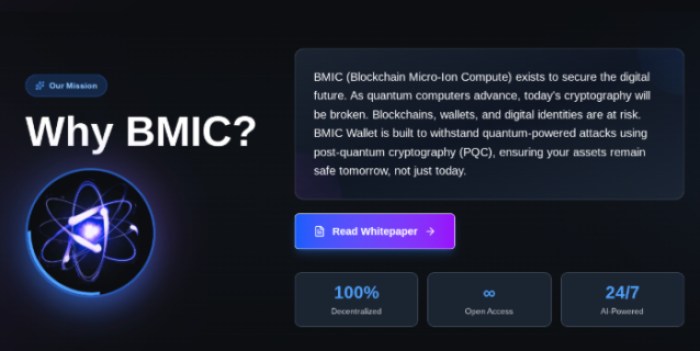
That suggests solid early demand, nearly half a million dollars, for a security-first offering. We haven’t seen massive whale wallets enter just yet, but that’s typical for this stage. The story here is about preservation and preparedness, not pump mechanics.

The logic is simple. As markets shake, defensive plays aren’t just about ROI; they’re about resilience. BMIC offers asset-level protection that conventional solutions (still relying on old encryption standards) simply lack. The pivot makes sense.

CHEcK OUT THE $BMIC PRESALE

What’s Next and What to Watch

Quantum headlines: Any news about advances in quantum computing, or regulatory chatter on encryption standards, could turbocharge demand for this specific tech stack.
Crypto market stabilization: If $BTC or $ETH recovers, altcoins and infrastructure layers like $BMIC often see inflows shortly after.
Regulatory clarity: Early alignment on post-quantum encryption could deliver institutional confidence and adoption fast.

Risks? Plenty. BMIC faces execution hurdles common to deep-tech projects. Quantum resistance today doesn’t guarantee immunity tomorrow; it’s an arms race that requires continuous evolution. Plus, wallet adoption cycles are notoriously sticky. And let’s be real—even promising token sales can buckle under a deep bear market.

But here’s the second-order effect casual observers might miss: BMIC isn’t just ‘one more alt.’ It’s a modular infrastructure. That positions it for future ecosystem integration, think cold wallets, DeFi rails, and enterprise-grade custody.

LEARN MORE ABOUT THE QUANTUM STACK THAT’S PREPARING FOR THE FUTURE

This article is not financial advice. Presale participation involves high risk, and markets may continue to fall sharply. Evaluate tech maturity and institutional adoption before investing.


Preguntas relacionadas

QWhat was the primary reason for the significant shift in investor attention from Bullish to the BMIC presale, as mentioned in the article?

AInvestors are repositioning towards infrastructure that promises long-term safety, like quantum-secure wallets, following Bullish's massive Q4 loss and the broader market downturn, seeking asset protection rather than just short-term gains.

QAccording to the article, what specific technological threat does the BMIC project aim to address?

ABMIC aims to address the threat of 'harvest now, decrypt later' attacks by providing a post-quantum-cryptography (PQC)-backed, RSA-resistant ecosystem to protect against the looming risk of quantum decryption.

QWhat are two key technical features of the BMIC wallet mentioned in the report?

ATwo key features are zero public-key exposure and ERC-4337 smart accounts, which are part of its quantum-proof security and AI-enhanced threat detection system.

QWhat market conditions, as described in the article, are driving interest in defensive projects like BMIC?

AThe market is in correction mode, with Bitcoin down roughly 20% and Ethereum off more than 10% since January, due to tech-sector weakness and policy uncertainty, causing capital to rotate towards protocols that address structural risks.

QWhat are some of the major risks associated with investing in the BMIC presale, as outlined in the article?

ARisks include execution hurdles common to deep-tech projects, the need for continuous evolution to maintain quantum resistance, sticky wallet adoption cycles, and the potential for the token sale to struggle in a deep bear market.

Lecturas Relacionadas

AI Trading Cools, South Korean Stocks Plunge 1.8%, Spot Gold Rises 1%, Bitcoin Dives

A sell-off in AI-related stocks, triggered by Broadcom's disappointing earnings forecast, sent shockwaves through global markets. South Korea's KOSPI led Asia's decline, plunging 1.8% as the risks from concentrated chip stock gains and surging leveraged investments came to the fore. The tech-heavy Nasdaq 100 futures fell 0.5% following Broadcom's 14% after-hours plunge, which signaled a slower-than-expected transition to AI clients. This pullback extended Wall Street's weakness, halting the S&P 500's nine-day rally amid hawkish Fed signals and renewed Middle East tensions. South Korean authorities convened an emergency meeting, pledging "immediate measures" against market volatility and warning of record-high stock margin debt. The adjustment rippled across assets: Bitcoin fell to around $64,000, its lowest since February, while safe-haven gold rose 1% on bargain hunting. Oil prices dipped on Middle East ceasefire news. Market analysts noted the sell-off was driven by profit-taking after massive gains, particularly in chip stocks like Samsung and SK Hynix, which now dominate the KOSPI. Wall Street banks are divided on Korea's outlook, with Goldman Sachs raising its target while Citigroup and others warn of overvaluation and a potential bubble. Bridgewater's Ray Dalio noted that great technological shifts often create bubbles. Meanwhile, Fed officials' hints at potential future rate hikes added to the cautious mood ahead of key U.S. jobs data.

华尔街日报Hace 27 min(s)

AI Trading Cools, South Korean Stocks Plunge 1.8%, Spot Gold Rises 1%, Bitcoin Dives

华尔街日报Hace 27 min(s)

Seeking Alpha's Hot Article: Why Might the U.S. Stock Market Crash in June?

In a recent Seeking Alpha article, financial professor and analyst Damir Tokic argues that the US stock market may be poised for a significant crash in June 2026. The core thesis centers on a "mega-bubble" in equities, particularly within the technology sector, which has driven the S&P 500 to near-record valuations, with a Shiller P/E ratio exceeding 40—a level comparable to the 2000 dot-com bubble. Tokic identifies two primary catalysts for a potential collapse. First, he points to unsustainable market exuberance fueled by what he terms the "Trump Stimulus"—massive AI capital expenditure by tech giants, which he believes is politically driven and cannot last. Second, and more urgently, he highlights the escalating Iran war as a critical threat. The ongoing closure of the Strait of Hormuz has created a severe global energy supply crunch. Strategic petroleum reserves are projected to hit critically low operational levels by June, potentially causing oil prices to spike above $200 per barrel and triggering a severe, supply-driven inflationary shock. This scenario, Tokic warns, would force the Federal Reserve's hand. Despite currently maintaining a dovish bias, the Fed would likely be compelled to officially pivot to a hawkish stance at its June FOMC meeting to combat soaring inflation and bond yields. He contends that such a shift—or even a failure to act, which would destroy Fed credibility—could be the trigger that punctures the market bubble. The resulting downturn, he concludes, could rival the bear markets of 2000 and 2008, advising investors to prepare for a major correction.

marsbitHace 50 min(s)

Seeking Alpha's Hot Article: Why Might the U.S. Stock Market Crash in June?

marsbitHace 50 min(s)

AI PC Battle: Bet on the Toll Booth, Not the Camp

**Title:** The AI PC Battle: Don't Bet on Sides, Bet on the Tollbooth **Summary:** The AI PC competition is moving beyond simple "x86 vs. Arm" narratives. The core investment thesis should focus on identifying which players can sustain margins, cash flow, and pricing power throughout the upgrade cycle, rather than backing a particular architecture. The opportunity is analyzed in three layers: 1. **The Advanced Foundry Tollbooth:** TSMC is positioned to collect "tolls" regardless of which chip designer wins, due to its dominant ~70% share in advanced semiconductor manufacturing, which is essential for high-end AI PC chips. 2. **Compute & Platform Spillover:** AMD represents an offensive in the x86 CPU+GPU space, while NVIDIA leverages its GPU and CUDA software stack dominance. Both benefit from the demand for increased local AI compute. 3. **Architecture Diffusion & Turnaround Plays:** ARM and Intel offer potential for significant upside (elasticity), but investments here require stricter discipline due to higher execution risks and competitive challenges. The industry is transitioning from concept to shipment validation. While short-term forecasts for AI PC adoption have been revised down slightly due to tariffs and procurement delays, the long-term trend towards AI becoming a standard PC feature remains intact. The key driver for upgrade cycles will be whether compelling enterprise applications (e.g., privacy-sensitive computing, low-latency inference) emerge beyond consumer-focused features like meeting summarization. Investment strategy should prioritize companies with platform-level advantages and recurring revenue streams. TSMC offers high certainty as the foundational tollbooth. AMD presents a strong offensive play within the established ecosystem. ARM and Intel are higher-risk, higher-potential-reward turnaround bets. The report cautions against chasing short-term hype and emphasizes a disciplined, long-term approach focused on buying ecosystem strength and cash-flow certainty after market enthusiasm subsides. **Key Risks:** Underwhelming AI PC applications slowing upgrade cycles; slow improvement in Windows on Arm compatibility; macro/tariff impacts on PC demand; potential advanced node supply-demand mismatches affecting TSMC; high overall AI sector valuations making stocks vulnerable to a risk-off shift in markets.

marsbitHace 1 hora(s)

AI PC Battle: Bet on the Toll Booth, Not the Camp

marsbitHace 1 hora(s)

Ten-Thousand-Word Analysis: From $10 to $290, MRVL Wins the Entire AI Era by 'Not Making GPUs'

Marvell Technology's stock price surged from under $10 in 2016 to a record $290 in June 2026, fueled not by making GPUs, but by dominating AI infrastructure connectivity. This analysis argues the market misvalues MRVL as merely a smaller Broadcom in custom AI chips, overlooking its true, unique position. Marvell's core strength lies in enabling high-speed data flow for AI clusters through three interconnected businesses. First, it holds a commanding ~70% market share in high-speed optical DSPs (essential for data center light modules), a deep-moat business with accelerating growth. Second, its custom AI chip design business serves hyperscalers like AWS, Microsoft, and Google, with a significant revenue pipeline despite lower margins. Third, stable cash flows come from Ethernet switch chips and enterprise storage controllers. Together, they form a full-stack "AI data movement" platform. CEO Matt Murphy's transformative leadership since 2016, involving strategic divestments, key acquisitions (like Inphi for optical DSPs), and securing long-term agreements with major cloud providers, repositioned the company. A pivotal $2 billion strategic investment from NVIDIA in 2026 underscored Marvell's critical role in the AI ecosystem, particularly through collaborations like NVLink Fusion. While Marvell faces risks—including client concentration (losing the Amazon Trainium3 design), lower-margin business mix, competitive threats, insider selling, and complex supply chains—its fundamentals remain strong. The optical interconnect moat is widening with the acquisition of Celestial AI (photonics fabric), and financial metrics show accelerating revenue growth and operating leverage. With a PEG ratio suggesting undervaluation relative to its growth, the thesis is that the market undervalues Marvell's monopolistic position in AI "plumbing" while overemphasizing its competitive custom chip segment. The story transcends investing, symbolizing how in any complex system—from the internet to AI—the value of "connection" ultimately surpasses that of individual "nodes."

marsbitHace 1 hora(s)

Ten-Thousand-Word Analysis: From $10 to $290, MRVL Wins the Entire AI Era by 'Not Making GPUs'

marsbitHace 1 hora(s)

Trading

Spot
Futuros
活动图片