Bullish Reports Massive Q4 Loss; Investors Pivot to $BMIC Presale

bitcoinistPublicado a 2026-02-05Actualizado a 2026-02-05

Resumen

Bullish shares tumbled after the company reported a massive Q4 net loss of $563 million, a sharp reversal from its profit a year earlier. This occurred amid a broader tech and crypto market downturn, prompting investors to seek safer, long-term infrastructure plays. Attention has shifted to the $BMIC presale, a quantum-secure wallet project built on Ethereum. BMIC offers post-quantum cryptography to protect against future decryption threats, positioning itself as a defensive solution for asset security. With over $433K raised, the project addresses growing concerns over quantum computing risks. However, it faces execution challenges and market volatility. The article cautions that this is not financial advice and presale investments carry high risk.

Shares of Bullish tumbled after the firm disclosed a staggering Q4 net loss of $563M, a brutal reversal from the $104.8M profit booked just a year earlier. The timing couldn’t be worse.

The report landed while tech and crypto sectors were already reeling, dragging broader equities down with them. It’s a harsh reminder: even heavyweight, institutional-grade platforms aren’t immune to macro pressure.

Amid the fallout, attention has quietly shifted to BMIC, a quantum-secure wallet project currently in presale. Why? Investors seem to be repositioning toward infrastructure that promises long-term safety rather than just short-term gains.

Frankly, if established platforms like Bullish can stumble on financials, securing assets with post-quantum cryptography suddenly feels less like a luxury and more like insurance.

The context is undeniable: the market is in correction mode. Bitcoin has plunged below $70K (down roughly 20% since January), while Ethereum is off more than 10%, both caught in a wave of tech-sector weakness and policy uncertainty. When majors slip this hard, capital often rotates toward protocols addressing deeper structural risks, like the looming threat of quantum decryption.

BMIC Brings Quantum-Proof Security to Crypto Finance

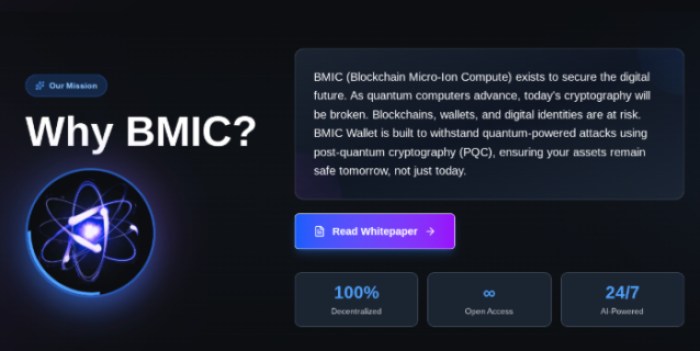
BMIC ($BMIC) isn’t just another wallet and token. It positions itself as the only Post‐Quantum‐Cryptography (PQC)-backed ecosystem for staking and payments on Ethereum.

Its full-stack, RSA-resistant design tackles ‘harvest now, decrypt later’ attacks directly. Sound paranoid? It’s not; it’s a realistic response to advancing quantum capabilities.

With zero public-key exposure, ERC-4337 smart accounts, and AI-enhanced threat detection, the project is building defense for a future that’s approaching faster than most realize.
The numbers are specific: tokens are currently priced at $0.049474, and total raised stands at over $433K.
That suggests solid early demand, nearly half a million dollars, for a security-first offering. We haven’t seen massive whale wallets enter just yet, but that’s typical for this stage. The story here is about preservation and preparedness, not pump mechanics.

The logic is simple. As markets shake, defensive plays aren’t just about ROI; they’re about resilience. BMIC offers asset-level protection that conventional solutions (still relying on old encryption standards) simply lack. The pivot makes sense.

CHEcK OUT THE $BMIC PRESALE

What’s Next and What to Watch

Quantum headlines: Any news about advances in quantum computing, or regulatory chatter on encryption standards, could turbocharge demand for this specific tech stack.
Crypto market stabilization: If $BTC or $ETH recovers, altcoins and infrastructure layers like $BMIC often see inflows shortly after.
Regulatory clarity: Early alignment on post-quantum encryption could deliver institutional confidence and adoption fast.

Risks? Plenty. BMIC faces execution hurdles common to deep-tech projects. Quantum resistance today doesn’t guarantee immunity tomorrow; it’s an arms race that requires continuous evolution. Plus, wallet adoption cycles are notoriously sticky. And let’s be real—even promising token sales can buckle under a deep bear market.

But here’s the second-order effect casual observers might miss: BMIC isn’t just ‘one more alt.’ It’s a modular infrastructure. That positions it for future ecosystem integration, think cold wallets, DeFi rails, and enterprise-grade custody.

LEARN MORE ABOUT THE QUANTUM STACK THAT’S PREPARING FOR THE FUTURE

This article is not financial advice. Presale participation involves high risk, and markets may continue to fall sharply. Evaluate tech maturity and institutional adoption before investing.


Preguntas relacionadas

QWhat was the primary reason for the significant shift in investor attention from Bullish to the BMIC presale, as mentioned in the article?

AInvestors are repositioning towards infrastructure that promises long-term safety, like quantum-secure wallets, following Bullish's massive Q4 loss and the broader market downturn, seeking asset protection rather than just short-term gains.

QAccording to the article, what specific technological threat does the BMIC project aim to address?

ABMIC aims to address the threat of 'harvest now, decrypt later' attacks by providing a post-quantum-cryptography (PQC)-backed, RSA-resistant ecosystem to protect against the looming risk of quantum decryption.

QWhat are two key technical features of the BMIC wallet mentioned in the report?

ATwo key features are zero public-key exposure and ERC-4337 smart accounts, which are part of its quantum-proof security and AI-enhanced threat detection system.

QWhat market conditions, as described in the article, are driving interest in defensive projects like BMIC?

AThe market is in correction mode, with Bitcoin down roughly 20% and Ethereum off more than 10% since January, due to tech-sector weakness and policy uncertainty, causing capital to rotate towards protocols that address structural risks.

QWhat are some of the major risks associated with investing in the BMIC presale, as outlined in the article?

ARisks include execution hurdles common to deep-tech projects, the need for continuous evolution to maintain quantum resistance, sticky wallet adoption cycles, and the potential for the token sale to struggle in a deep bear market.

Lecturas Relacionadas

Misjudged A-Shares: Resilience, Expectations, and Confidence

China's A-share market recently faced selling pressure, especially in tech sectors, initially triggered by a global tech sell-off that began in South Korea. However, the article argues this is a case of "mistaken injury" and highlights the market's underlying resilience. This resilience stems from three main pillars: **1) Tech Sector Fundamentals:** Unlike Korea's market dominated by a few memory chip stocks, China's tech sector is diversified across computing, communications, electronics, and semiconductors, supported by dual narratives of global AI supply chains and domestic substitution. Core areas like optical modules and fiber optics continue to show strong earnings growth. **2) "National Team" Support:** State-backed institutions and large corporations have made significant market purchases and announced buybacks, providing liquidity and signaling confidence. This is seen as a stabilizing policy signal, often associated with market bottoms. **3) Broader Market Pillars:** Other major sectors are showing endogenous recovery momentum. Consumer stocks benefit from stabilizing CPI and signs of sector recovery (e.g., liquor price hikes). Cyclical sectors like aluminum have high earnings, potential price increases due to tight supply, and low valuations. The financial sector offers stable dividends and low valuations. The conclusion is that the sell-off was driven by external contagion, not a collapse in fundamentals. With strong policy support and recovering momentum across key sectors, the A-share market possesses the toughness to regain stability.

marsbitHace 31 min(s)

Misjudged A-Shares: Resilience, Expectations, and Confidence

marsbitHace 31 min(s)

The Clarity Act's Journey Through Congress: The Thorny Path of Bipartisan Compromise in the U.S.

The U.S. Congress is struggling to advance the crypto market structure bill known as the Clarity Act, with bipartisan compromise proving difficult. Key hurdles include unresolved disputes over "yield" products and, more critically, the inclusion of strong ethics provisions for elected officials—a non-negotiable demand for many Democrats. While a compromise on yield was reached in May, securing only limited Democratic support in committee, the separate Senate Agriculture Committee version later passed with no Democratic votes due to the ethics impasse. As Republicans push for a full Senate vote in July, demands for ethics rules have expanded, and other contentious issues like developer protections and concerns from law enforcement and large banks further complicate negotiations. Despite consensus on the need for legislation, the path forward is unclear. Recent discussions between senators and White House officials aim to find acceptable ethics language. Some lawmakers question whether a compromise text can garner enough bipartisan support, with one Democrat stating the current proposal lacks the strong ethics provisions required for their vote. Potential short-term goals for the crypto community include symbolic Senate action before the August recess, a longer-term aim for passage by 2026, or establishing a detailed framework that addresses ethics and other compromises. The process remains arduous, relying on the traditional, vote-by-vote effort to build bipartisan support.

marsbitHace 50 min(s)

The Clarity Act's Journey Through Congress: The Thorny Path of Bipartisan Compromise in the U.S.

marsbitHace 50 min(s)

Are Kalshi and Polymarket Founders at Odds? This Business Rivalry Is More Brutal Than You Think

"The Rivalry Between Kalshi and Polymarket Founders Turns Bitter and Litigious" The intense feud between Tarek Mansour, CEO of Kalshi, and Shayne Coplan, founder of Polymarket, has escalated far beyond typical business competition into personal animosity and regulatory battles. Both lead billion-dollar prediction market platforms, but their approaches differ sharply. Kalshi positions itself as the compliant operator, securing U.S. regulatory approval before launching. In contrast, Polymarket initially operated offshore, allowing U.S. users to access its platform via VPN, which drew regulatory scrutiny. The conflict reached a peak in November 2024 when FBI agents raided Coplan's New York apartment. While Coplan publicly blamed political motives, his team privately suspected Kalshi was involved. According to sources, Kalshi's lawyers had previously reported Polymarket's operations to federal prosecutors, highlighting its accessibility to U.S. users despite a ban. This incident fueled mutual accusations and underhanded tactics, including social media smear campaigns and attempts to sabotage each other's major business deals. Their rivalry also played out in Washington, influencing regulatory debates. Kalshi actively lobbied against Polymarket's practices, framing them as illegal and unethical. Polymarket, after facing a CFTC fine and investigation, later acquired a licensed U.S. firm to launch a domestic app, regaining a foothold. Despite the hostility, both companies have seen massive growth, with combined trading volumes soaring. However, increased regulatory scrutiny, particularly around insider trading on Polymarket's platform, continues to pose challenges. The founders' deep-seated mutual disdain ensures their battle for market dominance remains as much a personal vendetta as a commercial one.

marsbitHace 59 min(s)

Are Kalshi and Polymarket Founders at Odds? This Business Rivalry Is More Brutal Than You Think

marsbitHace 59 min(s)

Trading

Spot
活动图片




