Bull Run: Four Key Drivers Behind the Overnight Market-Wide Surge in Crypto

marsbitPublicado a 2026-08-20Actualizado a 2026-08-20

Resumen

"Crypto markets surged overnight with Bitcoin reclaiming $69,000 and Ethereum jumping nearly 20%. Key drivers include: 1) The U.S. Treasury doubling its long-term bond buyback size, lowering yields and boosting risk appetite. 2) Positive regulatory signals from a White House crypto summit and a new SEC proposal offering funding exemptions. 3) A reversal in Bitcoin ETF outflows, indicating renewed institutional buying. 4) A massive short squeeze, with over 93% of recent liquidations being short positions, amplifying the price moves."

Author|jk

The quiet crypto market suddenly roared "bull run" today, with mainstream cryptocurrencies collectively experiencing a sharp rally. Bitcoin reclaimed the $69,000 mark, Ethereum surged nearly 20% in a single day, and Hyperliquid skyrocketed over 22%. The rapid price surge was accompanied by a large-scale liquidation of short positions.

Mainstream Cryptocurrencies Rise Across the Board

  • Bitcoin: According to Coingecko data, currently trading at $69,165, up 7.4% in 24 hours, with a 24-hour trading range between $64,123.86–$69,892.23, a total market cap of $1.393 trillion, and 24-hour volume of $41.587 billion. After maintaining a narrow range in the morning, the price initiated a rapid rally during the European trading session.
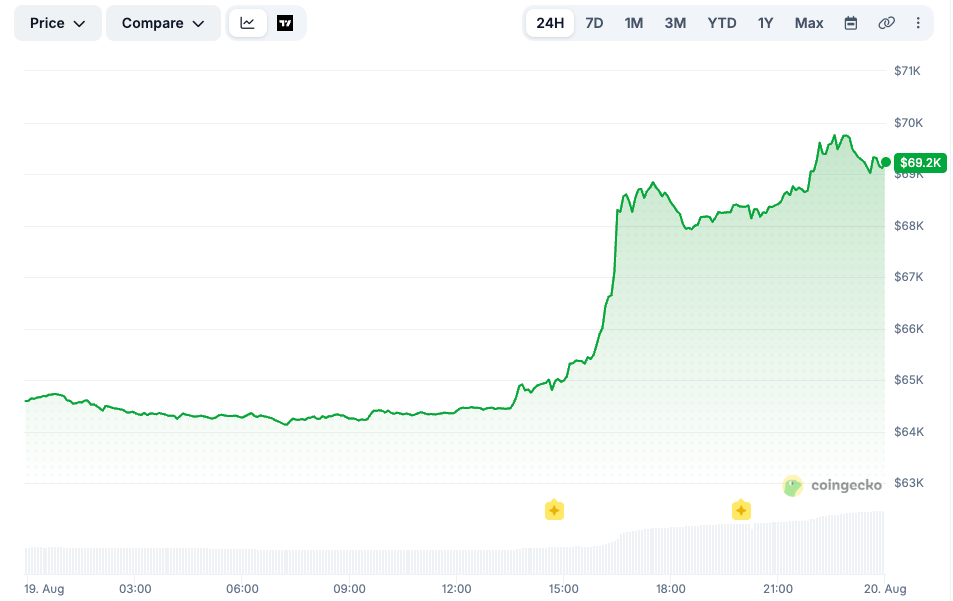
Bitcoin Price Chart, Source: Coingecko

  • Ethereum: Currently trading at $2,269.04, surging 18.6% in 24 hours, with a trading range of $1,905.44–$2,318.66, market cap reaching $274.047 billion. Ethereum's gains in this rally significantly outperformed Bitcoin's, and its exchange rate against BTC also strengthened, indicating accelerated capital inflow back into the Ethereum ecosystem.
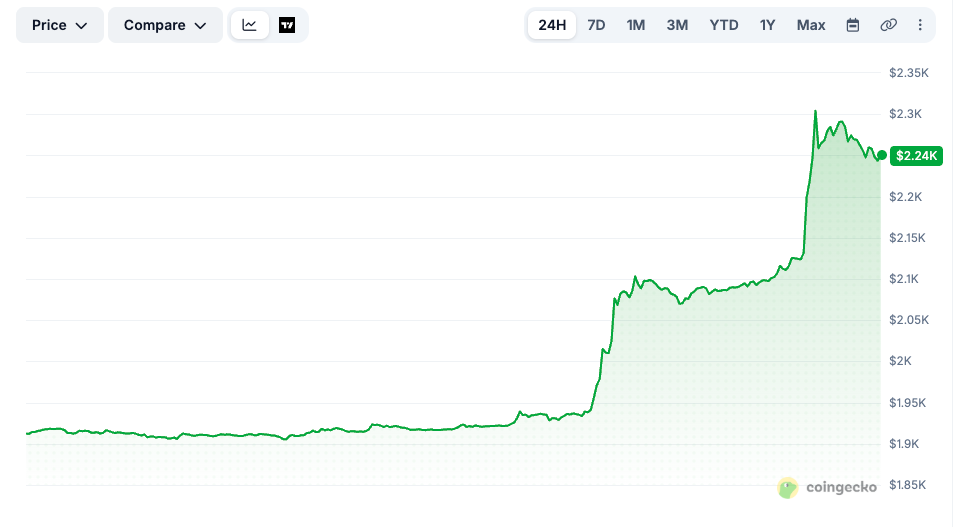
Ethereum Price Chart, Source: Coingecko

  • BNB: Currently trading at $631.92, up 4.9% in 24 hours, with a relatively moderate gain among mainstream large caps, trading range $600.92–$635.85.
  • Solana: Currently trading at $85.65, up 11.2% in 24 hours, trading range $76.59–$86.96, market cap $49.952 billion, the chart shows an accelerated breakout above previous highs.
  • Hyperliquid (HYPE): The most dramatic gainer in this rally, currently trading at $71.41, surging 22.2% in 24 hours, trading range $58.04–$72.28.

Reason Analysis: Macro Spark, Leveraged Structure Amplifies Gains

Considering recent market dynamics and derivatives data, this rally was not driven by a single factor, but rather the combined effect of macro liquidity tailwinds, warmer regulatory signals, and the concentrated unwinding of leveraged short positions.

Reason One: U.S. Treasury's unexpected "injection," lowering long-term rates, boosting risk appetite. On August 19 local time, the U.S. Treasury Department announced it would at least double the size of its long-term Treasury buyback operations, increasing from $2 billion per operation to over $4 billion, covering the period from September 9 to November 4, primarily targeting 10 to 30-year Treasury bonds. This move was seen as a direct response to the recent surge in the 30-year Treasury yield to its highest level since 2007 (briefly reaching 5.34%). Following the announcement, yields on both the 10-year and 30-year Treasuries immediately fell, and U.S. stock futures rose in tandem, with the overall improvement in risk appetite providing a tailwind for the crypto market. The market interpreted the Treasury's operation as a de facto liquidity injection, and its timing aligns closely with the start of the crypto market rally.

Reason Two: White House crypto summit combined with SEC regulatory easing shifts policy sentiment positively. On the same day, Trump met with crypto industry executives from companies like Coinbase, Ripple, Gemini, and leaders from the SEC and CFTC at the White House, reiterating efforts to push the CLARITY Act through the Senate quickly to provide a clearer regulatory framework for the industry. Just one day before the summit, the SEC formally proposed a new draft rule named Regulation Crypto Assets, aiming to provide crypto project teams with a fundraising exemption channel of up to $75 million per year. The intensive release of friendly signals from regulators and the White House within the same week has somewhat alleviated market concerns about previous policy uncertainty, providing a narrative foundation for capital to flow back into crypto assets.
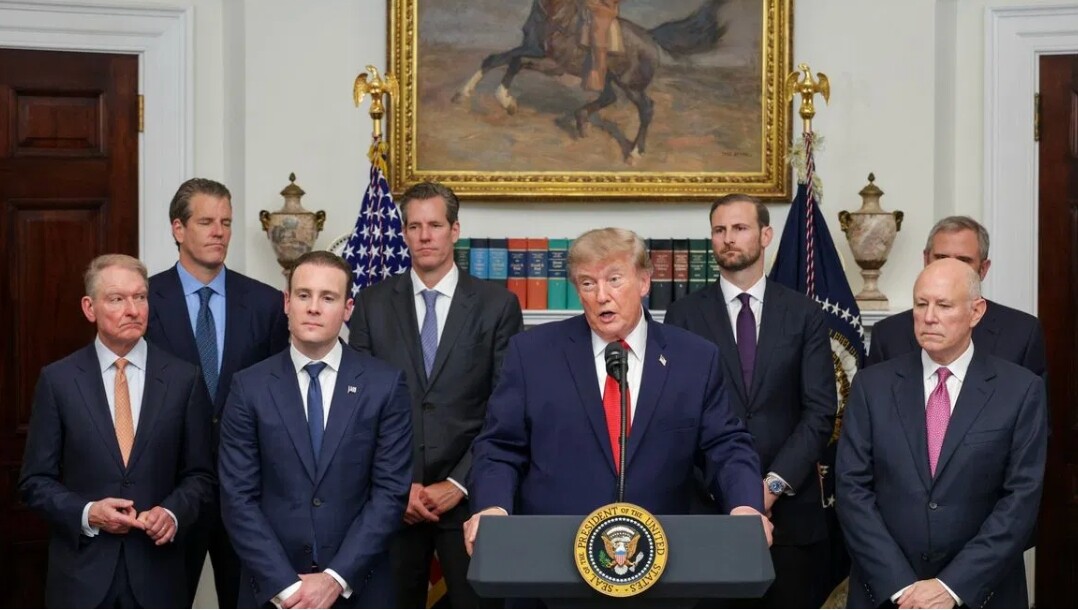
Trump meets industry leaders, Source: ABCNews

Reason Three: Bitcoin Spot ETF outflows trend reverses, whales accumulating on dips. Previously, Bitcoin Spot ETFs had seen consecutive days of net outflows. However, this rally is accompanied by signs of improving fund flows, with leading products like BlackRock's IBIT and Fidelity's FBTC recording net inflows again, indicating institutional capital is returning. Meanwhile, on-chain data shows that large holder addresses, after a period of sustained selling for about 60 days, have begun accumulating again, providing support on the spot side for price stabilization and creating conditions for the subsequent squeeze on leveraged shorts.

Reason Four: Concentrated liquidation of leveraged shorts creates a typical "short squeeze" scenario. Looking at derivatives data, the scale of short liquidations during this rally far exceeded long liquidations. According to Coinglass data, as of publication time, total 24-hour liquidations across all exchanges have expanded to $2.98 billion, with over 170,000 traders liquidated, the vast majority being shorts; in a 4-hour window, short liquidations once accounted for up to 93.3% of the total. The largest single liquidation order across all networks appeared on Hyperliquid's BTC-USD contract, amounting to $48.8 million. The forced liquidation of large short positions often creates an instantaneous vacuum of buy orders in the order book, pushing prices to accelerate away from their previous range, thereby triggering more stop-loss orders and forming a positive feedback loop of "longs squeezing shorts."


Preguntas relacionadas

QWhat were the four main reasons identified in the article for the sudden surge across the cryptocurrency market?

AThe four main reasons were: 1) The US Treasury's unexpected liquidity injection by doubling its long-term Treasury bond buyback operation, which lowered long-term yields and boosted risk appetite. 2) Positive regulatory sentiment from the White House crypto summit and the SEC's new regulatory draft, easing policy uncertainty. 3) A reversal in the outflow trend of Bitcoin spot ETFs and renewed accumulation by large investors ('whales'). 4) A classic 'short squeeze' where leveraged short positions were liquidated on a large scale, amplifying the price rise.

QAccording to the article, which cryptocurrency posted the highest 24-hour gain, and what was its percentage increase?

AAccording to the article, Hyperliquid (HYPE) posted the highest 24-hour gain, with a surge of 22.2%.

QHow did the article describe the role of the SEC's new regulatory draft in the market rally?

AThe article described the SEC's proposed new rule, 'Regulation Crypto Assets,' as a positive regulatory signal that eased market concerns about policy uncertainty. The draft aims to provide a financing exemption channel for crypto projects, offering up to $75 million per year. This, combined with signals from the White House summit, provided a supportive narrative for capital flowing back into crypto assets.

QWhat specific action by the US Treasury coincided with the start of the crypto market rally, and what was its intended effect?

AThe specific action was the US Treasury's announcement to at least double the size of its long-term Treasury bond buyback operations, increasing from $2 billion to over $4 billion per operation. This was a direct response to high long-term bond yields and was interpreted by the market as a form of liquidity injection. Its intended effect was to lower long-term interest rates (like the 10-year and 30-year Treasury yields), which in turn boosted overall risk appetite among investors.

QWhat data point from Coinglass indicated that a short squeeze was a major factor in the price surge?

AThe data point from Coinglass indicating a major short squeeze was that within a 4-hour window, short liquidations accounted for as high as 93.3% of the total liquidations. Furthermore, over a 24-hour period, the total liquidation amount reached $2.98 billion, with short positions making up the overwhelming majority of that figure.

Lecturas Relacionadas

Musk Awaits $50 Trillion: Is There a Limit to the U.S. National Debt and What Comes Next?

Elon Musk reacted to a projection of US national debt reaching $50 trillion by 2030, labeling it a "precise timeline" with a laughing emoji. The debt has recently passed the $40 trillion mark. Skeptics note that specific debt thresholds have been breached before without immediate collapse. However, analysts warn the focus should shift from the nominal debt amount to its affordability. A key metric is when the average interest rate on the debt exceeds the economy's growth rate, a point the US Congressional Budget Office projects for 2031. Once this "debt spiral" begins, interest costs grow self-reinforcing. Currently, interest payments have already surpassed defense spending, exceeding $1 trillion annually. Ray Dalio warns a debt crisis could occur within "three years, plus or minus two," advising portfolio diversification into gold and some Bitcoin. Potential outcomes if debt becomes unmanageable include: 1) Financial repression and monetization (the "Japanese path" of controlled yields and inflation), seen as the most likely; 2) Severe austerity (the "Greek path" of spending cuts/tax hikes), considered politically unlikely; or 3) Technical default/restructuring, which would cause global financial shock. The most probable path is a hybrid of moderate financial repression and gradual inflation, leading not to a sudden crash but to long-term economic stagnation and a declining standard of living. By 2056, debt could reach 175% of GDP. Ultimately, the limit for US debt is not a fixed number but a function of market confidence in the dollar.

cryptonews.ruHace 1 hora(s)

Musk Awaits $50 Trillion: Is There a Limit to the U.S. National Debt and What Comes Next?

cryptonews.ruHace 1 hora(s)

Solana Developer Mert Mumtaz Highly Praises Altcoin!

In the world of cryptocurrencies and finance, where privacy is a major focus, significant developments are underway. Valor Group founder Dev and notable crypto ecosystem figure Mert Mumtaz participated in a program on The Rollup crypto broadcasting platform, discussing the latest developments for the Zcash (ZEC) network and its important future roadmap. The conversation covered network scalability, security updates, and measures taken against quantum threats. The recent Ironwood update implemented in the Zcash network is considered a crucial milestone for the project. During the event, Mert highlighted that internal security audits using 'red team' methods and AI identified a potential vulnerability in the Orchard pool that could have allowed the creation of counterfeit notes. Extensive work and formal verification proved the code mathematically perfect according to specifications. The seamless migration of funds from the Orchard pool to the new Ironwood pool has completely eliminated the risk of counterfeit coin creation in the network. Dev shared important technical details about Zcash's future vision, emphasizing that Valor Group's main goal is for Zcash to achieve transaction volumes comparable to credit cards. He stated they aim to process over 50,000 transactions per second with sub-second latency while maintaining the full proof-of-work mechanism. The main scaling bottleneck was identified not as the nodes themselves, but wallet scanning processes. A new wallet architecture and synchronization delay optimization are expected to resolve this issue. The upcoming Tachion update promises to provide complete protection for Zcash against quantum computing threats. This update will integrate recursive zero-knowledge proofs into the network. It is reported to reduce transaction sizes by more than five times, eliminate node data processing overhead, and address state growth issues. With Tachion, the network is claimed to achieve not just 'quantum-resilient' but a truly 'quantum-secure' privacy structure.

cryptonews.ruHace 1 hora(s)

Solana Developer Mert Mumtaz Highly Praises Altcoin!

cryptonews.ruHace 1 hora(s)

Trading

Spot
活动图片