BREAKING: Mastercard Just Opened Its Global Payment Network To Crypto — Which Altcoins Made The Cut?

bitcoinistPublicado a 2026-06-03Actualizado a 2026-06-03

Resumen

Mastercard announced the expansion of its global settlement infrastructure to support on-chain settlement using regulated stablecoins. This enables card transactions to settle 24/7, eliminating delays from traditional banking hours. The initial rollout supports six stablecoins—USDC, PYUSD, USDG, USDP, RLUSD, and SoFiUSD—across eight blockchains, including Ethereum, Solana, and the XRP Ledger. The service is launching with partners in the U.S. and Latin America. This is a back-end settlement upgrade, not a consumer-facing change, allowing network partners to optionally use blockchain rails while traditional fiat settlement remains available.

Mastercard announced on June 3 that it will expand its global settlement infrastructure to support on-chain settlement using crypto via regulated stablecoins — enabling card transactions to settle 24 hours a day, seven days a week, across weekends and holidays for the first time in the network’s history, per the company’s official press release.

Six regulated crypto and stable coins are supported in the initial rollout: Circle’s USDC, PayPal’s PYUSD, Paxos-issued USDG and USDP, Ripple’s RLUSD, and SoFi’s SoFiUSD. Settlement will operate across eight blockchain networks — Ethereum, Solana, Polygon, Base, Arbitrum, the XRP Ledger, Canton, and Tempo — per the official announcement.

ARQ (formerly DolarApp), CBW Bank, Cross River, Lead Bank, and Nuvei are among the first partners to support stablecoin settlement optionality, with the initial rollout targeting the United States and Latin America before broader expansion through 2026.
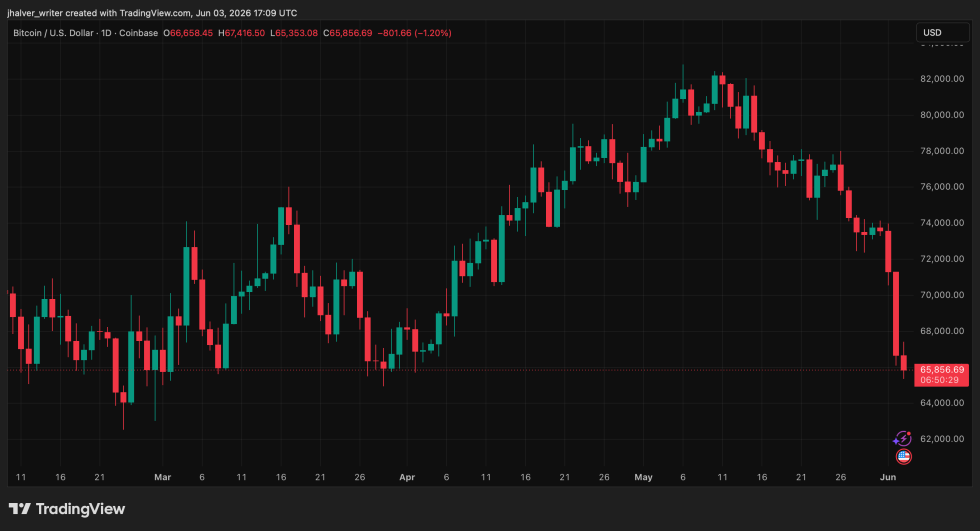
BTC's price trends to the downside on the daily chart. Source: BTCUSD on Tradingview

What Changes For Crypto — And What Doesn’t

The announcement is a settlement-layer development, not a consumer-facing product shift. Issuers and acquirers on Mastercard’s network can now choose to settle card-based transactions using regulated stablecoins on-chain rather than through traditional banking rails — or continue using existing fiat processes. Both options run in parallel. No cardholder needs to change how they pay.

What changes is the back-end infrastructure that clears and finalizes transactions between merchants, banks, and payment processors. That infrastructure can now operate on blockchain networks around the clock — removing the dead zones created by banking hours, weekend closures, and public holidays that have been a structural friction point in global payments for decades, per Mastercard’s press release.

Raj Dhamodharan, Mastercard’s Executive Vice President for Blockchain and Digital Assets, described the enhancement as expanding how partners manage liquidity while operating in an always-on digital economy, per the announcement. Ripple SVP Jack McDonald called it a landmark validation that blockchain technology is ready for the world’s most critical payment infrastructure, per Benzinga’s reporting of his statement.

This development marks a pivotal and historic moment for the nascent sector. The world’s second-largest card network opening its global settlement rails to six regulated stablecoins across eight blockchains — not as a pilot, not as a proof of concept, but as a live network-level enhancement — is the clearest institutional validation the stablecoin economy has received to date.

Cover image from Grok, BTCUSD chart from Tradingview

Preguntas relacionadas

QWhat major announcement did Mastercard make on June 3 regarding its payment network?

AMastercard announced it is expanding its global settlement infrastructure to support on-chain settlement using regulated stablecoins, enabling card transactions to be settled 24/7 for the first time in the network's history.

QWhich six regulated stablecoins are supported in the initial rollout of Mastercard's new settlement system?

AThe six supported stablecoins are Circle's USDC, PayPal's PYUSD, Paxos-issued USDG and USDP, Ripple's RLUSD, and SoFi's SoFiUSD.

QHow many and which blockchain networks will this settlement system operate across according to the announcement?

ASettlement will operate across eight blockchain networks: Ethereum, Solana, Polygon, Base, Arbitrum, the XRP Ledger, Canton, and Tempo.

QWho are among the first partners to support stablecoin settlement optionality with Mastercard?

AThe first partners include ARQ (formerly DolarApp), CBW Bank, Cross River, Lead Bank, and Nuvei.

QWhat is the key difference this announcement makes for crypto transactions on Mastercard's network?

AThe announcement is a settlement-layer development, not a consumer-facing change. Issuers and acquirers can now choose to settle card transactions using regulated stablecoins on-chain, operating 24/7, instead of or alongside traditional banking rails. Cardholders' payment methods do not change.

Lecturas Relacionadas

$9.4 Billion: The Largest Robotics Funding This Year Has Emerged

Munich-based humanoid robotics company Neura has completed a $1.4 billion (approximately RMB 94.9 billion) Series C funding round, valuing the company at around $7 billion and positioning it among the global leaders in the sector. The investment round is notable not just for its size—reportedly the largest in robotics this year—but also for its strategic backers, which include tech giants like NVIDIA and Amazon, alongside established industrial players such as German engineering firms Bosch and Schaeffler. This mix of investors signals a significant shift in the industry's focus from technological demonstrations and general-purpose narratives toward practical, industrial deployment and commercialization. Neura's approach centers on developing humanoid robots for defined, high-value industrial tasks rather than pursuing a general-purpose model. Its early validation comes from a partnership with BMW, where its robots are being tested on actual production lines. The involvement of Bosch and Schaeffler, companies deeply embedded in global manufacturing, underscores a growing belief that humanoid robots are transitioning from labs to viable factory-floor solutions. The article highlights two converging trends driving investment: advancements in AI and large language models, which enhance robots' perception and decision-making in unstructured environments, and mounting pressure from labor shortages and rising costs in major manufacturing regions. The funding landscape is now bifurcating between companies like Figure AI, focusing on versatile general-purpose robots, and firms like Neura, targeting specific vertical industrial applications with clearer, shorter paths to ROI. While technical hurdles remain, the core challenges for widespread adoption are increasingly seen as engineering and commercial in nature: managing the high integration and customization costs for different factory environments and establishing robust, localized maintenance and service networks. The record investment in Neura, particularly from industrial capital, indicates the industry's growing confidence in moving from proving feasibility to solving the practical problems of scalability, reliability, and building sustainable business models around humanoid robots in real-world settings like automotive manufacturing and hazardous labor environments.

marsbitHace 3 hora(s)

$9.4 Billion: The Largest Robotics Funding This Year Has Emerged

marsbitHace 3 hora(s)

"119 to 176 Dollars": Behind SpaceX's Listing, MSX Once Again Successfully Executes the Pre-IPO Closed Loop

Following May's 300% gain on Cerebras, MSX delivered another outstanding performance during SpaceX's listing night. On June 12, SpaceX (SPCX) launched on Nasdaq, reaching a high of $176. This marked the successful culmination of MSX's Pre-IPO project launched in March, where users subscribed at $119, achieving gains of approximately 40-48%. This event validated MSX's complete Pre-IPO mechanism, a crucial advantage in a market where access to top-tier private company equity is typically limited to institutions. MSX's model provides a full cycle for users: subscription (at $119 for SpaceX), real-time on-chain portfolio tracking, optional early redemption, seamless conversion to tradable spot assets (SPCX.M) upon IPO, and final settlement in stablecoins. This end-to-end process distinguishes MSX from platforms that faced settlement issues during the SpaceX IPO, highlighting that the core challenge of Pre-IPO is not just access, but a clear exit and conversion path post-listing. This success with SpaceX is MSX's second major Pre-IPO verification, following the Cerebras listing in May, which yielded ~300% returns for early participants. These back-to-back achievements demonstrate MSX's capability to source, structure, and deliver real assets through a replicable on-chain model. The true barrier for Pre-IPO products lies not in providing an entry point, but in ensuring reliable fulfillment from subscription through to post-IPO liquidity. MSX's proven闭环 (closed-loop) process addresses this, offering Web3 users a structured way to access high-growth, pre-public companies in sectors like AI and frontier tech. MSX plans to continue expanding its Pre-IPO portfolio with this focus on authenticity, transparency, and post-listing execution.

Odaily星球日报Hace 16 hora(s)

"119 to 176 Dollars": Behind SpaceX's Listing, MSX Once Again Successfully Executes the Pre-IPO Closed Loop

Odaily星球日报Hace 16 hora(s)

Trading

Spot
Futuros
活动图片





