Breaking! A Historic Turning Point in U.S. Crypto Regulation: A Guide to the New Framework (Essential Edition)

比推Publicado a 2026-03-18Actualizado a 2026-03-18

Resumen

The U.S. SEC and CFTC jointly released a landmark 68-page regulatory framework on March 17, 2026, marking a historic shift in crypto regulation. The framework classifies crypto assets into five categories: Digital Commodities (e.g., BTC, ETH), Digital Securities, Regulated Payment Stablecoins, Digital Tools, and Digital Collectibles. A key innovation is the "Separation" mechanism, allowing assets to transition from securities to commodities once they become decentralized and no longer rely on managerial efforts. The guidance also clarifies that activities like mining, staking, wrapping, and airdrops (without consideration) are generally not securities transactions. This clarity aims to reduce compliance costs, encourage innovation, and solidify U.S. leadership in crypto regulation, ending the "Wild West" era of digital assets.

The era of the 'Wild West' for crypto assets is officially over.

On March 17, 2026, the U.S. Securities and Exchange Commission (SEC) and the Commodity Futures Trading Commission (CFTC) jointly released an interpretive document numbered 33-11412. This 68-page regulatory framework officially marks the end of a decade-long era of 'regulation by enforcement' for U.S. crypto oversight, ushering in a new epoch of clarity and harmony driven by "Project Crypto".
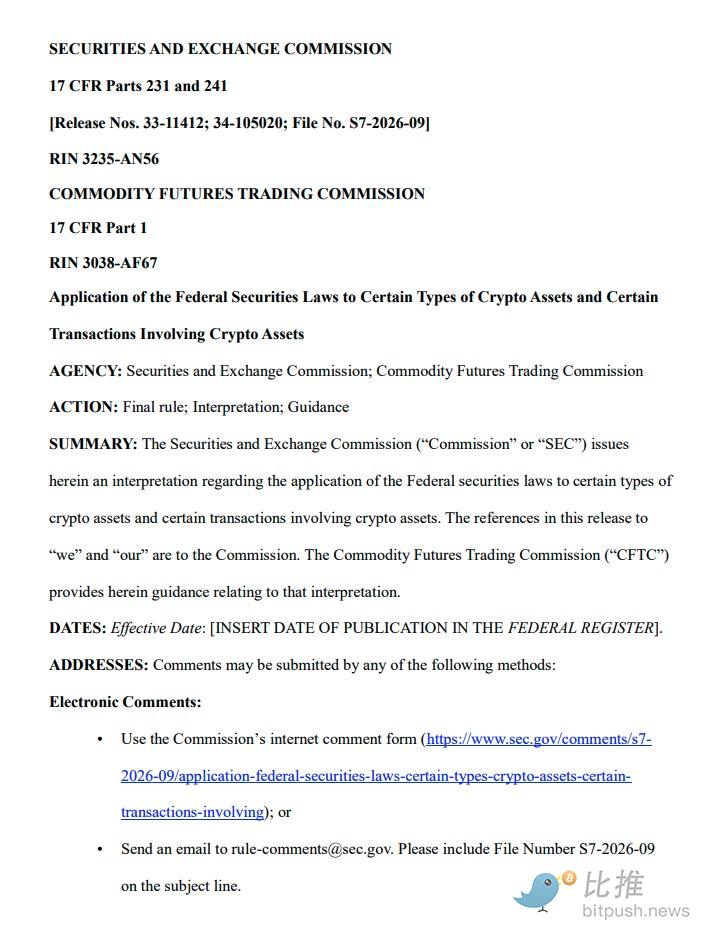
This document is not only a rare product of regulatory collaboration between the SEC and CFTC but also the most landmark guidance in the history of U.S. crypto regulation. Below is the full essential interpretation:

I. Background: "Project Crypto" - From Conflict to Collaboration

In 2017, the SEC first applied the Howey Test to crypto assets through "The DAO Report." For the following decade, regulation primarily relied on enforcement actions to define asset attributes, leaving the market in a prolonged state of uncertainty and controversy.

In early 2025, the SEC established the "Crypto Task Force," subsequently launching the "Project Crypto" initiative, co-led by SEC Chairman Paul S. Atkins and CFTC Chairman Michael S. Selig. The initiative aimed to coordinate the mandates of the two regulatory bodies, establish a unified asset classification methodology, and provide a clear path for crypto innovation to remain in the U.S. In January 2026, the project was officially upgraded to a joint SEC-CFTC operation.

II. Asset Classification: The "Five-Category" Logic for Crypto Assets

Based on asset characteristics, use cases, and functionality, the document divides crypto assets into five major categories, providing the market with a clear classification standard for the first time:

  1. Digital Commodities

    Definition: Assets whose value derives from the programmed operation and supply-demand dynamics of a "functional" crypto system, not from the managerial efforts of others.

    Core List: The document explicitly names mainstream tokens such as BTC, ETH, SOL, XRP, ADA, DOT, AVAX, LINK, etc., as digital commodities. These assets are not controlled by any single centralized entity and do not possess economic rights that generate passive income.

  2. Digital Securities

    Definition: "Tokenized securities," referring to traditional securities represented in the form of crypto assets, or digital assets possessing the economic substance of securities (e.g., representing corporate ownership, dividend rights).

    Regulation: Regardless of whether on-chain or off-chain, as long as the economic substance is met, they fall under SEC jurisdiction.

  3. Regulated Payment Stablecoins

    Definition: Stablecoins that meet the definition of the 2025 "GENIUS Act" and are issued by authorized institutions.

    Classification: These stablecoins are explicitly excluded from the definition of "securities" and are primarily constrained as payment instruments under specific legislation.

  4. Digital Tools

    Use: Tokens with utility functions (e.g., access rights or service payments) only within specific crypto systems, typically not considered securities.

  5. Digital Collectibles

    Definition: Assets intended to be collected and/or used, representing items such as artwork, music, videos, in-game items, or internet memes.

    Examples: CryptoPunks, Chromie Squiggles, WIF, VCOIN, etc.

    Classification: Not securities themselves; value derives from supply and demand, not the managerial efforts of others. However, if fractionalized and sold, they may constitute securities.

III. Innovation: "Separation" and "Dynamic Conversion" of Security Attributes

This is the document's most groundbreaking legal innovation—the SEC acknowledges for the first time that the "security attribute" of a crypto asset is not permanent.

"Separation" Mechanism

  • Principle: A project in its early financing stages might be considered a security (investment contract) if it meets the Howey Test. However, once the project completes its roadmap, achieves autonomous operation of open-source code, and decentralizes network power, the asset can be "separated" from the investment contract.

  • Judgment Standard: When investors no longer reasonably rely on the "essential managerial efforts" of the issuer for profits, but instead rely on the system's own operation and market supply and demand, the asset transitions from a "security" to a "digital commodity."

  • Separation Timing: Can occur immediately upon delivery of the asset to the purchaser or at a future date.

Three Scenarios for Separation

  1. Issuer Fulfills Promises: After completing essential managerial efforts, even if non-essential maintenance continues, the asset is no longer bound by the investment contract.

  2. Issuer Abandons Project: If development is publicly abandoned and promises are no longer fulfilled, the asset falls outside securities law jurisdiction (though the issuer may still face legal liability for fraud).

  3. Secondary Market Trading: If subsequent purchasers no longer reasonably expect to rely on the issuer's efforts for profit, the transaction does not constitute a securities transaction.

Transparency Recommendation

The SEC encourages project teams to publicly disclose roadmap progress and milestone achievements to help the market identify the "point of separation."

IV. Qualification of On-Chain Activities: "Demining" Decentralization

The document provides extremely detailed and favorable interpretations of long-debated activities like staking, mining, wrapping, and airdrops:

Protocol Mining

  • Qualification: PoW mining is an "administrative or ministerial" activity that secures the network and validates transactions.

  • Conclusion: Whether solo mining or joining a mining pool, it does not involve securities issuance.

  • Pool Operation: The activities of pool operators are administrative and do not constitute essential managerial efforts.

Protocol Staking

  • Qualification: Staking is an administrative activity for maintaining network operation.

  • Coverage: Includes solo staking, delegated third-party staking, custodial staking, liquid staking.

  • Custodial Staking: If a custodian stakes on behalf of users, and it does not involve re-lending, leveraging, or discretionary trading of assets, it does not constitute a securities activity.

  • Ancillary Services: Auxiliary services like slash insurance, early unstaking, flexible reward distribution, and asset aggregation are all considered administrative tasks.

Staking Receipt Tokens

  • Qualification: If the underlying asset is a non-security commodity and not subject to an investment contract, the receipt token itself is not a security.

  • Principle: The receipt merely acts as a "receipt"; it does not generate yield—yield originates from the underlying staking activity.

Wrapping Tokens

  • Definition: Users deposit crypto assets with a custodian or cross-chain bridge to obtain 1:1 pegged, redeemable wrapped tokens.

  • Qualification: If the underlying asset is a non-security commodity and not subject to an investment contract, wrapping is an "administrative function" aimed at enhancing interoperability and does not constitute a securities transaction.

  • Key Restriction: The custodian must lock the assets and cannot lend, collateralize, or re-stake them.

Airdrops

  • Qualification Breakthrough: As long as the recipient does not provide money, goods, services, or other consideration, it does not meet the "investment of money" element of the Howey Test.

  • Applicable Scenarios:

    • Airdropping to wallets holding a specific token, without prior announcement.

    • Rewarding early testnet users.

    • Airdropping to eligible users based on application usage.

  • Red Line: If recipients need to provide services (e.g., social media promotion) in exchange for the airdrop, it may constitute a securities offering.

V. Consolidation of U.S. Leadership

The document details its economic significance at the end:

  1. Eliminate "Chilling Effect": By providing legal clarity, it reduces business stagnation caused by opaque compliance and encourages crypto innovation to return to the U.S.

  2. Reduce Compliance Costs: Clear classification and separation paths significantly lower legal consulting and regulatory response costs for enterprises.

  3. Enhance Market Transparency: The new framework requires more detailed disclosure during the "investment contract" stage, better protecting investors.

  4. Promote Competition and Innovation: Clear rules will attract more issuers and entrepreneurs to the market.

  5. Improve Pricing Efficiency: Reduce price distortions caused by uncertainty.

VI. Historic Breakthrough in Regulatory Collaboration

Structurally, the document establishes a clear analytical path: first classify the asset, then judge the transaction structure, and finally analyze whether the investment relationship continues to exist.

More importantly, this is a rare instance of coordination between the SEC and CFTC on crypto regulatory issues. Previously, the two agencies had long-standing disagreements over the "security vs. commodity" definition. This joint framework essentially provides a preliminary division for the归属 (guīshǔ -归属) of major asset categories, marking a shift in U.S. crypto regulation from the stage of "inter-agency jurisdictional competition" to a "division of labor system based on unified rules."

This 68-page document not only ends a decade of regulatory chaos but also establishes U.S. leadership in the global crypto regulatory landscape. For practitioners, it is a must-read "industry constitution"; for investors, it is a clear "rights protection guide"; for entrepreneurs, it is a definitive "compliance roadmap".

The era of the 'Wild West' for crypto assets is officially over.


Twitter:https://twitter.com/BitpushNewsCN

Bitpush TG Discussion Group:https://t.me/BitPushCommunity

Bitpush TG Subscription: https://t.me/bitpush

Disclaimer: All articles on Bitpush represent the author's views only and do not constitute investment advice.
CFTCHoweySECRegulationSecurities

Criptos en tendencia

Preguntas relacionadas

QWhat is the significance of the joint SEC and CFTC interpretive release (33-11412) for US crypto regulation?

AThe release marks a historic shift from a decade of 'regulation by enforcement' to a new era of clear, harmonized rules under 'Project Crypto'. It provides a comprehensive 68-page framework that clarifies asset classification, establishes a path for innovation, and signifies unprecedented collaboration between the two major US financial regulators.

QHow does the new framework classify crypto assets, and can you name some examples?

AThe framework classifies crypto assets into five categories: 1) Digital Commodities (e.g., BTC, ETH, SOL, XRP, ADA, DOT, AVAX, LINK), 2) Digital Securities (tokenized traditional securities), 3) Regulated Payment Stablecoins (as defined by the 2025 GENIUS Act), 4) Digital Tools (utility tokens for system access), and 5) Digital Collectibles (e.g., CryptoPunks, WIF).

QWhat is the 'Separation' mechanism, and why is it a legal breakthrough?

AThe 'Separation' mechanism is a legal breakthrough where the SEC acknowledges that an asset's 'security' status is not permanent. An asset can be 'stripped' from being an investment contract (security) when a project completes its roadmap, becomes decentralized, and its value no longer relies on the 'essential managerial efforts' of a promoter but on the system's own operation and market supply and demand.

QHow does the framework regulate on-chain activities like staking, wrapping, and airdrops?

AThe framework provides favorable clarifications: Protocol Staking and Mining are 'administrative or ministerial' activities, not securities offerings. Wrapping is an 'administrative function' if the underlying asset is a non-security commodity. Airdrops are generally not securities if recipients provide no consideration (money, goods, services); however, they can be if they require services like social media promotion.

QWhat are the expected economic impacts of this new regulatory framework?

AThe framework is expected to: 1) Eliminate the 'chilling effect' of regulatory uncertainty, encouraging crypto innovation to return to the US; 2) Lower compliance costs for businesses; 3) Enhance market transparency and investor protection; 4) Foster competition and innovation; and 5) Improve pricing efficiency by reducing distortions caused by uncertainty.

Lecturas Relacionadas

Must-Watch Events Next Week|CLARITY Act Could Face Senate Vote; SpaceX, Circle to Report Earnings (8.3-8.9)

**Summary: Key Events and Developments to Watch (August 3-9)** The upcoming week is marked by significant financial disclosures, key legislative deadlines, and notable product updates. **Major Financial Events:** Several companies are scheduled to release their Q2 2026 earnings. American Bitcoin (ABTC) will report on August 3, followed by SpaceX and Hut 8 Mining Corp. on August 4, and Circle on August 5. Notably, a significant portion of SpaceX shares (up to 12% of total shares) will be unlocked on August 6 following their earnings release. **Key Legislative Deadline:** The U.S. Senate faces an August 7 deadline to secure 60 votes for the CLARITY Act, a bipartisan bill aiming to establish a federal regulatory framework for cryptocurrencies. The Senate may hold a full vote on the bill during the week. **Economic Data:** The U.S. July Non-Farm Payrolls report will be released on August 7, providing crucial labor market data. **Technology & Product Updates:** * **Shutdowns:** DeFi portfolio tracker Zapper and wallet app Ctrl Wallet will cease operations on August 3. * **Upgrades:** LayerZero will deprecate its v1 relayers on August 3. XRP Ledger's new version 3.3.0, featuring five new functions, is expected next week. * **AI:** Elon Musk announced that the advanced Grok 4.6 AI model is set for release around August 7. * **Bitcoin:** The BIP-110 forced signaling for a potential Bitcoin network change is scheduled to begin around August 8. **Other Notable Events:** Chinese robotics firm Unitree Tech has set its preliminary price inquiry for its IPO for August 5. South Korean exchange Upbit will delist AQT and AERGO tokens on August 3.

marsbitHace 1 hora(s)

Must-Watch Events Next Week|CLARITY Act Could Face Senate Vote; SpaceX, Circle to Report Earnings (8.3-8.9)

marsbitHace 1 hora(s)

Stocks Are Plummeting More Sharply Than Cryptocurrencies. Where Has the Money Gone?

Stock Markets Plunge Deeper Than Cryptocurrencies: Where Did the Money Go? In late July, Seoul's Kospi index triggered circuit breakers for two consecutive days, plummeting over 40% from its June high. The collapse was led by heavyweight stocks like SK Hynix, whose record profits still disappointed investors, and devastating leveraged ETFs, with one major product losing over 83% of its value. This signaled a global, forced deleveraging targeting the most crowded trades. Interestingly, while stocks exhibited extreme volatility akin to crypto markets, Bitcoin rose nearly 15% in July after a prior steep drop. Analysis shows the money fleeing equities did not flow into Bitcoin. Instead, Bitcoin had already absorbed its sell-off in May-June, when U.S. spot Bitcoin ETFs saw historic outflows. The true safe-haven beneficiary was gold, whose price rose over 20% year-on-year, highlighting a decoupling between Bitcoin and gold as "digital gold." The sell-off was a targeted unwinding of leveraged positions in tech and semiconductors, accelerated by broker-dealer risk management and shifts in the AI narrative, including new competition from Chinese memory chipmakers. The retreat path was clear: from high-valuation tech stocks to cash and U.S. Treasuries, then to gold. For Bitcoin to attract sustained institutional inflows, conditions like eased global liquidity pressure, a "soft-landing" Fed rate cut, and U.S. regulatory clarity via legislation like the stalled CLARITY Act are needed. Currently, Bitcoin is not a safe haven but an already-cleared asset. Its low correlation with tech stocks, however, makes it a potential diversification play for institutional portfolios once the storm passes. The money isn't here yet, but the positioning is underway.

marsbitHace 1 hora(s)

Stocks Are Plummeting More Sharply Than Cryptocurrencies. Where Has the Money Gone?

marsbitHace 1 hora(s)

In Conversation with Ray Dalio: We Are Currently in an AI Bubble, with 1% of My Portfolio in Bitcoin

Ray Dalio, founder of Bridgewater Associates, warns in an interview that the current AI boom shows classic bubble characteristics, which could lead to significant economic downturns as seen in past cycles like 1929 or 2000. He explains that speculative enthusiasm, fueled by debt and overvaluation, often precedes a crash when rising rates or taxation force asset sales, causing widespread losses and recession. Dalio also outlines his "Big Cycle" theory, describing an approximate 80-year pattern where widening wealth gaps, massive government deficits, and shifting geopolitical power (like China's rise) create internal conflict and global instability. He emphasizes that we are in a late-cycle, transitional phase where traditional powers like the US and UK face decline. For personal wealth protection, Dalio advises diversification beyond cash into assets like stocks, bonds, real estate, and particularly gold, which he prefers over Bitcoin. While he holds about 1% of his portfolio in Bitcoin as a non-printable hard asset, he views gold as more secure from technological or governmental threats. Regarding AI's impact, Dalio believes it will disproportionately benefit capital owners, worsening inequality by replacing both physical and cognitive labor. He suggests that human intuition and emotional intelligence, combined with AI, will be key for future workers. On taxation, Dalio argues that wealth taxes are impractical and risk triggering asset sell-offs, reducing productive investment. He points to the UK as a cautionary example of debt, low productivity, and political strife. Geopolitically, Dalio foresees a more regionalized world, with the US showing weakness in prolonged conflicts like with Iran, akin to past imperial declines. The ideal outcome, he suggests, is coexisting powerful blocs (e.g., Americas, China-Asia Pacific) without major war.

marsbitHace 5 hora(s)

In Conversation with Ray Dalio: We Are Currently in an AI Bubble, with 1% of My Portfolio in Bitcoin

marsbitHace 5 hora(s)

Trading

Spot

Artículos destacados

Cómo comprar ERA

¡Bienvenido a HTX.com! Hemos hecho que comprar Caldera (ERA) sea simple y conveniente. Sigue nuestra guía paso a paso para iniciar tu viaje de criptos.Paso 1: crea tu cuenta HTXUtiliza tu correo electrónico o número de teléfono para registrarte y obtener una cuenta gratuita en HTX. Experimenta un proceso de registro sin complicaciones y desbloquea todas las funciones.Obtener mi cuentaPaso 2: ve a Comprar cripto y elige tu método de pagoTarjeta de crédito/débito: usa tu Visa o Mastercard para comprar Caldera (ERA) al instante.Saldo: utiliza fondos del saldo de tu cuenta HTX para tradear sin problemas.Terceros: hemos agregado métodos de pago populares como Google Pay y Apple Pay para mejorar la comodidad.P2P: tradear directamente con otros usuarios en HTX.Over-the-Counter (OTC): ofrecemos servicios personalizados y tipos de cambio competitivos para los traders.Paso 3: guarda tu Caldera (ERA)Después de comprar tu Caldera (ERA), guárdalo en tu cuenta HTX. Alternativamente, puedes enviarlo a otro lugar mediante transferencia blockchain o utilizarlo para tradear otras criptomonedas.Paso 4: tradear Caldera (ERA)Tradear fácilmente con Caldera (ERA) en HTX's mercado spot. Simplemente accede a tu cuenta, selecciona tu par de trading, ejecuta tus trades y monitorea en tiempo real. Ofrecemos una experiencia fácil de usar tanto para principiantes como para traders experimentados.

467 Vistas totalesPublicado en 2025.07.17Actualizado en 2026.06.02

Cómo comprar ERA

Discusiones

Bienvenido a la comunidad de HTX. Aquí puedes mantenerte informado sobre los últimos desarrollos de la plataforma y acceder a análisis profesionales del mercado. A continuación se presentan las opiniones de los usuarios sobre el precio de ERA (ERA).

活动图片













