Both are Top Derivatives Protocols, Is Lighter's P/E Ratio Really Twice That of Hyperliquid?

marsbitPublished on 2026-10-08Last updated on 2026-10-08

Abstract

"Two top-tier derivative protocols, Hyperliquid and Lighter, are often compared, but with inconsistent metrics. This analysis standardizes the valuation framework using the same criteria for both. It employs the Outstanding Token Supply (OTS) method, which counts circulating tokens plus locked allocations for teams and investors, while excluding treasury reserves. Earnings are annualized from September 2026 data. The results show Lighter's price-to-earnings (P/E) ratio is approximately double that of Hyperliquid: 88.1x versus 43.3x. Hyperliquid's OTS valuation is $43 billion with annualized earnings of $994 million. Lighter's OTS valuation is $2.85 billion. As Lighter doesn't directly disclose profits, its September buyback amount of $2.7 million is used as a proxy, leading to annualized 'earnings' of $32.4 million. This comparison indicates the market currently values each dollar of Lighter's earnings about twice as much as Hyperliquid's. However, the article notes this single-month snapshot doesn't imply mispricing, as P/E ratios reflect growth expectations, profitability, and risk. Key limitations include using buybacks as an earnings proxy for Lighter, the short one-month sample period, and the exclusion of distributed ecosystem rewards from the OTS calculation."

Authored by: GLC Research

Compiled by: Chopper, Foresight News

Hyperliquid and Lighter are two projects often compared in terms of revenue and valuation in the market. However, most comparisons lack strong reference value because each side selects data favorable to their own argument: one uses circulating supply, the other fully diluted supply; one counts fees, the other net profit; or uses one week's revenue data versus annual data.

This article adopts the same set of calculation standards for both tokens. Token supply uses the framework established by HSI and HRC (Note: HRC is the Hyperliquid Research Consortium, jointly initiated by institutions including Four Pillars and GLC Research; HSI is a digital asset treasury listed company focused on the Hyperliquid ecosystem and is one of the largest HYPE holders in the market). Profit data uniformly selects September 2026 monthly data and annualizes it. This article does not provide any long/short judgments on the tokens; its purpose is solely to show the valuation levels of the two projects when definitions and metrics are completely consistent.

Result: 43x vs 88x

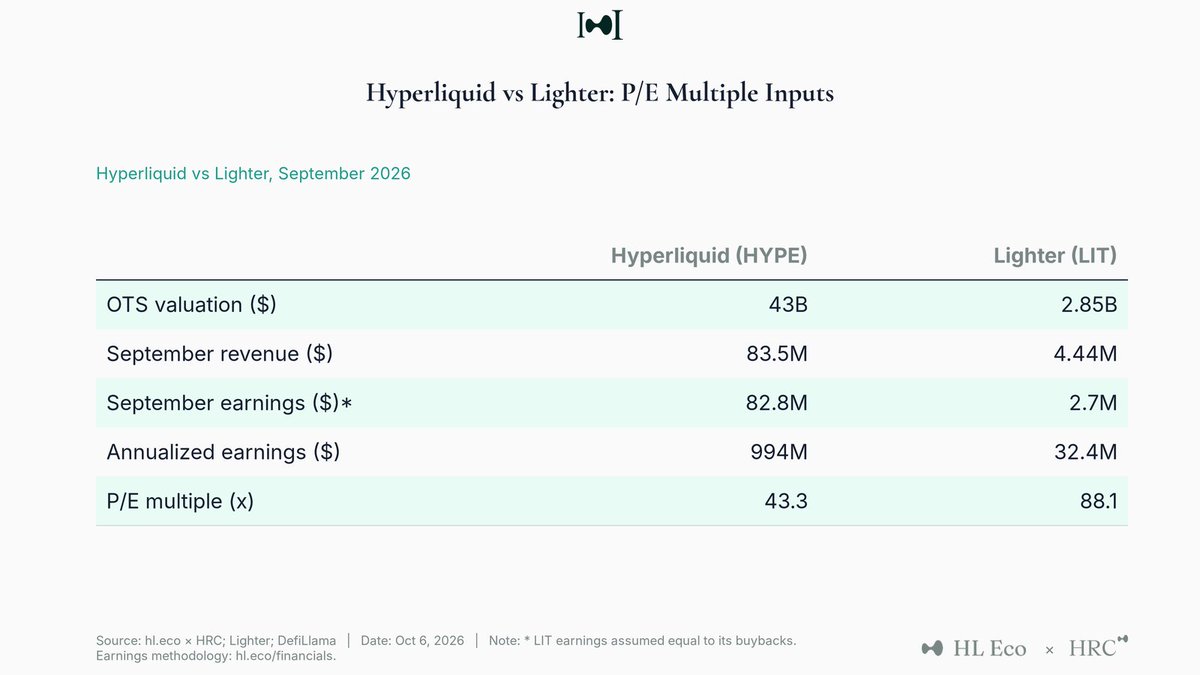
Under unified metrics, Lighter's price-to-earnings (P/E) ratio is approximately twice that of Hyperliquid, at 88.1x and 43.3x respectively.
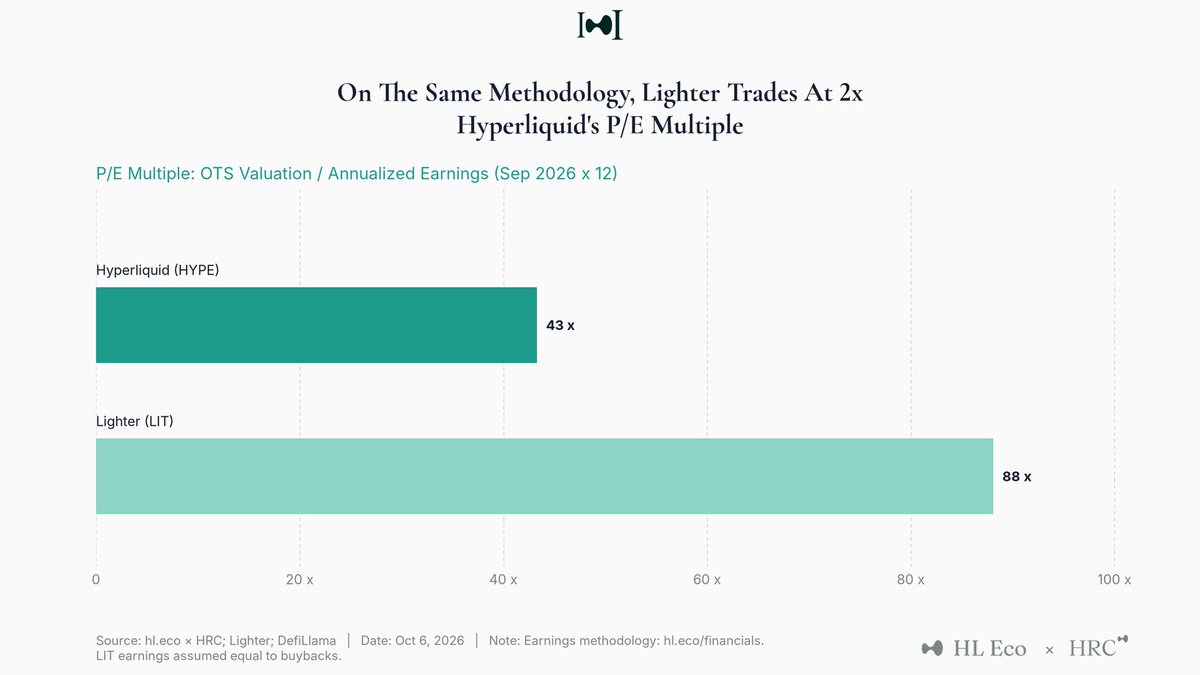
The P/E ratio here is derived by dividing the OTS valuation by the annualized earnings, where annualized earnings equal September 2026 earnings multiplied by 12.
Supply: Outstanding Token Supply (OTS)

This valuation entirely uses the OTS metric. OTS counts tokens that are already circulating or allocated to designated holders according to a public, fixed schedule. It sits between circulating supply and fully diluted supply, most closely resembling the equivalent concept of stock market capitalization.

Both tokens use exactly the same statistical rules:

  • Include: Circulating tokens, plus team and investor allocation shares (even if still locked, counted in full)
  • Exclude: Reserve tokens, such as future unreleased tokens, community rewards, ecosystem reserves
  • Deduct: Burned tokens, tokens repurchased and retired per buyback policies

According to hl.eco data, Hyperliquid's OTS valuation is $43 billion.

Lighter's token distribution plan comes from team tweets: 50% ecosystem share (half airdropped at launch), 26% team share, 24% investor share. Team and investor tokens have a 1-year lockup, followed by a 3-year linear vesting period.
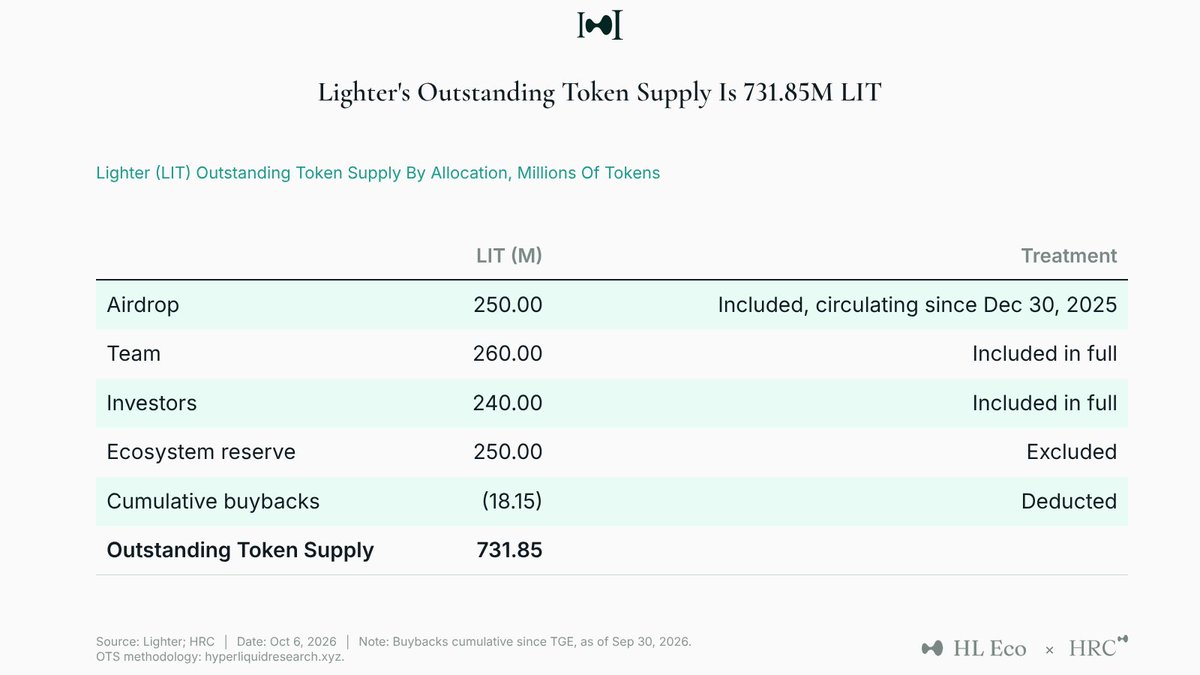
Calculated at the LIT price of $3.896 on October 6, 2026, Lighter's OTS valuation is $2.85 billion. According to team disclosure, Lighter has repurchased 18.15 million LIT since launch and burns the repurchased tokens. A portion is yet to be executed for burning, and this calculation has deducted them in full; consistent with the treatment of HYPE held by the Hyperliquid Rescue Fund, which is deducted immediately upon repurchase.

Both tokens undergo the same simplification: staking rewards and incentives already distributed from the ecosystem reserve are not counted in OTS. This portion is minimal relative to total supply, and this treatment aligns with the statistical approach for HYPE's future token releases and community rewards.

Earnings: Uniformly Using Same Month Data

Both projects' earnings data are taken from September 2026 and then annualized by multiplying by 12. A calendar month is chosen because Lighter discloses buyback data monthly.

Hyperliquid's earnings metric follows the financial framework established by hl.eco and HRC.

Revenue = Trading fees after deducting developer and deployer shares + Priority fees + HyperEVM Gas fees + Auction burn proceeds + USDC reserve interest.

Earnings = Revenue - Fee share paid to HLP.

September revenue was $83.5 million, earnings were $82.8 million, annualized earnings $994 million. No team or shareholders take a cut; earnings are returned to HYPE holders via buyback and burn.

Lighter does not directly disclose earnings data. This article uses the buyback amount as the closest proxy. According to team disclosure, Lighter's total September revenue was $4.44 million, with 597,200 LIT repurchased. The average price for the month was $4.52, corresponding to a buyback amount of $2.70 million, annualized to $32.4 million.

The September buyback size nearly equals the $2.72 million revenue generated by Lighter's core business, with the remaining $1.72 million revenue coming from Robinhood Chain operations.

Conclusion Boundaries: What It Can and Cannot Explain

This comparison only indicates that, based on current annualized earnings, the market is paying approximately twice the valuation for every $1 of Lighter's earnings compared to Hyperliquid.

But this does not mean either token is mispriced. The P/E ratio reflects market expectations for growth, profit margins, and risk, which single-month earnings data cannot fully capture. A higher P/E can be supported by higher expected growth rates; a lower P/E often corresponds to a larger, more mature earnings base. The research team itself holds views on this, but this article makes no such judgments, only presenting the valuation multiples based on September data.

Three limitations of this article should be noted:

  • Lighter's earnings are an approximation; buyback amount is only a proxy. If Lighter retains part of its revenue (e.g., Robinhood Chain fees), its actual earnings would be higher, and its P/E would be lower. If using total revenue instead of buyback amount, the P/E would be approximately 54x.
  • Short sample window: Both protocols use September single-month data annualized, maintaining uniform comparison metrics, but single-month performance may be above or below long-term trends.
  • Reserve distributions excluded: Distributed ecosystem reserve rewards for both tokens are not included in OTS. If included, both valuations would increase slightly.


Related Questions

QWhat is the main comparison made in the article regarding Lighter and Hyperliquid?

AThe article compares the Price-to-Earnings (P/E) ratios of the Lighter (LIT) and Hyperliquid (HYPE) tokens. Under a unified calculation standard, it finds Lighter's P/E ratio is approximately double that of Hyperliquid (88.1x vs. 43.3x).

QWhat metric does the article use for token supply in its valuation comparison, and what does it stand for?

AThe article uses OTS (Outstanding Token Supply) for valuation. OTS counts tokens that are already circulating or allocated to specific holders (like team and investors) according to a fixed, public schedule, excluding reserves like future emissions, community rewards, and treasury holdings.

QWhat month's data is used to calculate the annualized earnings for both protocols in this analysis?

AThe analysis uses earnings data from September 2026, which is then multiplied by 12 to get an annualized figure.

QFor Lighter, what proxy is used to estimate its monthly 'profit' since it does not directly disclose this figure?

AFor Lighter, the article uses the amount of LIT tokens repurchased (and destined for burning) during September 2026 as a proxy for its profit.

QAccording to the article, what are two key limitations or caveats of the presented P/E ratio comparison?

ATwo key limitations are: 1) Lighter's 'profit' is an approximation based on buyback amount, not a direct financial figure. Its actual profit could be higher if it retains some revenue. 2) The analysis is based on a single month's data (September 2026), which may not represent long-term trends.

Related Reads

Tech Veteran: Anthropic IPO Will Be the Peak of the US AI Rally, Will "Go Big on China AI" If Conditions Allow

Veteran tech investor Jack Selby, head of Copper Sky and managing partner of Peter Thiel's family office, warns that Anthropic's planned IPO—aiming to raise up to $100 billion—could mark the peak of the AI market rally. He cautions that if the highly anticipated IPO prices well below expectations, the expiry of lock-up periods could trigger significant selling pressure and a large-scale AI market correction. Selby names SoftBank and Oracle as "canaries in the coal mine," flagging Oracle's higher debt ratio as a bigger risk, and suggests investors needing AI exposure consider Google instead. Selby also questions Anthropic's fundamentals: over 80% of its revenue is non-recurring and vulnerable to competitors closing the technology gap within six to nine months. He notes the business is extremely capital-intensive—requiring costly data, energy, data centers, and chips—and that with interest rates no longer near zero, calling it a trillion-dollar company seems far-fetched. He further highlights Chinese competition, saying DeepSeek and other Chinese AI models trail Anthropic by only about six months, posing a direct threat. Selby says he would "aggressively go long on Chinese AI" if conditions allow, arguing that Anthropic cannot claim all its business must rely on U.S. models, since most AI use cases resemble basic tool applications, leaving room for Chinese alternatives.

marsbit2h ago

Tech Veteran: Anthropic IPO Will Be the Peak of the US AI Rally, Will "Go Big on China AI" If Conditions Allow

marsbit2h ago

Grayscale's $1 Million Sponsorship Can't Save It: Why ZEC, Once Hyped as the Belle of the Ball, Crashed Again?

Grayscale announced a $1 million ecosystem sponsorship for Zcash on November 10, pledging to return all first-year management fees from its Zcash ETF (ZCSH) to network development and marketing, with the first $100,000 distributed to four nonprofit organizations. Yet the same day, ZEC plunged 11.3% to around $1,043, extending its 30-day decline to nearly 20%. After two months of hype from overseas KOLs and institutions touting ZEC as a "second spring for old coins," the token quickly turned into a slow bleed under the weight of $2.3 billion in open interest. The article argues that Wall Street's narrative halo and Grayscale's PR subsidy have been exhausted, and ZEC—lacking fundamental support—has once again become an ATM for highly leveraged speculators to cash out on good news. Grayscale's pledge, while seemingly generous, is voluntary and can be modified or terminated at any time; only $400,000 of the $1 million has actually been paid, making it more brand marketing for its own ETF than genuine ecosystem donation. The sum is negligible relative to Zcash's market cap, and the Zcash ETF has not attracted sustained institutional capital the way Bitcoin or Ethereum ETFs did. Without new external liquidity, the inflated narrative cannot hold. The core problem is market structure: ZEC perpetual futures open interest stands at roughly $2.3 billion, dominated by high-volatility leveraged gamblers. The article contends that the earlier social media hype was a precise harvest of derivatives liquidity—promoters used the "first privacy ETF" theme to lure retail into leveraged longs, then exited as open interest peaked and the sponsorship news landed. Compounding this, Zcash's privacy pool suffered a critical vulnerability about three months before the ETF listing, halving the price and shattering conservative investors' confidence despite a July fix. The piece concludes that "old coin re-hype" follows a familiar script: find a traditional-finance-approved angle, package a grand revaluation narrative, use KOLs to drive retail buying, then distribute chips at peak liquidity. Those who hyped ZEC have largely cashed out, leaving behind a broken price and $2.3 billion in unsettled leverage. Grayscale's advertising cannot save Zcash; a real revival requires far more than Wall Street's charity.

marsbit3h ago

Grayscale's $1 Million Sponsorship Can't Save It: Why ZEC, Once Hyped as the Belle of the Ball, Crashed Again?

marsbit3h ago

Trading

Spot
活动图片