BNB Chain 2025 Year-End Review: Self-Transcendence, Trading Everything

marsbitPublicado a 2026-01-09Actualizado a 2026-01-09

Resumen

BNB Chain 2025 Year-End Review: Self-Transformation and Trading Everything In 2025, BNB Chain underwent a qualitative transformation, evolving from a low-cost alternative to a robust infrastructure capable of handling real-world financial and payment scenarios. Key achievements include a 40.5% growth in TVL, a 100% increase in on-chain stablecoin market cap to $14.7 billion, and over $1.8 billion in RWA assets. The network maintained zero downtime despite high transaction loads, processing a record 31 million daily transactions. Technical upgrades through Lorentz and Maxwell hard forks reduced block time to sub-second levels and increased throughput to 133 million gas/second, significantly improving speed, reducing MEV attacks by 95%, and lowering costs. These enhancements enabled high-frequency applications like stablecoin payments and DEX interactions, driving daily active addresses to 4.4 million, the highest among blockchains. Stablecoin adoption flourished, with BNB Chain becoming a leading network for efficient, low-cost payments. Initiatives like United Stables' multi-collateral model and a $1 billion Builder Fund fostered ecosystem growth. RWA integration accelerated with major institutions like BlackRock and Franklin Templeton tokenizing assets on-chain, leveraging BNB Chain’s user base and liquidity for deeper adoption. BNB Chain’s 2025 progress validated its capacity as reliable infrastructure under sustained demand, setting the stage for 2026 goals: enhancing ...

In recent days, with the listing effect of Binance, Meme tokens on BSC have once again gained market attention. The massive wealth effect and traffic have refocused the market on this five-year-old public chain. However, looking beyond the surface and re-examining, what we see is actually a qualitative transformation of an ecosystem.

If the initial BNB Chain in 2020 primarily accumulated its initial users and transactions from the spillover due to high gas fees and low efficiency on ETH, then 2025 was a critical year for BNB Chain to proactively achieve self-transcendence.

Looking back on this year, BNB Chain is no longer just a cheaper alternative but has begun to possess the fundamental capability to stably and sustainably host real financial and payment scenarios.

New highs were reached in users, liquidity, and trading volume. TVL grew by 40.5%, the on-chain stablecoin market cap increased by over 100% to $14 billion, and RWA asset scale exceeded $1.8 billion.

From the results, the on-chain activity of BNB Chain is not a short-term burst but shows a continuous and stable growth trend.

Core scenarios such as annual transactions, stablecoins, payments, and RWA maintained high-frequency usage. The network had to operate continuously under long-term high load, rather than relying on occasional peaks to prove its performance. It was in this real production environment that BNB Chain withstood the test, achieving zero downtime for the year and maintaining stable operation amidst high-intensity transactions and asset transfers.

Supporting these figures is not a single technological breakthrough but a year-long continuous advancement in underlying engineering capabilities. In 2025, BNB Chain underwent deep iterations of its underlying protocols and clients. Block time and throughput capacity were systematically restructured, endowing the chain itself with high concurrency, low latency, and long-term scalable execution capabilities. Block time was compressed from the previous 3-second level to sub-second levels, finality was significantly advanced, and network bandwidth was expanded to over 133 million gas/second, enabling the chain to continuously handle daily loads as high as 5 trillion gas in high-concurrency environments. Coupled with the seamless integration of the stablecoin payment network and the large-scale introduction of compliant RWA assets, this helped BNB Chain achieve key leaps in technology, assets, and ecology.

Driven by multiple factors, BNB Chain has been able to touch the threshold of infrastructure for billions of users. Moreover, it is no longer just serving crypto-native users but has begun to provide a blockchain foundation that can be accepted and used by the broader public and the real financial system.

The significance of 2025 for BNB Chain lies not in any single extreme metric, but in validating one thing: under real, sustained, high-intensity usage conditions, a public chain can be operated as infrastructure, rather than remaining in the theoretical performance stage. It is this experience that forms the practical foundation for the 2026 technical roadmap—higher TPS, lower latency, fairer execution, and more完善的 middleware and development tools.

2025: With the Highest Daily Active Users, Is Technology Still Important?

During the AMA at BNB Chain's fifth-anniversary celebration, CZ stated that attracting more Web3 users requires powerful and attractive products for projects.

This statement aptly summarizes the strategic主线 (main thread) of BNB Chain's development throughout 2025.

Going back to the beginning of 2025, in the context of modularization significantly reducing costs and L2s being everywhere, BNB Chain's narrative was not particularly sexy, and its moat was not wide. BNB Chain did not rush to chase trends but focused on underlying technological restructuring, laying the groundwork for its explosion in the second half of the year and its climb to the top in daily active users.

Through the Lorentz and Maxwell hard forks, BNB Chain's block time was compressed from 3 seconds to 0.75 seconds, and with the upcoming Fermi fork, further down to 0.45 seconds. Network throughput capacity increased to the level of 133 million gas/s, transaction confirmation time entered the sub-2-second range, MEV sandwich attacks were reduced by 95%, and transaction costs were significantly lowered in high-concurrency environments.

For some users, these changes might seem like mere parameter improvements—'faster'. But in practical operation, the shortening of block time made high-frequency interactive applications usable for the first time. The increase in throughput capacity meant the chain no longer had to throttle during sudden traffic spikes. The reduction in confirmation time and fees directly changed the psychological expectation of whether on-chain operations are worth it for ordinary users.

In other words, the work in the first half of the year solved a core contradiction for BNB Chain: how to achieve performance comparable to centralized servers without sacrificing decentralization.

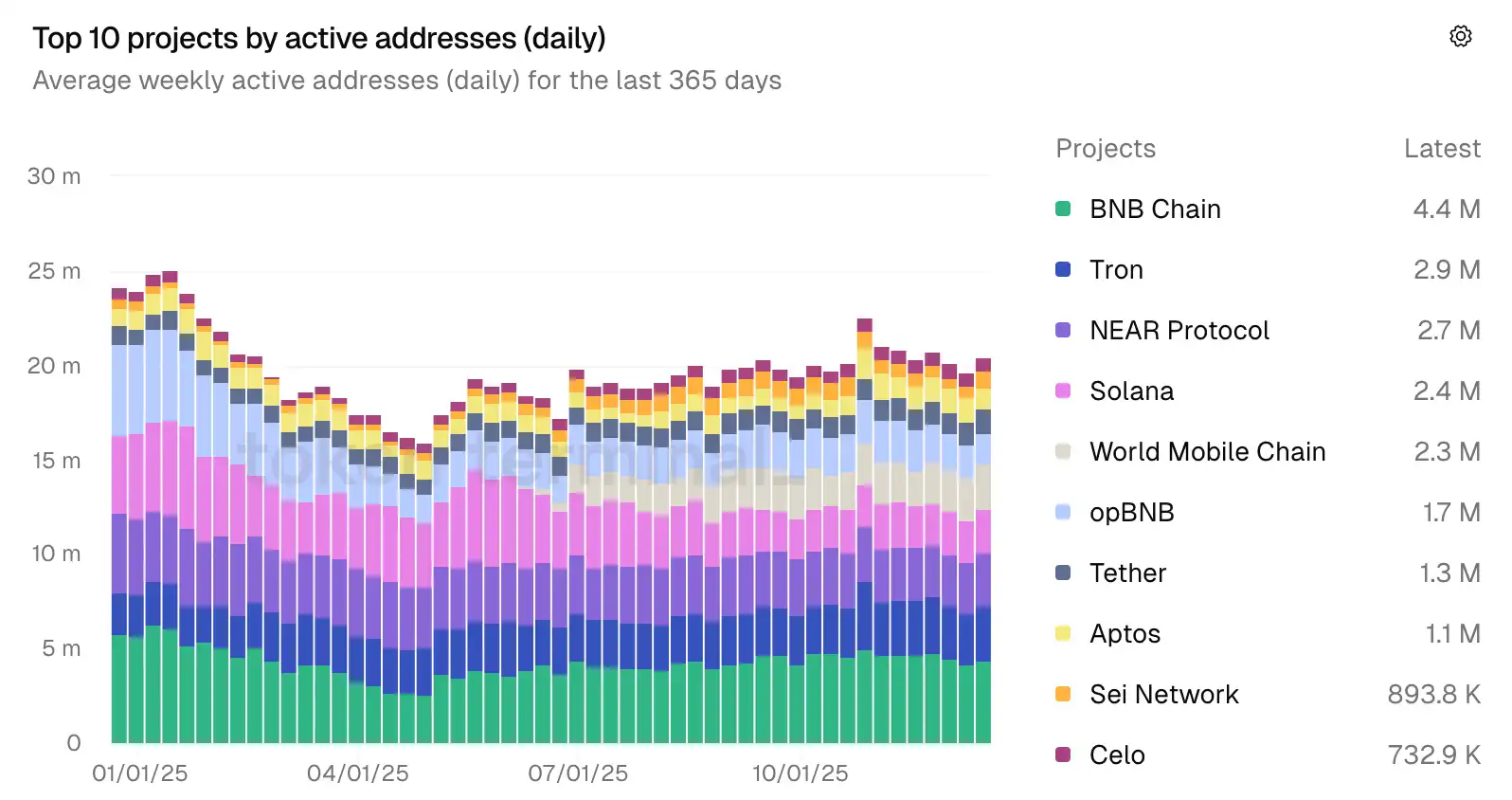
The effects were also evident. High-frequency behaviors such as stablecoin trading, DEX interactions, and on-chain transfers grew rapidly. BNB Chain became one of the public chains with the highest number of daily active addresses during multiple time windows. The latest data from Token Terminal shows that BNB Chain's daily active addresses reached 4.4 million, ranking at the top among blockchains. The average daily number of on-chain transactions in 2025 stabilized at tens of millions, hitting a historical high of 31 million transactions in a single day in October, a 150% year-on-year increase in peak value. Meanwhile, TVL increased by 40.5% year-on-year, the stablecoin market cap on-chain doubled, peaking at $14 billion.
Entering the second half of 2025, BNB Chain quickly switched modes, transitioning from an engineer to a product manager. Leveraging the solid foundation laid in the first half, it successfully accommodated massive stablecoin payment and RWA demands.

$14.7 Billion in Stablecoins and 4 Million Daily Active Users

If crypto before 2024 was driven by speculation, then 2025 transformed into an era dominated by utility, primarily stablecoins. This year, USDC issuer Circle went public, and Franklin Templeton, with $1.6 trillion in assets under management, launched JUSD.

Stablecoins are evolving from mere trading mediums into channels connecting traditional finance and the Web3 world. Stablecoins are no longer just tools for DeFi but are beginning to assume roles closer to real-world payments and capital turnover.

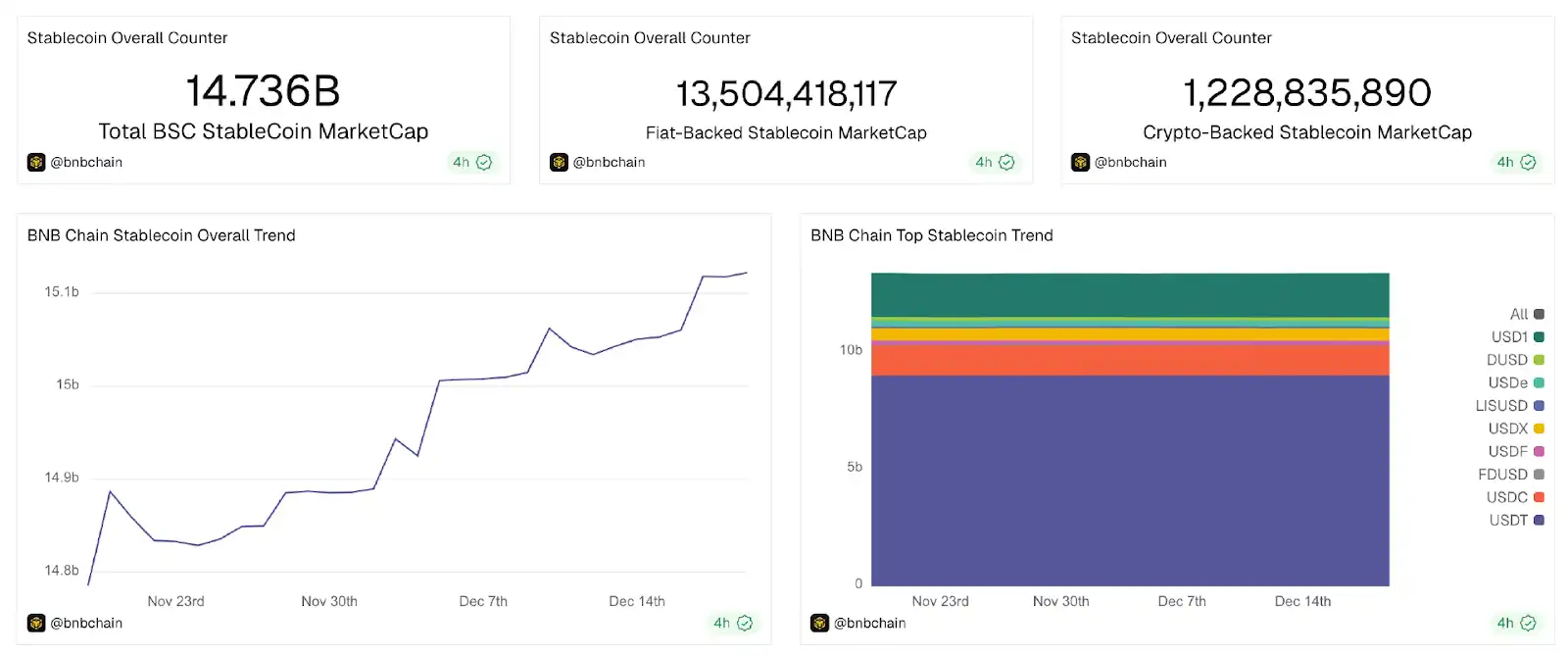
In this transformation, BNB Chain, with its 2-second settlement and transaction fees as low as $0.005, became the fastest-growing platform. Latest data shows that the value of stablecoins on the BNB Chain network exceeds $14.7 billion, with BSC and opBNB serving over 4 million daily active users.
The adoption of stablecoins depends not only on the assets themselves but also on their operating environment. If stablecoins are to serve billions of users, the underlying chain must be cheap, fast, and seamless. The upgrades BNB Chain implemented in the first half laid the foundation for stablecoin普及 (popularization).

Through gas-free transactions, opBNB, and other scaling solutions, the cost of stablecoin transfers was compressed to near zero, significantly lowering the barrier to using stablecoins for payments. On BSC and opBNB, stablecoin transfers are completed almost instantly, providing a near-Web2 experience for on-chain payments, salary disbursements, and merchant settlements.

The supply of stablecoins on BNB Chain has doubled to approximately $14 billion, making it one of the most active stablecoin networks globally. Against this backdrop, the stablecoin ecosystem itself began to change. United Stables chose to natively issue its stablecoin, U, on BNB Chain. Unlike traditional stablecoins reliant on a single collateral asset, U employs a multi-stablecoin reserve model, allowing mainstream dollar stablecoins including USDT, USDC, and USD1 to be directly used as collateral to mint U.

From an ecological perspective, the introduction of U is not an isolated event but a natural outcome of the maturation of BNB Chain's stablecoin system. As the scale of on-chain stablecoins continues to expand and address activity keeps increasing, the demand for unified liquidity and higher capital efficiency also grows. United Stables' multi-collateral model is a response to this demand. Its design reduces the efficiency loss caused by repeatedly splitting different stablecoins, helps consolidate on-chain liquidity, and simplifies the usage path of funds in trading, payments, and DeFi applications.

Another landmark event in 2025 was Abu Dhabi's MGX investing $2 billion in Binance through the stablecoin USD1. USD1 is a dollar-pegged stablecoin supported by the Trump family's World Liberty Financial, backed by highly liquid asset reserves and deployed on mainstream blockchains like BNB Chain and ETH.

This investment sent a clear signal: stablecoins are no longer confined to the crypto industry but have become a tool connecting traditional capital with on-chain finance. And BNB Chain is an important carrier network for this channel.

Furthermore, BNB Chain, in collaboration with YZi Labs, launched a massive $1 billion Builder Fund to accelerate the development of existing and future developers on BNB Chain, particularly those building applications that can make stablecoins truly流动起来 (flow). The fund provides not only capital but also technical incubation and compliance consulting.

According to the development blueprint disclosed by BNB Chain, sectors such as on-chain payroll systems, programmable vaults, stablecoin-native credit cards, invoice tokenization, CBDC bridging and custody, green finance, and supply chain automation are poised for explosive growth. These upcoming booming sectors share common characteristics: they are efficient, automated, and globally accessible, rather than focusing on crypto attributes. The positioning of stablecoins therein is closer to a universal unit of the digital economy, and BNB Chain aims to become the underlying operating system hosting these functions.

It is worth noting that the growth of the stablecoin ecosystem on the BNB Chain network is not an isolated爆发 (outbreak) but is deeply intertwined with RWA.

BNB Chain and RWA Mutually Enable Each Other

This year, we no longer debate the feasibility of asset tokenization. Traditional financial giants like BlackRock, CMBI (China Merchants Bank International), VanEck, and Franklin Templeton are moving hundreds of billions of dollars in assets on-chain. In this on-chain movement, BNB Chain,凭借 (relying on) its massive user base and ecological strategy, has become one of the largest infrastructures承载 (hosting) RWA capital.

BlackRock deployed its USD Institutional Digital Liquidity Fund, BUIDL Fund, to BNB Chain with technical support from Securitize and Wormhole. Moreover, this fund can also be used as collateral on the Binance exchange. This means on-chain funds are no longer obscure financial products but have become a liquidity layer for the crypto market.

CMBI tokenized its US dollar money market fund, with assets under management exceeding $3.8 billion, on BNB Chain. It is reported that this fund ranks first among its peers in the Asia-Pacific region according to Bloomberg. Investors can subscribe to shares on BNB Chain using stablecoins.

The deployment of a series of RWA assets on BNB Chain is not a one-sided benefit but a deeper two-way promotional relationship. RWA and BNB Chain are forming a positive feedback flywheel that complements and amplifies each other.

Asset tokenization is only the first step. Without sufficient trading depth and turnover, these tokens are merely on-chain digital certificates, unable to unleash real financial value. Illiquidity is the biggest pain point hindering the large-scale爆发 (explosion) of RWA.

As a mature ecosystem, BNB Chain provides three key elements for RWA assets: high throughput, low fees, and a庞大的 (massive) user base. Compared to other expensive public chains (public chains), BNB Chain's low gas fees and high TPS make high-frequency trading and instant settlement possible, significantly lowering the barrier for user participation in RWA investments. Simultaneously, BNB Chain users are among the most active groups in Web3, meaning RWA assets can directly reach a vast pool of potential investors upon launch.

In fact, CZ had already revealed the key to RWA's prosperity on BNB Chain during the BNB Chain 5th-anniversary AMA: without users, there are no trades; without trades, there is no liquidity.

When Ondo Global Markets announced the introduction of 100+ US stocks and ETFs to BNB Chain, with deep integration into Binance Wallet, a剧烈的化学反应 (violent chemical reaction) occurred in the market. Thanks to BNB Chain's large number of daily active users, the trading volume of Ondo's tokenized stocks surged from a previous single-day peak of $84 million to $170 million.

Standing at the beginning of 2026 and looking back on the entirety of 2025, this was a milestone year for BNB Chain. It moved from participating in public chain competition with performance and cost, towards benchmarking itself against global traditional finance and internet payment systems with real usage scale, stable operational capability, and compliant accessibility. Over the past year, zero downtime under sustained high load, the规模化增长 (scaled growth) of stablecoins and RWA, and the systematic optimization of underlying performance and cost structure collectively proved that BNB Chain is no longer in the stage of technological feasibility.

Looking forward, BNB Chain's development focus will no longer be solely on chasing higher metrics but on further improving execution quality and user experience on top of the existing scale—faster confirmation speeds, lower usage costs, a fairer trading environment, and middleware and tool systems more friendly to complex scenarios like stablecoins, RWA, payments, and AI.

Looking ahead to 2026, BNB Chain's goal is to truly solidify sub-second performance, global payment capability, and compliant asset hosting into a default capability, enabling developers to build applications with near-Web2 experience on top of it, and allowing ordinary users to utilize blockchain services without perceiving the underlying complexity. When blockchain is no longer seen as a new technology but naturally integrates into daily economic activities like the internet or payment systems, the大规模采用 (mass adoption) of Web3 will truly arrive. And 2025 was a decisive step taken by BNB Chain in this direction.


Preguntas relacionadas

QWhat were the key performance indicators (KPIs) that demonstrated BNB Chain's growth in 2025?

AKey KPIs included a 40.5% growth in TVL, over 100% growth in on-chain stablecoin market cap reaching $14 billion, RWA asset scale exceeding $1.8 billion, daily active addresses peaking at 4.4 million, and a record 31 million daily transactions.

QHow did BNB Chain's technical upgrades in 2025 improve its performance?

AThrough the Lorentz and Maxwell hard forks, BNB Chain reduced block time from 3 seconds to 0.75 seconds, increased network throughput to over 133 million gas/second, achieved sub-2-second transaction finality, reduced MEV sandwich attacks by 95%, and significantly lowered transaction costs in high-concurrency environments.

QWhat role did stablecoins play on BNB Chain in 2025, and what was a significant development in its stablecoin ecosystem?

AStablecoins evolved into a channel connecting traditional finance and Web3, with the on-chain value exceeding $14.7 billion. A significant development was the native issuance of the multi-collateral stablecoin 'U' by United Stables on BNB Chain, which uses a basket of major dollar stablecoins (like USDT, USDC) as collateral to improve capital efficiency and unify liquidity.

QHow did the integration of Real World Assets (RWA) and BNB Chain create a mutually beneficial relationship?

ABNB Chain's high throughput, low fees, and large user base provided the necessary liquidity and accessibility for RWA assets. In turn, major institutions like BlackRock (with its BUIDL Fund) and CMB International brought billions in traditional assets onto the chain, boosting transaction volume and cementing BNB Chain's role as key infrastructure for tokenized real-world assets.

QWhat was the overarching strategic goal for BNB Chain in 2025, as highlighted by CZ?

AThe overarching strategic goal, as highlighted by CZ during the 5th-anniversary AMA, was to attract more Web3 users by building powerful and attractive products, focusing on underlying technology重构 (restructuring) and utility (like stablecoin payments and RWA) rather than chasing short-term hype.

Lecturas Relacionadas

North Korean Hackers Loot $500 Million in a Single Month, Becoming the Top Threat to Crypto Security

North Korean hackers, particularly the notorious Lazarus Group and its subgroup TraderTraitor, have stolen over $500 million from cryptocurrency DeFi platforms in less than three weeks, bringing their total theft for the year to over $700 million. Recent major attacks on Drift Protocol and KelpDAO, resulting in losses of approximately $286 million and $290 million respectively, highlight a strategic shift: instead of targeting core smart contracts, attackers are now exploiting vulnerabilities in peripheral infrastructure. For instance, the KelpDAO attack involved compromising downstream RPC infrastructure used by LayerZero's decentralized validation network (DVN), allowing manipulation without breaching core cryptography. This sophisticated approach mirrors advanced corporate cyber-espionage. Additionally, North Korea has systematically infiltrated the global crypto workforce, with an estimated 100 operatives using fake identities to gain employment at blockchain companies, enabling long-term access to sensitive systems and facilitating large-scale thefts. According to Chainalysis, North Korean-linked hackers stole a record $2 billion in 2025, accounting for 60% of all global crypto theft that year. Their total historical crypto theft has reached $6.75 billion. Post-theft, they employ specialized money laundering methods, heavily relying on Chinese OTC brokers and cross-chain mixing services rather than standard decentralized exchanges. Security experts, while acknowledging the increased sophistication, emphasize that many attacks still exploit fundamental weaknesses like poor access controls and centralized operational risks. Strengthening private key management, limiting privileged access, and enhancing coordination among exchanges, analysts, and law enforcement immediately after an attack are critical to improving defense and fund recovery chances. The industry's challenge now extends beyond secure smart contracts to safeguarding operational security at the infrastructure level.

marsbitHace 34 min(s)

North Korean Hackers Loot $500 Million in a Single Month, Becoming the Top Threat to Crypto Security

marsbitHace 34 min(s)

Circle CEO's Seoul Visit: No Korean Won Stablecoin Issuance, But Met All Major Korean Banks

Circle CEO Jeremy Allaire's recent activities in Seoul indicate a strategic shift for the company, moving away from issuing a Korean won-backed stablecoin and instead focusing on embedding itself as a key infrastructure provider within Korea’s financial and crypto ecosystem. Despite Korea accounting for nearly 30% of global crypto trading volume—with a market characterized by high retail participation and altcoin dominance—Circle has chosen not to compete for the role of stablecoin issuer. Instead, Allaire met with major Korean banks (including Shinhan, KB, and Woori), financial groups, leading exchanges (Upbit, Bithumb, Coinone), and tech firms like Kakao. This approach reflects a broader industry transition: the core of stablecoin competition is shifting from issuance rights to systemic positioning. With Korean regulators still debating whether banks or tech companies should issue stablecoins, Circle is avoiding regulatory uncertainty by strengthening its role as a service and technology partner. The company is deepening integration with trading platforms, building connections, and promoting stablecoin infrastructure. This positions Circle to benefit regardless of which entity eventually issues a won stablecoin. Allaire also noted the potential for a Chinese yuan stablecoin in the next 3–5 years, underscoring a regional trend of stablecoins becoming more regulated and integrated with traditional finance. Ultimately, Circle’s strategy highlights that future influence in the stablecoin market will belong not necessarily to the issuers, but to the foundational infrastructure layers that enable cross-system transactions.

marsbitHace 1 hora(s)

Circle CEO's Seoul Visit: No Korean Won Stablecoin Issuance, But Met All Major Korean Banks

marsbitHace 1 hora(s)

SpaceX Ties Up with Cursor: A High-Stakes AI Gambit of 'Lock First, Acquire Later'

SpaceX has secured an option to acquire AI programming company Cursor for $60 billion, with an alternative clause requiring a $10 billion collaboration fee if the acquisition does not proceed. This structure is not merely a potential acquisition but a strategic move to control core access points in the AI era. The deal is designed as a flexible, dual-path arrangement, allowing SpaceX to either fully acquire Cursor or maintain a binding partnership through high-cost collaboration. This "option-style" approach minimizes immediate regulatory and integration risks while ensuring long-term alignment between the two companies. At its core, the transaction exchanges critical AI-era resources: SpaceX provides its Colossus supercomputing cluster—one of the world’s most powerful AI training infrastructures—while Cursor contributes its AI-native developer environment and strong product adoption. This synergy connects compute power, models, and application layers, forming a closed-loop AI capability stack. Cursor, founded in 2022, has achieved rapid growth with over $1 billion in annual revenue and widespread enterprise adoption. Its value lies in transforming software development through AI agents capable of coding, debugging, and system design—positioning it as a gateway to future software production. For SpaceX, this move is part of a broader strategy to evolve from a aerospace company into an AI infrastructure empire, integrating xAI, supercomputing, and chip manufacturing. Controlling Cursor fills a gap in its developer tooling layer, strengthening its AI narrative ahead of a potential IPO. The deal reflects a shift in AI competition from model superiority to ecosystem and entry-point control. With programming tools as a key battleground, securing developer loyalty becomes crucial for dominating the software production landscape. Risks include questions around Cursor’s valuation, technical integration challenges, and potential regulatory scrutiny. Nevertheless, the deal underscores a strategic bet: controlling both compute and software development access may redefine power dynamics in the AI-driven future.

marsbitHace 1 hora(s)

SpaceX Ties Up with Cursor: A High-Stakes AI Gambit of 'Lock First, Acquire Later'

marsbitHace 1 hora(s)

Trading

Spot
Futuros

Artículos destacados

Qué es BNB WHALES

Entendiendo a las Ballenas de BNB: Una Inmersión Profunda en el Paisaje de las Criptomonedas Introducción a las Ballenas de BNB En el vibrante mundo de las criptomonedas, nuevos proyectos emergen regularmente, a menudo prometiendo soluciones innovadoras y experiencias únicas. Uno de estos proyectos es Ballenas de BNB, lanzado en 2023 y construido sobre la BNB Smart Chain (BEP20). Ballenas de BNB se propone establecer una presencia distintiva dentro del ecosistema de criptomonedas, enfocándose en crear una plataforma atractiva que combine los beneficios de la tecnología blockchain con interacciones sociales y de juegos. Este artículo tiene como objetivo profundizar en Ballenas de BNB, explorando sus componentes principales, mecánicas y trayectoria de desarrollo. ¿Qué son las Ballenas de BNB? Ballenas de BNB es una iniciativa de criptomonedas que busca proporcionar una amplia gama de características y oportunidades para sus usuarios en el emergente entorno de Web3. Utilizando el estándar BEP20, el proyecto opera con un suministro total de tokens de 100 billones (100,000,000,000,000,000). A pesar de esta cifra significativa, es notable que no hay tokens actualmente en circulación, lo que indica que el proyecto aún puede estar en sus primeras etapas de desarrollo. El objetivo principal de Ballenas de BNB es crear una plataforma donde los usuarios puedan participar en diversas actividades interactivas mientras se benefician de la seguridad y transparencia que brinda la tecnología blockchain. Al fomentar un entorno único y atractivo, Ballenas de BNB busca construir una comunidad sólida de usuarios que estén comprometidos con el proyecto y su desarrollo. ¿Quién es el Creador de Ballenas de BNB? La identidad del creador de Ballenas de BNB sigue siendo desconocida en este momento, lo que presenta un desafío para quienes buscan entender los principios fundacionales y las ideas visionarias del proyecto. Esta ausencia de información públicamente disponible sobre el liderazgo del proyecto puede levantar preguntas entre posibles inversores y usuarios acerca de su estructura de gobernanza y responsabilidad. ¿Quiénes son los Inversores de Ballenas de BNB? A medida que Ballenas de BNB continúa evolucionando, la información sobre inversores específicos o apoyo de fundaciones de inversión actualmente no está disponible. La documentación oficial del proyecto, incluido su libro blanco, no revela patrocinadores financieros individuales o institucionales. La falta de transparencia en este sentido puede a veces generar dudas sobre la legitimidad y sostenibilidad de nuevos proyectos dentro del ecosistema de criptomonedas. ¿Cómo Funciona Ballenas de BNB? Ballenas de BNB opera en la BNB Smart Chain utilizando el estándar BEP20, conocido por su eficiencia y bajas tarifas de transacción, atrayendo a una variedad de desarrolladores y proyectos. El aspecto único de Ballenas de BNB radica en su enfoque en crear una plataforma impulsada por la comunidad. A pesar de que los detalles operativos precisos son escasos, el proyecto enfatiza la interacción y el compromiso, posiblemente incorporando elementos gamificados en sus ofertas. El énfasis en la comunidad es fundamental, ya que se alinea con las tendencias actuales en el espacio de criptomonedas, donde la participación y el aporte de los usuarios a menudo dictan el éxito de un proyecto. Se pueden anticipar más innovaciones, pero en este momento, los mecanismos y características específicos que diferencian a Ballenas de BNB de otras iniciativas cripto aún deben ser completamente elucidado. Sin información detallada sobre su funcionalidad, es un desafío evaluar de manera integral los diferenciadores del proyecto. Cronología de Ballenas de BNB El desarrollo de Ballenas de BNB ha transcurrido en hitos clave, marcando su trayectoria en el paisaje de las criptomonedas. A continuación se muestra una cronología de eventos significativos relacionados con el proyecto: 2023: Lanzamiento de Ballenas de BNB, marcando la entrada del proyecto en el mercado. 2023: Publicación del libro blanco del proyecto, que expone los objetivos generales y el marco operativo. En curso: Ballenas de BNB continúa desarrollando sus características, con el objetivo de construir una base de usuarios sólida y expandir sus ofertas. Puntos Clave Sobre Ballenas de BNB Plataforma: BNB Smart Chain (BEP20) Suministro Total: 100 billones de tokens (100,000,000,000,000,000) Suministro Circulante: 0 tokens (indicando una etapa incipiente) Objetivo del Proyecto: Fomentar una plataforma de criptomonedas atractiva para la interacción y la construcción de comunidad. Creador: Desconocido Inversores: No divulgados Estado Operativo: Activo con desarrollo y expansión en curso Conclusión A medida que Ballenas de BNB navega por el competitivo paisaje de las criptomonedas, ofrece una visión del potencial de los proyectos impulsados por la comunidad construidos sobre los cimientos de la tecnología blockchain. Al enfocarse en la participación y la interacción, la iniciativa se encuentra a la vanguardia de la innovación en el espacio Web3. Sin embargo, el éxito del proyecto depende en última instancia de la claridad de sus mecánicas operativas, la divulgación de su gobernanza y el establecimiento de una sólida comunidad de usuarios. Para posibles usuarios e inversores, Ballenas de BNB representa un estudio de caso sobre la naturaleza en evolución de los proyectos de criptomonedas, uno que ilustra tanto las emocionantes posibilidades como las complejidades asociadas con nuevas iniciativas. A medida que el paisaje continúa evolucionando, será esencial monitorear el progreso de Ballenas de BNB y su impacto en el ecosistema más amplio de criptomonedas.

400 Vistas totalesPublicado en 2024.04.05Actualizado en 2024.12.03

Qué es BNB WHALES

Cómo comprar BNB

¡Bienvenido a HTX.com! Hemos hecho que comprar Binance Coin (BNB) sea simple y conveniente. Sigue nuestra guía paso a paso para iniciar tu viaje de criptos.Paso 1: crea tu cuenta HTXUtiliza tu correo electrónico o número de teléfono para registrarte y obtener una cuenta gratuita en HTX. Experimenta un proceso de registro sin complicaciones y desbloquea todas las funciones.Obtener mi cuentaPaso 2: ve a Comprar cripto y elige tu método de pagoTarjeta de crédito/débito: usa tu Visa o Mastercard para comprar Binance Coin (BNB) al instante.Saldo: utiliza fondos del saldo de tu cuenta HTX para tradear sin problemas.Terceros: hemos agregado métodos de pago populares como Google Pay y Apple Pay para mejorar la comodidad.P2P: tradear directamente con otros usuarios en HTX.Over-the-Counter (OTC): ofrecemos servicios personalizados y tipos de cambio competitivos para los traders.Paso 3: guarda tu Binance Coin (BNB)Después de comprar tu Binance Coin (BNB), guárdalo en tu cuenta HTX. Alternativamente, puedes enviarlo a otro lugar mediante transferencia blockchain o utilizarlo para tradear otras criptomonedas.Paso 4: tradear Binance Coin (BNB)Tradear fácilmente con Binance Coin (BNB) en HTX's mercado spot. Simplemente accede a tu cuenta, selecciona tu par de trading, ejecuta tus trades y monitorea en tiempo real. Ofrecemos una experiencia fácil de usar tanto para principiantes como para traders experimentados.

856 Vistas totalesPublicado en 2024.12.12Actualizado en 2025.03.21

Cómo comprar BNB

Qué es BNB CARD

Entendiendo BNB Card: Revolucionando la Identidad Digital en Web3 En el paisaje en rápida evolución de la tecnología blockchain y las criptomonedas, la BNB Card o $BNBCARD se destaca como un proyecto notable. Este token meme de utilidad impulsado por la comunidad aprovecha la BNB Smart Chain (BSC), con el objetivo de integrar la cultura meme con soluciones innovadoras de identidad digital. A medida que más usuarios se sumergen en los reinos de la descentralización, es crucial desglosar lo que BNB Card ofrece, sus matices operativos y su potencial impacto en el mercado. ¿Qué es BNB Card ($BNBCARD)? En su esencia, BNB Card representa un token meme con una utilidad sustancial. Está diseñado para empoderar a los usuarios al permitir la creación de tarjetas de identidad digital personalizadas que son tanto expresivas como funcionales. El proyecto encapsula varias características clave: Tarjetas de ID Personalizables: Los usuarios tienen la capacidad de diseñar tarjetas de ID digitales con temática de Binance, proporcionándoles una plataforma para la autoexpresión y una interacción comunitaria mejorada. Marco Descentralizado: Desarrollado en la BSC, BNB Card enfatiza atributos clave como seguridad, transparencia y soberanía del usuario. La naturaleza descentralizada del marco permite transacciones que son tanto eficientes como seguras. Modelo Centrado en la Comunidad: El énfasis en la participación de base en lugar de modelos financieros impulsados por laboratorios crea un entorno atractivo para sus usuarios. Al aprovechar la viralidad inherente de la cultura meme, BNB Card fomenta un movimiento comunitario robusto. El objetivo principal de BNB Card es democratizar las herramientas de identidad digital en Web3, ofreciendo soluciones accesibles que benefician a los usuarios sin las cargas típicamente asociadas con los sistemas de gestión de identidad tradicionales. Creador e Inversores Al explorar la identidad detrás de BNB Card, es importante notar que no se acredita explícitamente a un creador singular. En cambio, el proyecto parece ser impulsado por la comunidad, sugiriendo un esfuerzo colectivo inspirado en la noción de la “Tarjeta de Constructor Temprano” de Binance. Este enfoque de desarrollo orgánico es común entre los proyectos dentro del espectro de tokens meme, donde el desarrollo a menudo está influenciado por la pasión de la comunidad en lugar de una autoridad central. En términos de inversión, la ausencia de patrocinadores institucionales divulgados públicamente destaca aún más la base comunitaria del proyecto. Se nutre del apoyo orgánico de la comunidad, reflejando una característica habitual de los proyectos impulsados por memes que a menudo involucran a su audiencia a través de canales sociales en lugar de rutas de inversión formales. Cómo Funciona BNB Card emplea varios mecanismos que delinean su funcionamiento y espíritu innovador: Utilidad del Token: El token BNBCARD permite a los usuarios acceder a un conjunto de herramientas para la creación de ID, al mismo tiempo que proporciona una plataforma para la gobernanza comunitaria. El token sirve como el eje que habilita estas funcionalidades. Integración Blockchain: Al utilizar la BSC, BNB Card asegura compatibilidad con aplicaciones basadas en la Máquina Virtual de Ethereum (EVM). Esta integración proporciona a los usuarios los beneficios de bajas tarifas de transacción mientras mejora la accesibilidad. Ecosistema DIY: Central al atractivo de BNB Card es su enfoque de hazlo tú mismo (DIY) para la generación de tarjetas de identidad digital. Este elemento participativo anima a los usuarios a involucrarse en la expresión creativa, fomentando una cultura inclusiva que prospera en la contribución y colaboración. Cronología La cronología es vital para entender la trayectoria de BNB Card. Los hitos importantes en la historia del proyecto incluyen: 18 de marzo de 2025: BNB Card fue listado en LBank, marcando un paso significativo en su trayectoria de intercambio y abriendo puertas para la liquidez y la accesibilidad de los usuarios. 19 de marzo de 2025: Ocurrió un momento pivotal cuando el token experimentó un aumento astronómico del 26,000% en 24 horas, captando la atención por su potencial y el entusiasmo de la comunidad. Desarrollos en Curso: El proyecto está expandiendo continuamente sus asociaciones con intercambios descentralizados (DEXs) como PancakeSwap, mejorando aún más la liquidez y el compromiso de los usuarios. Innovación y Diferenciación Entender qué distingue a BNB Card implica una exploración más profunda de su marco innovador: Híbrido de Meme y Utilidad: BNB Card fusiona con éxito el atractivo lúdico de la cultura meme con aplicaciones prácticas en la gestión de identidad digital. Este enfoque de nicho atiende de manera efectiva a una amplia demografía, atrayendo tanto a usuarios expertos en tecnología como a aquellos nuevos en cripto. Gobernanza Descentralizada: Operar sin control centralizado permite al proyecto aprovechar directamente la opinión de la comunidad. El proceso de toma de decisiones colectivas impulsado por la participación comunitaria empodera a los usuarios, asegurando que sus voces contribuyan al desarrollo y dirección del proyecto. Escalabilidad: BNB Card se beneficiará enormemente de las mejoras en la hoja de ruta de 2025 para la BNB Chain, que incluyen mejoras como el aumento de la velocidad de transacciones y la integración de herramientas de inteligencia artificial. Estas mejoras posicionan al proyecto de manera ventajosa dentro de un entorno altamente competitivo. Conclusión BNB Card es emblemático de una nueva ola de soluciones de identidad digital dentro del ecosistema Web3. Al mezclar diversión, participación comunitaria y utilidad práctica, invita a los usuarios a participar activamente en la formación de sus personas digitales. A medida que el proyecto navega por el dinámico paisaje de las criptomonedas, su éxito probablemente dependerá de mantener un fuerte apoyo comunitario mientras se adapta a los avances tecnológicos y las necesidades de los usuarios. La integración de la descentralización con la cultura meme no solo sirve como un medio para el compromiso impulsado por los usuarios, sino también como una base para la narrativa en evolución en torno a la identidad digital en la era de blockchain. En resumen, BNB Card no solo ejemplifica la convergencia de creatividad y utilidad dentro del espacio cripto, sino que también subraya la importancia de la comunidad en la dirección del futuro de las tecnologías descentralizadas.

278 Vistas totalesPublicado en 2025.03.26Actualizado en 2025.03.26

Qué es BNB CARD

Discusiones

Bienvenido a la comunidad de HTX. Aquí puedes mantenerte informado sobre los últimos desarrollos de la plataforma y acceder a análisis profesionales del mercado. A continuación se presentan las opiniones de los usuarios sobre el precio de BNB (BNB).

活动图片