BlockFills Suspends Withdrawals: Is the First Domino About to Fall?

比推Publicado a 2026-02-12Actualizado a 2026-02-12

Resumen

BlockFills, a major institutional crypto lending platform backed by traditional finance giants like CME Ventures and Susquehanna International Group (SIG), has temporarily suspended withdrawals, citing "temporary liquidity adjustments" to protect client and company interests. The move echoes language used by Celsius before its collapse in 2022, raising concerns about a potential repeat of past crypto lending failures. Founded in Chicago in 2018, BlockFills serves over 2,000 institutional clients—including miners, hedge funds, and payment processors—and processed over $61.1 billion in trading volume in 2025. Its sudden pause on withdrawals has triggered market anxiety, especially amid Bitcoin’s sharp decline from $120,000 to around $60,000, which has pressured mining operations reliant on financing. While BlockFills emphasizes its institutional risk management and strong backing, analysts note that prolonged suspension could signal systemic risk in the crypto credit sector. If resolved quickly, it may demonstrate resilience of institutional infrastructure; if not, it could become the first major domino to fall in a new wave of crypto financial stress.

The day Celsius halted operations, it also used the phrase "temporary liquidity adjustment." Four years later, BlockFills has turned to the exact same page in the same playbook.

This lending platform, which claims to serve over 2,000 institutional clients and processed over $61.1 billion in trading volume in 2025, has initiated an internal circuit breaker. The official statement was measured in its wording: not a default, not bankruptcy, but a "temporary measure taken to protect the interests of clients and the company." Clients can still open and close positions, but funds cannot be withdrawn.
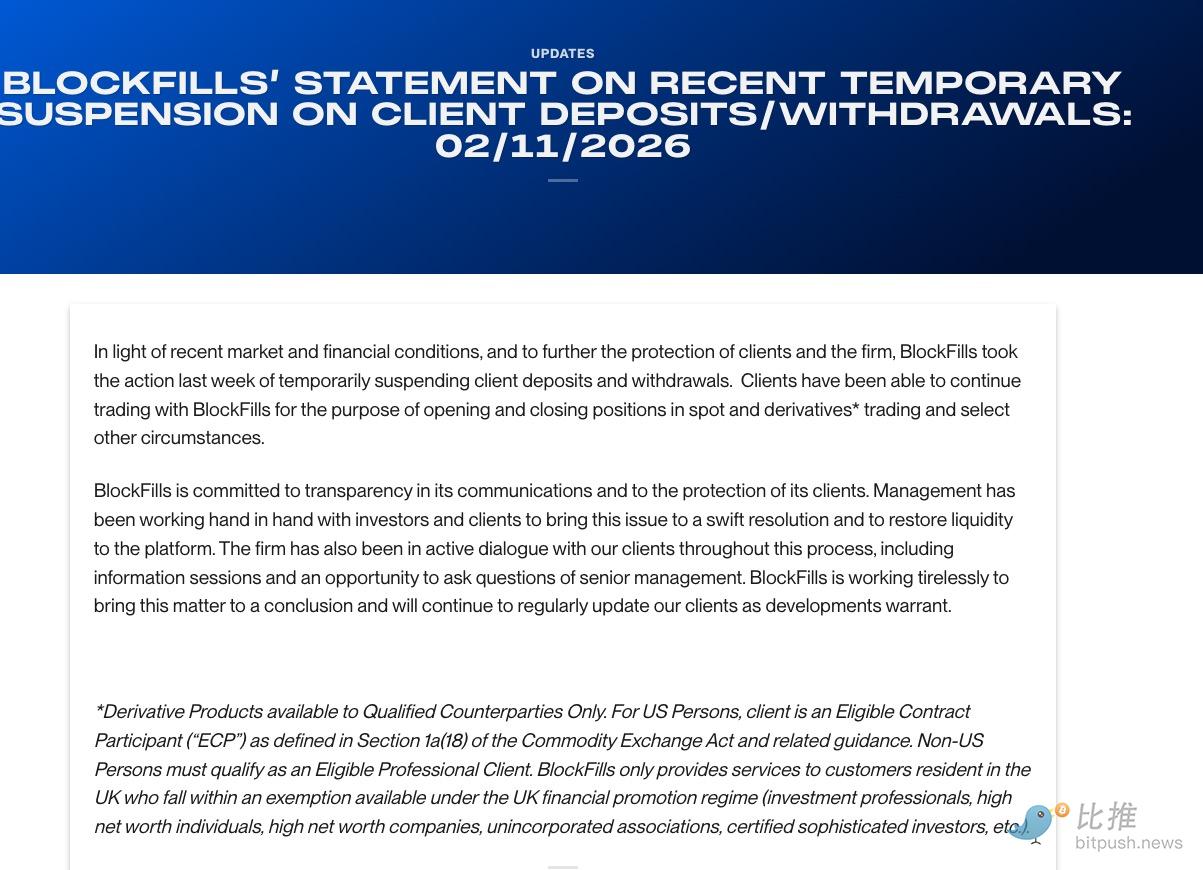
How familiar it smells. When Celsius collapsed in 2022, its opening line was also "temporary liquidity adjustment."

BlockFills' move immediately triggered collective market anxiety: Are we about to witness a repeat of the 2022 tragedies of Celsius and Genesis?

Who is BlockFills?

Founded in Chicago in 2018, this company is not a grassroots project, nor a Dubai-based exile exchange. It's based in Chicago—the Jerusalem of derivatives markets, home to the CME. Its core team comes from traditional finance market making and trading backends. Two names are written on its early investor list: CME Ventures and Susquehanna International Group (SIG).

What caliber of player is Susquehanna? A top-tier Wall Street market maker, accounting for over 30% of annual US options trading volume, and also an early investor in TikTok's parent company, ByteDance. It's not the kind of Crypto VC that chases hot trends and sprays money around; it's old money that stations actuaries upstairs at the exchange.

In 2021, BlockFills completed a $6 million seed round; on the eve of FTX's collapse in 2022, it counter-trend completed a $37 million Series A round. The lead investor was again Susquehanna Capital, with the follow-on list including CME Ventures, Simplex, C6 Ventures, and even Nexo.

Therefore, BlockFills is a "regular army" piece placed by traditional financial giants in the crypto lending arena. Its clients aren't the retail investors who rushed in during 2021, but miners, hedge funds, family offices, market makers, payment processors—over 2,000 institutions across 95 countries. Last year, the payment processor C14 alone processed billions of dollars in onboarding business through it.

Such a company initiating a "voluntary circuit breaker" is more worrying than the blow-up of any retail lending platform in 2022.

Who is BlockFills' largest client group?

Most likely, miners.

According to the official company disclosure, as of 2025, BlockFills provided approximately $150 million in financing and asset management solutions for global miners. As for which specific mining companies received this money, BlockFills did not say. As a platform serving 2,000 institutional clients, publicly disclosing a client list violates both commercial惯例 and privacy red lines. We can only find some clues from scattered public information: it has partnered with payment processor C14, integrated with Fireblocks and Zodia Custody, but those are ecosystem partners, not the borrowers.

The borrowers are silent, but their balance sheets don't lie.

Bitcoin fell from $120,000 to just over $60,000 in less than four months. In early February, "shutdown" warnings began circulating in mining circles. The breakeven line for Antminer S19 series models is around $70,000, and the coin price had been lying below that number for two weeks.

When an industry benchmark like MARA was monitored transferring over 1,300 BTC to an exchange—when the industry benchmark chooses to cut its losses and exit at the $60,000 mark—how many within BlockFills' miner client group were already in technical default?

Is it a "Protective Mechanism" or a "Precursor to Collapse"?

Fintech consultant Dr. Anya Sharma points out that such suspensions are essentially an extension of the "circuit breaker" mechanism in traditional finance. In the digital asset space, the lag of blockchain settlement and potential price flash crashes can lead to collateral valuation failures. Suspending services allows the system to recalibrate, preventing a complete meltdown caused by asset-liability mismatches.

Furthermore, compared to the retail platforms that failed in the 2022 bankruptcy wave, BlockFills has two significant "moats":

  1. Top-Tier "Blue-Blood" Background:

    BlockFills is backed by CME (Chicago Mercantile Exchange) and Susquehanna (SIG). These traditional financial giants not only provide credit endorsement but are also more likely to provide liquidity support (bailout) at critical moments.

  2. Institutionalized Risk Control:

    Celsius/BlockFi (Retail High-Yield Model): They attracted funds by promising high interest rates (10%-20% APY) to ordinary retail investors, then invested in high-risk projects (like Three Arrows Capital). This is a typical "high-cost liability" model, extremely fragile. BlockFills is more like a "cryptocurrency bank trading desk." Its funding sources are primarily institutional clients, and its business focus is providing hedging for miners and trading liquidity for hedge funds. BlockFills' business logic is closer to traditional finance, and its accounts are theoretically more transparent than the more Ponzi-esque model of Celsius.

Therefore, if BlockFills can resume services shortly (e.g., within 72 hours or a week) and transparently disclose its asset status, it will become a model of "risk management," proving that institutional-grade infrastructure is indeed more resilient than the previous generation of platforms. Conversely, if the suspension is prolonged, it will inevitably become the first giant domino to fall in this bear market, triggering a credit collapse in the institutional lending space.

Author: Little Bear Biscuit | Bitpush


Twitter:https://twitter.com/BitpushNewsCN

Bitpush TG Discussion:https://t.me/BitPushCommunity

Bitpush TG Subscription: https://t.me/bitpush

Original link:https://www.bitpush.news/articles/7611258

Preguntas relacionadas

QWhat is the main reason BlockFills has suspended withdrawals, according to its official statement?

AAccording to its official statement, BlockFills suspended withdrawals as a 'temporary measure to protect the interests and the company', not due to default or bankruptcy. It described the action as an internal circuit breaker.

QWhich major traditional financial institutions are key investors in BlockFills?

AThe key investors in BlockFills are CME Ventures and Susquehanna International Group (SIG), which are major players in traditional finance.

QWhat is the primary customer base that BlockFills serves, and why are they particularly vulnerable currently?

ABlockFills primarily serves institutional clients such as miners, hedge funds, and family offices. Miners are particularly vulnerable because the price of Bitcoin has fallen below the breakeven point for many mining rigs, potentially leading to defaults on loans.

QHow does BlockFills' business model differ from that of failed retail lending platforms like Celsius?

ABlockFills operates as a 'cryptocurrency bank trading desk' with institutional clients and focuses on hedging for miners and providing liquidity for hedge funds. In contrast, Celsius used a high-yield model targeting retail customers, which was more fragile and prone to collapse.

QWhat are the potential outcomes if BlockFills fails to resume services quickly, as suggested in the article?

AIf BlockFills fails to resume services quickly and transparently, it could become the first major domino to fall in this bear market, triggering a credit collapse in the institutional lending sector.

Lecturas Relacionadas

MSX US Stock Daily Insight: Amazon 2026 Q2 Earnings: AWS Records Fastest Growth in Five Years

**MSX Daily US Stock Observation: Amazon's Q2 2026 Earnings: AWS Achieves Fastest Growth in Five Years** Amazon's latest quarterly results exceeded expectations, driven by a strong performance from its cloud computing unit. The company reported revenue of $200.66 billion, surpassing estimates of approximately $197 billion. The key highlight was Amazon Web Services (AWS), which generated $42.232 billion in revenue, surging 37% year-over-year. This marked the segment's fastest growth pace in 18 quarters, indicating robust demand for cloud services. Reported Earnings Per Share (EPS) of $5.75 significantly exceeded the $1.84 forecast. However, this figure included a substantial one-time, non-operating gain of $53.4 billion, primarily from the revaluation of Amazon's investment in AI company Anthropic. Excluding this item, core operating profit was $27.461 billion, a strong increase of 43% compared to the same period last year. Despite the positive results, Amazon provided guidance for the upcoming third quarter that fell short of market expectations. The company's revenue guidance midpoint is $199.5 billion, below the consensus estimate of around $204 billion. Operating profit guidance of $24.5 billion also slightly missed expectations of approximately $247.9 billion. Furthermore, Amazon raised its forecast for full-year capital expenditures to $220 billion, citing rising memory chip costs, which weighed on investor sentiment regarding future profitability. In summary, Amazon's quarter showcased accelerating momentum in its core AWS business. The underlying operational profit growth remains solid. However, cautious forward guidance and increased investment spending present key areas for monitoring in the coming quarters, as the market assesses whether the current growth phase will translate into sustained profit margin expansion.

Odaily星球日报Hace 10 min(s)

MSX US Stock Daily Insight: Amazon 2026 Q2 Earnings: AWS Records Fastest Growth in Five Years

Odaily星球日报Hace 10 min(s)

Cyclical Stock or Growth Stock? Coinbase's Q2 Earnings Report Reveals 'Valuation Disagreement'

Coinbase's Q2 2026 financial results revealed a mixed performance, reigniting debate over whether the company should be valued as a cyclical stock tied to crypto markets or a growth stock with future potential. Total revenue missed expectations at $1.22 billion, down 19% year-over-year. Transaction revenue fell to $599 million, with retail crypto spot trading revenue dropping 30% to $452 million, back to 2023 levels. The company reported a net loss of $359 million, marking its third consecutive quarterly loss. Despite CEO Brian Armstrong's positive commentary on metrics like a 10.3% overall crypto trading market share and 106% growth in prediction markets, the market reacted negatively, with shares dropping over 5% after-hours. A key issue is the decline in core retail trading. While Coinbase touted record market share, this figure includes derivatives and new products. Its traditional crypto spot trading share is likely shrinking. New ventures like prediction markets, while growing, contributed less than $30 million, insufficient to offset the core revenue decline. The valuation debate hinges on perspective. As a cyclical stock, Coinbase remains deeply tied to the crypto bear market, with user attrition and competitive pressures justifying a lower valuation. The company's strategy appears focused on surviving until the next bull cycle. Viewed as a growth stock, however, Coinbase shows promising diversification. Subscription and service revenue reached $555 million, nearly matching transaction revenue. Stablecoin revenue, its second-largest source at $292 million, remains strong through its partnership with Circle. Critically, Coinbase is positioning itself as a leader in the emerging on-chain "agent economy." Over 90% of agent-based stablecoin transactions occur on its Base network, which it believes could handle trillions in future agent transactions. The recent acquisition of Deribit also aims to boost its international derivatives offering. In summary, Coinbase's present struggles are clear, but its future hinges on whether its investments in revenue diversification, stablecoins, and the agent economy can ultimately transform its business model and justify a growth premium.

Odaily星球日报Hace 30 min(s)

Cyclical Stock or Growth Stock? Coinbase's Q2 Earnings Report Reveals 'Valuation Disagreement'

Odaily星球日报Hace 30 min(s)

Global Market Share Survey: Japanese Firms Lead in Semiconductor Materials

Global Market Share Survey: Japanese Firms Lead in Semiconductor Materials According to the 2025 "Major Goods and Services Market Share Survey" by Nikkei, Japanese companies maintain strong positions in semiconductor-related materials. In silicon wafers, Shin-Etsu Chemical ranks first with a 26.3% share, followed by SUMCO at 17.8%. Together, they hold 44.1% of the market, widening their lead over competitors from Taiwan, Germany, and South Korea. In photoresists, Tokyo Ohka Kogyo, JSR, and Shin-Etsu Chemical occupy the top three spots, with a combined share of 60.5%. Despite their strength in materials, Japanese firms have a weaker presence in core semiconductor segments like DRAM and NAND flash memory, where South Korean and U.S. companies dominate. For instance, SK Hynix and Samsung lead in DRAM, while China’s CXMT doubled its share to 6% in 2025. The semiconductor market is projected to grow rapidly, with WSTS forecasting a 90% increase to $1.5112 trillion by 2026. Major players like Samsung, SK Hynix, and Micron are making massive investments to expand capacity. To maintain their edge in materials, Japanese companies must similarly commit to large-scale, risk-taking investments. In contrast, Japan’s automotive sector shows stagnation. Toyota remains the global leader but with only a slight share increase to 12.3%, while Japanese brands are absent from the top five in the EV market. In shipbuilding, Imabari Shipbuilding rose to third place globally with a 7.2% share, benefiting from large container ship deliveries. However, Chinese and South Korean firms dominate the sector, holding the top two positions. Japan aims to revitalize its shipbuilding industry through government and corporate efforts, targeting a near doubling of output by 2035. Addressing labor shortages and adopting advanced technologies like physical AI will be critical for competitiveness.

marsbitHace 54 min(s)

Global Market Share Survey: Japanese Firms Lead in Semiconductor Materials

marsbitHace 54 min(s)

Trading

Spot
活动图片