Blockchain Association Rejects Proposal To Widen Stablecoin Yield Restrictions

bitcoinistPublicado a 2025-12-21Actualizado a 2025-12-21

Resumen

The Blockchain Association, along with over 125 crypto and fintech groups, is urging Senate Banking leaders to oppose efforts to expand a ban on stablecoin yields beyond what is explicitly stated in the GENIUS Act. The law prohibits stablecoin issuers from paying yields directly to holders but allows third-party platforms to offer rewards. The association argues that broadening the ban would harm competition and innovation, favoring larger financial firms. In contrast, banking groups, led by the American Bankers Association, are pushing for the ban to extend to partners and affiliates, warning that stablecoin rewards could circumvent the law and drain trillions from traditional bank deposits. The debate centers on consumer protection, financial stability, and the future competitive landscape of digital payments. Senate Banking staff are reviewing both sides as they consider potential legislative clarifications.

The Blockchain Association led a broad industry push this week, asking Senate Banking leaders to resist efforts that would widen a ban on stablecoin yields beyond what Congress wrote into law.

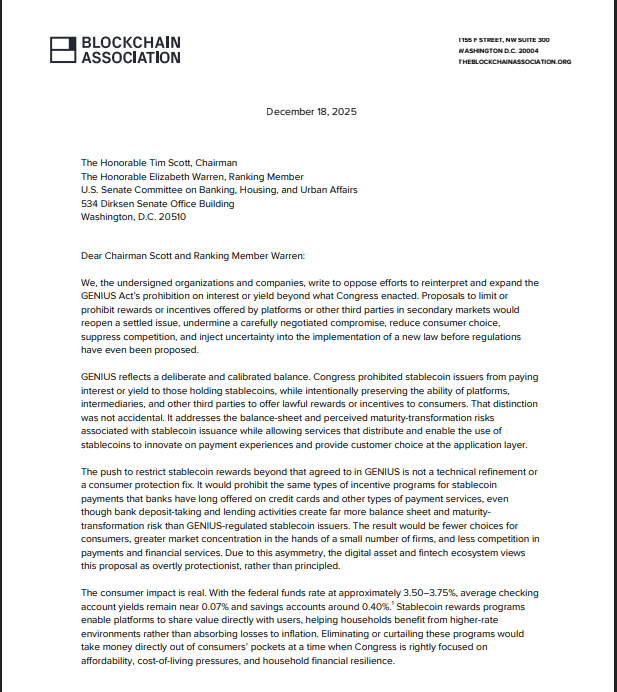
According to the association, the letter was signed by more than 125 crypto and fintech groups and companies and was sent to lawmakers to warn against reinterpreting the new rules in a way that would also bar exchanges and apps from offering rewards tied to stablecoin holdings.

Preserving Platforms’ Ability To Offer Rewards

The coalition’s argument rests on the text of the GENIUS Act, which was signed into law earlier this year by US President Donald Trump and explicitly bars permitted stablecoin issuers from paying interest or yield directly to holders.

Reports have disclosed that the statute nevertheless leaves room for third-party platforms to provide incentives, a distinction industry groups say is intentional and important for competition.

The letter pushes back against attempts to bar crypto platforms from offering yield to customers. Source: The Blockchain Association
Banks Call For Closing A Loophole

Banking groups have pushed back hard. A coalition led by the American Bankers Association and other banking trade groups asked Congress to clarify that the prohibition should extend to partners and affiliates, arguing that third-party rewards could circumvent the law and drain deposits from traditional banks.

According to recent coverage, Treasury analyses cited by bank advocates estimate that stablecoins could, in some scenarios, pull over $6 trillion from bank deposits — a figure that has become central to the banks’ case for tightening the rules.

What Industry Leaders Say

Industry spokespeople say expanding the ban would chill new services that rely on stablecoins and would tilt the market toward larger, incumbent financial firms that already control many payment rails.

BTCUSD currently trading at $88,063. Chart: TradingView

Based on reports, the Blockchain Association and partner groups contend that changing the law’s interpretation now would reopen negotiations the GENIUS Act resolved and would sow regulatory confusion before agencies finish writing implementing rules.

Competition And Consumer Choice At Stake

Supporters of stronger limits say the aim is consumer protection — to stop stablecoin arrangements from becoming de-facto interest accounts that could undermine the banking system and reduce loans to households and businesses.

Other observers point out the issue could also shape which firms win in payments going forward, since restrictions on rewards would affect the commercial incentives of exchanges and fintechs.

Next Steps In Washington

Senate Banking staff are weighing letters from both sides as they consider potential fixes or clarifying language during upcoming hearings.

Regulators who must implement the GENIUS Act have been urged to issue rules that prevent evasion of the ban, and lawmakers may face pressure to either leave the law as written or to craft narrow changes aimed at banks’ concerns.

Featured image from Unsplash, chart from TradingView

Preguntas relacionadas

QWhat is the main action taken by the Blockchain Association this week?

AThe Blockchain Association led a broad industry push by sending a letter to Senate Banking leaders, asking them to resist efforts to widen a ban on stablecoin yields beyond the text of the GENIUS Act.

QAccording to the coalition's argument, what does the GENIUS Act explicitly prohibit?

AThe GENIUS Act explicitly bars permitted stablecoin issuers from paying interest or yield directly to holders.

QWhy are banking groups, like the American Bankers Association, pushing for a broader interpretation of the ban?

ABanking groups argue that third-party rewards could circumvent the law and drain deposits from traditional banks, with estimates suggesting stablecoins could pull over $6 trillion from bank deposits in some scenarios.

QWhat is the potential market impact if the ban on stablecoin yields is expanded to third parties, according to industry spokespeople?

AIndustry spokespeople say expanding the ban would chill new services that rely on stablecoins and would tilt the market toward larger, incumbent financial firms that already control many payment rails.

QWhat are the next steps for Senate Banking staff regarding this issue?

ASenate Banking staff are weighing letters from both sides as they consider potential fixes or clarifying language during upcoming hearings.

Lecturas Relacionadas

Wall Street's 'Compliance Hunt': The Great Stablecoin Reserve Migration

In a concentrated move over the past week, several Wall Street giants have advanced their tokenized money market fund initiatives, signaling a strategic shift driven by impending U.S. stablecoin regulations. JPMorgan Chase launched its second such fund, JLTXX, on Ethereum, explicitly targeting future stablecoin issuer reserve needs. Concurrently, Franklin Templeton partnered with Kraken to integrate its BENJI tokenized funds onto the exchange platform for use as collateral and cash management tools. BlackRock further solidified its position by filing for two new tokenized funds with the SEC, aiming to convert its massive traditional stablecoin custody business into a tokenized model. These parallel developments represent a multi-pronged institutional "compliance hunt" to capture future crypto liquidity. BlackRock and JPMorgan are focusing on the backend, preparing to serve as the core reserve and settlement infrastructure for compliant stablecoins as outlined by the GENIUS Act. This act defines strict "qualified reserve asset" requirements for stablecoin backing while prohibiting interest payments to holders. Franklin Templeton and Kraken, however, are exploiting a potential regulatory gap. By offering a tokenized fund (BENJI) that is not a stablecoin, they aim to provide yield-bearing, collateralizable digital cash instruments, circumventing GENIUS Act's ban on stablecoin yield. The impending CLARITY Act, which will delineate digital asset market structure, is seen as a complementary piece to GENIUS. Its treatment of passive income could solidify the niche for instruments like BENJI. With conservative market size estimates for tokenized money market funds reaching hundreds of billions by 2030, Wall Street institutions are positioning themselves early, using on-chain settlement as a key competitive differentiator to offer superior liquidity and composability for the next generation of dollar reserves.

marsbitHace 37 min(s)

Wall Street's 'Compliance Hunt': The Great Stablecoin Reserve Migration

marsbitHace 37 min(s)

Altman Drops Bombshell While Musk is Away: He Once Wanted His Children to Inherit OpenAI

In a California court, Sam Altman testified for the first time in the ongoing legal battle between Elon Musk and OpenAI. Altman made a striking claim: Musk once suggested that control of OpenAI could one day be passed down to his children. This statement reframes the long-standing conflict not as a simple governance dispute but as a foundational power struggle. Altman sought to counter the narrative that OpenAI betrayed its original non-profit, idealistic mission. He argued that from the beginning, it was Musk who sought increasing control over the organization, including a larger equity stake and ultimate decision-making authority. Altman opposed this, citing OpenAI's core principle that AGI should not be controlled by any single individual. He also addressed the key point of contention about OpenAI's shift to a for-profit structure, claiming Musk was aware of and initially supportive of exploring such a model to secure the massive funding needed for advanced AI research. Altman framed the change as a practical necessity, not a betrayal. Further testimony revealed internal concerns after Musk left OpenAI's board, with worries he might take retaliatory action. Altman critiqued Musk's management style as unsuitable for a research lab, damaging morale and culture. Throughout his testimony, Altman's focus appeared to shift from technological idealism to the realities of organizational governance and resource requirements. Regarding his brief ouster in 2023, Altman stated he seriously considered joining Microsoft but ultimately returned because OpenAI was too important to abandon.

marsbitHace 1 hora(s)

Altman Drops Bombshell While Musk is Away: He Once Wanted His Children to Inherit OpenAI

marsbitHace 1 hora(s)

Trading

Spot
Futuros
活动图片





