Blockchain and no-code tools challenge AWS' dominance: Crypto exec

cointelegraphPublicado a 2025-12-20Actualizado a 2025-12-20

Resumen

The rise of AI-powered no-code tools and blockchain technology is challenging Amazon Web Services' dominance in cloud computing, according to Lomesh Dutta of the Dfinity Foundation. These tools democratize app creation and enable AI-driven, continuously updated user experiences without relying on centralized servers. Blockchain provides a secure, tamper-resistant infrastructure that operates without constant human intervention. Despite promoting decentralization, many crypto and Web3 projects still depend on AWS, as seen in multiple 2025 outages that disrupted major platforms like Binance, Coinbase, and MetaMask. Industry executives argue that true decentralization must extend beyond the ledger to infrastructure to avoid reliance on centralized providers.

The rise of AI-powered no-code tools that allow users to create applications through linguistic prompts rather than computer code, decentralized through blockchain technology, will challenge Amazon Web Services’ (AWS) dominance of the cloud computing market.

No-code tools will democratize access to app creation and custom-tailored user experiences that will require constant updates and maintenance from AI, Lomesh Dutta, vice president of growth at the Dfinity Foundation, a non-profit organization that guides development of the Internet Computer Protocol (ICP) ecosystem, told Cointelegraph.

This rise of user-created applications eliminates the need for centrally managed software solutions stored on centralized servers.
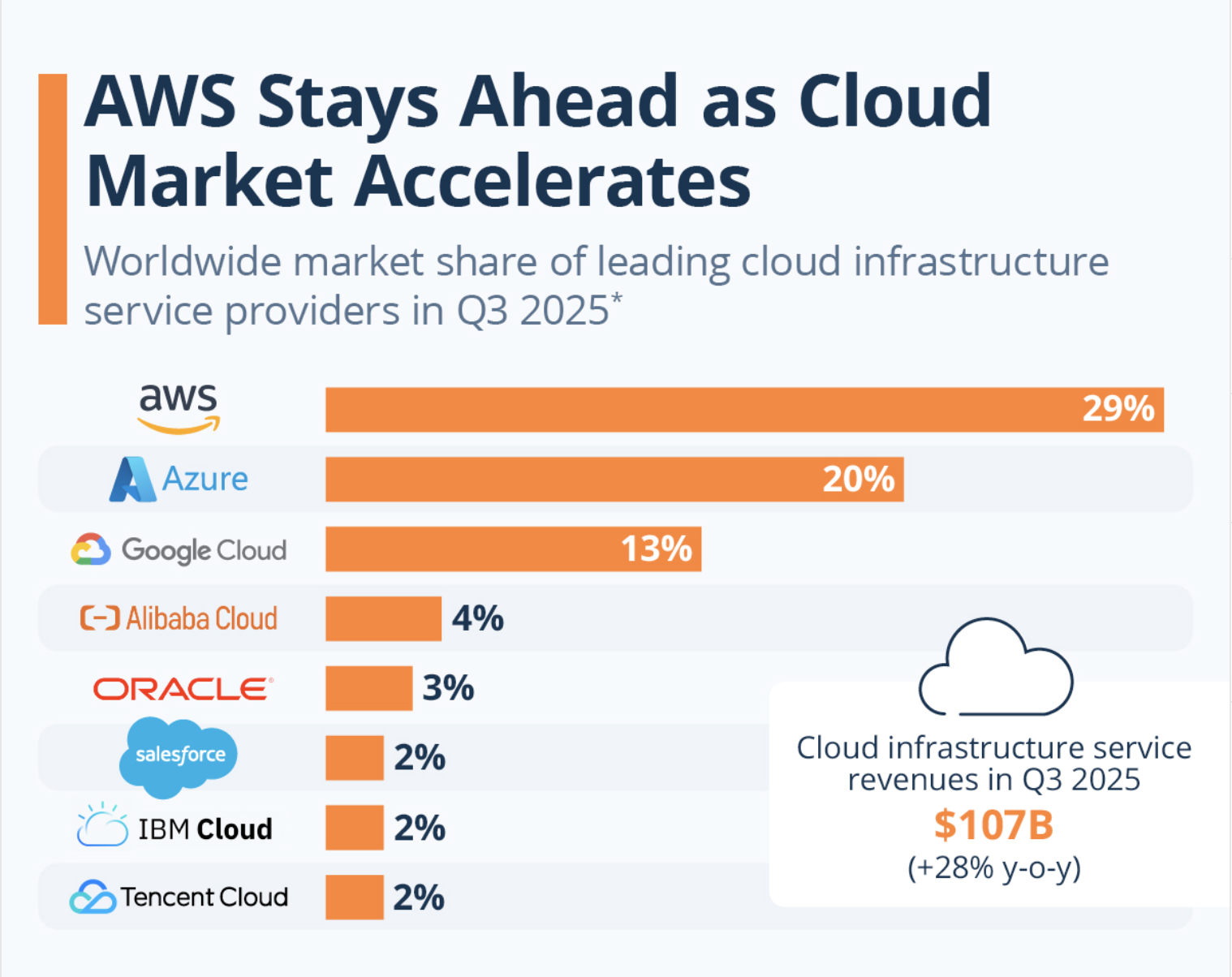
AWS continues to dominate the cloud-computing market in 2025. Source: Statista

“When applications are continuously generated and evolved by AI, you need infrastructure that is secure, tamper-resistant, and able to stay online without constant human intervention,” he said. Lomesh added:

“Decentralized blockchain networks introduced a revolutionary computing paradigm: by eliminating central points of control, they enable the creation of secure, reliable, and fault-tolerant software.”

A significant portion of crypto companies and Web3 projects rely on centralized AWS infrastructure to power their consumer-facing applications and websites, Internet Computer founder Dominic Williams told Cointelegraph.

Related: Cloudflare outage shows why crypto needs end-to-end decentralization

AWS outages rock the crypto industry in 2025

Several AWS outages occurred in 2025, impacting multiple crypto platforms and exchanges using AWS servers and data centers to host their applications.

The first outage occurred in April, causing disruptions to centralized crypto exchanges, including Binance, KuCoin and MEXC. At the time, Binance temporarily paused withdrawals until normal service was restored.

AWS experienced another outage in October, causing disruptions in crypto exchange Coinbase’s mobile application, with users reporting login problems, slowdowns and withdrawal issues.
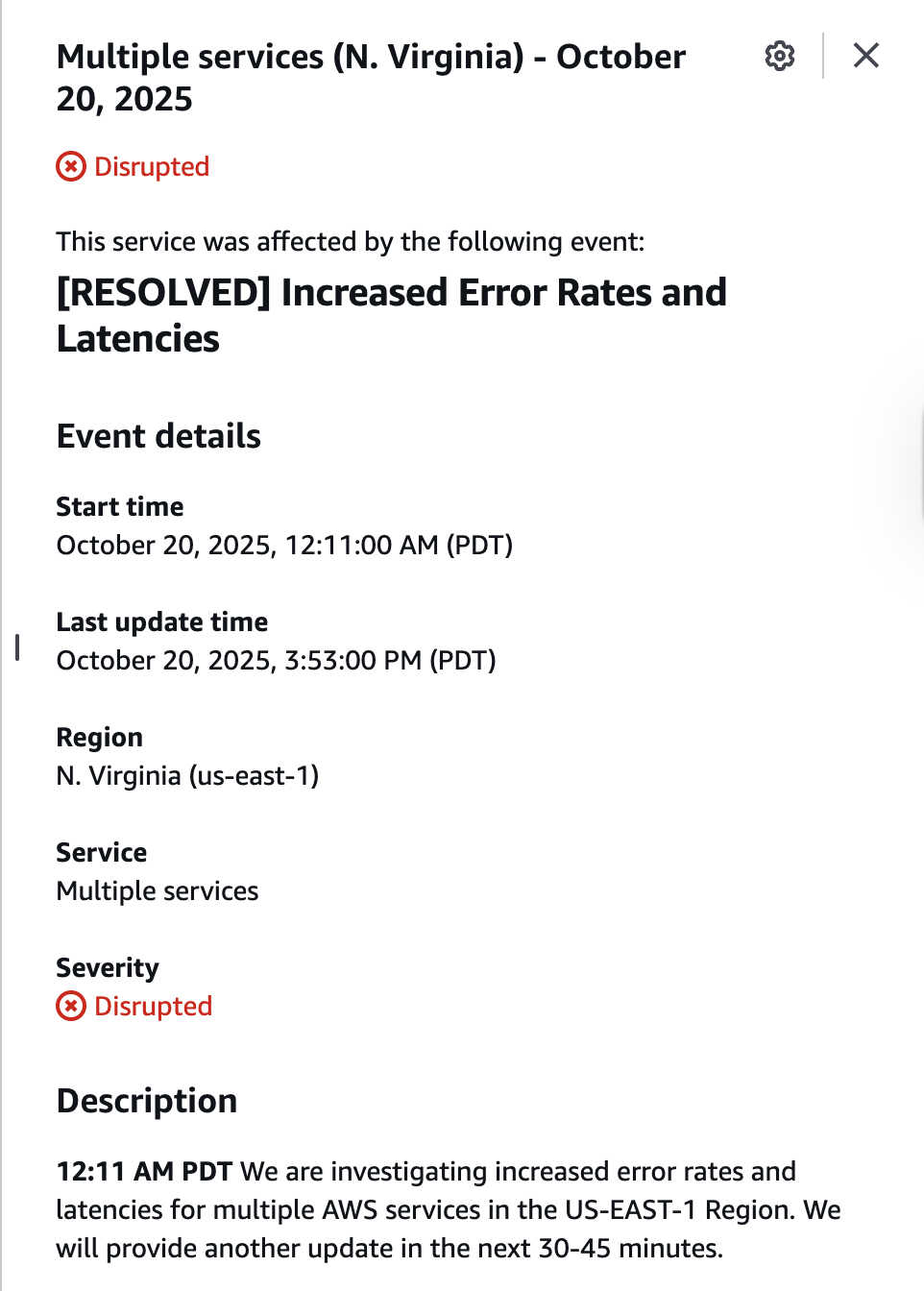
AWS reports an outage on October 20. Source: AWS Health Dashboard

Other financial applications were impacted by the outage, including the mixed-asset brokerage platform Robinhood and Web3 wallet MetaMask.

The October AWS outage lasted for about 15 hours and underscored the level of reliance crypto and Web3 projects, which market themselves as decentralized alternatives, have on centralized cloud infrastructure providers.

Crypto’s reliance on centralized infrastructure has drawn criticism from several crypto industry executives, including Jamie Elkaleh, chief marketing officer at crypto wallet company Bitget Wallet, and Carlos Lei, co-founder of decentralized physical infrastructure network (DePIN) marketplace Uplink.

“Decentralization has succeeded at the ledger layer but not yet at the infrastructure layer,” Elkaleh told Cointelegraph in October.

Magazine: Meet the onchain crypto detectives fighting crime better than the cops

Preguntas relacionadas

QAccording to the article, how will no-code tools and blockchain technology challenge AWS' dominance in cloud computing?

ANo-code tools democratize app creation through AI-powered linguistic interfaces, while blockchain provides decentralized, secure, and tamper-resistant infrastructure that eliminates reliance on centralized servers and reduces need for constant human maintenance.

QWhat specific problems did AWS outages cause for crypto platforms in 2025 as mentioned in the article?

AAWS outages in April and October 2025 caused disruptions including Binance pausing withdrawals, Coinbase experiencing login problems and withdrawal issues, and affecting platforms like KuCoin, MEXC, Robinhood, and MetaMask.

QWhat criticism did crypto executives have regarding the industry's infrastructure according to the article?

AExecutives like Jamie Elkaleh criticized that 'decentralization has succeeded at the ledger layer but not yet at the infrastructure layer,' highlighting the contradiction between Web3's decentralized ideals and its reliance on centralized cloud providers like AWS.

QWhat advantages does Lomesh Dutta attribute to decentralized blockchain networks for AI-generated applications?

AHe stated decentralized blockchain networks provide 'a revolutionary computing paradigm' by eliminating central points of control, enabling the creation of secure, reliable, and fault-tolerant software that can stay online without constant human intervention.

QWhich major companies and projects were mentioned as being affected by the AWS outages in the article?

AThe affected entities included crypto exchanges Binance, KuCoin, MEXC, and Coinbase; mixed-asset brokerage Robinhood; and Web3 wallet MetaMask.

Lecturas Relacionadas

a16z: Why Prediction Markets Could Become the Infrastructure for 'Future Probabilities'

The article explores the concept and potential of prediction markets, arguing that they are evolving from niche trading tools into a foundational infrastructure for assessing the probability of future events. A prediction market creates tradable contracts on specific event outcomes, using market price to aggregate dispersed information and approximate a collective probability assessment. This mechanism offers advantages over polls or expert forecasts by providing a real-time, incentivized signal, as participants risk real money on their judgments. Key strengths include the ability to generate probabilistic estimates, built-in financial incentives that encourage genuine information gathering, and the capacity to address specialized questions (e.g., AI model performance, geopolitical events) not easily captured by traditional financial markets. The author emphasizes that a prediction market is essentially a market—a tool for both resource allocation and information aggregation. However, the article also outlines significant challenges for reliability and effectiveness. Success depends on participation from well-informed traders, thoughtful contract design, unambiguous outcome resolution, and robust safeguards against manipulation (e.g., by insiders or groups seeking to influence public perception). Without these, prices may be mere noise or tools for propaganda. The future of prediction markets, therefore, lies not simply in scaling up trading volume, but in building more credible and transparent infrastructure. This includes clear rules for participation, auditable settlement mechanisms, and designs that mitigate manipulation. If these challenges can be addressed, prediction markets could become a vital public utility for navigating uncertainty, providing a new class of probability signals about the future.

marsbitHace 15 min(s)

a16z: Why Prediction Markets Could Become the Infrastructure for 'Future Probabilities'

marsbitHace 15 min(s)

Optical Modules Soar, Why Is NOK the Second Leader After MRVL?

Nokia's stock has surged nearly 170% to around $16.8 since Nvidia's $1 billion investment and AI-RAN partnership in October 2025, reflecting a market re-rating from a cyclical telecom equipment provider to an AI infrastructure player. This rise, adding roughly $60 billion in market cap, is driven by AI capex expansion into telecom edge, RAN, and optical networks. The company's Q1 2026 results showed strong momentum, with AI & Cloud net sales up 49% and 10 billion euros in new orders, prompting Nokia to raise its AI & Cloud market growth forecast to a 27% CAGR (2025-2028). Optical network growth of 20% further strengthens its position in connecting AI data centers. Recent tests with operators like T-Mobile and the opening of an AI Networking Innovation Lab demonstrate progress from concept to early commercial deployment. Nokia's strategy integrates Nvidia GPUs into its network hardware, enabling concurrent AI processing and RAN tasks for real-time optimization and new edge services. However, with a trailing P/E nearing 100x and consensus price targets lagging the current stock price, significant future growth is already priced in. The key constraint now is the pace and scale of large-scale operator deployments. While execution signals remain positive and the company's position in AI edge infrastructure is established, high valuation leaves limited room for error, making tangible commercial contracts the critical factor for further stock performance.

marsbitHace 25 min(s)

Optical Modules Soar, Why Is NOK the Second Leader After MRVL?

marsbitHace 25 min(s)

Trading

Spot
Futuros
活动图片