Bitwise Plants Its Flag In ETF Staking With Chorus One Buyout

bitcoinistPublicado a 2026-02-26Actualizado a 2026-02-26

Resumen

Crypto asset manager Bitwise has acquired staking infrastructure firm Chorus One, which manages over $2.2 billion in assets across dozens of blockchain networks. The deal brings 50 employees into Bitwise's onchain division and expands its staking services to more than 30 proof-of-stake networks, including Solana, Avalanche, and Sui. While financial terms were undisclosed, the acquisition positions Bitwise to capitalize on staking as a key growth opportunity, especially as the SEC warms to crypto investment products like ETFs that may offer staking rewards. Bitwise, which already manages $15 billion in assets and runs over 40 investment products, including its Bitcoin and Ethereum ETFs, continues to expand beyond its core ETF offerings.

Crypto asset manager Bitwise just made one of its boldest moves yet. The company has acquired Chorus One, a staking infrastructure firm that manages more than $2.2 billion in assets across dozens of blockchain networks. The deal brings 50 Chorus One employees into Bitwise’s growing onchain division, where several billion dollars in crypto assets are already being staked by clients.

Financial Terms Undisclosed

Chorus One has been in the staking business since 2018. Over those years, it built a client base that includes family offices, large funds, exchanges, high-net-worth individuals, and custodians — the kind of institutional relationships that take years to earn. Its founder and CEO, Brian Crain, will stay on in an advisory role as the rest of the team folds into Bitwise Onchain Solutions.
Image: Bitwise Asset Management

Reports say the financial terms of the deal were not made public. Bitwise did not disclose how much it paid.

What is clear, though, is what the company gets out of it. The acquisition extends Bitwise’s staking reach across more than 30 proof-of-stake networks — among them Solana, Avalanche, Sui, Aptos, Hyperliquid, Monad, and Tezos. That is a wide net, and it signals the company is not thinking just about Ethereum.

BTCUSD now trading at $65,247. Chart: TradingView

Staking, for those unfamiliar, works like this: holders of certain crypto tokens lock them up on a blockchain to help keep the network running. In return, they earn rewards — typically somewhere between 2% and 10% a year, on top of any gains from the token itself.

Why The Timing Matters

The US Securities and Exchange Commission has been warming up to a wider range of crypto investment products. That shift has opened the door for new types of exchange-traded funds, including ones that could one day offer staking rewards to ordinary investors. Bitwise appears to be positioning itself for exactly that possibility.
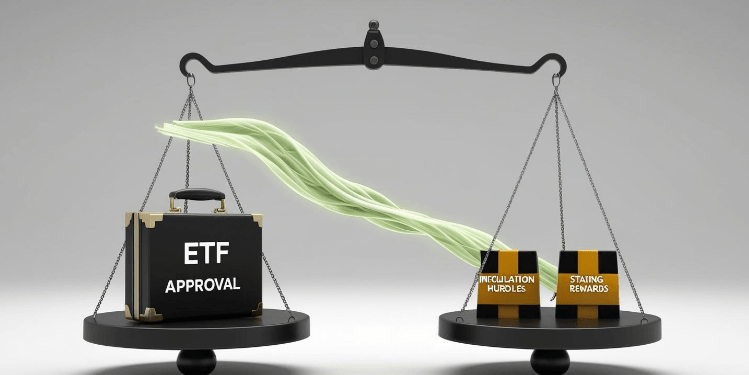
Image: OSL

Bitwise CEO Hunter Horsley described staking as “one of the most compelling growth opportunities” the firm sees for its clients. The company already runs more than 40 investment products and oversees roughly $15 billion in assets under management. Its flagship offerings include the Bitwise Bitcoin ETF and the Bitwise Ethereum ETF, which have pulled in over $2 billion and $387 million in flows respectively since launching in 2024.

Room To Grow

With nearly 200 employees now spread across the world, Bitwise has been steadily building out beyond its core ETF lineup. Reports note that its other products include ETFs tied to Solana, XRP, Chainlink, and even Dogecoin. The Chorus One deal adds staking muscle to that already broad product shelf.

Featured image from Gemini, chart from TradingView

Criptos en tendencia

Preguntas relacionadas

QWhat is the significance of Bitwise's acquisition of Chorus One?

AThe acquisition of Chorus One is a significant move for Bitwise as it expands the company's staking capabilities across more than 30 proof-of-stake blockchain networks, bringing in over $2.2 billion in staked assets and 50 experienced employees to bolster its onchain division.

QWhat types of clients did Chorus One serve prior to the acquisition?

AChorus One's client base included family offices, large funds, exchanges, high-net-worth individuals, and custodians, representing a range of institutional relationships built since 2018.

QHow does staking work in the context of cryptocurrency, according to the article?

AStaking involves holders of certain crypto tokens locking them up on a blockchain to help maintain network operations. In return, they earn rewards, typically between 2% and 10% annually, in addition to any appreciation in the token's value.

QWhy is the timing of this acquisition particularly important for Bitwise?

AThe timing is crucial because the US Securities and Exchange Commission is becoming more open to a wider range of crypto investment products, potentially including exchange-traded funds (ETFs) that offer staking rewards. Bitwise is positioning itself to capitalize on this future opportunity.

QWhat are some of Bitwise's flagship investment products mentioned in the article?

ABitwise's flagship offerings include the Bitwise Bitcoin ETF and the Bitwise Ethereum ETF, which have attracted over $2 billion and $387 million in flows, respectively, since their launch in 2024. The company also has ETFs tied to Solana, XRP, Chainlink, and Dogecoin.

Lecturas Relacionadas

A 'Overlooked' Market Event: Joint US-Japan-South Korea Intervention, Rare US Treasury Involvement, and Bessent's Quiet 'Market Rescue'?

Summary: The United States, Japan, and South Korea executed their largest coordinated foreign exchange intervention in nearly 30 years. The action targeted depreciation pressure on the Japanese yen and South Korean won. This move is seen as a significant effort by the US to stabilize the financial markets of its key allies and prevent the spillover of risks. Key details: * Japan reportedly intervened on July 30 using approximately 8.45 trillion yen (about $52.8 billion). South Korean authorities also intervened that day, selling dollars to support the won. * Notably, the US Treasury Department intervened directly in yen markets for the first time in roughly 30 years. The New York Fed, reportedly acting on behalf of the Treasury, sold euros to buy yen via Goldman Sachs and Morgan Stanley on July 31. Analysts view the use of the euro-yen pair as a way to alleviate yen pressure without adding selling pressure to the US dollar. * Prior to the action, the New York Fed conducted "rate checks" on both USD/JPY and EUR/JPY, a newer signaling tool that falls between verbal and physical intervention. The intervention is interpreted as going beyond traditional currency stabilization. Analysts, such as Michael Hartnett of Bank of America, suggest it resembles a "Price Keeping Operation" for the AI era. The core US objectives are perceived to be: 1. Preventing rapid yen depreciation from triggering a sharp rise in Japanese government bond yields. 2. Containing financial stress from spreading across Asian markets like South Korea and Japan. 3. Reducing the risk of disorderly capital flows impacting the US bond market. This coordinated action underscores the importance of Japan and South Korea as critical partners in the US semiconductor and AI supply chain. Stabilizing their financial markets is seen as vital to mitigating risks to the broader tech industry and the US market itself. The intervention coincides with market pressures, including the KOSDAQ index hitting a low since October 2022. While seen as a move to control volatility, some analysts caution it may not fundamentally reverse existing market trends.

marsbitHace 4 min(s)

A 'Overlooked' Market Event: Joint US-Japan-South Korea Intervention, Rare US Treasury Involvement, and Bessent's Quiet 'Market Rescue'?

marsbitHace 4 min(s)

Will the Federal Reserve Definitely Raise Interest Rates in September? How Will Cryptocurrencies and US Stocks Bear the Pressure?

In early August 2024, market expectations for a September Federal Reserve rate hike surged dramatically, from below 50% to over 80%, driven by renewed inflation concerns. This shift followed a contentious July FOMC meeting where a 9-3 vote to hold rates revealed a growing hawkish faction advocating for an immediate hike, citing prolonged above-target inflation. The key catalyst is escalating conflict near the Strait of Hormuz, which has pushed oil prices up approximately 20% in July, threatening to reignite inflation. The next critical data point is the July CPI report on August 12th; a hot reading could solidify hike expectations. For crypto assets, particularly Bitcoin, this represents near-term pressure. Bitcoin continues to exhibit high-beta, risk-on characteristics, making it sensitive to tightening liquidity and higher opportunity costs. However, historical precedent suggests that if a hike is perceived as the cycle's end rather than its start, the negative impact may be brief, with markets quickly pivoting to anticipate future rate cuts. U.S. stocks, especially crypto-linked equities like Coinbase and high-valuation tech stocks, face amplified volatility. Higher rates increase discount rates in valuation models, pressuring growth stocks. This coincides with a pivotal tech earnings season where investor focus has shifted from massive AI capital expenditures to demonstrable revenue and cash flow generation. Companies with negative cash flows and weak growth narratives could see severe pressure if a September hike materializes, as financing costs would rise. Key indicators to watch include oil prices, upcoming inflation data, and Fed commentary at events like the Jackson Hole symposium.

Odaily星球日报Hace 4 min(s)

Will the Federal Reserve Definitely Raise Interest Rates in September? How Will Cryptocurrencies and US Stocks Bear the Pressure?

Odaily星球日报Hace 4 min(s)

From South Korea to the United States: Blue-Collar Jobs Are Becoming Increasingly Popular, Thanks to AI

AI is reshaping the labor market's value proposition. The traditional four-year college degree is losing its appeal as a guaranteed career path, while skilled blue-collar trades like electricians, welders, and plumbers are experiencing historic demand and wage premiums. This shift is driven by dual pressures: AI's displacement of certain white-collar roles and a booming need for physical infrastructure and data center construction. Data confirms the trend. In the U.S., vocational school revenue surged, and a significant portion of recent layoffs are AI-related. Surveys show a majority of Gen Z adults plan to pursue blue-collar work, citing better job security against AI automation. Vocational education interest has exploded recently. Experts cite a psychological shift as younger generations seek tangible, AI-resistant careers and avoid high student debt. In many cases, salaries for skilled trades now match or exceed those requiring a bachelor's degree. In South Korea, semiconductor vocational high schools boast near-total employment, with graduates securing high-paying roles at companies like Samsung. The shortage is structural, exacerbated by a retiring baby boomer workforce and massive infrastructure projects. Companies like JPMorgan Chase, Meta, and Lowe's are investing heavily in training programs. However, overcoming historical stigma and a "perception gap" around trade careers remains a key challenge to closing the talent gap.

marsbitHace 1 hora(s)

From South Korea to the United States: Blue-Collar Jobs Are Becoming Increasingly Popular, Thanks to AI

marsbitHace 1 hora(s)

Trading

Spot

Artículos destacados

Cómo comprar ONE

¡Bienvenido a HTX.com! Hemos hecho que comprar Harmony (ONE) sea simple y conveniente. Sigue nuestra guía paso a paso para iniciar tu viaje de criptos.Paso 1: crea tu cuenta HTXUtiliza tu correo electrónico o número de teléfono para registrarte y obtener una cuenta gratuita en HTX. Experimenta un proceso de registro sin complicaciones y desbloquea todas las funciones.Obtener mi cuentaPaso 2: ve a Comprar cripto y elige tu método de pagoTarjeta de crédito/débito: usa tu Visa o Mastercard para comprar Harmony (ONE) al instante.Saldo: utiliza fondos del saldo de tu cuenta HTX para tradear sin problemas.Terceros: hemos agregado métodos de pago populares como Google Pay y Apple Pay para mejorar la comodidad.P2P: tradear directamente con otros usuarios en HTX.Over-the-Counter (OTC): ofrecemos servicios personalizados y tipos de cambio competitivos para los traders.Paso 3: guarda tu Harmony (ONE)Después de comprar tu Harmony (ONE), guárdalo en tu cuenta HTX. Alternativamente, puedes enviarlo a otro lugar mediante transferencia blockchain o utilizarlo para tradear otras criptomonedas.Paso 4: tradear Harmony (ONE)Tradear fácilmente con Harmony (ONE) en HTX's mercado spot. Simplemente accede a tu cuenta, selecciona tu par de trading, ejecuta tus trades y monitorea en tiempo real. Ofrecemos una experiencia fácil de usar tanto para principiantes como para traders experimentados.

404 Vistas totalesPublicado en 2024.12.12Actualizado en 2026.06.02

Cómo comprar ONE

Discusiones

Bienvenido a la comunidad de HTX. Aquí puedes mantenerte informado sobre los últimos desarrollos de la plataforma y acceder a análisis profesionales del mercado. A continuación se presentan las opiniones de los usuarios sobre el precio de ONE (ONE).

活动图片













