Bitwise Files With SEC to Launch First Uniswap ETF in U.S. Markets

TheNewsCryptoPublicado a 2026-02-06Actualizado a 2026-02-06

Resumen

Bitwise Asset Management has filed with the SEC to launch the first U.S. ETF focused solely on Uniswap’s UNI token. The proposed fund aims to provide regulated exposure to UNI through a conventional investment vehicle, without staking the tokens. Coinbase Custody is set to serve as the custodian. This filing follows the SEC’s recent conclusion of its investigation into Uniswap Labs, easing regulatory concerns. If approved, the ETF would mark a significant step in offering institutional and retail investors traditional access to a DeFi governance token, reflecting growing demand for regulated crypto investment products.

Bitwise Asset Management has filed a registration statement with the U.S. Securities and Exchange Commission to launch an exchange-traded fund focused on Uniswap. The offering would give investors regulated exposure to the governing UNI token via a traditional investment vehicle. If approved, it will become the first ETF to focus on a DeFi protocol token in the United States.
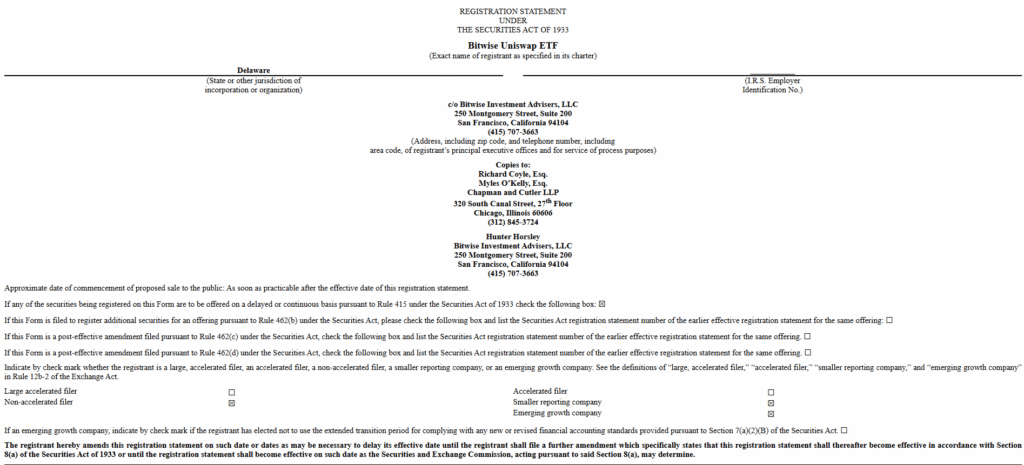
The Bitwise Uniswap ETF would have the UNI token as its main asset for tracking investor exposure. “The Trust’s investment objective is to provide exposure to the value of UNI, less the Trust’s expenses”. If approved, Coinbase Custody Trust Company will serve as the ETF custodian. Meanwhile, Bitwise has confirmed there will be no staking of UNI tokens associated with the proposed ETF at the time of its inception.
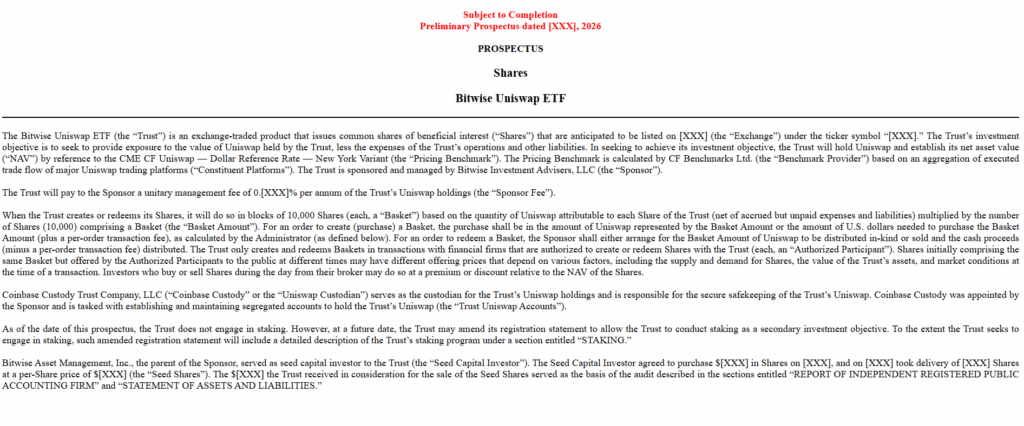
On Thursday, the SEC officially made the filing, bringing the product a step closer to the general financial markets. Indeed, access to DeFi coins via traditional applications has been a major focus for the firm, as stated, as an emerging trend with institutional investment demand. Brokerage accounts could potentially facilitate the ETF, opening more avenues for the UNI asset class. This filing will be part of a trend in crypto ETF filings in the U.S., which started in 2021 with the change in regulations.

Regulatory and Market Context

This comes when the SEC concluded its investigation into the case involving Uniswap Labs last year, which eased regulation issues facing the decentralized finance protocols. Delaware statutory trust filings were the foundation before submitting to the SEC for its approval. Trust filings are technical processes before an actual filing is made to the SEC.

An actual filing of the S-1 form signifies their readiness to start the regulatory process for their Uniswap ETF product. Analysts have revealed that it remains to be seen when the ETF will complete the review and approval process when it is sent to the SEC for processing. The ETF’s standard to trade on the US stock exchange will be determined by the SEC.

Bitwise filing for a Uniswap ETF with the SEC marks a new milestone for bringing a DeFi governance token into a regulated investment product. The new fund would be designed to give investors traditional exposure to UNI without token staking, pending regulatory approval. This action underscores ongoing institutional appetite for regulated crypto-investment vehicles linked to decentralized finance protocols.

Highlighted Crypto News:

Public Retirement Funds Hit by Sharp Decline Amid Bitcoin Slump

TagsBitwiseBlockchainDeFiETFSECUniswapUniswap (UNI)

Preguntas relacionadas

QWhat is the main asset that the Bitwise Uniswap ETF will use to track investor exposure?

AThe UNI token.

QWhich company will serve as the custodian for the proposed Bitwise Uniswap ETF?

ACoinbase Custody Trust Company.

QWhat significant regulatory event involving Uniswap Labs occurred last year, as mentioned in the article?

AThe SEC concluded its investigation into the case involving Uniswap Labs.

QWhat type of filing with the SEC signifies Bitwise's readiness to start the regulatory process for the Uniswap ETF?

AThe filing of an S-1 form.

QAccording to the article, what will the proposed ETF NOT involve at the time of its inception?

AStaking of UNI tokens.

Lecturas Relacionadas

Cook's Curtain Call and Ternus Takes the Helm: The Disruption and Reboot of Apple's 4 Trillion Dollar Empire

Tim Cook has officially announced he will step down as CEO of Apple in September, transitioning to executive chairman after a 15-year tenure during which he grew the company’s market value from around $350 billion to nearly $4 trillion. He will be succeeded by John Ternus, a 50-year-old hardware engineering veteran who has been groomed for the role through increasing public visibility and internal responsibility. Ternus’s appointment signals a strategic shift toward hardware and engineering leadership, with Johny Srouji—head of Apple Silicon—taking on an expanded role as Chief Hardware Officer. This consolidation aims to strengthen Apple’s core technological capabilities. However, Cook’s departure highlights a significant unresolved issue: Apple’s delayed and fragmented approach to artificial intelligence. Despite early efforts, such as hiring John Giannandrea from Google in 2018, Apple’s AI initiatives—particularly around Siri—have struggled with internal restructuring and reliance on external partnerships, including with Google. The transition comes at a critical moment as Apple faces paradigm shifts with the rise of artificial general intelligence (ASI). The company’s closed ecosystem of hardware, software, and services—once a major advantage—now presents challenges in adapting to an AI-centric world where intelligence may matter more than the device itself. Ternus must quickly articulate a clear AI strategy, possibly starting at WWDC, to reassure markets and redefine Apple’s role in a new technological era. His task is not only to maintain Apple’s operational excellence but also to reinvigorate its capacity to innovate and lead in the age of AI.

marsbitHace 28 min(s)

Cook's Curtain Call and Ternus Takes the Helm: The Disruption and Reboot of Apple's 4 Trillion Dollar Empire

marsbitHace 28 min(s)

Trading

Spot
Futuros
活动图片





