Bitwise Chief Investment Officer: The Long Night Is at Its Deepest, a Glimmer of Light for the Crypto Market Is Near

marsbitPublicado a 2026-02-03Actualizado a 2026-02-03

Resumen

Bitwise's Chief Investment Officer asserts that the crypto market has been in a severe winter since January 2025, though its end is likely nearer than its beginning. While Bitcoin and Ethereum are down 39% and 53% from their October 2025 peaks, respectively, many other assets have fallen even more sharply. This isn't a typical bull market pullback but a full-scale crypto winter, driven by over-leverage and large-scale profit-taking by early investors. Despite positive developments in adoption and regulation, prices continue to fall because bear markets often ignore good news. Historically, crypto winters last around 13 months. However, the current downturn may have started earlier than perceived, as massive inflows into Bitcoin and Ethereum ETFs, along with crypto treasury products (DATs), masked underlying weakness in the broader market. These institutional purchases, totaling approximately $75 billion in Bitcoin alone, provided crucial support floor—without which declines could have been much steeper. The market is now categorized into three groups: assets with strong institutional support (like BTC and ETH) saw milder declines; those with recent ETF approvals fell more significantly; and assets without such backing experienced severe drops. The current climate feels hopeless, but the fundamental strengths of crypto—regulatory progress, institutional adoption, and real-world utility—remain intact. These positive factors are accumulating potential that is likely to trigger...

The bad news is: We have been in a crypto winter since January 2025. The good news is: We are likely closer to the end of the winter than to its beginning.

I want to state something obvious, because I believe it will help you make beneficial decisions in the coming months: We are in a full-blown crypto winter.

I find that few people online or in the mainstream media are talking about this, but it is an indisputable fact. Bitcoin is down 39% from its all-time high in October 2025, Ethereum is down 53%, and many other crypto assets have fallen even more.

It's important to recognize it for what it is. This is not a bull market correction, nor a dip. This is a full-blown, harsh winter comparable to 2022, as brutal as what Leonardo DiCaprio endured in *The Revenant*. The causes of this winter range from excessive leverage to large-scale profit-taking by early players.

For me, acknowledging and accepting this has made everything incredibly clear.

Why are crypto prices falling despite continuous positive news in areas like adoption and regulation? Because we are in the deep end of the crypto winter. Why is the new Fed Chair a Bitcoin supporter, yet the Crypto Fear & Greed Index is in the extreme fear zone? Because we are in a crypto winter.

Those who experienced the past winters of 2018 or 2022 will remember that in the depths of winter, positive news means nothing. We won't see a rebound just because Wall Street is hiring aggressively or Morgan Stanley is increasing its crypto exposure. These things are important in the long term, but not now. Crypto winter doesn't end in euphoria; it ends in exhaustion.

So, when will the winter end? The good news is: I believe we are nearing the end.

The Historical Pattern of Crypto Winters

Crypto winters typically last about 13 months. For example, Bitcoin peaked in December 2017 and bottomed in December 2018; it peaked in October 2021 and bottomed in November 2022.

By this cycle's logic, we still have a difficult period ahead. After all, Bitcoin peaked in October 2025, so wouldn't we have to wait until November 2026? I don't think so.

After further analysis of the current winter, I've become increasingly aware that it actually started in January 2025. We just couldn't see it because inflows into ETFs and Digital Asset Trusts (DATs) masked the truth.

ETF and DAT Flows Masked the 2025 Winter

Take a close look at this chart of the performance of the components of the Bitwise 10 Large Cap Crypto Index since January 1, 2025.
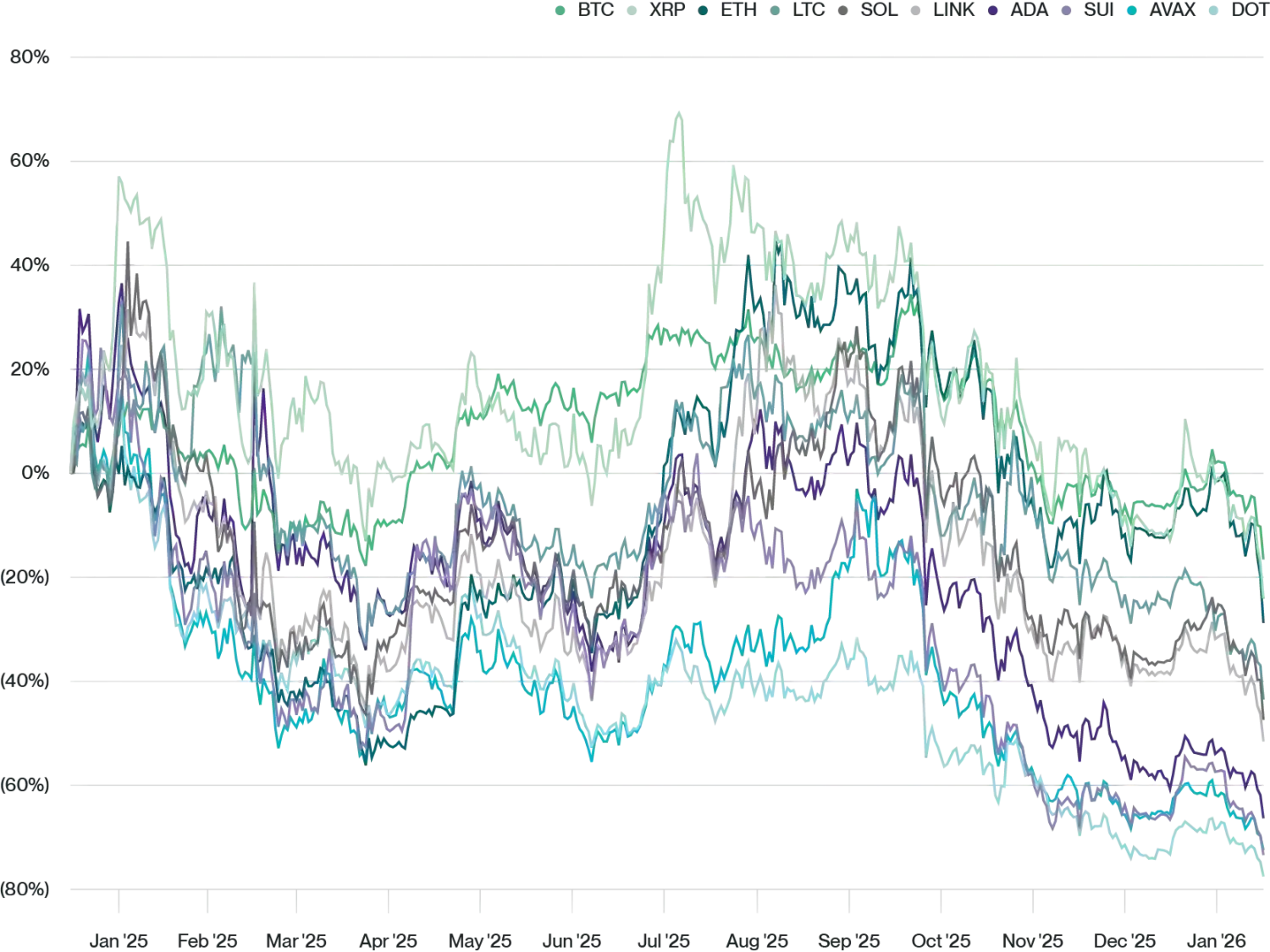
They clearly fall into three categories:

· First-category assets (BTC, ETH, XRP) performed relatively okay, down 10.3% to 19.9%

· Second-category assets (SOL, LTC, LINK) experienced a standard bear market, down 36.9% to 46.2%

· Third-category assets (ADA, AVAX, SUI, DOT) were decimated, down 61.9% to 74.7%

The core difference between these three categories essentially boils down to whether institutions have channels to invest in them. First-category assets received massive support from ETF/DAT inflows throughout the year; second-category assets had ETFs approved in 2025; third-category assets never did. (Note: XRP is an exception. It didn't have an ETF at the start of 2025 but performed well. The reason might be that XRP faced a life-or-death lawsuit from the U.S. SEC at the start of 2025, which was dropped in early 2025, leading to a significant rally for the asset.)

The scale of institutional support is staggering. For example, during the period shown in the chart, ETFs and DATs cumulatively bought 744,417 Bitcoin, worth approximately $75 billion. Imagine where Bitcoin would be without this $75 billion of support? I suspect it would be down about 60%.

The retail market has been in a brutal winter since January 2025. Institutional money just masked this fact for some assets for a while.

It's Always Darkest Before the Dawn

What needs to be remembered right now is that there is a lot of tangible, positive development happening in crypto. Regulatory progress is real, institutional adoption is real, stablecoins and asset tokenization are real, and Wall Street's embrace is real.

In a bear market, positive news gets ignored, but it doesn't disappear. It gets stored as potential energy. Once the clouds part and market sentiment returns to normal, this pent-up energy is released in a vengeful manner. What can disperse the clouds? Strong economic growth triggering a broad risk-asset rally, positive signals from the Clarity Act, signs of sovereign nation Bitcoin adoption, or simply the passage of time.

As a veteran who has lived through multiple crypto winters, I can tell you that the feeling right before the winter ends feels very much like this: despair, helplessness, gloom. But the current market pullback has done nothing to change the fundamentals of the crypto market.

I believe we will rebound faster and more violently. After all, the winter started in January 2025. Spring can't be far away.


Preguntas relacionadas

QAccording to the Bitwise CIO, when did the crypto winter actually begin, and what masked its early signs?

AThe crypto winter actually began in January 2025, but its early signs were masked by massive inflows into ETFs and Digital Asset Trusts (DATs), which provided significant institutional buying support for certain assets like Bitcoin.

QWhat are the three categories of crypto asset performance since January 1, 2025, as described in the article, and what was the key differentiating factor?

AThe three categories are: 1) Assets like BTC, ETH, and XRP that performed relatively okay, down 10.3% to 19.9%. 2) Assets like SOL, LTC, and LINK that experienced a standard bear market, down 36.9% to 46.2%. 3) Assets like ADA, AVAX, SUI, and DOT that were decimated, down 61.9% to 74.7%. The key differentiating factor was whether the assets had a channel for institutional investment (via ETFs/DATs).

QWhy does the author believe that positive news in areas like adoption and regulation fails to boost crypto prices during a deep crypto winter?

AThe author states that during the depths of a crypto winter, positive news becomes meaningless for price action. The market ignores good news because sentiment is dominated by fear and exhaustion; the winter doesn't end in a frenzy of excitement but rather when the selling is exhausted.

QBased on historical patterns, how long do crypto winters typically last, and why does the author think the current one might end sooner than a simple pattern extrapolation would suggest?

AHistorically, crypto winters have lasted about 13 months. A simple extrapolation from the October 2025 peak would suggest a bottom around November 2026. However, the author believes it will end sooner because the analysis shows the winter actually began in January 2025, meaning the market has already been in a downturn for a significant period.

QWhat does the author conclude about the state of crypto fundamentals despite the current price downturn?

AThe author concludes that the current price downturn has not changed the strong fundamentals of the crypto market. Progress in regulation, institutional adoption, stablecoins, asset tokenization, and Wall Street's embrace are all real. This positive energy is being stored as potential energy and will be released in a powerful, retaliatory manner once market sentiment returns to normal.

Lecturas Relacionadas

KOL's Perspective: Why Is SOL Set to Rise from This Point?

**Summary: Why SOL is Positioned for Growth at This Level** The article argues that SOL is poised for an upward move from its current price point, citing several key factors. Primarily, SOL has just broken out of a 4-month consolidation phase. This breakout signals a return of risk appetite to the broader crypto market, as SOL is seen as a key indicator of overall crypto health. The token's ownership has reportedly shifted from short-term traders and tourists to long-term accumulators, leading to low volume. Any meaningful increase in trading activity could thus trigger significant upward momentum. Fundamental strengths include strong institutional adoption, integration with DeFi and RWAs (Real-World Assets), and the potential benefits from the Clarity Act. Despite its high volatility—having dropped 70% from its all-time high but still up 12x from its bear market low—SOL is highlighted as one of the few tokens from the last cycle to reach new highs. It boasts a robust ecosystem of applications, users, and protocols. Future catalysts include the expected influx of AI developers following the Miami Accelerate conference, which focused on AI on Solana. Furthermore, Solana is positioned as the premier chain for memecoin activity, a trend expected to continue and drive network usage and fees. The article concludes that recent price action reflects a healthy transfer to long-term holders, setting the stage for growth.

marsbitHace 16 min(s)

KOL's Perspective: Why Is SOL Set to Rise from This Point?

marsbitHace 16 min(s)

Those Pre-Bitcoin PoW Protocols Have Recently Been Reimplemented

This article details a recent surge in replicating pre-Bitcoin Proof-of-Work (PoW) protocols, specifically focusing on Hal Finney's 2004 RPOW (Reusable Proofs of Work). Within five days in May 2026, multiple independent builders in the Bitcoin/cypherpunk community launched projects inspired by this early electronic cash proposal. The initiative began with Fred Krueger's `rpow2.com`, a centralized but auditable system that replaced RPOW's original IBM 4758 hardware with Ed25519 signatures. Initially a faithful replica, it later adopted Bitcoin-like features (21M supply cap, difficulty adjustment) and a controversial 5.24% founder allocation. This sparked rapid forks, including `rpow4.com` which incorporated full Bitcoin parameters, a prediction market (`rpowmarket.com`), and a DEX (`rpow2swap.com`). Concurrently, Mike In Space created a prototype of Wei Dai's 1998 b-money proposal (`b-money.replit.app`), pushing the historical exploration even further back. The article contrasts these centralized, server-dependent experiments with Bitcoin's core innovation of decentralized, trustless consensus. It also highlights a parallel development: the `HASH` project on Ethereum, which uses smart contract hooks to enable a purely fair-launch, browser-mineable PoW token with 0% allocations to team or VCs. The collective activity is framed as a meme-driven, educational exploration of cypherpunk history rather than a serious financial movement, with all projects heavily disclaiming any investment value.

marsbitHace 20 min(s)

Those Pre-Bitcoin PoW Protocols Have Recently Been Reimplemented

marsbitHace 20 min(s)

South Korean Exchanges 'Battle' Regulators, Challenging the Boundaries of Enforcement and Legislation

South Korea's cryptocurrency industry is engaged in a rare, direct confrontation with regulators. The Financial Intelligence Unit (FIU), the primary anti-money laundering (AML) watchdog, has recently imposed heavy penalties on major exchanges like Upbit and Bithumb for alleged violations involving unregistered overseas VASPs and AML procedures. However, exchanges are now actively challenging these actions in court and through industry associations. In a significant shift, the Seoul Administrative Court ruled in favor of Upbit's operator, Dunamu, overturning part of an FIU-ordered business suspension. The court found the FIU's penalty criteria and justification insufficiently clear. Similarly, the court suspended the enforcement of a six-month business suspension against Bithumb pending a final ruling, citing potential irreversible harm to the exchange. Beyond legal battles, the industry is contesting proposed legislative amendments. The Digital Asset eXchange Alliance (DAXA) strongly opposes a draft rule that would mandate Suspicious Transaction Reports (STRs) for all crypto transfers over 10 million KRW (~$6,800). DAXA argues this "poison pill" clause violates legal principles and would overwhelm the STR system, increasing reports from 63,000 to an estimated 5.45 million annually for major exchanges, thereby crippling effective AML monitoring. This conflict highlights a structural tension in South Korea's crypto governance: comprehensive digital asset laws are still developing, while regulators rely heavily on AML enforcement. The industry's move from passive compliance to active legal and legislative challenges signifies a new phase, pressing for clearer rules and more proportionate enforcement. While short-term disputes may intensify, this clash could ultimately lead to a more mature and sustainable regulatory framework for South Korea's vibrant crypto market.

marsbitHace 1 hora(s)

South Korean Exchanges 'Battle' Regulators, Challenging the Boundaries of Enforcement and Legislation

marsbitHace 1 hora(s)

After 50x Storage Surge, Justin Sun Always Looks to the Next Decade

Sun Yuchen, known for his controversial stunts like a $30 million lunch with Warren Buffett (canceled due to a kidney stone) and eating a $6.2 million duct-taped banana, is often overshadowed by a significant fact: his decade-long track record of spotting major investment trends. In 2016, he famously advised young people to invest in Bitcoin, Nvidia, Tesla, and Tencent instead of buying property. A hypothetical $20,000 investment in Nvidia and Tesla from that list would now be worth over 50 million RMB. His latest major call was on November 6, 2025, predicting a "50x storage opportunity" tied to the AI boom, which materialized with Sandisk's stock surging nearly 50-fold by 2026. Looking ahead, Sun now focuses on the next frontier: Physical AI. He identifies four key areas: 1. **Embodied AI/Robotics**: He sees this reaching its "iPhone moment," with companies like UBTech and Galaxy General leading in commercialization. 2. **Drones**: Viewed as the first commercially viable form of Physical AI, revolutionizing sectors from warfare (e.g., AeroVironment's Switchblade) to logistics. 3. **Spatial Computing**: Beyond VR, it's about AI understanding physical space, a foundational technology for robotics and autonomous systems, exemplified by Apple's Vision Pro. 4. **Space Exploration**: After a 2025 suborbital flight with Blue Origin, Sun advocates for space as the ultimate frontier, discussing blockchain's potential role in space asset management and data transactions. His investment philosophy involves betting on entire, inevitable trends rather than single companies. For robotics, he sees Tesla (the body/manufacturer) and Nvidia (the brain/AI platform) as complementary plays. In defense drones, he highlights companies making tanks obsolete (AeroVironment) and those augmenting fighter jets (Kratos). For space, he participated in Blue Origin's flight and anticipates SpaceX's potential IPO to redefine the sector's valuation. Sun Yuchen's vision frames the next two decades not as a revolution in information flow (like the internet), but in the fundamental operation of the physical world through AI-powered robots, autonomous systems, and spatial intelligence, ultimately extending human and AI activity into space. While many still focus on conventional assets, he continues to look toward the next technological horizon.

marsbitHace 2 hora(s)

After 50x Storage Surge, Justin Sun Always Looks to the Next Decade

marsbitHace 2 hora(s)

Trading

Spot
Futuros

Artículos destacados

Cómo comprar NIGHT

¡Bienvenido a HTX.com! Hemos hecho que comprar Midnight (NIGHT) sea simple y conveniente. Sigue nuestra guía paso a paso para iniciar tu viaje de criptos.Paso 1: crea tu cuenta HTXUtiliza tu correo electrónico o número de teléfono para registrarte y obtener una cuenta gratuita en HTX. Experimenta un proceso de registro sin complicaciones y desbloquea todas las funciones.Obtener mi cuentaPaso 2: ve a Comprar cripto y elige tu método de pagoTarjeta de crédito/débito: usa tu Visa o Mastercard para comprar Midnight (NIGHT) al instante.Saldo: utiliza fondos del saldo de tu cuenta HTX para tradear sin problemas.Terceros: hemos agregado métodos de pago populares como Google Pay y Apple Pay para mejorar la comodidad.P2P: tradear directamente con otros usuarios en HTX.Over-the-Counter (OTC): ofrecemos servicios personalizados y tipos de cambio competitivos para los traders.Paso 3: guarda tu Midnight (NIGHT)Después de comprar tu Midnight (NIGHT), guárdalo en tu cuenta HTX. Alternativamente, puedes enviarlo a otro lugar mediante transferencia blockchain o utilizarlo para tradear otras criptomonedas.Paso 4: tradear Midnight (NIGHT)Tradear fácilmente con Midnight (NIGHT) en HTX's mercado spot. Simplemente accede a tu cuenta, selecciona tu par de trading, ejecuta tus trades y monitorea en tiempo real. Ofrecemos una experiencia fácil de usar tanto para principiantes como para traders experimentados.

374 Vistas totalesPublicado en 2025.12.08Actualizado en 2025.12.08

Cómo comprar NIGHT

Discusiones

Bienvenido a la comunidad de HTX. Aquí puedes mantenerte informado sobre los últimos desarrollos de la plataforma y acceder a análisis profesionales del mercado. A continuación se presentan las opiniones de los usuarios sobre el precio de NIGHT (NIGHT).

活动图片












