BitMine’s $ETH Holdings Reach $10.7B After New Purchase as MAXI Soars

bitcoinistPublicado a 2026-02-03Actualizado a 2026-02-03

Resumen

BitMine, a major digital asset mining firm, has significantly expanded its Ethereum holdings to $10.7 billion through a strategic acquisition, signaling a shift toward institutional balance sheet strengthening amid a tightening ETH market. This large-scale accumulation reduces circulating supply, potentially raising Ethereum's price floor. Meanwhile, retail traders are shifting toward high-risk, high-reward meme tokens like Maxi Doge ($MAXI), which positions itself as a leveraged trading-focused project within the Ethereum ecosystem. Having raised over $4.5M in its presale, $MAXI incorporates staking mechanisms and community incentives, appealing to traders seeking outsized returns. The trend highlights a market divergence between institutional accumulation and retail speculation.

Institutional capital isn’t just tiptoeing around Ethereum anymore; it’s stomping in. BitMine, a heavyweight in digital asset mining, has officially expanded its Ether treasury to a massive $10.7B following its latest strategic acquisition.

This purchase marks a pivotal shift in market structure, moving beyond simple speculation toward genuine balance sheet fortification.
The timing is critical. On-chain metrics are already flashing signs of a deepening supply squeeze as exchange reserves hit multi-year lows. BitMine’s aggressive buying acts as a volatility dampener for the second-largest cryptocurrency.
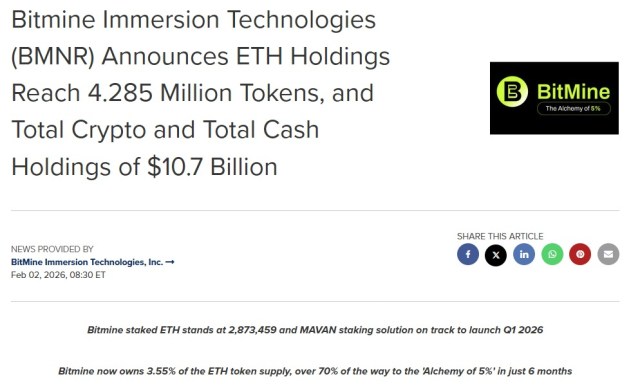
That matters. Large-scale accumulation usually precedes a reduction in liquidity, where price discovery becomes hypersensitive to marginal demand. When entities like BitMine lock billions in cold storage, they effectively remove that supply from circulation, theoretically establishing a higher price floor.

While institutions play the safe long game with blue-chip assets, retail traders are signaling a different kind of appetite. The stability provided by these institutional floors often emboldens high-frequency traders to seek alpha further out on the risk curve. This rotation of capital, from safety to speculation, is fueling a surge in the meme token sector.

That’s where Maxi Doge ($MAXI) has emerged as a focal point for traders seeking high-leverage exposure.

Buy your $MAXI here.

Maxi Doge Brings Gym-Bro Intensity to Ethereum’s Meme Ecosystem

While the broader market watches BitMine stabilize the macro environment, the meme token niche is rewarding projects that bring utility to the culture of volatility. Maxi Doge has captured this sentiment by positioning itself as the ‘Leverage King’ of the ERC-20 space.

Distancing itself from the passive ‘hold and hope’ strategy of earlier dog coins (which often fail to deliver), the project embodies the aggressive mentality of 1000x leverage trading. The brand identity centers on ‘never skipping leg day’ and the perpetual grind of the bull market.

This narrative seems to be hitting home with sophisticated capital. On-chain data from Etherscan shows two whale wallets accumulated $503K in recent transactions, a signal that smart money is hunting for outsized returns beyond standard ETH beta.

The appeal lies in the ecosystem design, which essentially gamifies the trading experience. By introducing holder-only competitions and a ‘Maxi Fund’ treasury, the project aligns community incentives with price performance.

It’s a pivot from memes as passive images to memes as active financial sports. The market data implies that traders are increasingly favoring tokens that reflect their own aggressive strategies, ‘lift, trade, repeat’, rather than those relying solely on cute aesthetics.

Explore the Maxi Doge ecosystem.

Presale Data Points to Strong Momentum for $MAXI Staking Model

The financial structuring of Maxi Doge focuses on liquidity retention through dynamic staking rewards. Unlike projects that flood the market with tokens immediately, the smart contract governs supply through a 5% staking allocation pool, offering daily automatic distribution for up to one year.

This mechanism encourages holders to lock assets, theoretically reducing sell pressure while earning yield. It’s a strategy that mirrors the institutional ‘hodl’ mentality, just with significantly higher risk-reward ratios.

According to the official presale page, Maxi Doge has raised over $4.5M, validating strong early interest. With tokens currently priced at $0.0002802, the valuation offers an entry point that stands in stark contrast to the multi-billion dollar market caps of established meme coins.
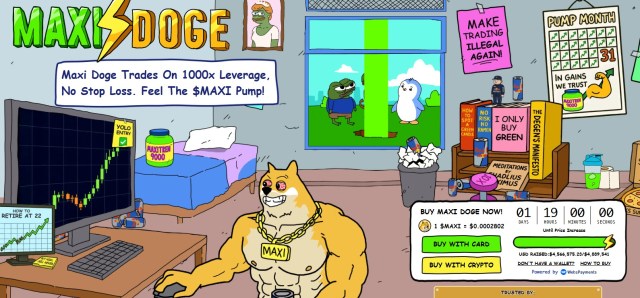
For retail investors, the math is simple: catching a 10x or 100x return is often more probable from a sub-penny price point than from assets already saturated with capital.

Current capital inflows suggest the market is hunting for an Ethereum-based contender to challenge the dominance of Solana memes. By using the security of the Ethereum Proof-of-Stake network while adopting the viral ‘gym bro’ humor that dominates crypto Twitter, the project creates a dual-threat value proposition.

It offers the technical reliability of ERC-20 with the viral velocity of a breakout meme, a counterbalance to the slow, steady accumulation seen in BitMine’s strategy.

Learn more about the Maxi Doge presale.

The content provided in this article is for informational purposes only and does not constitute financial advice. Cryptocurrency markets are highly volatile, and meme tokens like $MAXI carry significant risk. Investors should conduct their own due diligence and never invest more than they can afford to lose.


Criptos en tendencia

Preguntas relacionadas

QWhat is the total value of BitMine's ETH holdings after their latest purchase, and what does this signify for the market?

ABitMine's ETH holdings have reached $10.7 billion after their latest strategic purchase. This signifies a pivotal shift from simple speculation to genuine balance sheet fortification and acts as a volatility dampener for Ethereum. The large-scale accumulation reduces liquidity and helps establish a higher price floor by removing supply from circulation.

QAccording to the article, what is the primary narrative and utility that Maxi Doge ($MAXI) brings to the meme token ecosystem?

AMaxi Doge positions itself as the 'Leverage King' of the ERC-20 space, bringing an aggressive, high-leverage trading mentality to the meme ecosystem. It distances itself from passive 'hold and hope' strategies by gamifying the trading experience with holder-only competitions and a 'Maxi Fund' treasury, aligning community incentives with price performance.

QHow does the Maxi Doge staking model work to retain liquidity and reduce sell pressure?

AThe Maxi Doge staking model uses a smart contract with a 5% staking allocation pool that offers daily automatic distribution of rewards for up to one year. This mechanism encourages holders to lock their assets to earn yield, which theoretically reduces immediate sell pressure and promotes liquidity retention.

QWhat on-chain activity indicates 'smart money' interest in Maxi Doge ($MAXI)?

AOn-chain data from Etherscan shows that two whale wallets accumulated $503,000 worth of $MAXI in recent transactions. This activity is a signal that sophisticated capital (smart money) is seeking outsized returns beyond standard ETH beta exposure.

QWhat key factor does the article suggest makes a sub-penny token like $MAXI attractive to retail investors compared to established meme coins?

AThe article suggests that the sub-penny price point of $MAXI, currently at $0.0002802, makes catching a 10x or 100x return more probable than from assets with multi-billion dollar market caps that are already saturated with capital.

Lecturas Relacionadas

As Consensus Accelerates, What Are Young Investors Betting On?

Title: As Consensus Forms Faster, What Are Young Investors Betting On? In the rapid evolution of tech investment, a new generation of young investors is navigating a landscape where AI, robotics, commercial aerospace, and quantum computing are advancing simultaneously. Traditional investment logic based on financial models is giving way to a need for deep technical understanding and the ability to act before industry consensus forms. An analysis of trends from the "WAIC FUTURE TECH" list of young investment leaders reveals key shifts in focus. The first major trend is the movement of AI from the digital screen into the physical world. Investment is shifting from large language models and chatbots towards embodied AI, robotics, AI hardware, and edge computing. While demonstrations generate excitement, the real challenge lies in achieving scalable, reliable, and cost-effective delivery in complex real-world environments like factories and logistics. Success depends not just on algorithms but on the integration of sensors, actuators, and control systems. Second, the competitive focus for large models is moving beyond raw capability toward building an "intelligence flywheel." The goal is to create self-reinforcing systems where user interaction generates data, improving the model, which in turn enhances the user experience and attracts more engagement. Companies that successfully embed AI into workflows to create these closed-loop systems can build lasting value that isn't easily erased by the next model upgrade. Third, facing a potential bottleneck in high-quality human-generated data, investors are looking at new underlying technologies. Reinforcement learning and self-play, as demonstrated by AlphaGo Zero, offer paths for AI to generate its own experience. Scientific foundation models, which aim to build general AI capabilities for fields like life sciences and materials discovery, represent a non-consensus direction that could unlock new frontiers of knowledge and data. Finally, in deep-tech areas like quantum computing, commercial aerospace, and space-based infrastructure, patient capital is essential. These fields have long, uncertain development and validation cycles involving complex engineering, supply chains, and regulations. Investment here requires a long-term view, focusing on foundational team capabilities and the eventual emergence of market demand, even if commercial returns are distant. Collectively, these trends illustrate how young investors are adapting to a new era. They are learning to make earlier, technically-informed judgments, balance hype with real-world viability, and provide the patient capital needed to build the deep-tech foundations of the future.

marsbitHace 28 min(s)

As Consensus Accelerates, What Are Young Investors Betting On?

marsbitHace 28 min(s)

Can Japan Buy Growth with AI? Will the Bond Market Believe It?

Japan's cabinet has introduced the 2026 Basic Policy on Economic and Fiscal Management and Reform, shifting its primary fiscal target. The new framework moves away from the traditional annual primary balance goal and instead prioritizes a stable reduction of the debt-to-GDP ratio. This change is tied to a strategy of increased "responsible proactive fiscal" spending, aiming to boost long-term growth through investments in strategic sectors like AI, semiconductors, energy, and robotics. The government estimates total public and private investment in 62 key technologies could exceed 370 trillion yen by 2040. The market reaction has been mixed and cautious. While equity markets may respond to policy signals, bond markets are focused on fiscal credibility. Concerns center on whether the weakening of the clear primary balance anchor could lead to looser fiscal discipline. If investors doubt that these strategic investments will generate sufficient productivity gains, tax revenue, and nominal growth to outpace rising interest costs, they may demand higher yields on Japanese Government Bonds (JGBs). Recent volatility in the yen and JGB yields, with the 10-year yield briefly reaching 2.9%, reflects this skepticism. The success of this new framework hinges on two factors: whether Japan can achieve a nominal growth rate consistently higher than its long-term interest rates, and whether future budgets demonstrate disciplined control over bond issuance. The government's narrative is that strategic investment is essential to break Japan's cycle of low growth, aging, and labor shortages. However, the bond market will continuously assess the credibility of this plan, pricing the risk that it may represent fiscal expansion rather than a viable growth strategy.

marsbitHace 1 hora(s)

Can Japan Buy Growth with AI? Will the Bond Market Believe It?

marsbitHace 1 hora(s)

Misjudged A-Shares: Resilience, Expectations, and Confidence

China's A-share market recently faced selling pressure, especially in tech sectors, initially triggered by a global tech sell-off that began in South Korea. However, the article argues this is a case of "mistaken injury" and highlights the market's underlying resilience. This resilience stems from three main pillars: **1) Tech Sector Fundamentals:** Unlike Korea's market dominated by a few memory chip stocks, China's tech sector is diversified across computing, communications, electronics, and semiconductors, supported by dual narratives of global AI supply chains and domestic substitution. Core areas like optical modules and fiber optics continue to show strong earnings growth. **2) "National Team" Support:** State-backed institutions and large corporations have made significant market purchases and announced buybacks, providing liquidity and signaling confidence. This is seen as a stabilizing policy signal, often associated with market bottoms. **3) Broader Market Pillars:** Other major sectors are showing endogenous recovery momentum. Consumer stocks benefit from stabilizing CPI and signs of sector recovery (e.g., liquor price hikes). Cyclical sectors like aluminum have high earnings, potential price increases due to tight supply, and low valuations. The financial sector offers stable dividends and low valuations. The conclusion is that the sell-off was driven by external contagion, not a collapse in fundamentals. With strong policy support and recovering momentum across key sectors, the A-share market possesses the toughness to regain stability.

marsbitHace 1 hora(s)

Misjudged A-Shares: Resilience, Expectations, and Confidence

marsbitHace 1 hora(s)

Trading

Spot

Artículos destacados

Cómo comprar T

¡Bienvenido a HTX.com! Hemos hecho que comprar Threshold Network Token (T) sea simple y conveniente. Sigue nuestra guía paso a paso para iniciar tu viaje de criptos.Paso 1: crea tu cuenta HTXUtiliza tu correo electrónico o número de teléfono para registrarte y obtener una cuenta gratuita en HTX. Experimenta un proceso de registro sin complicaciones y desbloquea todas las funciones.Obtener mi cuentaPaso 2: ve a Comprar cripto y elige tu método de pagoTarjeta de crédito/débito: usa tu Visa o Mastercard para comprar Threshold Network Token (T) al instante.Saldo: utiliza fondos del saldo de tu cuenta HTX para tradear sin problemas.Terceros: hemos agregado métodos de pago populares como Google Pay y Apple Pay para mejorar la comodidad.P2P: tradear directamente con otros usuarios en HTX.Over-the-Counter (OTC): ofrecemos servicios personalizados y tipos de cambio competitivos para los traders.Paso 3: guarda tu Threshold Network Token (T)Después de comprar tu Threshold Network Token (T), guárdalo en tu cuenta HTX. Alternativamente, puedes enviarlo a otro lugar mediante transferencia blockchain o utilizarlo para tradear otras criptomonedas.Paso 4: tradear Threshold Network Token (T)Tradear fácilmente con Threshold Network Token (T) en HTX's mercado spot. Simplemente accede a tu cuenta, selecciona tu par de trading, ejecuta tus trades y monitorea en tiempo real. Ofrecemos una experiencia fácil de usar tanto para principiantes como para traders experimentados.

650 Vistas totalesPublicado en 2024.12.10Actualizado en 2026.06.02

Cómo comprar T

Discusiones

Bienvenido a la comunidad de HTX. Aquí puedes mantenerte informado sobre los últimos desarrollos de la plataforma y acceder a análisis profesionales del mercado. A continuación se presentan las opiniones de los usuarios sobre el precio de T (T).

活动图片












