The largest U.S. mining company, MARA Holdings, concluded the second quarter with a net loss of $611.3 million, compared to a profit of $808.2 million for the same period in 2025.
MARA's Q2 2026 Shareholder Letter is here.
— MARA (@MARA) August 6, 2026
Read the full report: https://t.co/HRvpUHvI8S pic.twitter.com/Op9ics7f5V
Management cited the drop in the price of the leading cryptocurrency as the primary reason for the negative results. The average Bitcoin price was 28% lower than the previous year — as a result, MARA's revenue fell by 27%, from $238.5 million to $174.9 million. Concurrently, the value of the coin inventory on the balance sheet decreased: a paper revaluation of digital assets resulted in approximately $343 million in losses.
The remaining portion came from depreciation charges, one-time write-offs, and operating expenses.
The adjusted EBITDA metric declined to a negative $360.9 million, compared to a profit of $1.2 billion recorded a year earlier.
"Two factors defined the quarter. On one hand, Bitcoin's price environment created challenging conditions for revenue. On the other hand, we used this period for a fundamental restructuring of the energy portfolio and optimization of the capital structure," stated MARA's CFO Salman Khan during a conference call with analysts.
MARA's quarterly loss amounted to $1.3 billion
Production, however, increased
In the second quarter, MARA increased its mining output to 2422 $BTC — 3% higher than the figure from a year ago and the best result in the past year and a half. The deployed computing power increased by 22%, reaching 70.3 EH/s, while the cost per petahash per day decreased by 4% — to $27.7.
Over the three months, the company sold 2213 $BTC at an average price of $73,078. The Bitcoin reserve on the balance sheet decreased by 29% — to 35,577 $BTC (~$2.1 billion).
The company is currently reorienting its energy assets for AI computations. MARA is finalizing a deal to acquire the Long Ridge energy complex in Ohio for $1.5 billion — upon approval by the Federal Energy Regulatory Commission, the facility will be able to provide up to 600 MW of capacity for AI workloads.
In July, a site in Matagorda County (Texas) with potential access to 2 GW by April 2028 was added to the portfolio. By the end of the year, management expects to sign at least two lease agreements for AI infrastructure and high-performance computing.
"Bitcoin mining remains our foundation. We are convinced that digital infrastructure, combined with Exaion and technological initiatives, will allow us to expand the value created on this basis," noted MARA's Chairman and CEO Fred Thiel.
CleanSpark's Results
CleanSpark generated $138 million in revenue compared to $198.6 million a year earlier. The net loss was $239.8 million, compared to a profit of $257.4 million for the same period last year. The adjusted EBITDA metric fell to a negative $113 million.
Today $CLSK reported financial results for fiscal third quarter 2026 (ended 6/30/26):
— CleanSpark Inc. (@CleanSpark_Inc) August 6, 2026
*Signed 20-year $6.6 billion triple-net lease at Sandersville with high investment-grade tenant
*Ordered and pre-paid all long-lead items to meet Sandersville RFS date
*Anticipated equity... pic.twitter.com/NcL3aBZbpm
The loss from the revaluation of the leading cryptocurrency for the quarter was estimated by the company at $116.3 million. As of June 30, the balance sheet included $202.6 million in cash and Bitcoin worth $814.9 million, with total assets of $2.7 billion, long-term debt of $1.8 billion, and working capital of $761 million.
CleanSpark controls over 1.8 GW of energy capacity, land, and data centers. In July, the company signed a twenty-year, $6.6 billion lease agreement for a facility in Sandersville with a high investment-grade tenant.
"Despite the challenging current economics of Bitcoin mining, we have a portfolio of rare grid-connected energy assets and multiple paths to their commercialization," noted CleanSpark's President and CFO Gary Vecchiarelli.
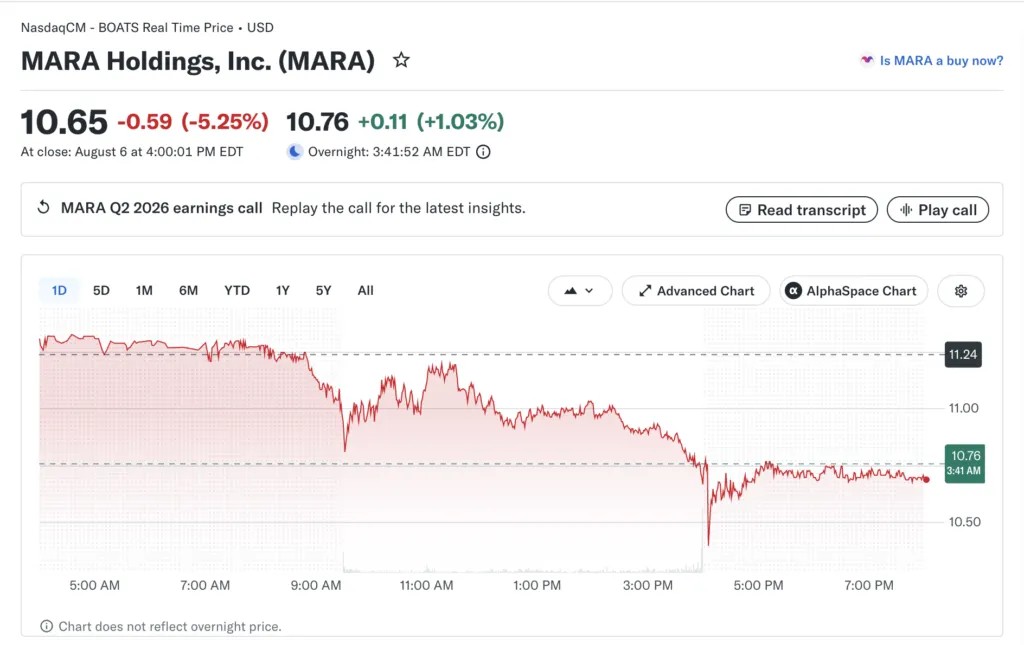
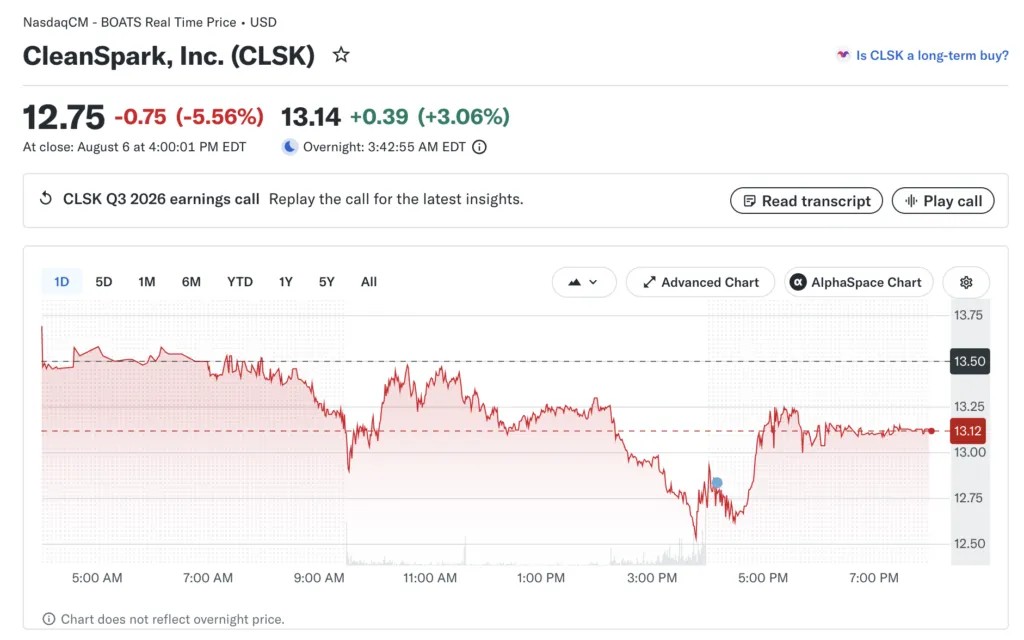
Following trading on August 6th, MARA shares fell by 5.2%, and CleanSpark shares by more than 6%.
Recall that in recent years, major Bitcoin miners have accelerated the conversion of energy sites into data centers for AI amidst pressure on mining profitability.
Miners have intensified the competition for electricity