Bitcoin's $78,000 Support Faces Ultimate Test: With Soaring Treasury Yields and Inflation Pressure, the Door to $75,000 is Opening

marsbitPublicado a 2026-05-18Actualizado a 2026-05-18

Resumen

Bitcoin has fallen below the $78,000 support level, now facing a critical test due to severe macro pressures. The price slid from above $81,000 to a low near $77,711, with the $77,700-$78,000 zone identified as the next key support. The primary headwinds are surging U.S. Treasury yields—with the 10-year approaching 4.6% and the 30-year surpassing 5.13%—and persistent inflation. April's CPI accelerated to 3.8%, while WTI oil prices climbed above $105. These factors increase the opportunity cost of holding zero-yield assets like Bitcoin and tighten the Fed's policy space. Crucially, U.S. spot Bitcoin ETFs, which previously provided a buffer, saw significant net outflows on two of the past three trading days, removing buying support when it was most needed. The technical outlook hinges on whether Bitcoin can hold above $77,700. A daily close below this level could open a path toward $76,500 and then the major $75,000 support. A recovery above $80,000 is needed to break the bearish pattern, with a close above $82,000 (the 200-day moving average) required to invalidate the breakdown. Failure to hold support could shift the narrative from a crypto correction to a broader, macro-driven risk asset deleveraging.

Author: Gino Matos

Translation: TechFlow DeepTide

DeepTide Guide: Bitcoin has fallen for two consecutive days into the $78,000 support zone after failing to break above $82,000. With the US 10-year Treasury yield approaching 4.6%, the 30-year yield breaking above 5.13%, coupled with April CPI accelerating to 3.8% and oil prices rising above $105, the macro environment is extremely unfriendly to risk assets. ETF flows have also turned to net outflows at a critical moment. Can $78,000 hold? If not, the next stop is $75,000.

$78,000: If This Level Fails, It's $75,000 Next

Bitcoin hit an intraday low of $77,711 before rebounding slightly to around $78,225. This marks the second consecutive trading day under macro pressure.

The US 10-year Treasury yield rose to 4.599%, and the 30-year yield jumped 11.8 basis points to 5.131%, hitting a new high since May 2025. BTC has fallen 3.9% from its opening price above $81,000 on May 15, with US stocks and bonds weakening simultaneously.

When BTC lost the $82,000 level, the $77,700-$78,000 range became the next key support. Now, this support is bearing the full weight of macro pressure.
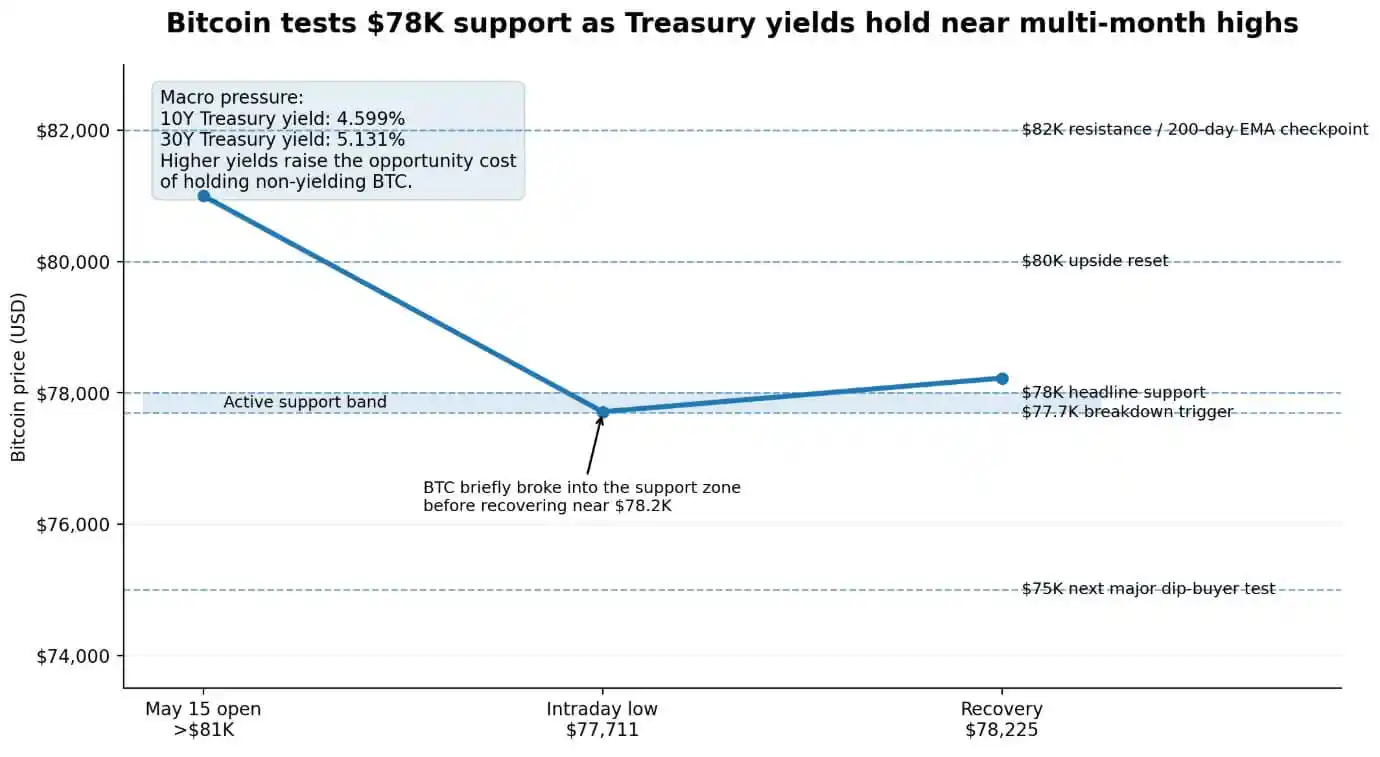
Caption: Bitcoin fell from above $81,000 at the May 15 open to an intraday low of $77,711 before rebounding to $78,225, testing the $77,700-$78,000 support band.

The Weight of Macroeconomics

BTC is a zero-yield asset, now competing against US Treasuries offering yields of 4.5%-5.1%. With the interest rate floor raised to this level, the opportunity cost of holding BTC has increased sharply.

K33 data shows Bitcoin's 30-day correlation with Nasdaq futures exceeds 0.7. During sharp Nasdaq declines, BTC's beta value amplifies. Both transmission channels are active in this sell-off, and the macro environment leaves almost no room for Fed easing.

April CPI accelerated year-on-year to 3.8%, up from 3.3% in March. Core CPI remained at 2.8%, while the energy component rose 17.9% over 12 months.

WTI crude oil closed at $105.42 on May 15, up 4.2% for the day and 11.33% for the month. Brent crude touched $109.26, up 3.35%. Trading Economics models predict Brent to reach $111.28 by the quarter's end, while HSBC raised its 2026 Brent forecast to an average of $95, potentially reaching $110 if supply agreements are delayed until late summer.

University of Michigan May data shows one-year inflation expectations rising to 4.5%. The Fed's April FOMC statement indicated a need to assess inflation before considering easing. The bar for policy relief is high.

ETF Flows Drop the Ball at a Critical Moment

CoinShares data shows that as of the week ending May 11, Bitcoin investment products attracted net inflows of $706.1 million, indicating strong institutional buying interest.

However, daily data from Farside Investors shows a sharp reversal thereafter: net outflows of $630.4 million on May 13, a small inflow of $131.3 million on May 14, and another outflow of $290.4 million on May 15.

Outflows on two out of three days. The ETF flow buffer disappeared at the very moment the $78,000 support needed defense most. This buffer had been absorbing macro headwinds in previous weeks.

Support Map

The intraday low of $77,716.09 already fell within the support range. If the daily close can reclaim territory above $78,000, this pullback would still be technically contained.

Once $77,700 is effectively broken, the downward path opens: $76,500 is the first follow-up target. After bears confirm the breakdown, $75,000 is the key psychological round number where dip-buying capital historically needs to step in with real money.

If the decline extends further, the $73,000-$74,000 range comes into view. At that point, the market narrative would shift from 'pullback' to 'macro-driven deleveraging of risk assets.'
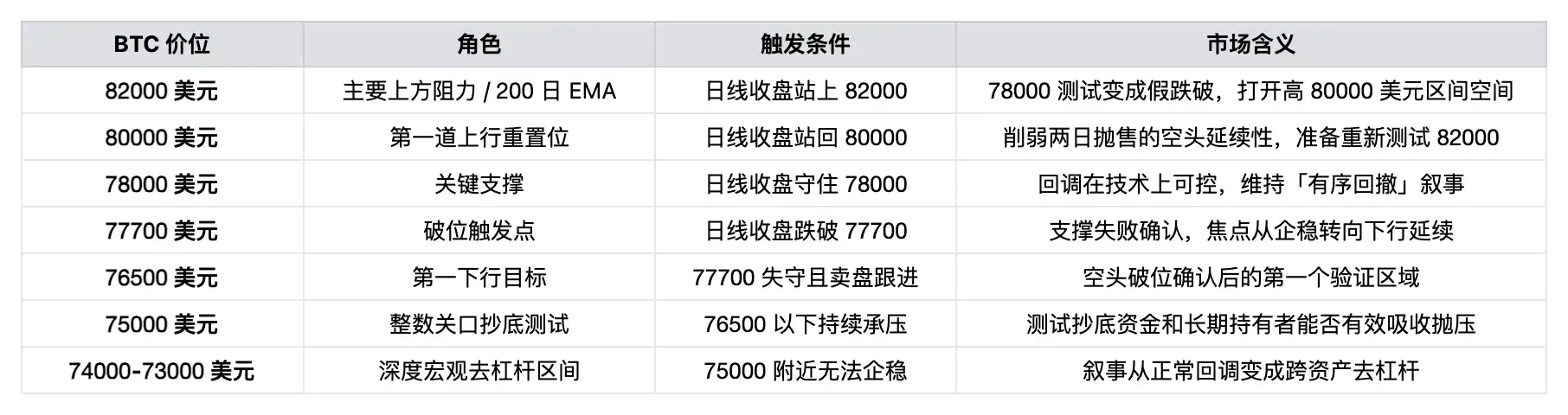
Recapturing $80,000 is the first step to reversing the bearish structure—a daily close above that level would break the sequence of lower lows over the past two trading days, giving bulls a technically clean reset.

The tougher hurdle is at $82,000. On May 13, BTC already broke below its 200-day moving average (around $82,000), meaning $82,000 serves as both a round-number resistance and a technical barrier. A daily close above $82,000 would turn the $78,000 test into a false breakdown.

Four Scenarios

What to Watch Next

If the 10-year yield retreats below 4.50%, oil prices cool from above $105, and ETF flows turn positive, Bitcoin could reclaim $80,000. That would break the pattern of lower lows over the past two days, setting the stage for a retest of $82,000—the level of the 200-day moving average that BTC broke below on May 13.

A daily close above $82,000 would turn the yield-driven retreat into a false breakdown, opening the door to the high $80,000s. The past week's decline would then be viewed as a shakeout-style correction, with the underlying accumulation logic remaining intact.

Conversely, if BTC closes below $77,700 on a daily basis while Treasury yields remain around 4.60% and ETFs see sustained outflows, the support test is confirmed to have failed. $76,500 becomes the first downside target, with a new leg lower beginning once bears confirm the breakdown. $75,000 is the key round-number level where dip-buying forces historically need to demonstrate real demand.

Continued weakness below $75,000 would target the $74,000-$73,000 range. At that point, the narrative would no longer be 'crypto market pullback,' but 'cross-asset macro deleveraging'—with stocks and bonds being repriced, and BTC simply following along.

For Bitcoin's short-term direction, the key macro variables need to stabilize first to form a rebound anchor. With the 10-year at 4.599% and the 30-year at 5.131%, they offer holders a yield floor of 4.5%-5.1%. BTC, as a zero-yield asset, is at a natural disadvantage in terms of carry. With one-year inflation expectations at 4.5% and the Fed still in an 'assessment phase,' rapid easing is far from market reality pricing.

The $78,000 zone faces a structural test: Can ETF buyers and long-term holders absorb selling pressure quickly enough amid an interest rate cost shock to stabilize the price before the support board is broken?


Preguntas relacionadas

QAccording to the article, what are the two main negative macro factors currently pressuring Bitcoin's price and testing the $78,000 support level?

AThe two main negative macro factors are surging U.S. Treasury yields (10-year near 4.6% and 30-year above 5.13%) and persistent inflationary pressures, highlighted by April CPI accelerating to 3.8% and oil prices rising above $105.

QWhat key change in the behavior of Bitcoin ETF inflows is mentioned as undermining the $78,000 support?

ABitcoin ETF inflows have reversed from strong net inflows to net outflows at a critical time. Data showed net outflows of $630.4 million on May 13th and $290.4 million on May 15th, removing the 'buffer' that previously absorbed selling pressure.

QIf Bitcoin's daily close falls below $77,700, what are the next two potential price targets mentioned in the article's 'support map'?

AIf Bitcoin's daily close falls below $77,700, the next two potential price targets are $76,500 as the first follow-up target, and then the historically significant $75,000 level where real buying interest would be tested.

QWhat specific condition must Bitcoin meet to technically break the recent bearish sequence and potentially shift momentum towards testing higher resistance?

ABitcoin needs a daily close back above $80,000 to break the recent sequence of lower lows and provide a clean technical reset for bullish momentum. A close above $82,000 (the 200-day moving average) would turn the recent decline into a 'false breakdown'.

QHow does the article define the scenario where Bitcoin price falls into the $73,000-$74,000 range?

AIf Bitcoin falls into the $73,000-$74,000 range, the market narrative would change from a 'crypto market correction' to a 'macro-driven deleveraging across risk assets,' where Bitcoin is repricing alongside stocks and bonds.

Lecturas Relacionadas

STRC Breaks Below $95: Why Does It Continue to Depeg? Is There Default Risk?

"STRC Falls Below $95: Why the Persistent Depegging and Is There Default Risk?" The article discusses the recent decline in the price of STRC, a perpetual preferred stock issued by Strategy (MSTR) designed to trade around a $100 par value. As of publication, STRC traded at $94.65, raising market concerns. STRC is described as a high-yield cash flow product, offering an 11.50% annual dividend paid monthly. Its "preferred" status grants it priority over common stock for dividends and in liquidation. Key reasons cited for the price depegging include: 1. **Bitcoin's Price Drop:** MSTR's assets are heavily tied to Bitcoin (BTC), which fell over 21% from its recent high, pressuring all Strategy-related products. 2. **Competitive Pressure:** Rival Strive Asset Management's similar product, SATA, offers daily dividends and has maintained its $100 par value with a ~13% yield. In response, Strategy has proposed changing STRC's dividend frequency from monthly to bi-weekly, pending shareholder vote. 3. **Technical Selling:** A break below $100 may have triggered algorithmic selling and stop-losses, exacerbating the decline. Regarding default risk, the analysis suggests it is currently low. Strategy founder Michael Saylor confirmed the June 2026 dividend rate remains at 11.50% with no cuts or suspensions. The company's massive reserve of 843,706 BTC provides a significant backstop for its obligations. Industry opinions are mixed. Some analysts view the BTC holdings as reliable support for dividends, while critics like Peter Schiff warn of potential dividend cuts leading to price crashes and lawsuits. Others highlight inflation risk and the company's ability to reduce dividends without a formal default. In summary, STRC's drop is attributed to BTC volatility, competition, and technical factors. While immediate default risk appears contained, the product faces challenges from market conditions and competitive dynamics.

marsbitHace 50 min(s)

STRC Breaks Below $95: Why Does It Continue to Depeg? Is There Default Risk?

marsbitHace 50 min(s)

AI Trading Cools, South Korean Stocks Plunge 1.8%, Spot Gold Rises 1%, Bitcoin Dives

A sell-off in AI-related stocks, triggered by Broadcom's disappointing earnings forecast, sent shockwaves through global markets. South Korea's KOSPI led Asia's decline, plunging 1.8% as the risks from concentrated chip stock gains and surging leveraged investments came to the fore. The tech-heavy Nasdaq 100 futures fell 0.5% following Broadcom's 14% after-hours plunge, which signaled a slower-than-expected transition to AI clients. This pullback extended Wall Street's weakness, halting the S&P 500's nine-day rally amid hawkish Fed signals and renewed Middle East tensions. South Korean authorities convened an emergency meeting, pledging "immediate measures" against market volatility and warning of record-high stock margin debt. The adjustment rippled across assets: Bitcoin fell to around $64,000, its lowest since February, while safe-haven gold rose 1% on bargain hunting. Oil prices dipped on Middle East ceasefire news. Market analysts noted the sell-off was driven by profit-taking after massive gains, particularly in chip stocks like Samsung and SK Hynix, which now dominate the KOSPI. Wall Street banks are divided on Korea's outlook, with Goldman Sachs raising its target while Citigroup and others warn of overvaluation and a potential bubble. Bridgewater's Ray Dalio noted that great technological shifts often create bubbles. Meanwhile, Fed officials' hints at potential future rate hikes added to the cautious mood ahead of key U.S. jobs data.

华尔街日报Hace 1 hora(s)

AI Trading Cools, South Korean Stocks Plunge 1.8%, Spot Gold Rises 1%, Bitcoin Dives

华尔街日报Hace 1 hora(s)

Trading

Spot
Futuros

Artículos destacados

Qué es BITCOIN

Entendiendo HarryPotterObamaSonic10Inu (ERC-20) y Su Posición en el Espacio Cripto En los últimos años, el mercado de criptomonedas ha sido testigo de un aumento en la popularidad de las monedas meme, capturando el interés no solo de los comerciantes, sino también de aquellos que buscan compromiso comunitario y valor de entretenimiento. Entre estos tokens únicos se encuentra HarryPotterObamaSonic10Inu (ERC-20), un proyecto intrigante que mezcla referencias culturales en el tejido de las criptomonedas. Este artículo profundiza en los aspectos clave de HarryPotterObamaSonic10Inu, explorando sus mecanismos, ethos impulsado por la comunidad y su relación con el paisaje cripto más amplio. ¿Qué es HarryPotterObamaSonic10Inu (ERC-20)? Como su nombre sugiere, HarryPotterObamaSonic10Inu es una moneda meme construida sobre la blockchain de Ethereum, clasificada bajo el estándar ERC-20. A diferencia de las criptomonedas tradicionales que pueden enfatizar la utilidad práctica o el potencial de inversión, este token prospera en el valor de entretenimiento y la fuerza de su comunidad. El proyecto tiene como objetivo fomentar un entorno donde los usuarios comprometidos puedan reunirse, compartir ideas y participar en actividades inspiradas por diversos fenómenos culturales. Una característica notable de HarryPotterObamaSonic10Inu es su cero impuestos en las transacciones. Este atractivo elemento tiene como objetivo incentivar el comercio y la participación comunitaria, sin cargos adicionales que puedan disuadir a los comerciantes de pequeña escala. El suministro total de la moneda está establecido en mil millones de tokens, una cifra que marca su intención de mantener una circulación sustancial dentro de la comunidad. Creador de HarryPotterObamaSonic10Inu (ERC-20) Los orígenes de HarryPotterObamaSonic10Inu están algo envueltos en misterio; los detalles sobre el creador siguen siendo desconocidos. El desarrollo de este token carece de un equipo identificable o de un plan explícito, lo cual no es inusual dentro del sector de monedas meme. En cambio, el proyecto ha surgido de manera orgánica, con su progreso muy dependiente del entusiasmo y la participación de su comunidad. Inversores de HarryPotterObamaSonic10Inu (ERC-20) En cuanto a inversiones externas y respaldo, HarryPotterObamaSonic10Inu también sigue siendo ambiguo. El token no lista ninguna fundación de inversión conocida o apoyo organizacional significativo. En cambio, la savia del proyecto es su comunidad de base, que informa su crecimiento y sostenibilidad a través de la acción colectiva y el compromiso en el espacio cripto. ¿Cómo Funciona HarryPotterObamaSonic10Inu (ERC-20)? Como una moneda meme, HarryPotterObamaSonic10Inu opera principalmente fuera de los marcos tradicionales que a menudo rigen el valor de los activos. Hay varios aspectos distintivos que definen cómo funciona el proyecto: Transacciones Sin Impuestos: Sin tarifas impositivas en las transacciones, los usuarios pueden comprar y vender el token libremente sin preocuparse por costos ocultos. Compromiso Comunitario: El proyecto prospera en la interacción comunitaria, aprovechando plataformas de redes sociales para crear entusiasmo y facilitar la participación. Las discusiones, el intercambio de contenido y el compromiso son elementos cruciales que ayudan a expandir su alcance y fomentar la lealtad entre los seguidores. Sin Utilidad Práctica: Cabe señalar que HarryPotterObamaSonic10Inu no ofrece utilidad concreta dentro del ecosistema financiero. Más bien, se clasifica como un token principalmente para actividades de entretenimiento y comunitarias. Referencia Cultural: El token incorpora astutamente elementos de la cultura popular para atraer interés, conectando con entusiastas de los memes y seguidores de las criptomonedas por igual. HarryPotterObamaSonic10Inu ejemplifica cómo las monedas meme operan de manera diferente a los proyectos de criptomonedas más tradicionales, ingresando al mercado como construcciones sociales innovadoras en lugar de activos utilitarios. Cronología de HarryPotterObamaSonic10Inu (ERC-20) La historia de HarryPotterObamaSonic10Inu está marcada por varios hitos notables: Creación: El token surgió de un meme viral, capturando la imaginación de muchos entusiastas de las criptomonedas. Las fechas específicas de creación no están disponibles, subrayando su ascenso orgánico. Listado en Exchanges: HarryPotterObamaSonic10Inu ha llegado a varios exchanges, permitiendo un acceso y comercio más fácil por parte de la comunidad. Iniciativas de Compromiso Comunitario: Actividades continuas destinadas a mejorar la interacción comunitaria, incluyendo concursos, campañas en redes sociales y generación de contenido por parte de fanáticos y defensores. Planes de Expansión Futuros: La hoja de ruta del proyecto incluye el lanzamiento de una colección de NFT, mercancía y un sitio de comercio electrónico relacionado con sus temas culturales, involucrando aún más a la comunidad e intentando añadir más dimensiones a su ecosistema. Puntos Clave Sobre HarryPotterObamaSonic10Inu (ERC-20) Naturaleza Impulsada por la Comunidad: El proyecto prioriza la participación colectiva y la creatividad, asegurando que la involucración de los usuarios esté a la vanguardia de su desarrollo. Clasificación como Moneda Meme: Representa la epítome de las criptomonedas basadas en el entretenimiento, diferenciándose de los vehículos de inversión tradicionales. Sin Afiliación Directa con Bitcoin: A pesar de la similitud en el nombre del ticker, HarryPotterObamaSonic10Inu es distinto y no tiene relación con Bitcoin u otras criptomonedas establecidas. Enfoque en la Colaboración: HarryPotterObamaSonic10Inu está diseñado para crear un espacio para la colaboración y el intercambio de historias entre sus poseedores, proporcionando una vía para la creatividad y el vínculo comunitario. Perspectivas Futuras: La ambición de expandirse más allá de su premisa inicial hacia NFTs y mercancías describe un camino para que el proyecto potencialmente ingrese a avenidas más tradicionales dentro de la cultura digital. A medida que las monedas meme continúan capturando la imaginación de la comunidad de criptomonedas, HarryPotterObamaSonic10Inu (ERC-20) se destaca debido a sus lazos culturales y su enfoque centrado en la comunidad. Si bien puede no encajar en el molde típico de un token impulsado por la utilidad, su esencia radica en la alegría y la camaradería fomentadas entre sus seguidores, destacando la naturaleza en evolución de las criptomonedas en una era cada vez más digital. A medida que el proyecto continúa desarrollándose, será importante observar cómo las dinámicas comunitarias influyen en su trayectoria en el cambiante paisaje de la tecnología blockchain.

1.7k Vistas totalesPublicado en 2024.04.01Actualizado en 2024.12.03

Qué es BITCOIN

Cómo comprar BTC

¡Bienvenido a HTX.com! Hemos hecho que comprar Bitcoin (BTC) sea simple y conveniente. Sigue nuestra guía paso a paso para iniciar tu viaje de criptos.Paso 1: crea tu cuenta HTXUtiliza tu correo electrónico o número de teléfono para registrarte y obtener una cuenta gratuita en HTX. Experimenta un proceso de registro sin complicaciones y desbloquea todas las funciones.Obtener mi cuentaPaso 2: ve a Comprar cripto y elige tu método de pagoTarjeta de crédito/débito: usa tu Visa o Mastercard para comprar Bitcoin (BTC) al instante.Saldo: utiliza fondos del saldo de tu cuenta HTX para tradear sin problemas.Terceros: hemos agregado métodos de pago populares como Google Pay y Apple Pay para mejorar la comodidad.P2P: tradear directamente con otros usuarios en HTX.Over-the-Counter (OTC): ofrecemos servicios personalizados y tipos de cambio competitivos para los traders.Paso 3: guarda tu Bitcoin (BTC)Después de comprar tu Bitcoin (BTC), guárdalo en tu cuenta HTX. Alternativamente, puedes enviarlo a otro lugar mediante transferencia blockchain o utilizarlo para tradear otras criptomonedas.Paso 4: tradear Bitcoin (BTC)Tradear fácilmente con Bitcoin (BTC) en HTX's mercado spot. Simplemente accede a tu cuenta, selecciona tu par de trading, ejecuta tus trades y monitorea en tiempo real. Ofrecemos una experiencia fácil de usar tanto para principiantes como para traders experimentados.

5.0k Vistas totalesPublicado en 2024.12.12Actualizado en 2026.06.02

Cómo comprar BTC

Qué es $BITCOIN

ORO DIGITAL ($BITCOIN): Un Análisis Integral Introducción al ORO DIGITAL ($BITCOIN) ORO DIGITAL ($BITCOIN) es un proyecto basado en blockchain que opera en la red Solana, cuyo objetivo es combinar las características de los metales preciosos tradicionales con la innovación de las tecnologías descentralizadas. Aunque comparte un nombre con Bitcoin, a menudo referido como “oro digital” debido a su percepción como un refugio de valor, ORO DIGITAL es un token separado diseñado para crear un ecosistema único dentro del paisaje Web3. Su meta es posicionarse como un activo digital alternativo viable, aunque los detalles sobre sus aplicaciones y funcionalidades aún están en desarrollo. ¿Qué es ORO DIGITAL ($BITCOIN)? ORO DIGITAL ($BITCOIN) es un token de criptomoneda diseñado explícitamente para su uso en la blockchain de Solana. A diferencia de Bitcoin, que proporciona un papel de almacenamiento de valor ampliamente reconocido, este token parece centrarse en aplicaciones y características más amplias. Aspectos notables incluyen: Infraestructura Blockchain: El token está construido sobre la blockchain de Solana, conocida por su capacidad para manejar transacciones de alta velocidad y bajo costo. Dinámicas de Suministro: ORO DIGITAL tiene un suministro máximo limitado a 100 cuatrillones de tokens (100P $BITCOIN), aunque los detalles sobre su suministro circulante no se han divulgado actualmente. Utilidad: Si bien las funcionalidades precisas no están delineadas explícitamente, hay indicios de que el token podría ser utilizado para diversas aplicaciones, potencialmente involucrando aplicaciones descentralizadas (dApps) o estrategias de tokenización de activos. ¿Quién es el Creador de ORO DIGITAL ($BITCOIN)? En la actualidad, la identidad de los creadores y el equipo de desarrollo detrás de ORO DIGITAL ($BITCOIN) sigue siendo desconocida. Esta situación es típica entre muchos proyectos innovadores dentro del espacio blockchain, particularmente aquellos alineados con las finanzas descentralizadas y fenómenos de monedas meme. Si bien tal anonimato puede fomentar una cultura impulsada por la comunidad, intensifica las preocupaciones sobre la gobernanza y la responsabilidad. ¿Quiénes son los Inversores de ORO DIGITAL ($BITCOIN)? La información disponible indica que ORO DIGITAL ($BITCOIN) no tiene patrocinadores institucionales conocidos ni inversiones destacadas de capital de riesgo. El proyecto parece operar en un modelo de peer-to-peer centrado en el apoyo y la adopción de la comunidad en lugar de rutas de financiamiento tradicionales. Su actividad y liquidez se sitúan principalmente en intercambios descentralizados (DEX), como PumpSwap, en lugar de plataformas de trading centralizadas establecidas, lo que resalta aún más su enfoque de base. Cómo Funciona ORO DIGITAL ($BITCOIN) Los mecanismos operativos de ORO DIGITAL ($BITCOIN) pueden elaborarse en función de su diseño blockchain y atributos de red: Mecanismo de Consenso: Al aprovechar el único proof-of-history (PoH) de Solana combinado con un modelo de proof-of-stake (PoS), el proyecto asegura una validación de transacciones eficiente que contribuye al alto rendimiento de la red. Tokenómica: Si bien los mecanismos deflacionarios específicos no se han detallado extensamente, el vasto suministro máximo de tokens implica que podría atender microtransacciones o casos de uso nicho que aún están por definirse. Interoperabilidad: Existe el potencial de integración con el ecosistema más amplio de Solana, incluyendo varias plataformas de finanzas descentralizadas (DeFi). Sin embargo, los detalles sobre integraciones específicas permanecen no especificados. Cronología de Eventos Clave Aquí hay una cronología que destaca hitos significativos relacionados con ORO DIGITAL ($BITCOIN): 2023: El despliegue inicial del token ocurre en la blockchain de Solana, marcado por su dirección de contrato. 2024: ORO DIGITAL gana visibilidad al estar disponible para trading en intercambios descentralizados como PumpSwap, permitiendo a los usuarios comerciar contra SOL. 2025: El proyecto presencia actividad de trading esporádica y potencial interés en compromisos liderados por la comunidad, aunque no se han documentado asociaciones notables o avances técnicos hasta el momento. Análisis Crítico Fortalezas Escalabilidad: La infraestructura subyacente de Solana soporta altos volúmenes de transacciones, lo que podría mejorar la utilidad de $BITCOIN en varios escenarios de transacción. Accesibilidad: El potencial bajo precio de trading por token podría atraer a inversores minoristas, facilitando una participación más amplia debido a oportunidades de propiedad fraccionada. Riesgos Falta de Transparencia: La ausencia de patrocinadores, desarrolladores o un proceso de auditoría conocidos públicamente puede generar escepticismo sobre la sostenibilidad y confiabilidad del proyecto. Volatilidad del Mercado: La actividad de trading depende en gran medida del comportamiento especulativo, lo que puede resultar en una volatilidad de precios significativa y en incertidumbre para los inversores. Conclusión ORO DIGITAL ($BITCOIN) surge como un proyecto intrigante pero ambiguo dentro del ecosistema de Solana en rápida evolución. Si bien intenta aprovechar la narrativa del “oro digital”, su alejamiento del papel establecido de Bitcoin como refugio de valor subraya la necesidad de una diferenciación más clara de su utilidad y estructura de gobernanza previstas. La aceptación y adopción futura dependerán probablemente de abordar la actual opacidad y de definir sus estrategias operativas y económicas de manera más explícita. Nota: Este informe abarca información sintetizada disponible hasta octubre de 2023, y pueden haber ocurrido desarrollos más allá del período de investigación.

83 Vistas totalesPublicado en 2025.05.13Actualizado en 2025.05.13

Qué es $BITCOIN

Discusiones

Bienvenido a la comunidad de HTX. Aquí puedes mantenerte informado sobre los últimos desarrollos de la plataforma y acceder a análisis profesionales del mercado. A continuación se presentan las opiniones de los usuarios sobre el precio de BTC (BTC).

活动图片













