Bitcoiners push for quantum-resistant BIP-360 upgrade as debate heats up

cointelegraphPublicado a 2025-12-18Actualizado a 2025-12-18

Resumen

A group of Bitcoin advocates and fund managers is urging the network to accelerate the adoption of quantum-resistant cryptography, citing BIP-360 as a potential solution. Proponents like Charles Edwards of Capriole warn that a significant portion of Bitcoin could be vulnerable to quantum attacks within years and argue for a migration deadline by 2028. However, critics including Adam Back of Blockstream dismiss these concerns as premature, stating quantum threats are “decades away” and emphasizing that Bitcoin doesn’t rely on encryption vulnerable to near-term quantum breaks. Debate continues as Taproot adoption declines, possibly reflecting user anxiety, while alternative quantum-resistant signature schemes like hash-based proposals from Blockstream Research gain attention.

A small but growing group of Bitcoin advocates and crypto fund managers is urging the network to accelerate work on quantum-resistant signatures, arguing that the perception of a future “quantum threat” could become a market risk long before it becomes a practical one.

Some supporters are pointing to a draft Bitcoin Improvement Proposal known as BIP-360, which would introduce a post-quantum signature option for Bitcoin addresses that could be vulnerable to future advances in quantum computing.

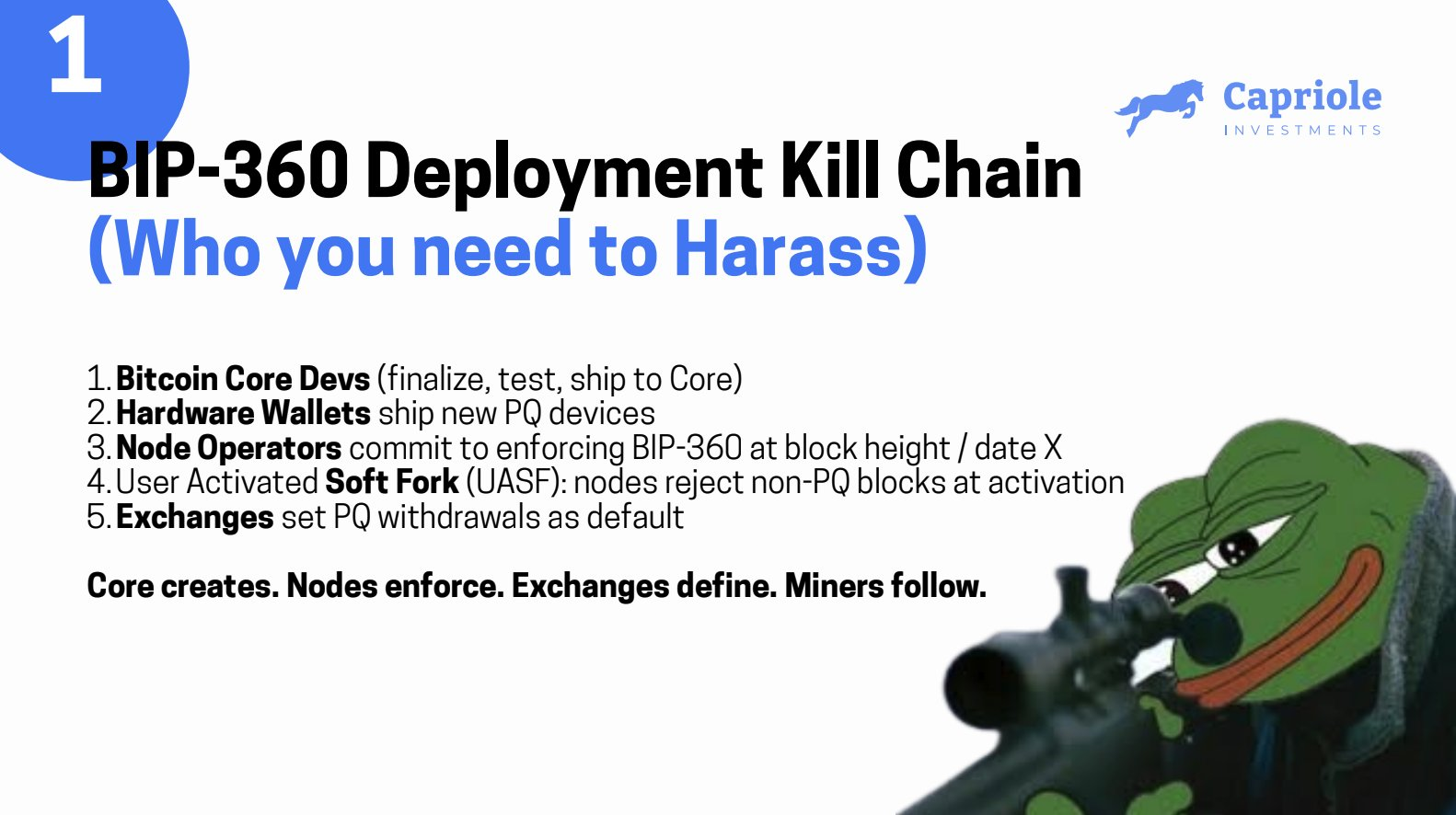
The implementation must be finalized and deployed in 2026, said Charles Edwards, the founder of quantitative Bitcoin (BTC) and digital asset fund Capriole.

However, the implementation of the new standard would require wider consensus among hardware wallet providers, node operators and cryptocurrency exchanges, added Capriole in a Thursday X post. Around “20-30% of Bitcoin will be taken by a quantum hacker in the next few years,” Edwards said. “I believe we should burn all coins that do not migrate to BIP-360 by 2028.”
Source: Charles Edwards

Related: Bitcoin treasuries stall in Q4, but largest holders keep stacking sats

However, other industry watchers see quantum computing as a short-term risk for Bitcoin’s price.

“Pro-tip for quantum FUD promoters. Bitcoin does not use encryption. Get your basics right, or it’s a tell,” wrote Adam Back, co-founder and CEO of Blockstream, and the inventor of Hashcash, in a Thursday X post, adding that the quantum computing threat is still “decades away.”

Samson Mow, the CEO of Bitcoin technology company Jan3, also mocked the idea of early quantum computing threatening the Bitcoin network.

“Quantum computing can’t even factor 21, yet people are panic selling because they think it will kill Bitcoin,” wrote Mow in a Wednesday X post.

Related: Bitcoin investor loses retirement fund in AI-fueled romance scam

Taproot questions and competing proposals

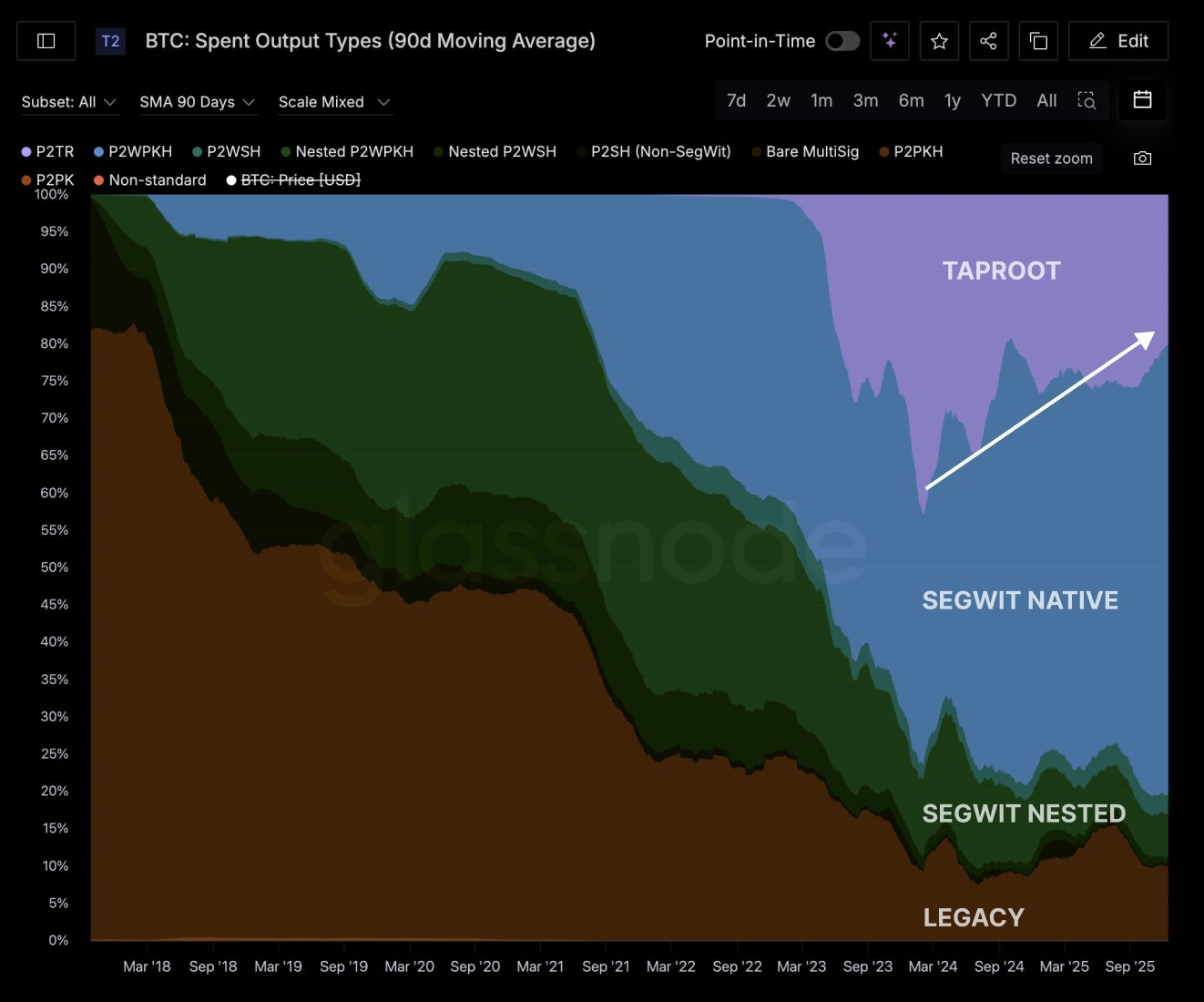
Bitcoin’s latest Taproot format, which is perceived as quantum vulnerable, is declining in usage, from 42% of transactions in 2024 to just 20%, signaling that users may be worried about Bitcoin's quantum threat.
Source: Willy Woo

“I’ve NEVER seen the latest format losing adoption before. Taproot is Quantum Vulnerable, while older SegWit and Legacy are not,” wrote Bitcoin analyst Willy Woo, in a Wednesday X post.

Bitcoin’s Taproot update is the most important upgrade the cryptocurrency has experienced since 2017, when Segregated Witness (SegWit) was activated. Taproot aimed to upgrade the privacy and efficiency of the Bitcoin network.

Meanwhile, Back, one of the leading cryptographers, proposed a new hash-based signature scheme as a promising post-quantum alternative for Bitcoin, where security would rely solely on hash function assumptions similar to the ones currently used in the Bitcoin network’s design.
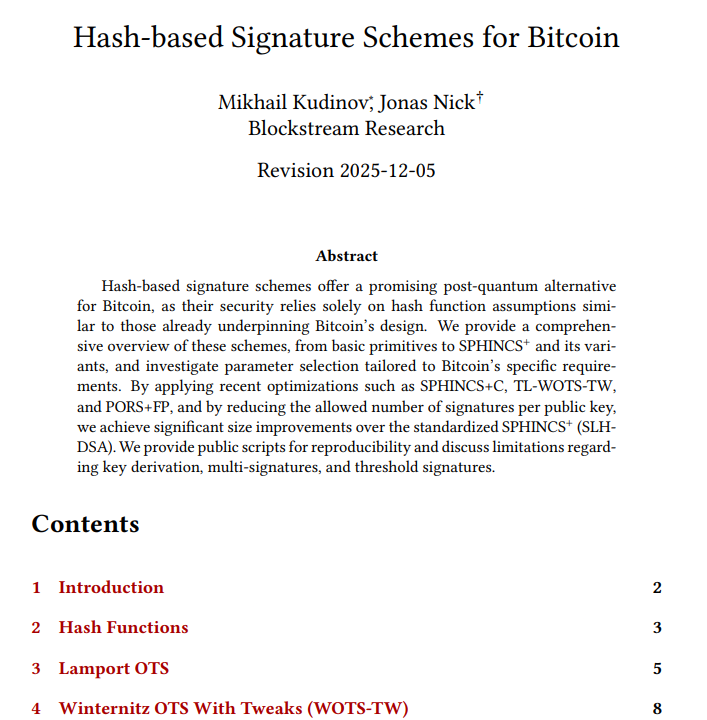
Hash-based signature schemes for Bitcoin, research paper. Source: Blockstream Research

Hash-based signature schemes like ECDSA and Schnorr signatures “offer a promising path for securing Bitcoin in a post-quantum world,” according to the paper released by Back’s Blockstream Research on Dec. 5.

The Elliptic Curve Digital Signature Algorithm (ECDSA) uses elliptic-curve cryptography to verify the authenticity and integrity of a message. Schnorr signatures are another signature scheme praised for enhancing privacy and reducing data size, due to their ability to combine multiple signatures into one.

Magazine: Bitcoin vs. the quantum computer threat — Timeline and solutions (2025–2035)

Criptos en tendencia

Preguntas relacionadas

QWhat is the main purpose of the proposed BIP-360 upgrade for Bitcoin?

AThe main purpose of the proposed BIP-360 upgrade is to introduce a post-quantum signature option for Bitcoin addresses, making them resistant to potential future attacks from advanced quantum computers.

QAccording to Charles Edwards, by when must the quantum-resistant implementation be deployed, and what is his proposal for non-migrated coins?

ACharles Edwards stated that the implementation must be finalized and deployed by 2026, and he proposed that all coins not migrated to BIP-360 by 2028 should be burned.

QWhy is Bitcoin's Taproot format considered a decline in usage significant, as noted by Willy Woo?

AThe decline in Taproot usage, from 42% of transactions in 2024 to just 20%, is significant because it is the first time a newer Bitcoin format has lost adoption. This signals that users may be concerned about Taproot's vulnerability to quantum threats, unlike older SegWit and Legacy formats.

QWhat alternative post-quantum solution did Adam Back and Blockstream Research propose for Bitcoin?

AAdam Back and Blockstream Research proposed a new hash-based signature scheme as a post-quantum alternative. This scheme's security relies solely on hash function assumptions, similar to those already used in Bitcoin's design, with ECDSA and Schnorr signatures being highlighted as promising paths.

QWhat are the differing views on the immediacy of the quantum computing threat to Bitcoin, as presented in the article?

AThe article presents differing views: Charles Edwards and others see it as a near-term market risk, urging immediate action. In contrast, Adam Back and Samson Mow consider the quantum threat to be decades away or currently insignificant, with Mow mocking the idea that quantum computing, which 'can't even factor 21,' is a reason for panic selling.

Lecturas Relacionadas

Must-Watch Events Next Week|CLARITY Act Could Face Senate Vote; SpaceX, Circle to Report Earnings (8.3-8.9)

**Summary: Key Events and Developments to Watch (August 3-9)** The upcoming week is marked by significant financial disclosures, key legislative deadlines, and notable product updates. **Major Financial Events:** Several companies are scheduled to release their Q2 2026 earnings. American Bitcoin (ABTC) will report on August 3, followed by SpaceX and Hut 8 Mining Corp. on August 4, and Circle on August 5. Notably, a significant portion of SpaceX shares (up to 12% of total shares) will be unlocked on August 6 following their earnings release. **Key Legislative Deadline:** The U.S. Senate faces an August 7 deadline to secure 60 votes for the CLARITY Act, a bipartisan bill aiming to establish a federal regulatory framework for cryptocurrencies. The Senate may hold a full vote on the bill during the week. **Economic Data:** The U.S. July Non-Farm Payrolls report will be released on August 7, providing crucial labor market data. **Technology & Product Updates:** * **Shutdowns:** DeFi portfolio tracker Zapper and wallet app Ctrl Wallet will cease operations on August 3. * **Upgrades:** LayerZero will deprecate its v1 relayers on August 3. XRP Ledger's new version 3.3.0, featuring five new functions, is expected next week. * **AI:** Elon Musk announced that the advanced Grok 4.6 AI model is set for release around August 7. * **Bitcoin:** The BIP-110 forced signaling for a potential Bitcoin network change is scheduled to begin around August 8. **Other Notable Events:** Chinese robotics firm Unitree Tech has set its preliminary price inquiry for its IPO for August 5. South Korean exchange Upbit will delist AQT and AERGO tokens on August 3.

marsbitHace 1 hora(s)

Must-Watch Events Next Week|CLARITY Act Could Face Senate Vote; SpaceX, Circle to Report Earnings (8.3-8.9)

marsbitHace 1 hora(s)

Stocks Are Plummeting More Sharply Than Cryptocurrencies. Where Has the Money Gone?

Stock Markets Plunge Deeper Than Cryptocurrencies: Where Did the Money Go? In late July, Seoul's Kospi index triggered circuit breakers for two consecutive days, plummeting over 40% from its June high. The collapse was led by heavyweight stocks like SK Hynix, whose record profits still disappointed investors, and devastating leveraged ETFs, with one major product losing over 83% of its value. This signaled a global, forced deleveraging targeting the most crowded trades. Interestingly, while stocks exhibited extreme volatility akin to crypto markets, Bitcoin rose nearly 15% in July after a prior steep drop. Analysis shows the money fleeing equities did not flow into Bitcoin. Instead, Bitcoin had already absorbed its sell-off in May-June, when U.S. spot Bitcoin ETFs saw historic outflows. The true safe-haven beneficiary was gold, whose price rose over 20% year-on-year, highlighting a decoupling between Bitcoin and gold as "digital gold." The sell-off was a targeted unwinding of leveraged positions in tech and semiconductors, accelerated by broker-dealer risk management and shifts in the AI narrative, including new competition from Chinese memory chipmakers. The retreat path was clear: from high-valuation tech stocks to cash and U.S. Treasuries, then to gold. For Bitcoin to attract sustained institutional inflows, conditions like eased global liquidity pressure, a "soft-landing" Fed rate cut, and U.S. regulatory clarity via legislation like the stalled CLARITY Act are needed. Currently, Bitcoin is not a safe haven but an already-cleared asset. Its low correlation with tech stocks, however, makes it a potential diversification play for institutional portfolios once the storm passes. The money isn't here yet, but the positioning is underway.

marsbitHace 1 hora(s)

Stocks Are Plummeting More Sharply Than Cryptocurrencies. Where Has the Money Gone?

marsbitHace 1 hora(s)

In Conversation with Ray Dalio: We Are Currently in an AI Bubble, with 1% of My Portfolio in Bitcoin

Ray Dalio, founder of Bridgewater Associates, warns in an interview that the current AI boom shows classic bubble characteristics, which could lead to significant economic downturns as seen in past cycles like 1929 or 2000. He explains that speculative enthusiasm, fueled by debt and overvaluation, often precedes a crash when rising rates or taxation force asset sales, causing widespread losses and recession. Dalio also outlines his "Big Cycle" theory, describing an approximate 80-year pattern where widening wealth gaps, massive government deficits, and shifting geopolitical power (like China's rise) create internal conflict and global instability. He emphasizes that we are in a late-cycle, transitional phase where traditional powers like the US and UK face decline. For personal wealth protection, Dalio advises diversification beyond cash into assets like stocks, bonds, real estate, and particularly gold, which he prefers over Bitcoin. While he holds about 1% of his portfolio in Bitcoin as a non-printable hard asset, he views gold as more secure from technological or governmental threats. Regarding AI's impact, Dalio believes it will disproportionately benefit capital owners, worsening inequality by replacing both physical and cognitive labor. He suggests that human intuition and emotional intelligence, combined with AI, will be key for future workers. On taxation, Dalio argues that wealth taxes are impractical and risk triggering asset sell-offs, reducing productive investment. He points to the UK as a cautionary example of debt, low productivity, and political strife. Geopolitically, Dalio foresees a more regionalized world, with the US showing weakness in prolonged conflicts like with Iran, akin to past imperial declines. The ideal outcome, he suggests, is coexisting powerful blocs (e.g., Americas, China-Asia Pacific) without major war.

marsbitHace 5 hora(s)

In Conversation with Ray Dalio: We Are Currently in an AI Bubble, with 1% of My Portfolio in Bitcoin

marsbitHace 5 hora(s)

Trading

Spot

Artículos destacados

Cómo comprar PUSH

¡Bienvenido a HTX.com! Hemos hecho que comprar Push Protocol (PUSH) sea simple y conveniente. Sigue nuestra guía paso a paso para iniciar tu viaje de criptos.Paso 1: crea tu cuenta HTXUtiliza tu correo electrónico o número de teléfono para registrarte y obtener una cuenta gratuita en HTX. Experimenta un proceso de registro sin complicaciones y desbloquea todas las funciones.Obtener mi cuentaPaso 2: ve a Comprar cripto y elige tu método de pagoTarjeta de crédito/débito: usa tu Visa o Mastercard para comprar Push Protocol (PUSH) al instante.Saldo: utiliza fondos del saldo de tu cuenta HTX para tradear sin problemas.Terceros: hemos agregado métodos de pago populares como Google Pay y Apple Pay para mejorar la comodidad.P2P: tradear directamente con otros usuarios en HTX.Over-the-Counter (OTC): ofrecemos servicios personalizados y tipos de cambio competitivos para los traders.Paso 3: guarda tu Push Protocol (PUSH)Después de comprar tu Push Protocol (PUSH), guárdalo en tu cuenta HTX. Alternativamente, puedes enviarlo a otro lugar mediante transferencia blockchain o utilizarlo para tradear otras criptomonedas.Paso 4: tradear Push Protocol (PUSH)Tradear fácilmente con Push Protocol (PUSH) en HTX's mercado spot. Simplemente accede a tu cuenta, selecciona tu par de trading, ejecuta tus trades y monitorea en tiempo real. Ofrecemos una experiencia fácil de usar tanto para principiantes como para traders experimentados.

250 Vistas totalesPublicado en 2024.12.13Actualizado en 2026.06.02

Cómo comprar PUSH

Discusiones

Bienvenido a la comunidad de HTX. Aquí puedes mantenerte informado sobre los últimos desarrollos de la plataforma y acceder a análisis profesionales del mercado. A continuación se presentan las opiniones de los usuarios sobre el precio de PUSH (PUSH).

活动图片













