Bitcoin Treasury Firm Strategy To Repurchase $1.5B Of Convertible Notes — Details

bitcoinistPublicado a 2026-05-17Actualizado a 2026-05-17

Resumen

Bitcoin treasury firm Strategy (formerly MicroStrategy) plans to repurchase approximately $1.5 billion of its convertible notes due in 2029 for an estimated $1.38 billion. According to a filing with the SEC, the company will fund the buyback using cash reserves, proceeds from securities sales, and/or potential sales of Bitcoin. This move, authorized by Chairman Michael Saylor, follows recent comments from CEO Phong Le about possible scenarios for selling Bitcoin to enhance shareholder value. The repurchase could positively impact equity holders by preventing future stock dilution. The news follows a record $1.53 billion trading volume for Strategy's preferred stock (STRC), a key instrument for its Bitcoin acquisitions. The firm remains the largest corporate Bitcoin holder with 818,869 BTC.

Bitcoin treasury company Strategy (formerly MicroStrategy) has disclosed its intention to repurchase $1.5 billion of its 2029 convertible debt notes. This move comes amid commentary on the shift in the Michael Saylor-led firm’s “Never Sell” perspective, intensifying focus on the company’s market actions in the coming weeks.

Will Strategy Sell Bitcoin To Repurchase Its Debt?

In a May 15th post on the social media platform X, Strategy’s chairman, Michael Saylor, confirmed that the firm has filed to repurchase $1.5 billion principal amount of its convertible senior notes due in 2029. This decision comes as part of the outcome of privately negotiated transactions with holders of this debt security.

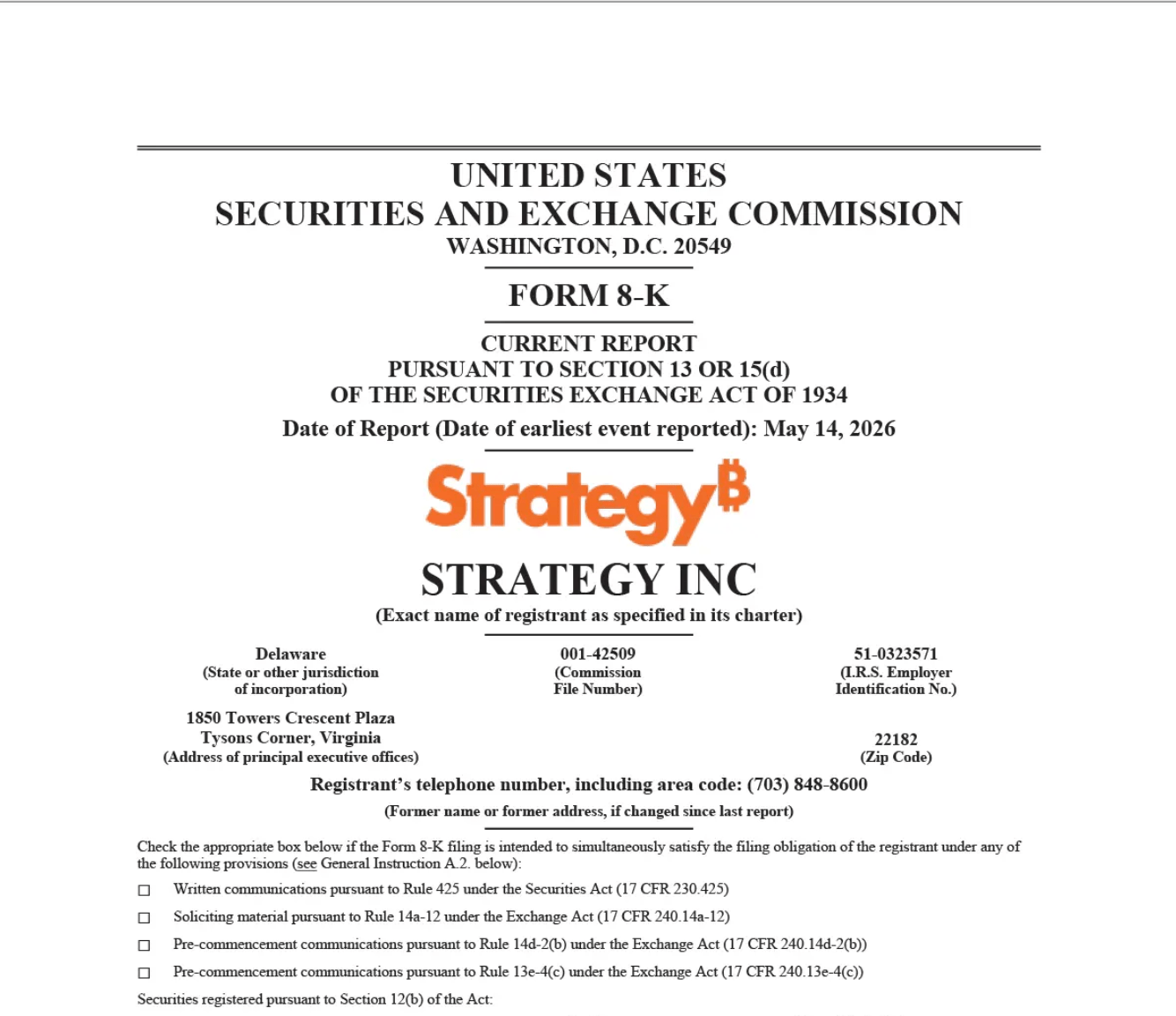
In the Form 8-K filed with the United States Securities and Exchange Commission (SEC) on May 14th, Strategy disclosed that it agreed to retire approximately $1.50 billion in aggregate principal amount of the 2029 Notes for an estimated aggregate cash repurchase price of approximately $1.38 billion.
Source: Strategy

The official filing read:

The final aggregate cash repurchase price for the Repurchased Notes is subject to adjustment, and will be based in part on the daily volume-weighted average price per share of Strategy’s class A common stock, par value $0.001 per share (the “Class A Common Stock”), during an agreed upon measurement period (the “Measurement Period”).

The Bitcoin treasury firm also revealed that these repurchase transactions will be funded with available cash reserves, proceeds from sales of securities under its at-the-market offering program, and/or proceeds from the sale of Bitcoin. Quite interestingly, this filing comes barely a week after the company’s CEO, Phong Le, highlighted scenarios in which the firm might shed some of its Bitcoin holdings.

According to the executive, this included situations that would increase shareholder value, such as dividend payments. It remains to be seen whether the firm debt repurchase falls into the category of activities that warrants the sale of a portion of its Bitcoin.

Merely looking at the action, retiring these convertible notes could be positive for equity investors, as it means that the hybrid debt instrument holders won’t be able to convert to common stock (and potentially dilute the shareholders). Instead, the repurchase gives Strategy a perfect opportunity to reorganize its balance sheet and capital structure.

Strategy’s STRC Registers Record High Daily Trading Volume

Interestingly, the news of this debt repurchase comes merely a day after STRC, Strategy’s Variable Rate Series A Perpetual Stretch Preferred Stock, posted its highest daily trading volume of $1.53 billion on Thursday, May 14th. This represents a significant jump from the previous record of $1.1 bill reached on April 13.

This trading explosion in STRC, which has been Strategy’s capital-raising instrument for purchasing Bitcoin, could help the firm raise about $735 million to buy BTC. As of this writing, the firm maintains its position as the largest corporate Bitcoin holder, with a stash of 818,869 Bitcoin, worth about $66 billion.

The price of BTC on the daily timeframe | Source: BTCUSDT chart on TradingView

Preguntas relacionadas

QWhat is the Bitcoin treasury firm formerly known as MicroStrategy planning to repurchase?

AThe Bitcoin treasury firm Strategy (formerly MicroStrategy) is planning to repurchase $1.5 billion principal amount of its convertible senior notes due in 2029.

QHow does Strategy plan to fund the repurchase of its convertible notes?

AStrategy plans to fund the repurchase transactions with available cash reserves, proceeds from sales of securities under its at-the-market offering program, and/or proceeds from the sale of Bitcoin.

QWhy could retiring the convertible notes be positive for Strategy's equity investors?

ARetiring the convertible notes could be positive for equity investors because it prevents holders of the debt instrument from converting to common stock, which would potentially dilute the shareholders. It also gives Strategy an opportunity to reorganize its balance sheet and capital structure.

QWhat recent record was set by Strategy's STRC preferred stock, and what could it enable the firm to do?

AStrategy's STRC (Variable Rate Series A Perpetual Stretch Preferred Stock) posted its highest daily trading volume of $1.53 billion on May 14th. This trading activity could help the firm raise about $735 million to buy Bitcoin.

QHow much Bitcoin does Strategy currently hold, and what is its approximate value?

AStrategy currently holds 818,869 Bitcoin, which is worth approximately $66 billion, maintaining its position as the largest corporate Bitcoin holder.

Lecturas Relacionadas

Putting Markets On-Chain: Canton Network Quietly Becomes the New Backbone of Institutional Finance

**Title: Letting the Market Itself Go On-Chain: Canton Network Quietly Becomes the New Backbone for Institutional Finance** **Summary:** The Canton Network, a blockchain platform designed for institutional finance, is gaining significant traction. A key sign of its maturity was Visa's recent entry as a super-validator, a proposal approved in just three days—highlighting prior, extensive collaboration between traditional finance and crypto. Unlike public chains like Ethereum that prioritize transparency and asset onboarding, Canton focuses on enabling confidential, compliant business operations for regulated institutions. Its core design features built-in **data visibility control**, meaning transaction details are only shared between direct counterparties. This privacy is fundamental, allowing competing institutions (like banks Goldman Sachs, JPMorgan, and BNP Paribas, all validators) to interact on the same network without exposing sensitive positions or strategies. Developed by Wall Street veterans at Digital Asset, Canton has taken a slow, deliberate approach to onboard real financial activity. It now handles over **$9 trillion monthly** in transaction volume, primarily from real-world institutional use cases like **tokenized repo agreements**, Treasury settlements, and collateral mobility. Major live applications include **JPM Coin** for institutional payments and **DTCC's tokenized U.S. Treasuries** project. Canton's native token, **CC**, is framed as a "network utility asset" with zero pre-mine or VC allocations. Its value is intended to be driven by the volume of real financial activity on the network. Looking ahead, Canton aims to become the invisible foundational layer for global finance—enabling atomic settlement (where payment and asset delivery occur simultaneously), 24/7 capital flows, and the native issuance and settlement of various asset classes, from corporate bonds to potentially equities. The main challenges are no longer technical but involve navigating fragmented global regulations and integrating with legacy financial systems.

marsbitHace 4 min(s)

Putting Markets On-Chain: Canton Network Quietly Becomes the New Backbone of Institutional Finance

marsbitHace 4 min(s)

It's Bankless That Needs Ethereum, Not Ethereum That Needs Bankless

Titled "Bankless Needs Ethereum, Not the Other Way Around," this article analyzes the significant recent news involving Bankless, a prominent crypto media outlet. Bankless co-founder David Hoffman announced the sale of all his ETH holdings, while the company also reportedly underwent major layoffs, with its founders parting ways. The news, likened to a high-profile defection, initially sent shockwaves through the Ethereum community, given Bankless's historical role as a key evangelist and "semi-official" narrative builder for Ethereum. For years, through its podcasts and writings, Bankless championed core Ethereum ideas like "ultrasound money" and the blockchain's role as a new financial settlement layer, acting as a crucial community hub and belief system during its growth phase. However, the article argues this development is not necessarily negative for Ethereum. It suggests Bankless's "first mission"—serving as Ethereum's passionate, inward-facing "propaganda department"—has largely been completed. As Ethereum matures and moves towards mainstream, institutional adoption, the narrative baton has shifted. Today, the value propositions of ETH are increasingly communicated to traditional finance by asset managers like BlackRock and VanEck, public companies adding ETH to their treasuries, and established financial figures. This represents a natural evolution towards a more decentralized, professional, and institutionally-focused narrative network. Therefore, while Bankless's retreat marks the end of an era, it signifies Ethereum's growing resilience and its reduced reliance on any single entity for belief, as its story is now carried forward by a broader and more mature ecosystem of advocates.

链捕手Hace 26 min(s)

It's Bankless That Needs Ethereum, Not Ethereum That Needs Bankless

链捕手Hace 26 min(s)

Google Officially Declares War

Google Declares War with AI-First I/O 2026 At its 2026 I/O developer conference, Google launched an aggressive, multi-pronged offensive, embedding AI across its ecosystem and challenging rivals on performance and price. The event showcased three major releases: Gemini 3.5 Flash, the video-centric Gemini Omni Flash, and the system-level AI assistant Spark. Gemini 3.5 Flash, despite being a smaller "Flash" model, outperforms its Pro counterpart in key benchmarks like mathematical reasoning (GSM8K) and coding (SWE-bench). Google attributes this to "extreme knowledge distillation" from a larger teacher model and a novel, highly granular MoE (Mixture of Experts) architecture with 256 experts, achieving sub-65ms response times. The native multi-modal model, Gemini Omni Flash, offers real-time video understanding with 120ms latency, enabling applications like preventing a cup from overfilling. The new Spark assistant gains deep Android system integration, allowing it to automate complex multi-app workflows based on voice commands. Complementing these, Google unveiled lightweight AI glasses featuring Micro-OLED displays and on-device Gemini chips for instant, offline translation and scene analysis. CEO Sundar Pichai announced Gemini has reached 900 million monthly active users, leveraged through integration into Chrome, Android, and Workspace. Google also slashed prices dramatically: the Gemini 3.5 Flash API is priced at a fraction of competitor rates. This price war is enabled by Google's vertically integrated TPU infrastructure. The strategy signals a shift: standalone AI models are becoming commoditized. Google's advantage lies in its "device + cloud + ecosystem + hardware" integration, aiming to reshape internet traffic from user-initiated searches to AI-driven service distribution. This move pressures pure-play AI firms like OpenAI and Anthropic on business models, and challenges Apple to respond in the next-generation, screen-less device race.

链捕手Hace 45 min(s)

Google Officially Declares War

链捕手Hace 45 min(s)

Top 10 Promising Emerging Hyperliquid Native Protocols to Watch

Title: A Review of 10 Emerging Native Protocols on Hyperliquid Hyperliquid is evolving beyond perpetual contracts into a comprehensive on-chain financial stack. This article highlights 10 key native protocols driving this growth: 1. **Monetrix**: A yield-optimizing protocol akin to Ethena, aggregating funding rates, HLP rewards, maker rebates, and HIP-3 into a single stablecoin yield. 2. **ROSETTA**: An automated stablecoin yield router, allocating USDC across top protocols (e.g., Felix, Aave, HLP) for optimal returns, factoring in gas and slippage. 3. **papertrade.xyz**: A fair-launched perpetuals protocol offering up to 1000x leverage, no funding rates, no slippage, and fully on-chain, oracle-based execution. 4. **alt.fun**: A launchpad where tokens are paired with leveraged perpetual positions (2x-5x), linking token price to trading activity and underlying position performance. 5. **Ventuals**: Pre-IPO perpetual contracts (built on HIP-3) allowing up to 10x leveraged speculation on valuations of private companies like SpaceX and Stripe. 6. **Liminal**: A delta-neutral yield protocol that captures funding rates via automated short positions and uses generated xTokens (xBTC, etc.) as DeFi collateral. 7. **Melt**: Brings tokenized stocks, commodities, and RWAs to Hyperliquid spot markets, enabling 24/7 trading alongside crypto assets. 8. **Chainsight**: An oracle and data infrastructure protocol providing low-latency (<3s) price feeds, volatility indices, and risk metrics for novel derivatives. 9. **rip.xyz**: Tokenized vault strategies on HyperEVM; its flagship rHYPURR offers liquidity and fractional exposure to a Hypurr NFT basket, priced hourly via NAV. 10. **Markets**: A perpetuals exchange (by Kinetiq) for trading stocks, forex, commodities, bonds, and crypto with up to 50x leverage, using USDH collateral and Kaiko oracles. These protocols form the foundational layer for generating real yield, liquidity, and innovative financial products natively on Hyperliquid.

marsbitHace 1 hora(s)

Top 10 Promising Emerging Hyperliquid Native Protocols to Watch

marsbitHace 1 hora(s)

Trading

Spot
Futuros
活动图片





