Bitcoin Treasury Firm Strategy To Repurchase $1.5B Of Convertible Notes — Details

bitcoinistPublicado a 2026-05-17Actualizado a 2026-05-17

Resumen

Bitcoin treasury firm Strategy (formerly MicroStrategy) plans to repurchase approximately $1.5 billion of its convertible notes due in 2029 for an estimated $1.38 billion. According to a filing with the SEC, the company will fund the buyback using cash reserves, proceeds from securities sales, and/or potential sales of Bitcoin. This move, authorized by Chairman Michael Saylor, follows recent comments from CEO Phong Le about possible scenarios for selling Bitcoin to enhance shareholder value. The repurchase could positively impact equity holders by preventing future stock dilution. The news follows a record $1.53 billion trading volume for Strategy's preferred stock (STRC), a key instrument for its Bitcoin acquisitions. The firm remains the largest corporate Bitcoin holder with 818,869 BTC.

Bitcoin treasury company Strategy (formerly MicroStrategy) has disclosed its intention to repurchase $1.5 billion of its 2029 convertible debt notes. This move comes amid commentary on the shift in the Michael Saylor-led firm’s “Never Sell” perspective, intensifying focus on the company’s market actions in the coming weeks.

Will Strategy Sell Bitcoin To Repurchase Its Debt?

In a May 15th post on the social media platform X, Strategy’s chairman, Michael Saylor, confirmed that the firm has filed to repurchase $1.5 billion principal amount of its convertible senior notes due in 2029. This decision comes as part of the outcome of privately negotiated transactions with holders of this debt security.

In the Form 8-K filed with the United States Securities and Exchange Commission (SEC) on May 14th, Strategy disclosed that it agreed to retire approximately $1.50 billion in aggregate principal amount of the 2029 Notes for an estimated aggregate cash repurchase price of approximately $1.38 billion.
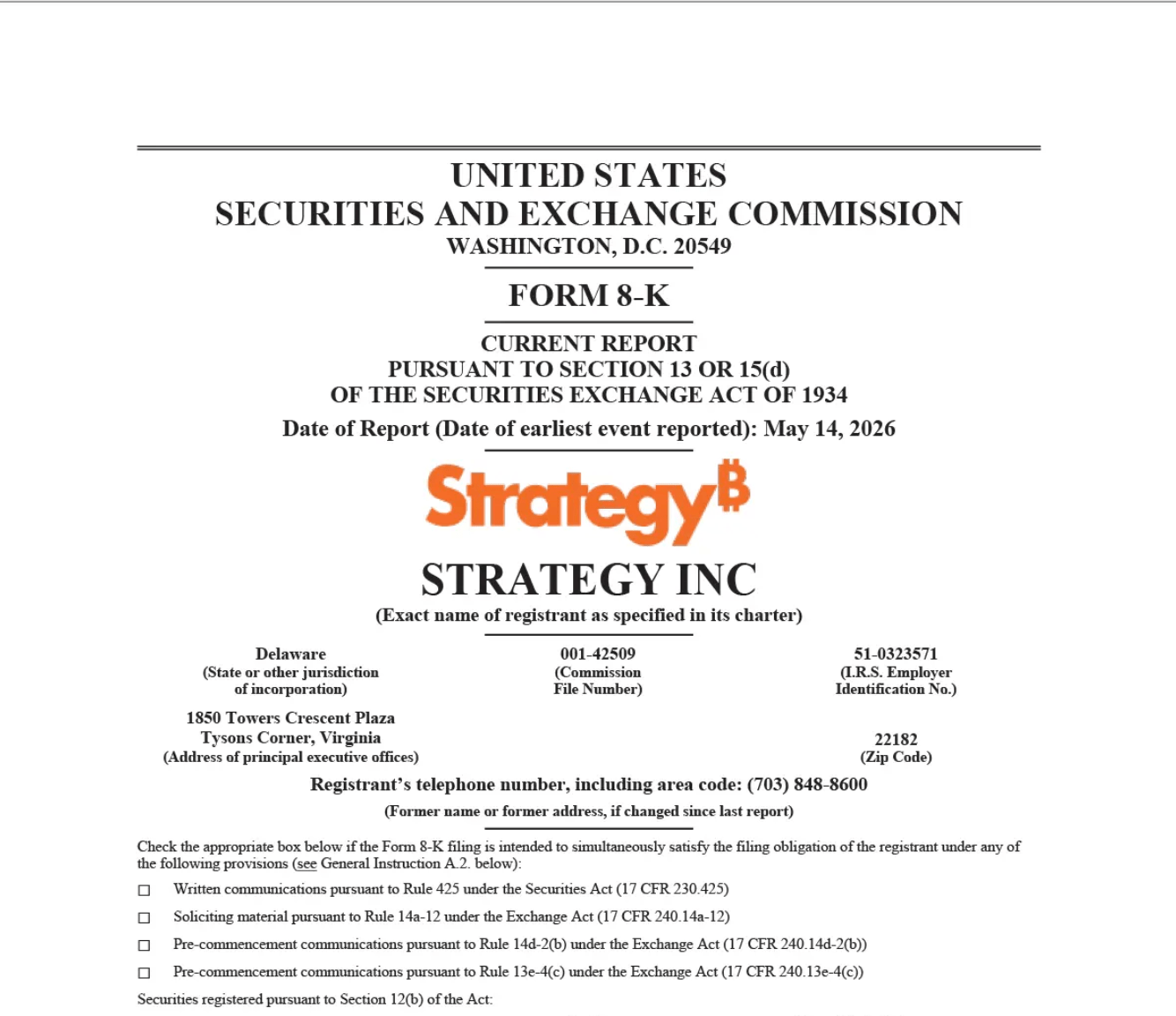
Source: Strategy

The official filing read:

The final aggregate cash repurchase price for the Repurchased Notes is subject to adjustment, and will be based in part on the daily volume-weighted average price per share of Strategy’s class A common stock, par value $0.001 per share (the “Class A Common Stock”), during an agreed upon measurement period (the “Measurement Period”).

The Bitcoin treasury firm also revealed that these repurchase transactions will be funded with available cash reserves, proceeds from sales of securities under its at-the-market offering program, and/or proceeds from the sale of Bitcoin. Quite interestingly, this filing comes barely a week after the company’s CEO, Phong Le, highlighted scenarios in which the firm might shed some of its Bitcoin holdings.

According to the executive, this included situations that would increase shareholder value, such as dividend payments. It remains to be seen whether the firm debt repurchase falls into the category of activities that warrants the sale of a portion of its Bitcoin.

Merely looking at the action, retiring these convertible notes could be positive for equity investors, as it means that the hybrid debt instrument holders won’t be able to convert to common stock (and potentially dilute the shareholders). Instead, the repurchase gives Strategy a perfect opportunity to reorganize its balance sheet and capital structure.

Strategy’s STRC Registers Record High Daily Trading Volume

Interestingly, the news of this debt repurchase comes merely a day after STRC, Strategy’s Variable Rate Series A Perpetual Stretch Preferred Stock, posted its highest daily trading volume of $1.53 billion on Thursday, May 14th. This represents a significant jump from the previous record of $1.1 bill reached on April 13.

This trading explosion in STRC, which has been Strategy’s capital-raising instrument for purchasing Bitcoin, could help the firm raise about $735 million to buy BTC. As of this writing, the firm maintains its position as the largest corporate Bitcoin holder, with a stash of 818,869 Bitcoin, worth about $66 billion.

The price of BTC on the daily timeframe | Source: BTCUSDT chart on TradingView

Preguntas relacionadas

QWhat is the Bitcoin treasury firm formerly known as MicroStrategy planning to repurchase?

AThe Bitcoin treasury firm Strategy (formerly MicroStrategy) is planning to repurchase $1.5 billion principal amount of its convertible senior notes due in 2029.

QHow does Strategy plan to fund the repurchase of its convertible notes?

AStrategy plans to fund the repurchase transactions with available cash reserves, proceeds from sales of securities under its at-the-market offering program, and/or proceeds from the sale of Bitcoin.

QWhy could retiring the convertible notes be positive for Strategy's equity investors?

ARetiring the convertible notes could be positive for equity investors because it prevents holders of the debt instrument from converting to common stock, which would potentially dilute the shareholders. It also gives Strategy an opportunity to reorganize its balance sheet and capital structure.

QWhat recent record was set by Strategy's STRC preferred stock, and what could it enable the firm to do?

AStrategy's STRC (Variable Rate Series A Perpetual Stretch Preferred Stock) posted its highest daily trading volume of $1.53 billion on May 14th. This trading activity could help the firm raise about $735 million to buy Bitcoin.

QHow much Bitcoin does Strategy currently hold, and what is its approximate value?

AStrategy currently holds 818,869 Bitcoin, which is worth approximately $66 billion, maintaining its position as the largest corporate Bitcoin holder.

Lecturas Relacionadas

Altcoin Hacked, Leading to Sharp Price Drop! Also Listed on Major Exchanges!

The price of the NES token plummeted significantly following suspicious activity and large sell-offs detected on the network. Blockchain observers suggested that one wallet minted approximately $55 million worth of NES tokens and began selling them on decentralized exchanges. This selling pressure caused the price of NES to drop by up to 40%. According to the data, the address in question still holds around $18 million worth of NES, indicating that market sell-off pressure may continue. Prior to the incident, it was reported that about $12.35 million worth (62.9 million NES tokens) were transferred to the Ethereum mainnet in the morning (Turkish time), with claims that liquidity was withdrawn and tokens were sold on the market later that evening. However, data regarding the $55 million token mint and the transfer of 62.9 million NES tokens has not been independently confirmed. The NESA team confirmed in a statement that they detected malicious activity exploiting a vulnerability in their Layer 1 network originating from Cosmos EVM. They stated they are working to contain the impact, responded promptly, and will restore services after implementing a software patch and additional measures to ensure secure network operation. Nesa also notified all cryptocurrency exchanges and stated deposit operations will resume after necessary work is completed. The article includes a chart showing the NES price decline following the exploit and concludes with a standard disclaimer that this is not investment advice.

cryptonews.ruHace 1 hora(s)

Altcoin Hacked, Leading to Sharp Price Drop! Also Listed on Major Exchanges!

cryptonews.ruHace 1 hora(s)

PeaqOS and World ID Integrate ZK Proofs into Autonomous Robots

The integration of PeaqOS and World ID now allows autonomous machines to verify they are interacting with real, unique individuals without collecting names, photos, or other personal data. This update, available via robotic.sh, enables connected devices to directly request and verify World ID proofs. The system leverages zero-knowledge technology, letting a person prove they are human while maintaining the privacy of their identity. This addresses a key challenge for operators of delivery robots, shared machines, and autonomous systems: how to authenticate a user as genuine without relying on insecure PINs, pickup codes, or traditional identity checks that require personal data collection. Instead of obtaining identifying information, a device receives a cryptographic proof that the user is a real person. PeaqOS acts as a coordination layer, allowing devices to utilize World ID via decentralized identifiers and a device marketplace. A robot can request verification, receive a zero-knowledge proof, and register an auditable record of the interaction—all without exposing underlying personal data. The system also supports uniqueness verification, enabling machines to enforce rules like "one item per person" without maintaining user identity databases. A demonstrated use case involves autonomous medicine delivery: a patient verifies via the World App when placing an order, a pharmacist verifies before loading the medication, and the patient verifies again upon delivery so the robot can confirm the recipient is linked to the order before unlocking the compartment. Similarly, promotional robots could ensure one item per person, and shared vending machines could grant access to verified individuals without requiring accounts or personal data. This integration for PeaqOS-powered robots and devices minimizes the identity information collected or stored while allowing autonomous systems to confirm they are interacting with real humans.

cryptonews.ruHace 2 hora(s)

PeaqOS and World ID Integrate ZK Proofs into Autonomous Robots

cryptonews.ruHace 2 hora(s)

Trading

Spot
活动图片