Bitcoin: The End of 'Faith-Based Trading'

华尔街日报Publicado a 2026-02-05Actualizado a 2026-02-05

Resumen

Bitcoin is undergoing a painful transition from a purely speculative asset to an institutional one, marked by a 40% decline from its October 2025 peak of around $125,000 to approximately $73,000. This signals the end of the "Tinkerbell Effect," where prices were sustained by belief rather than fundamentals. Key drivers include hawkish signals from the Fed, sustained institutional outflows—with U.S. spot Bitcoin ETFs seeing over $30 billion in outflows in January 2026 alone—and stalled regulatory progress, such as the delayed CLARITY Act. Bitcoin has decoupled from traditional assets, falling 11% in January while gold rose 13%, breaking its "digital gold" narrative. Correlation with equities has also dropped significantly. It is testing key technical levels, having broken below the average ETF entry price of $81,600 and approaching the psychologically critical $70,000 mark. Despite a 370% gain since early 2023, the current pullback reflects a withdrawal of speculative excess rather than a fundamental breakdown. The market is shifting from faith-based trading to value anchoring, though Bitcoin’s high volatility remains inherent. Concerns about a potential "crypto winter" persist if declines deepen, especially given Bitcoin’s sensitivity to Federal Reserve liquidity changes. The long-term outlook points to a complex maturation beyond pure speculation.

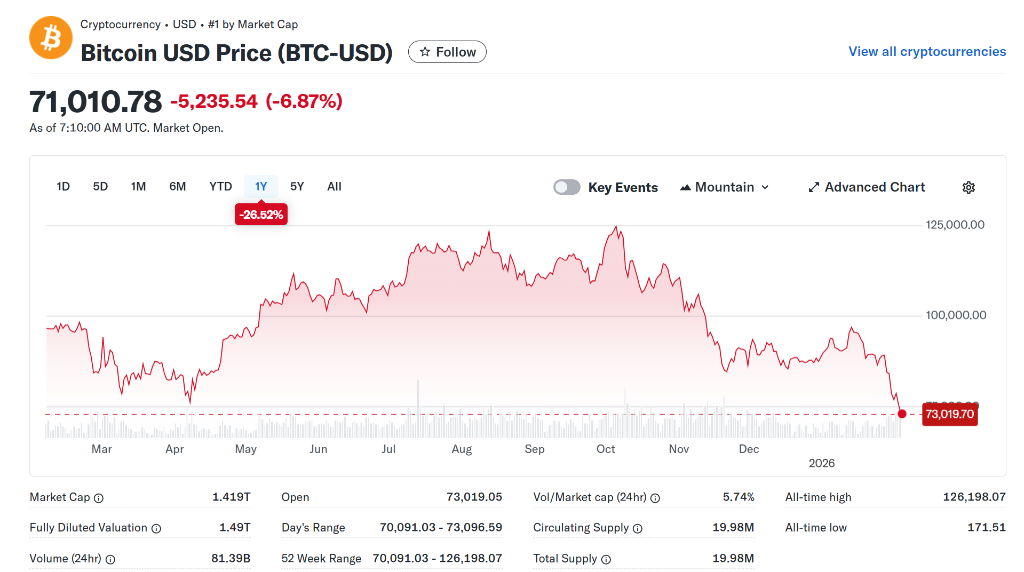
Bitcoin is undergoing a painful transition from a purely speculative asset to an institutionalized asset. The world's largest cryptocurrency fell to around $73,000 on February 3rd, down more than 40% from its peak of approximately $125,000 in October of last year. This marks the end of the so-called "Tinkerbell Effect" phase—a speculative frenzy sustained solely by belief is now receding.

According to Zhui Feng Trading Desk, a report released on the 4th by Deutsche Bank's Marion Laboure team identified three main drivers of this decline: multiple hawkish signals from the Fed, sustained institutional outflows, and stalled regulatory progress. News of Trump nominating Warsh as the next Fed Chair on January 29th triggered a 5.5% single-day drop in Bitcoin, followed by its largest single-day decline since January 2018 of 7.1% on January 31st. Warsh is known for supporting higher real interest rates and reducing the balance sheet.

The price is approaching key technical levels. According to research by Citi analyst Alex Saunders on the 3rd, Bitcoin has fallen below the average entry price of $81,600 for US spot ETFs and is nearing the pre-US election level of around $70,000. Given the current administration's promise to strengthen US leadership in the digital asset space, the $70,000 level is seen as a significant psychological barrier.

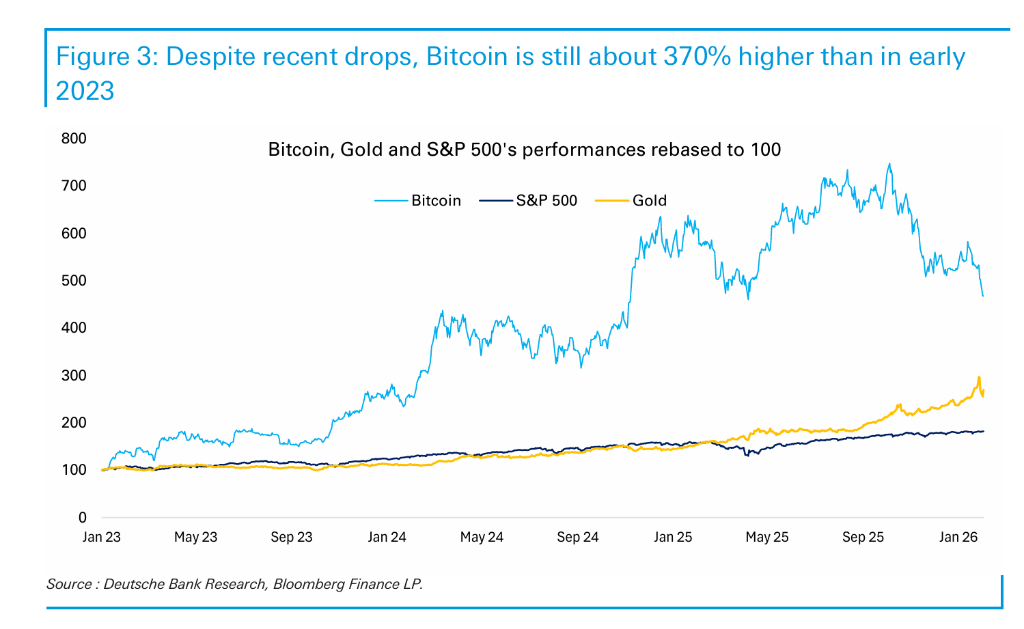
Despite the recent significant drop, Bitcoin is still up about 370% since the beginning of 2023. Deutsche Bank points out that the current adjustment reflects more of a pullback from the speculative gains of the past two years rather than a collapse in fundamentals. However, the crypto market is facing a difficult transition from being "faith-driven" to being "value-anchored".
Sustained Institutional Outflows

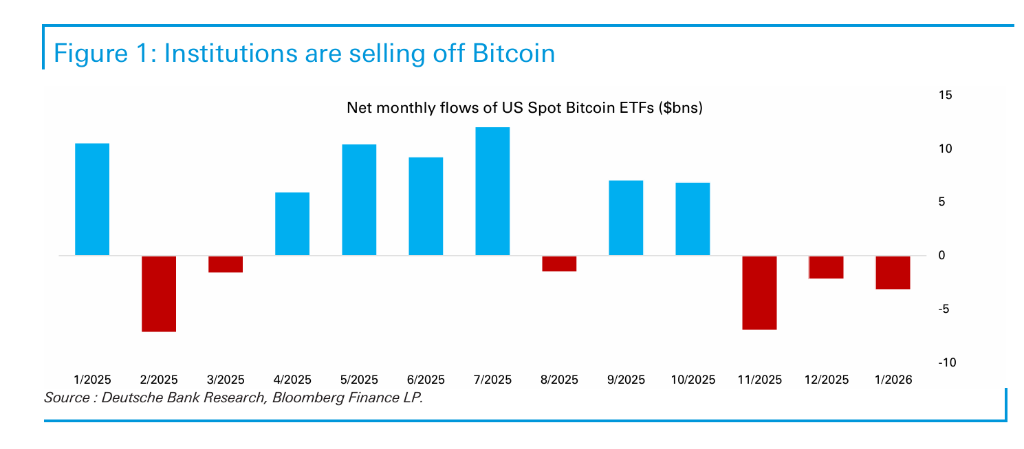
US spot Bitcoin ETFs experiencing large-scale redemptions have become a core factor putting pressure on the price. According to Deutsche Bank data, these funds recorded outflows of over $3 billion in January 2026, approximately $2 billion in December 2025, and around $7 billion in November 2025.

Since the market turned in October 2025, institutional investors have been selling billions of dollars in Bitcoin exposure every month. This sustained selling pressure indicates that traditional investors are losing interest, and overall pessimism towards cryptocurrencies is intensifying. The Crypto Fear & Greed Index has fallen back to around 15 points, indicating "Extreme Fear," nearing the low of 10 points seen in November 2025.

Retail participation is declining simultaneously. Deutsche Bank's own dbDatainsights survey shows that cryptocurrency adoption among US consumers is currently about 12%, down from 17% in July 2025, indicating a broad waning of interest.

Institutions reducing their Bitcoin exposure has led to decreased trading volume, which in turn exacerbates the price decline. Thinner liquidity makes the market react more violently to negative news, creating a vicious cycle.
Decoupling from Traditional Assets

Bitcoin's price movement has significantly diverged from gold's, highlighting the breakdown of its "digital gold" narrative. In January 2026, Bitcoin was one of the few major assets to close lower, falling 11% to $78,197. In contrast, gold rose 13%, and the S&P 500 index gained 1.4%. This was Bitcoin's fourth consecutive monthly decline, its longest losing streak since before the pandemic.

The full-year performance is even starker. Gold recorded a 65% return in 2025, while Bitcoin fell 6.5%. This indicates Bitcoin is no longer serving its role as "digital gold." Notably, although gold has recently shown volatility similar to cryptocurrencies, the fundamental drivers supporting gold demand remain strong—central bank purchases, geopolitical risks, and demand for safe-haven assets.
Correlations with the stock market are also changing. Bitcoin's 30-day correlation with both the Nasdaq and the S&P 500 has fallen to around 15%. In contrast, during the market sell-off in October 2025, Bitcoin's correlation with the Nasdaq was about 57% and with the S&P 500 about 52%—typical levels during previous macro-driven adjustments.

Previously, Bitcoin, due to its 24/7 trading and higher beta, often led equity market weakness. But in this recent decline, particularly in January 2026, Bitcoin performed weakly while equities performed well, indicating its risk-asset属性 is being repriced.
Stalled Regulatory Progress

Despite early legislative progress, regulatory uncertainty has weighed on Bitcoin's performance. The bipartisan-supported Clarity for Digital Asset Markets Act (CLARITY Act) has been stalled in Congress for months. This bill aims to establish a framework for digital asset classification and designate the Commodity Futures Trading Commission (CFTC) as the primary regulator for the industry.

The delay stems from disagreements between cryptocurrency and lobbying groups over how to handle stablecoin rewards. The Senate Finance Committee released a draft but it hasn't gained widespread acceptance, and committee votes have been postponed. The Senate Agriculture Committee has also advanced its version of the bill. According to Bloomberg, the White House has urged relevant lobbying groups to reach an agreement by the end of February.

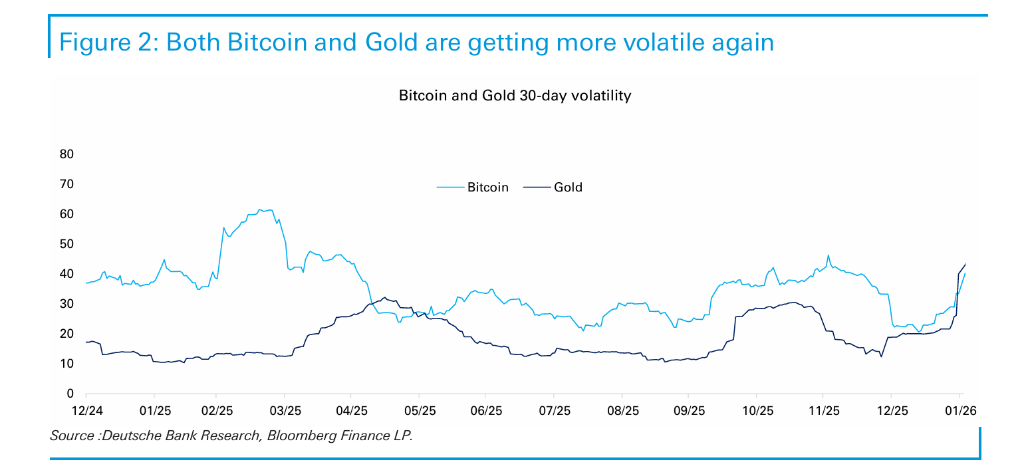
The loss of regulatory momentum has hindered the portfolio integration and liquidity deepening that Bitcoin showed earlier in 2025. According to a previous Deutsche Bank report, early regulatory progress helped lower Bitcoin's volatility in early 2025. Now, Bitcoin's 30-day volatility has rebounded to 40.72, climbing to levels seen in late October, compared to just 26 a week ago.

Citi Research believes the passage of a US market structure bill is a potential catalyst that could change market sentiment and restore inflows. History shows that positive news on regulation is an important factor in boosting investor confidence—ETF inflows increased following both the November 2024 election and the passage of the GENIUS Act in July 2025.

Key Price Levels Approaching

Bitcoin is testing two technical levels closely watched by the market. Citi Research points out that the first is the ETF average entry price of $81,600—calculated as the average based on the largest ETF's daily closing prices. Bitcoin has now fallen below this level, meaning the average holder is at a loss.

The second key level is the pre-US election price of around $70,000. This level holds political and psychological significance. Crypto advocates were enthusiastic donors in the US election, and the current administration has promised to strengthen US leadership in digital assets and established a Bitcoin strategic reserve. This reserve, funded by seized Bitcoin, can only be increased in a "budget-neutral" manner.

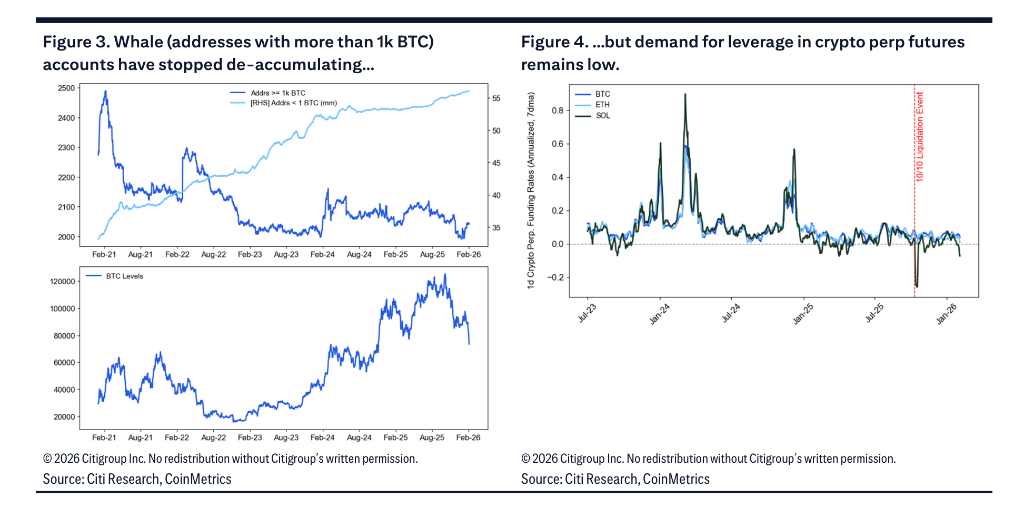
There is still room for long liquidations in the futures market. Although multiple rounds of liquidations have occurred since the sharp rise last October, Citi data shows exchanges are still seeing long positions being closed. Demand for leverage in crypto perpetual futures remains subdued.

It is worth noting that "whale" addresses holding over 1000 Bitcoin have recently stopped reducing their holdings. Citi data shows that these long-term holders, who showed concern about Bitcoin's cyclical weakness in November, have recently halted their selling behavior.
Fed Balance Sheet and "Winter" Concerns

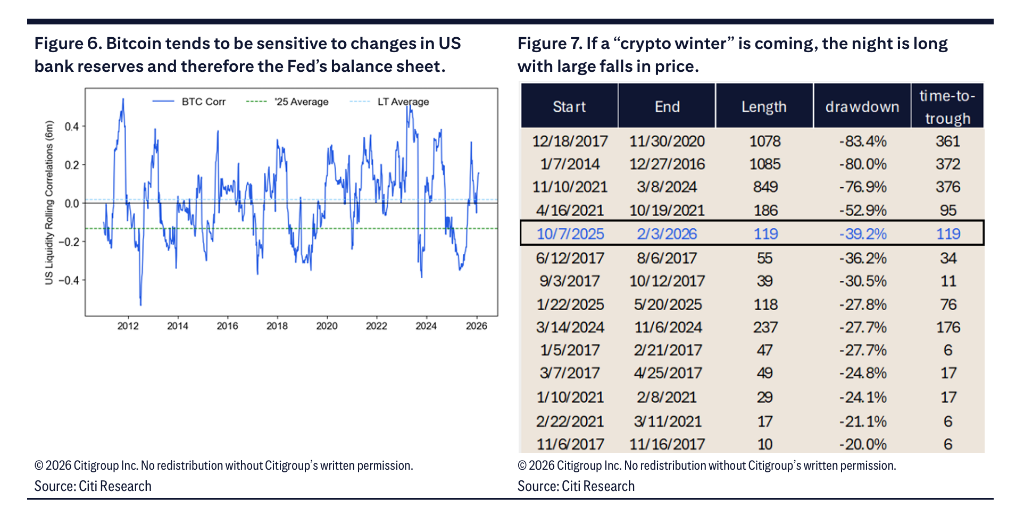
Bitcoin is highly sensitive to US bank liquidity, and a potential reduction of the Fed's balance sheet under Warsh's leadership adds an extra layer of concern. Citi Research shows that Bitcoin tends to be very sensitive to changes in US bank reserves, and therefore to changes in the Fed's balance sheet.

The possibility of a "crypto winter" is also heightening market anxiety. Citi's previous research found that while 20% corrections are common in Bitcoin, the current 40% drop from the all-time high is approaching a critical level—beyond which cryptocurrency bear markets have historically been prolonged and deep "winters".

Citi emphasizes this is not its base case scenario, but historical precedents keep investors vigilant. Past "crypto winters" were characterized by long duration and deep drawdowns, distinct from common 20% corrections.

Deutsche Bank's rates strategists believe a reduction in reserve management purchases is possible. Given the sensitivity of Bitcoin and other digital assets to US bank liquidity, this could constitute an additional headwind.
Long-Term Transition from Speculation to Maturity

Looking back, both 2024 and 2025 were extraordinary years for Bitcoin, but they also raised questions about whether the price had detached from fundamentals. Bitcoin started around $16,000 at the beginning of 2023. 2024 saw strong performance, with the price doubling, driven mainly by: ETF approval (January), the Bitcoin halving (April), positive comments from Trump's campaign on the crypto industry (July-August), and Trump's election (November).

In 2025, Bitcoin's value surged again, reaching $101,000 in January. It was another record year, driven by Trump's continued support and statements (like the Bitcoin reserve) and the GENIUS Act targeting stablecoins, reaching a record $125,000 in October.

While crypto-specific events were key, Bitcoin's price rose about 370% between 2023 and 2025. Deutsche Bank believes this indicates a possible decoupling from its fundamental value. A "bubble" forms when asset prices rise持续快速ly, driven by the hope of even higher prices rather than actual fundamental value, and are often followed by a sharp crash.

Deutsche Bank's conclusion is that Bitcoin is experiencing the end of the so-called "Tinkerbell Effect" phase, transitioning from a purely speculative asset to a more realistic positioning. Bitcoin is not a true means of payment or currency because it lacks the essential characteristics of a medium of exchange, unit of account, or store of value. Therefore, it is unlikely to replace established assets like gold or traditional currencies. Bitcoin's volatility is not a flaw but may be an inherent feature.

~~~~~~~~~~~~~~~~~~~~~~~~

The above精彩 content comes from Zhui Feng Trading Desk.

For more detailed interpretation, including real-time analysis, frontline research, and other content, please join the 【Zhui Feng Trading Desk ▪ Annual Membership

Preguntas relacionadas

QWhat are the three main drivers behind Bitcoin's recent price decline according to Deutsche Bank's report?

AThe three main drivers are hawkish signals from the Federal Reserve, persistent institutional outflows, and stalled regulatory progress.

QHow has the relationship between Bitcoin and traditional assets like gold changed recently?

ABitcoin's price movement has decoupled from gold, with Bitcoin falling 11% in January 2026 while gold rose 13%, breaking the 'digital gold' narrative. Bitcoin also showed weak performance while equities performed well.

QWhat is the significance of the $70,000 price level for Bitcoin mentioned in the article?

AThe $70,000 level is a key psychological and political support level, representing the price before the U.S. election. The current administration had promised to strengthen U.S. leadership in digital assets and established a Bitcoin strategic reserve.

QWhat does the term 'Tinkerbell Effect' refer to in the context of Bitcoin's market behavior?

AThe 'Tinkerbell Effect' refers to a phase where Bitcoin's price was sustained purely by speculative belief and faith rather than fundamental value, which is now coming to an end as the market transitions to a more institutionalized asset.

QHow have U.S. spot Bitcoin ETFs performed in terms of fund flows in recent months?

AU.S. spot Bitcoin ETFs experienced significant outflows, with over $3 billion in January 2026, approximately $2 billion in December 2025, and about $7 billion in November 2025, indicating sustained selling pressure from institutional investors.

Lecturas Relacionadas

VCs on 2025 Crypto Investments: 84% of 118 Tokens Break Issue Price, Only One Type of Company is Quietly Making Money

Crypto investor Ching Tseng categorizes the market into four quadrants based on two axes: crypto-native vs. traditional finance (TradFi)-oriented, and having traction vs. no traction. In 2025, 84.7% of 118 tracked token launches fell below their issuance price, with a median fully diluted valuation drop of 71%. Crypto-native projects without traction are experiencing massive capital destruction, often relying on speculative narratives without sustainable revenue or user retention. Crypto-native teams with traction, often built in prior cycles, generate real revenue but face structural challenges with their tokens lacking direct value capture mechanisms. While some have implemented successful buyback programs, the core issue remains finding growth beyond crypto volatility. TradFi-oriented startups without traction face long, costly enterprise sales cycles but benefit from a robust M&A environment, with crypto acquisitions reaching a record $8.6 billion in 2025. The current winners are TradFi-oriented companies with traction, particularly in the Real World Asset (RWA) tokenization space, which grew from $5.5B to $18.6B in 2025. They are winning through enterprise sales, building alliances, and improving unit economics on established compliance stacks. Their main risk is being bypassed by large incumbent institutions building their own infrastructure. The overarching theme is market maturation, where narrative alone is insufficient for long-term success.

marsbitHace 16 min(s)

VCs on 2025 Crypto Investments: 84% of 118 Tokens Break Issue Price, Only One Type of Company is Quietly Making Money

marsbitHace 16 min(s)

Trading

Spot
Futuros

Artículos destacados

Qué es BITCOIN

Entendiendo HarryPotterObamaSonic10Inu (ERC-20) y Su Posición en el Espacio Cripto En los últimos años, el mercado de criptomonedas ha sido testigo de un aumento en la popularidad de las monedas meme, capturando el interés no solo de los comerciantes, sino también de aquellos que buscan compromiso comunitario y valor de entretenimiento. Entre estos tokens únicos se encuentra HarryPotterObamaSonic10Inu (ERC-20), un proyecto intrigante que mezcla referencias culturales en el tejido de las criptomonedas. Este artículo profundiza en los aspectos clave de HarryPotterObamaSonic10Inu, explorando sus mecanismos, ethos impulsado por la comunidad y su relación con el paisaje cripto más amplio. ¿Qué es HarryPotterObamaSonic10Inu (ERC-20)? Como su nombre sugiere, HarryPotterObamaSonic10Inu es una moneda meme construida sobre la blockchain de Ethereum, clasificada bajo el estándar ERC-20. A diferencia de las criptomonedas tradicionales que pueden enfatizar la utilidad práctica o el potencial de inversión, este token prospera en el valor de entretenimiento y la fuerza de su comunidad. El proyecto tiene como objetivo fomentar un entorno donde los usuarios comprometidos puedan reunirse, compartir ideas y participar en actividades inspiradas por diversos fenómenos culturales. Una característica notable de HarryPotterObamaSonic10Inu es su cero impuestos en las transacciones. Este atractivo elemento tiene como objetivo incentivar el comercio y la participación comunitaria, sin cargos adicionales que puedan disuadir a los comerciantes de pequeña escala. El suministro total de la moneda está establecido en mil millones de tokens, una cifra que marca su intención de mantener una circulación sustancial dentro de la comunidad. Creador de HarryPotterObamaSonic10Inu (ERC-20) Los orígenes de HarryPotterObamaSonic10Inu están algo envueltos en misterio; los detalles sobre el creador siguen siendo desconocidos. El desarrollo de este token carece de un equipo identificable o de un plan explícito, lo cual no es inusual dentro del sector de monedas meme. En cambio, el proyecto ha surgido de manera orgánica, con su progreso muy dependiente del entusiasmo y la participación de su comunidad. Inversores de HarryPotterObamaSonic10Inu (ERC-20) En cuanto a inversiones externas y respaldo, HarryPotterObamaSonic10Inu también sigue siendo ambiguo. El token no lista ninguna fundación de inversión conocida o apoyo organizacional significativo. En cambio, la savia del proyecto es su comunidad de base, que informa su crecimiento y sostenibilidad a través de la acción colectiva y el compromiso en el espacio cripto. ¿Cómo Funciona HarryPotterObamaSonic10Inu (ERC-20)? Como una moneda meme, HarryPotterObamaSonic10Inu opera principalmente fuera de los marcos tradicionales que a menudo rigen el valor de los activos. Hay varios aspectos distintivos que definen cómo funciona el proyecto: Transacciones Sin Impuestos: Sin tarifas impositivas en las transacciones, los usuarios pueden comprar y vender el token libremente sin preocuparse por costos ocultos. Compromiso Comunitario: El proyecto prospera en la interacción comunitaria, aprovechando plataformas de redes sociales para crear entusiasmo y facilitar la participación. Las discusiones, el intercambio de contenido y el compromiso son elementos cruciales que ayudan a expandir su alcance y fomentar la lealtad entre los seguidores. Sin Utilidad Práctica: Cabe señalar que HarryPotterObamaSonic10Inu no ofrece utilidad concreta dentro del ecosistema financiero. Más bien, se clasifica como un token principalmente para actividades de entretenimiento y comunitarias. Referencia Cultural: El token incorpora astutamente elementos de la cultura popular para atraer interés, conectando con entusiastas de los memes y seguidores de las criptomonedas por igual. HarryPotterObamaSonic10Inu ejemplifica cómo las monedas meme operan de manera diferente a los proyectos de criptomonedas más tradicionales, ingresando al mercado como construcciones sociales innovadoras en lugar de activos utilitarios. Cronología de HarryPotterObamaSonic10Inu (ERC-20) La historia de HarryPotterObamaSonic10Inu está marcada por varios hitos notables: Creación: El token surgió de un meme viral, capturando la imaginación de muchos entusiastas de las criptomonedas. Las fechas específicas de creación no están disponibles, subrayando su ascenso orgánico. Listado en Exchanges: HarryPotterObamaSonic10Inu ha llegado a varios exchanges, permitiendo un acceso y comercio más fácil por parte de la comunidad. Iniciativas de Compromiso Comunitario: Actividades continuas destinadas a mejorar la interacción comunitaria, incluyendo concursos, campañas en redes sociales y generación de contenido por parte de fanáticos y defensores. Planes de Expansión Futuros: La hoja de ruta del proyecto incluye el lanzamiento de una colección de NFT, mercancía y un sitio de comercio electrónico relacionado con sus temas culturales, involucrando aún más a la comunidad e intentando añadir más dimensiones a su ecosistema. Puntos Clave Sobre HarryPotterObamaSonic10Inu (ERC-20) Naturaleza Impulsada por la Comunidad: El proyecto prioriza la participación colectiva y la creatividad, asegurando que la involucración de los usuarios esté a la vanguardia de su desarrollo. Clasificación como Moneda Meme: Representa la epítome de las criptomonedas basadas en el entretenimiento, diferenciándose de los vehículos de inversión tradicionales. Sin Afiliación Directa con Bitcoin: A pesar de la similitud en el nombre del ticker, HarryPotterObamaSonic10Inu es distinto y no tiene relación con Bitcoin u otras criptomonedas establecidas. Enfoque en la Colaboración: HarryPotterObamaSonic10Inu está diseñado para crear un espacio para la colaboración y el intercambio de historias entre sus poseedores, proporcionando una vía para la creatividad y el vínculo comunitario. Perspectivas Futuras: La ambición de expandirse más allá de su premisa inicial hacia NFTs y mercancías describe un camino para que el proyecto potencialmente ingrese a avenidas más tradicionales dentro de la cultura digital. A medida que las monedas meme continúan capturando la imaginación de la comunidad de criptomonedas, HarryPotterObamaSonic10Inu (ERC-20) se destaca debido a sus lazos culturales y su enfoque centrado en la comunidad. Si bien puede no encajar en el molde típico de un token impulsado por la utilidad, su esencia radica en la alegría y la camaradería fomentadas entre sus seguidores, destacando la naturaleza en evolución de las criptomonedas en una era cada vez más digital. A medida que el proyecto continúa desarrollándose, será importante observar cómo las dinámicas comunitarias influyen en su trayectoria en el cambiante paisaje de la tecnología blockchain.

1.3k Vistas totalesPublicado en 2024.04.01Actualizado en 2024.12.03

Qué es BITCOIN

Cómo comprar BTC

¡Bienvenido a HTX.com! Hemos hecho que comprar Bitcoin (BTC) sea simple y conveniente. Sigue nuestra guía paso a paso para iniciar tu viaje de criptos.Paso 1: crea tu cuenta HTXUtiliza tu correo electrónico o número de teléfono para registrarte y obtener una cuenta gratuita en HTX. Experimenta un proceso de registro sin complicaciones y desbloquea todas las funciones.Obtener mi cuentaPaso 2: ve a Comprar cripto y elige tu método de pagoTarjeta de crédito/débito: usa tu Visa o Mastercard para comprar Bitcoin (BTC) al instante.Saldo: utiliza fondos del saldo de tu cuenta HTX para tradear sin problemas.Terceros: hemos agregado métodos de pago populares como Google Pay y Apple Pay para mejorar la comodidad.P2P: tradear directamente con otros usuarios en HTX.Over-the-Counter (OTC): ofrecemos servicios personalizados y tipos de cambio competitivos para los traders.Paso 3: guarda tu Bitcoin (BTC)Después de comprar tu Bitcoin (BTC), guárdalo en tu cuenta HTX. Alternativamente, puedes enviarlo a otro lugar mediante transferencia blockchain o utilizarlo para tradear otras criptomonedas.Paso 4: tradear Bitcoin (BTC)Tradear fácilmente con Bitcoin (BTC) en HTX's mercado spot. Simplemente accede a tu cuenta, selecciona tu par de trading, ejecuta tus trades y monitorea en tiempo real. Ofrecemos una experiencia fácil de usar tanto para principiantes como para traders experimentados.

4.6k Vistas totalesPublicado en 2024.12.12Actualizado en 2025.03.21

Cómo comprar BTC

Qué es $BITCOIN

ORO DIGITAL ($BITCOIN): Un Análisis Integral Introducción al ORO DIGITAL ($BITCOIN) ORO DIGITAL ($BITCOIN) es un proyecto basado en blockchain que opera en la red Solana, cuyo objetivo es combinar las características de los metales preciosos tradicionales con la innovación de las tecnologías descentralizadas. Aunque comparte un nombre con Bitcoin, a menudo referido como “oro digital” debido a su percepción como un refugio de valor, ORO DIGITAL es un token separado diseñado para crear un ecosistema único dentro del paisaje Web3. Su meta es posicionarse como un activo digital alternativo viable, aunque los detalles sobre sus aplicaciones y funcionalidades aún están en desarrollo. ¿Qué es ORO DIGITAL ($BITCOIN)? ORO DIGITAL ($BITCOIN) es un token de criptomoneda diseñado explícitamente para su uso en la blockchain de Solana. A diferencia de Bitcoin, que proporciona un papel de almacenamiento de valor ampliamente reconocido, este token parece centrarse en aplicaciones y características más amplias. Aspectos notables incluyen: Infraestructura Blockchain: El token está construido sobre la blockchain de Solana, conocida por su capacidad para manejar transacciones de alta velocidad y bajo costo. Dinámicas de Suministro: ORO DIGITAL tiene un suministro máximo limitado a 100 cuatrillones de tokens (100P $BITCOIN), aunque los detalles sobre su suministro circulante no se han divulgado actualmente. Utilidad: Si bien las funcionalidades precisas no están delineadas explícitamente, hay indicios de que el token podría ser utilizado para diversas aplicaciones, potencialmente involucrando aplicaciones descentralizadas (dApps) o estrategias de tokenización de activos. ¿Quién es el Creador de ORO DIGITAL ($BITCOIN)? En la actualidad, la identidad de los creadores y el equipo de desarrollo detrás de ORO DIGITAL ($BITCOIN) sigue siendo desconocida. Esta situación es típica entre muchos proyectos innovadores dentro del espacio blockchain, particularmente aquellos alineados con las finanzas descentralizadas y fenómenos de monedas meme. Si bien tal anonimato puede fomentar una cultura impulsada por la comunidad, intensifica las preocupaciones sobre la gobernanza y la responsabilidad. ¿Quiénes son los Inversores de ORO DIGITAL ($BITCOIN)? La información disponible indica que ORO DIGITAL ($BITCOIN) no tiene patrocinadores institucionales conocidos ni inversiones destacadas de capital de riesgo. El proyecto parece operar en un modelo de peer-to-peer centrado en el apoyo y la adopción de la comunidad en lugar de rutas de financiamiento tradicionales. Su actividad y liquidez se sitúan principalmente en intercambios descentralizados (DEX), como PumpSwap, en lugar de plataformas de trading centralizadas establecidas, lo que resalta aún más su enfoque de base. Cómo Funciona ORO DIGITAL ($BITCOIN) Los mecanismos operativos de ORO DIGITAL ($BITCOIN) pueden elaborarse en función de su diseño blockchain y atributos de red: Mecanismo de Consenso: Al aprovechar el único proof-of-history (PoH) de Solana combinado con un modelo de proof-of-stake (PoS), el proyecto asegura una validación de transacciones eficiente que contribuye al alto rendimiento de la red. Tokenómica: Si bien los mecanismos deflacionarios específicos no se han detallado extensamente, el vasto suministro máximo de tokens implica que podría atender microtransacciones o casos de uso nicho que aún están por definirse. Interoperabilidad: Existe el potencial de integración con el ecosistema más amplio de Solana, incluyendo varias plataformas de finanzas descentralizadas (DeFi). Sin embargo, los detalles sobre integraciones específicas permanecen no especificados. Cronología de Eventos Clave Aquí hay una cronología que destaca hitos significativos relacionados con ORO DIGITAL ($BITCOIN): 2023: El despliegue inicial del token ocurre en la blockchain de Solana, marcado por su dirección de contrato. 2024: ORO DIGITAL gana visibilidad al estar disponible para trading en intercambios descentralizados como PumpSwap, permitiendo a los usuarios comerciar contra SOL. 2025: El proyecto presencia actividad de trading esporádica y potencial interés en compromisos liderados por la comunidad, aunque no se han documentado asociaciones notables o avances técnicos hasta el momento. Análisis Crítico Fortalezas Escalabilidad: La infraestructura subyacente de Solana soporta altos volúmenes de transacciones, lo que podría mejorar la utilidad de $BITCOIN en varios escenarios de transacción. Accesibilidad: El potencial bajo precio de trading por token podría atraer a inversores minoristas, facilitando una participación más amplia debido a oportunidades de propiedad fraccionada. Riesgos Falta de Transparencia: La ausencia de patrocinadores, desarrolladores o un proceso de auditoría conocidos públicamente puede generar escepticismo sobre la sostenibilidad y confiabilidad del proyecto. Volatilidad del Mercado: La actividad de trading depende en gran medida del comportamiento especulativo, lo que puede resultar en una volatilidad de precios significativa y en incertidumbre para los inversores. Conclusión ORO DIGITAL ($BITCOIN) surge como un proyecto intrigante pero ambiguo dentro del ecosistema de Solana en rápida evolución. Si bien intenta aprovechar la narrativa del “oro digital”, su alejamiento del papel establecido de Bitcoin como refugio de valor subraya la necesidad de una diferenciación más clara de su utilidad y estructura de gobernanza previstas. La aceptación y adopción futura dependerán probablemente de abordar la actual opacidad y de definir sus estrategias operativas y económicas de manera más explícita. Nota: Este informe abarca información sintetizada disponible hasta octubre de 2023, y pueden haber ocurrido desarrollos más allá del período de investigación.

83 Vistas totalesPublicado en 2025.05.13Actualizado en 2025.05.13

Qué es $BITCOIN

Discusiones

Bienvenido a la comunidad de HTX. Aquí puedes mantenerte informado sobre los últimos desarrollos de la plataforma y acceder a análisis profesionales del mercado. A continuación se presentan las opiniones de los usuarios sobre el precio de BTC (BTC).

活动图片