Bitcoin Price Forecast: BTC Aims for $70K Target as Weekly ETF Inflows Surpass $626M

cryptonews.ruPublicado a 2026-08-06Actualizado a 2026-08-06

Resumen

Bitcoin Price Forecast: BTC Targets $70K as Weekly ETF Inflows Surpass $626M Bitcoin is breaking out of a classic "cup and handle" pattern, trading around $64,742 on August 6th. This technical breakout is supported by the daily RSI moving above 50, indicating a shift in momentum towards buyers. Key resistance levels are the 100-day EMA at $66,988 and the 200-day EMA at $72,494, with crucial support at the $62,000 handle level. Fundamentally, spot Bitcoin ETFs have recorded net inflows of $626 million in the first three sessions of the week, already making it the best week since early May. A single day on August 5th saw $244.42 million flow in, led by BlackRock's IBIT. This marks a sharp reversal from the net outflows of the previous week. On-chain data from Glassnode shows the market is in a state of extreme compression, with realized volatility near multi-year lows and call option premiums at record lows, suggesting few traders are positioned for a major move. However, such conditions have historically preceded significant upward breakouts. Analyst Ali Martinez also highlighted that Bitcoin's Net Capital Flows are showing a bullish divergence from price, a signal that marked the cycle bottom before the previous massive rally. **Bullish Target:** A sustained breakout above the $64,000 neckline, fueled by continued strong ETF inflows, could propel BTC toward the 100-day EMA at $66,988. **Bearish Risk:** A failure to hold the $64,000-$64,500 level could invalidate the patt...

Bitcoin is breaking out of a classic cup-and-handle pattern at the $64,742 level on August 6, as spot ETFs have already posted their best week since May, and a cycle bottom signal flashes on net capital flows.

$BTC Breaks Cup and Handle with RSI Above 50
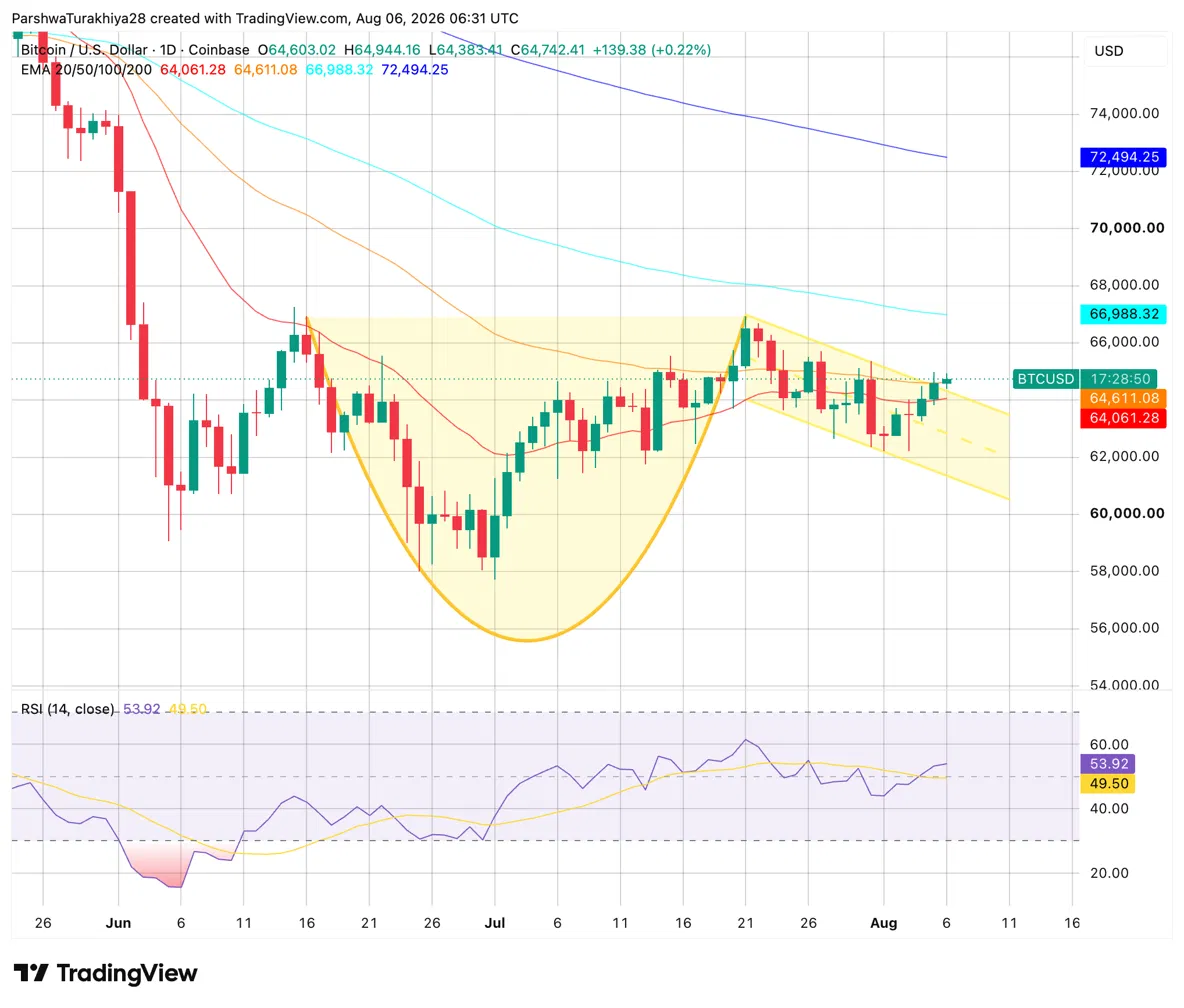
Price action of $BTC (Source: TradingView)

The daily chart shows $BTC completing a 'cup and handle' pattern formed between the June lows around $57,700 and the August recovery. The cup base formed in June and early July, the price recovered to retest the neckline around $65,000, was then pushed back forming the handle between $62,000 and $64,500, and is now breaking above the neckline. Today's session opened at $64,603, rose to $64,944, and is holding at $64,742.

The RSI at 53.92 is above the neutral 50 line for the first time since July's highs, confirming momentum has shifted in favor of buyers. The 20-day EMA at $64,061 and the 50-day at $64,611 are both clustered just below the current price and have been reclaimed.

Related: Zcash Price Forecast for August 2026: ZEC Presses for Triangle Breakout as DCG Buys Mining Site in Nebraska

The 100-day EMA at $66,988 is the next target above, while the 200-day at $72,494 represents the long-term ceiling. Horizontal support at $62,000 is the level that must hold on any pullback to preserve the cup-and-handle structure.

$BTC Support and Resistance Levels for August 6, 2026

Type Price Level
Resistance $66,988 100-day EMA, next major target
Resistance $72,494 200-day EMA, long-term ceiling
Support $64,611 50-day EMA
Support $64,061 20-day EMA
Support $62,000 Cup and Handle Neckline, must hold
Support $57,000 Cup Base, last major floor

Spot ETF Flows Exceed $626M, Two Days Still Remain This Week

Spot Bitcoin ETFs recorded net inflows of $626M over the first three sessions of the week ending August 5, with Wednesday and Thursday yet to close, according to SoSoValue. This already makes it the highest weekly sum since early May, when the week of May 8 brought $622.75M. If the pace holds in the remaining sessions, it will be the best ETF week in roughly three months.

August 5 alone brought $244.42M — the largest day of the week so far. BlackRock's IBIT led with $196.83M, followed by ARK and 21Shares' ARKB with $37.63M, Fidelity's FBTC with $11.28M, and Bitwise's BITB with $10.56M. VanEck's HODL was the only product to record an outflow of $14.67M. Cumulative net inflows across all products now stand at $51.95B with total net assets of $79.21B.

The reversal from the prior week is sharp. The week beginning July 31 recorded a net outflow of $61.53M, driven by one poor day on July 31 itself. The three days since have literally erased that in a single session.

Glassnode: Bitcoin, Unresponsive to Everything

In its latest report, Glassnode describes Bitcoin as a market where bottom signals are building, but the final piece is still missing. On-chain data shows price compression reaching levels that have historically preceded major rallies. The problem is, past recoveries had institutional buyers actively absorbing supply in the background. That is not the case yet: spot ETFs took in just 65,800 $BTC in June — the worst month on record.

The options market reinforces the picture. Traders are paying the lowest amount ever for upside — around 23% implied volatility, while demand for downside protection is also low. Simply put, no one is pricing in a big move in either direction. In Glassnode's view, such quietness typically ends loudly, and when the move happens, most people will not be ready for it and will be chasing price higher rather than already positioned.

Metric Reading What It Means
One-Month Realized Volatility Near multi-year lows Compressions this deep have nearly always resolved upwards
Upside Implied Volatility ~23%, lowest ever No one is paying for upside; The crowd will chase late
June ETF Net Flows Took in just 65,800 $BTC Worst month on record; Demand engine not fully recovered
Seller Exhaustion Constant Inside lower zone Still a third higher than every prior bear cycle level
Coldcard-Related $BTC Movement ~119,000 $BTC moved Price barely reacted; No live bids or offers under the surface

Bitcoin Net Capital Flows Signal Cycle Bottom

BITCOIN MARKET BOTTOM

The last bullish divergence between the $BTC price and Net Capital Flows marked the cycle bottom.

What followed was a bull run from $15,000 to $126,000.

The same signal is back. https://t.co/SxJ0w635qE pic.twitter.com/suckGSld8s

— Ali Charts (@alicharts) August 5, 2026

Analyst Ali Martinez noted on X that Bitcoin's net capital flow is showing the same bullish divergence from price that marked the cycle bottom ahead of the rally from $15,000 to $126,000.

The signal occurs when capital flows turn positive while price remains depressed, and has historically preceded significant recoveries. Ali Charts explicitly noted: the same pattern is back.

Bitcoin Price Forecast: Upside and Downside Targets

Bull Case, Target: $66,988 (100-day EMA)

The cup-and-handle breakout holds above the $64,000 neckline on a daily close, with the RSI holding above 50 confirming the momentum shift. Weekly ETF inflows continuing through Wednesday and Thursday lift the week's total above $700M, indicating a real return of institutional demand. Short liquidations continue to fuel the move, and price advances towards the 100-day EMA at $66,988, fitting Glassnode's historical observation that volatility compressions this deep nearly always resolve to the upside.

Bear Case, Risk Level: $62,000 (Handle Support)

The $64,000–$64,500 neckline fails to hold on a daily close, invalidating the cup and handle. ETF inflows slow in the week's remaining sessions, and Glassnode's warning about the missing demand engine proves prescient as institutional flows fail to materialize. Price pulls back towards handle support at $62,000, where buyers must step in to prevent a deeper retest of the cup base around $57,000.

end-content

Criptos en tendencia

Preguntas relacionadas

QWhat is the key technical chart pattern mentioned in the article that Bitcoin ($BTC) is breaking out of?

AThe key technical chart pattern mentioned is the 'cup and handle' pattern, which is completing between the June low and the August recovery.

QAccording to the article, what milestone did Spot Bitcoin ETFs achieve in the first three sessions of the week ending August 5, 2026?

ASpot Bitcoin ETFs recorded net inflows of $626 million in the first three sessions of that week, which was already the highest weekly amount since early May.

QWhat does the analyst Ali Martinez identify in the Net Capital Flow for Bitcoin, and what is its historical significance?

AAli Martinez identifies a bullish divergence between the Bitcoin price and Net Capital Flows. Historically, this same signal marked the cycle bottom before a bull run from $15,000 to $126,000.

QBased on the bullish case outlined in the article, what is the initial price target for Bitcoin ($BTC) and what indicator does it correspond to?

AThe initial bullish price target is $66,988, which corresponds to the 100-day Exponential Moving Average (EMA).

QWhat critical support level must hold to maintain the bullish structure according to the bearish case described?

AAccording to the bearish case, the critical support level that must hold to maintain the bullish structure is $62,000, which is the support level of the 'handle' in the cup and handle pattern.

Lecturas Relacionadas

Home Furnishing Listed Companies Are Trying to Turn Around with AI and Semiconductors

Chinese home furnishing listed companies are increasingly turning to AI and semiconductor cross-border ventures to revive their fortunes amid declining core businesses. A prominent example is PVC flooring giant **Elegant Home Furnishing**, whose stock price skyrocketed with 10 consecutive trading limits after announcing a plan to acquire a majority stake in **Ou Kang Nuo**, a semiconductor storage testing equipment and services company. Despite Elegant Home's own financial struggles—including recent losses and tight cash flow—the acquisition, funded through asset sales and loans, has dramatically boosted its market value. The deal involves a cross-shareholding structure with Ou Kang Nuo's controlling shareholder. This trend is widespread. Over the past year, numerous home furnishing firms with stagnant main operations have seen their stock prices surge after announcing moves into hot sectors like AI, semiconductors, or computing power. Key cases include: * **Markor Home Furnishings** ("high-end home furnishing first share"), after years of heavy losses, acquired an AI server high-speed copper cable company and later introduced AI computing power investors. * **Zhenai Meijia** ("blanket king") became the first A-listed manufacturer controlled by an AI large model company following a takeover. * **Fasilon** (integrated ceiling) saw its stock soar after establishing an AI subsidiary. * **Jinlong Decoration** experienced multiple trading limits after being linked to "commercial aerospace" and "AI computing," despite clarifying these segments contribute less than 1% of its business. Statistics show over 20 A-share companies announced semiconductor crossovers in 2025, with home furnishing and building materials firms being the most active. This shift is largely driven by pressures from the real estate downturn, shrinking overseas demand, and trade tariffs, pushing companies to seek growth through trendy concepts rather than core business improvement. However, the article warns that such speculative frenzies often end when the hype fades, leaving stock prices to eventually reflect the companies' weak fundamentals, as seen in Jinlong Decoration's subsequent sharp price correction. The repeated attempts to "ride the trend" highlight a desperate struggle for survival in a challenging traditional industry.

marsbitHace 17 min(s)

Home Furnishing Listed Companies Are Trying to Turn Around with AI and Semiconductors

marsbitHace 17 min(s)

"Sell America" Trade Resurfaces: Global Funds Reprice Washington Policy Risks, Dollar and Treasuries Bear the Brunt

"Sale of America" Trade Resurges as Global Funds Reprice Washington Policy Risks, Hitting Dollar and Treasuries First Recent policy signals from Washington are prompting global bond and foreign exchange investors to reignite the "Sale of America" debate. Uncertainty stems from Fed Chair Wash's shift towards less policy communication, Treasury Secretary Bessant's approval of joint intervention with Japan to support the Yen (the first such coordinated move in nearly 30 years), expanding fiscal deficits, and trade war fears. These factors are undermining confidence in U.S. assets. The 30-year Treasury yield recently broke above 5%, hitting a high not seen since 2007, while the Bloomberg Dollar Spot Index has fallen about 2% from its June peak. This dollar weakness is unusual given still-high U.S. interest rates. Investors cite policy uncertainty as a key driver, with one manager calling the Fed Chair and Treasury Secretary a "double whammy" creating a "Trump administration premium." While the S&P 500 continues hitting record highs and foreign holdings of U.S. Treasuries remain high, parts of the bond and FX markets are adjusting. A core concern is whether the Fed under Wash can effectively anchor inflation expectations; analysts warn that if the Fed lags the hiking cycle, long-end yields could face further upward pressure. The 30-year term premium has risen sharply. The U.S.-backed Yen intervention has also sparked debate on the dollar's structural outlook. While framed by Bessant as a "reallocation of reserves," market participants caution that if Japan—America's largest foreign creditor—must sell Treasuries to fund interventions, ripple effects could hit the bond market. Strategists predict moderate dollar depreciation ahead. Most experts are not predicting an end to dollar hegemony or the safe-haven status of Treasuries. However, a key underlying risk is highlighted: the pace of foreign buying of U.S. debt may not keep up with the speed of American borrowing, gradually eroding the structural advantages that have long supported "American exceptionalism."

marsbitHace 18 min(s)

"Sell America" Trade Resurfaces: Global Funds Reprice Washington Policy Risks, Dollar and Treasuries Bear the Brunt

marsbitHace 18 min(s)

Trading

Spot

Artículos destacados

Qué es BITCOIN

Entendiendo HarryPotterObamaSonic10Inu (ERC-20) y Su Posición en el Espacio Cripto En los últimos años, el mercado de criptomonedas ha sido testigo de un aumento en la popularidad de las monedas meme, capturando el interés no solo de los comerciantes, sino también de aquellos que buscan compromiso comunitario y valor de entretenimiento. Entre estos tokens únicos se encuentra HarryPotterObamaSonic10Inu (ERC-20), un proyecto intrigante que mezcla referencias culturales en el tejido de las criptomonedas. Este artículo profundiza en los aspectos clave de HarryPotterObamaSonic10Inu, explorando sus mecanismos, ethos impulsado por la comunidad y su relación con el paisaje cripto más amplio. ¿Qué es HarryPotterObamaSonic10Inu (ERC-20)? Como su nombre sugiere, HarryPotterObamaSonic10Inu es una moneda meme construida sobre la blockchain de Ethereum, clasificada bajo el estándar ERC-20. A diferencia de las criptomonedas tradicionales que pueden enfatizar la utilidad práctica o el potencial de inversión, este token prospera en el valor de entretenimiento y la fuerza de su comunidad. El proyecto tiene como objetivo fomentar un entorno donde los usuarios comprometidos puedan reunirse, compartir ideas y participar en actividades inspiradas por diversos fenómenos culturales. Una característica notable de HarryPotterObamaSonic10Inu es su cero impuestos en las transacciones. Este atractivo elemento tiene como objetivo incentivar el comercio y la participación comunitaria, sin cargos adicionales que puedan disuadir a los comerciantes de pequeña escala. El suministro total de la moneda está establecido en mil millones de tokens, una cifra que marca su intención de mantener una circulación sustancial dentro de la comunidad. Creador de HarryPotterObamaSonic10Inu (ERC-20) Los orígenes de HarryPotterObamaSonic10Inu están algo envueltos en misterio; los detalles sobre el creador siguen siendo desconocidos. El desarrollo de este token carece de un equipo identificable o de un plan explícito, lo cual no es inusual dentro del sector de monedas meme. En cambio, el proyecto ha surgido de manera orgánica, con su progreso muy dependiente del entusiasmo y la participación de su comunidad. Inversores de HarryPotterObamaSonic10Inu (ERC-20) En cuanto a inversiones externas y respaldo, HarryPotterObamaSonic10Inu también sigue siendo ambiguo. El token no lista ninguna fundación de inversión conocida o apoyo organizacional significativo. En cambio, la savia del proyecto es su comunidad de base, que informa su crecimiento y sostenibilidad a través de la acción colectiva y el compromiso en el espacio cripto. ¿Cómo Funciona HarryPotterObamaSonic10Inu (ERC-20)? Como una moneda meme, HarryPotterObamaSonic10Inu opera principalmente fuera de los marcos tradicionales que a menudo rigen el valor de los activos. Hay varios aspectos distintivos que definen cómo funciona el proyecto: Transacciones Sin Impuestos: Sin tarifas impositivas en las transacciones, los usuarios pueden comprar y vender el token libremente sin preocuparse por costos ocultos. Compromiso Comunitario: El proyecto prospera en la interacción comunitaria, aprovechando plataformas de redes sociales para crear entusiasmo y facilitar la participación. Las discusiones, el intercambio de contenido y el compromiso son elementos cruciales que ayudan a expandir su alcance y fomentar la lealtad entre los seguidores. Sin Utilidad Práctica: Cabe señalar que HarryPotterObamaSonic10Inu no ofrece utilidad concreta dentro del ecosistema financiero. Más bien, se clasifica como un token principalmente para actividades de entretenimiento y comunitarias. Referencia Cultural: El token incorpora astutamente elementos de la cultura popular para atraer interés, conectando con entusiastas de los memes y seguidores de las criptomonedas por igual. HarryPotterObamaSonic10Inu ejemplifica cómo las monedas meme operan de manera diferente a los proyectos de criptomonedas más tradicionales, ingresando al mercado como construcciones sociales innovadoras en lugar de activos utilitarios. Cronología de HarryPotterObamaSonic10Inu (ERC-20) La historia de HarryPotterObamaSonic10Inu está marcada por varios hitos notables: Creación: El token surgió de un meme viral, capturando la imaginación de muchos entusiastas de las criptomonedas. Las fechas específicas de creación no están disponibles, subrayando su ascenso orgánico. Listado en Exchanges: HarryPotterObamaSonic10Inu ha llegado a varios exchanges, permitiendo un acceso y comercio más fácil por parte de la comunidad. Iniciativas de Compromiso Comunitario: Actividades continuas destinadas a mejorar la interacción comunitaria, incluyendo concursos, campañas en redes sociales y generación de contenido por parte de fanáticos y defensores. Planes de Expansión Futuros: La hoja de ruta del proyecto incluye el lanzamiento de una colección de NFT, mercancía y un sitio de comercio electrónico relacionado con sus temas culturales, involucrando aún más a la comunidad e intentando añadir más dimensiones a su ecosistema. Puntos Clave Sobre HarryPotterObamaSonic10Inu (ERC-20) Naturaleza Impulsada por la Comunidad: El proyecto prioriza la participación colectiva y la creatividad, asegurando que la involucración de los usuarios esté a la vanguardia de su desarrollo. Clasificación como Moneda Meme: Representa la epítome de las criptomonedas basadas en el entretenimiento, diferenciándose de los vehículos de inversión tradicionales. Sin Afiliación Directa con Bitcoin: A pesar de la similitud en el nombre del ticker, HarryPotterObamaSonic10Inu es distinto y no tiene relación con Bitcoin u otras criptomonedas establecidas. Enfoque en la Colaboración: HarryPotterObamaSonic10Inu está diseñado para crear un espacio para la colaboración y el intercambio de historias entre sus poseedores, proporcionando una vía para la creatividad y el vínculo comunitario. Perspectivas Futuras: La ambición de expandirse más allá de su premisa inicial hacia NFTs y mercancías describe un camino para que el proyecto potencialmente ingrese a avenidas más tradicionales dentro de la cultura digital. A medida que las monedas meme continúan capturando la imaginación de la comunidad de criptomonedas, HarryPotterObamaSonic10Inu (ERC-20) se destaca debido a sus lazos culturales y su enfoque centrado en la comunidad. Si bien puede no encajar en el molde típico de un token impulsado por la utilidad, su esencia radica en la alegría y la camaradería fomentadas entre sus seguidores, destacando la naturaleza en evolución de las criptomonedas en una era cada vez más digital. A medida que el proyecto continúa desarrollándose, será importante observar cómo las dinámicas comunitarias influyen en su trayectoria en el cambiante paisaje de la tecnología blockchain.

2.5k Vistas totalesPublicado en 2024.04.01Actualizado en 2024.12.03

Qué es BITCOIN

Cómo comprar BTC

¡Bienvenido a HTX.com! Hemos hecho que comprar Bitcoin (BTC) sea simple y conveniente. Sigue nuestra guía paso a paso para iniciar tu viaje de criptos.Paso 1: crea tu cuenta HTXUtiliza tu correo electrónico o número de teléfono para registrarte y obtener una cuenta gratuita en HTX. Experimenta un proceso de registro sin complicaciones y desbloquea todas las funciones.Obtener mi cuentaPaso 2: ve a Comprar cripto y elige tu método de pagoTarjeta de crédito/débito: usa tu Visa o Mastercard para comprar Bitcoin (BTC) al instante.Saldo: utiliza fondos del saldo de tu cuenta HTX para tradear sin problemas.Terceros: hemos agregado métodos de pago populares como Google Pay y Apple Pay para mejorar la comodidad.P2P: tradear directamente con otros usuarios en HTX.Over-the-Counter (OTC): ofrecemos servicios personalizados y tipos de cambio competitivos para los traders.Paso 3: guarda tu Bitcoin (BTC)Después de comprar tu Bitcoin (BTC), guárdalo en tu cuenta HTX. Alternativamente, puedes enviarlo a otro lugar mediante transferencia blockchain o utilizarlo para tradear otras criptomonedas.Paso 4: tradear Bitcoin (BTC)Tradear fácilmente con Bitcoin (BTC) en HTX's mercado spot. Simplemente accede a tu cuenta, selecciona tu par de trading, ejecuta tus trades y monitorea en tiempo real. Ofrecemos una experiencia fácil de usar tanto para principiantes como para traders experimentados.

5.8k Vistas totalesPublicado en 2024.12.12Actualizado en 2026.06.02

Cómo comprar BTC

Qué es $BITCOIN

ORO DIGITAL ($BITCOIN): Un Análisis Integral Introducción al ORO DIGITAL ($BITCOIN) ORO DIGITAL ($BITCOIN) es un proyecto basado en blockchain que opera en la red Solana, cuyo objetivo es combinar las características de los metales preciosos tradicionales con la innovación de las tecnologías descentralizadas. Aunque comparte un nombre con Bitcoin, a menudo referido como “oro digital” debido a su percepción como un refugio de valor, ORO DIGITAL es un token separado diseñado para crear un ecosistema único dentro del paisaje Web3. Su meta es posicionarse como un activo digital alternativo viable, aunque los detalles sobre sus aplicaciones y funcionalidades aún están en desarrollo. ¿Qué es ORO DIGITAL ($BITCOIN)? ORO DIGITAL ($BITCOIN) es un token de criptomoneda diseñado explícitamente para su uso en la blockchain de Solana. A diferencia de Bitcoin, que proporciona un papel de almacenamiento de valor ampliamente reconocido, este token parece centrarse en aplicaciones y características más amplias. Aspectos notables incluyen: Infraestructura Blockchain: El token está construido sobre la blockchain de Solana, conocida por su capacidad para manejar transacciones de alta velocidad y bajo costo. Dinámicas de Suministro: ORO DIGITAL tiene un suministro máximo limitado a 100 cuatrillones de tokens (100P $BITCOIN), aunque los detalles sobre su suministro circulante no se han divulgado actualmente. Utilidad: Si bien las funcionalidades precisas no están delineadas explícitamente, hay indicios de que el token podría ser utilizado para diversas aplicaciones, potencialmente involucrando aplicaciones descentralizadas (dApps) o estrategias de tokenización de activos. ¿Quién es el Creador de ORO DIGITAL ($BITCOIN)? En la actualidad, la identidad de los creadores y el equipo de desarrollo detrás de ORO DIGITAL ($BITCOIN) sigue siendo desconocida. Esta situación es típica entre muchos proyectos innovadores dentro del espacio blockchain, particularmente aquellos alineados con las finanzas descentralizadas y fenómenos de monedas meme. Si bien tal anonimato puede fomentar una cultura impulsada por la comunidad, intensifica las preocupaciones sobre la gobernanza y la responsabilidad. ¿Quiénes son los Inversores de ORO DIGITAL ($BITCOIN)? La información disponible indica que ORO DIGITAL ($BITCOIN) no tiene patrocinadores institucionales conocidos ni inversiones destacadas de capital de riesgo. El proyecto parece operar en un modelo de peer-to-peer centrado en el apoyo y la adopción de la comunidad en lugar de rutas de financiamiento tradicionales. Su actividad y liquidez se sitúan principalmente en intercambios descentralizados (DEX), como PumpSwap, en lugar de plataformas de trading centralizadas establecidas, lo que resalta aún más su enfoque de base. Cómo Funciona ORO DIGITAL ($BITCOIN) Los mecanismos operativos de ORO DIGITAL ($BITCOIN) pueden elaborarse en función de su diseño blockchain y atributos de red: Mecanismo de Consenso: Al aprovechar el único proof-of-history (PoH) de Solana combinado con un modelo de proof-of-stake (PoS), el proyecto asegura una validación de transacciones eficiente que contribuye al alto rendimiento de la red. Tokenómica: Si bien los mecanismos deflacionarios específicos no se han detallado extensamente, el vasto suministro máximo de tokens implica que podría atender microtransacciones o casos de uso nicho que aún están por definirse. Interoperabilidad: Existe el potencial de integración con el ecosistema más amplio de Solana, incluyendo varias plataformas de finanzas descentralizadas (DeFi). Sin embargo, los detalles sobre integraciones específicas permanecen no especificados. Cronología de Eventos Clave Aquí hay una cronología que destaca hitos significativos relacionados con ORO DIGITAL ($BITCOIN): 2023: El despliegue inicial del token ocurre en la blockchain de Solana, marcado por su dirección de contrato. 2024: ORO DIGITAL gana visibilidad al estar disponible para trading en intercambios descentralizados como PumpSwap, permitiendo a los usuarios comerciar contra SOL. 2025: El proyecto presencia actividad de trading esporádica y potencial interés en compromisos liderados por la comunidad, aunque no se han documentado asociaciones notables o avances técnicos hasta el momento. Análisis Crítico Fortalezas Escalabilidad: La infraestructura subyacente de Solana soporta altos volúmenes de transacciones, lo que podría mejorar la utilidad de $BITCOIN en varios escenarios de transacción. Accesibilidad: El potencial bajo precio de trading por token podría atraer a inversores minoristas, facilitando una participación más amplia debido a oportunidades de propiedad fraccionada. Riesgos Falta de Transparencia: La ausencia de patrocinadores, desarrolladores o un proceso de auditoría conocidos públicamente puede generar escepticismo sobre la sostenibilidad y confiabilidad del proyecto. Volatilidad del Mercado: La actividad de trading depende en gran medida del comportamiento especulativo, lo que puede resultar en una volatilidad de precios significativa y en incertidumbre para los inversores. Conclusión ORO DIGITAL ($BITCOIN) surge como un proyecto intrigante pero ambiguo dentro del ecosistema de Solana en rápida evolución. Si bien intenta aprovechar la narrativa del “oro digital”, su alejamiento del papel establecido de Bitcoin como refugio de valor subraya la necesidad de una diferenciación más clara de su utilidad y estructura de gobernanza previstas. La aceptación y adopción futura dependerán probablemente de abordar la actual opacidad y de definir sus estrategias operativas y económicas de manera más explícita. Nota: Este informe abarca información sintetizada disponible hasta octubre de 2023, y pueden haber ocurrido desarrollos más allá del período de investigación.

413 Vistas totalesPublicado en 2025.05.13Actualizado en 2025.05.13

Qué es $BITCOIN

Discusiones

Bienvenido a la comunidad de HTX. Aquí puedes mantenerte informado sobre los últimos desarrollos de la plataforma y acceder a análisis profesionales del mercado. A continuación se presentan las opiniones de los usuarios sobre el precio de BTC (BTC).

活动图片