Bitcoin Price Forecast Breaks Out as Treasury Doubles Bond Buyback Program

cryptonews.ruPublicado a 2026-08-20Actualizado a 2026-08-20

Resumen

Bitcoin price forecasts turned bullish after a decisive breakout from a multi-month consolidation pattern, reaching levels not seen since early June. This surge triggered the largest short squeeze in cryptocurrency history, surpassing the liquidations during the record crash of October 2025. The move was fueled by a combination of technical factors and fundamental news. The U.S. Treasury's announcement to double its bond buyback program to $4 billion was seen as inflationary and positive for hard assets like Bitcoin. Simultaneously, President Trump urged Congress to pass the Clarity Act, providing regulatory tailwinds. Technically, Bitcoin broke out from a symmetrical triangle pattern. Key resistance now lies at the 200-day EMA near $71,479, while support levels include the 20-day and 50-day EMAs around $64,919 and $64,720, respectively. Analyst Benjamin Cowen highlighted the critical test: whether Bitcoin can break through and hold above its bear market resistance band. The short squeeze resulted in approximately $2.74 billion in liquidated short positions within 24 hours. While this forced buying fueled the rally, the key question is whether organic demand can sustain prices above $69,000. The bullish case targets a move toward the 200-day EMA, while failure could see a retracement back to the 50-day EMA support zone.

The $BTC price forecast has turned constructive following a decisive breakout from a multi-month consolidation pattern, reaching levels not seen since early June. This move triggered the largest short squeeze wave in the cryptocurrency's history, even bigger than the shorts liquidated during the record crash in October last year.

Bitcoin Price Analysis: Will the Bitcoin Price Rise After Breaking Through the Bear Market Zone?
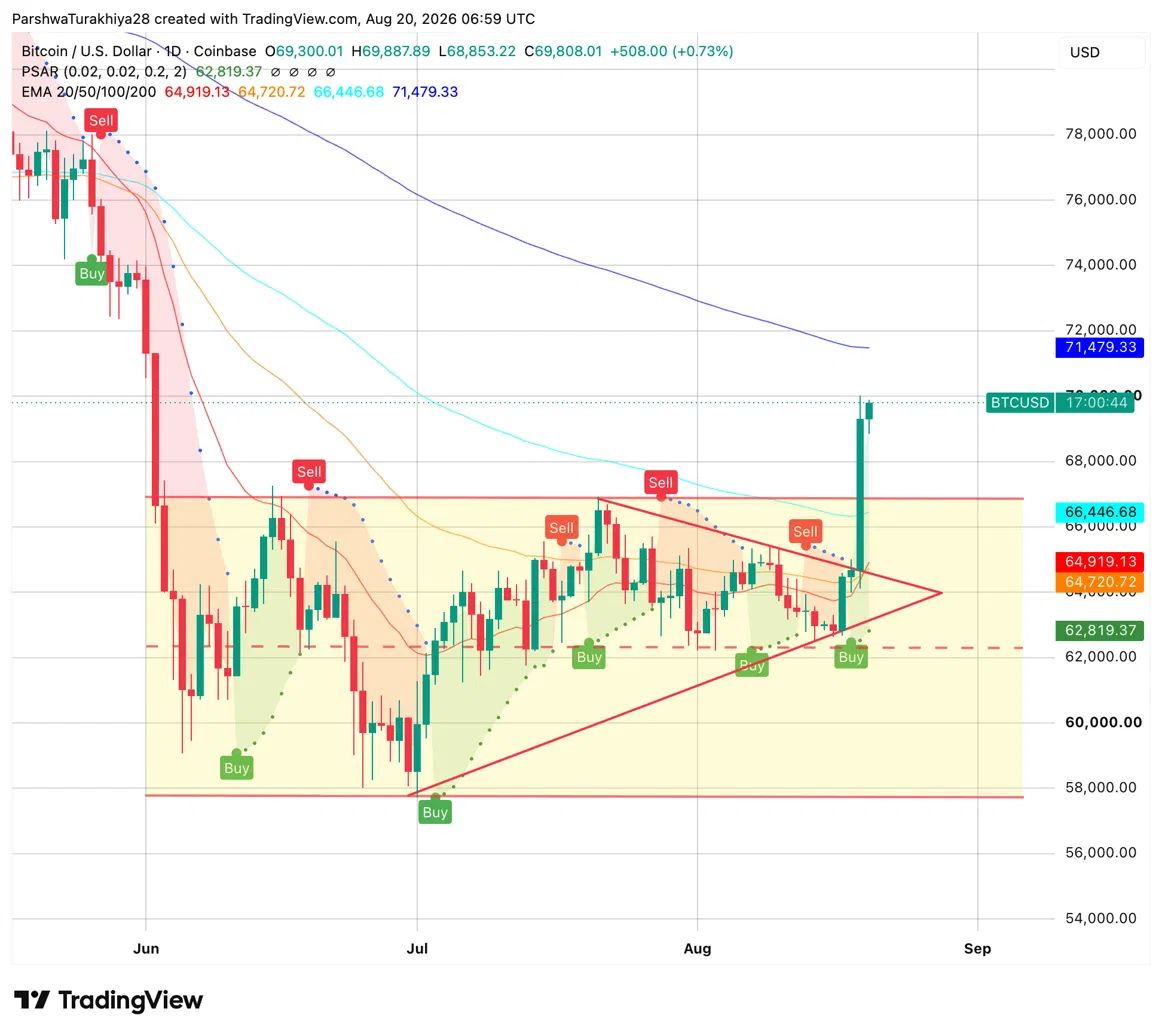
Bitcoin Price Analysis (Source: TradingView)

Since late May, $BTC had been consolidating inside a symmetrical triangle, oscillating roughly between $58,000 and $67,000 as the range gradually narrowed. The price decisively broke above the upper boundary of this triangle this week, surging from a Wednesday low around $64,100 to nearly $69,900 — a move of over $5,700 in a single session.

The Parabolic SAR flipped to the bullish side at $62,819.37, confirming a short-term trend shift. All four EMAs are below the current price for the first time in months: the nearest support is the 20-day EMA at $64,919.13, followed by the 50-day at $64,720.72 and the 100-day at $66,446.68. The 200-day EMA at $71,479.33 lies slightly above the current price and is the next serious obstacle.

Why Cowen Says Bitcoin Faces a Serious Test Here?

Analyst Benjamin Cowen characterized this move as Bitcoin returning to the so-called bear market resistance zone — a zone that has capped all recovery attempts in this cycle.

Cowen noted that Bitcoin closed above its 200-day moving average — historically a mixed signal, sometimes preceding a real trend change, sometimes a false start followed by another step down, as seen in parts of 2014, 2019, and 2022.

Related: Chainlink Price Forecast Hits $14.50, Confirms Cup And Handle Breakout

He noted that the real test is whether Bitcoin can break through this band and hold it as support on a retest, rather than just hitting the top again.

$BTC Support and Resistance Levels, August 20, 2026

Type Price Level
Resistance $69,887.89 Session High
Resistance $71,479.33 200-day EMA
Support $66,446.68 100-day EMA
Support $64,919.13 20-day EMA
Support $64,720.72 50-day EMA
Support $62,819.37 Parabolic SAR

Bitcoin News: Shorts Lost $2.74 Billion in Largest Squeeze Ever

Traders betting against Bitcoin lost nearly $2.74 billion in 24 hours as the price soared toward $70,000 — the largest wave of forced short liquidations on record since 2021, according to CoinGlass data. Total liquidations across crypto reached nearly $3 billion among over 172,000 traders, with shorts accounting for roughly 92% of that amount versus just $257 million on the long side — a ratio of more than ten to one.

A comparison that gives this figure weight relates to October 2025, when Bitcoin crashed over several days after hitting a record high above $126,000, causing $19 billion in liquidations in a single day — until now the largest deleveraging event in crypto history. Shorts made up $2.47 billion of that crash. Wednesday's short liquidations were larger than that entire figure, without comparable damage on the long side.

The squeeze was swift and concentrated. Over $1 billion in Bitcoin shorts were closed in roughly an hour, totaling $1.42 billion for the day. Ethereum shorts accounted for $1.13 billion, and Solana for $104.67 million. The largest single position loss was a $48.8 million Bitcoin trade on Hyperliquid.

Details Value
Total Liquidations (24h) ~$3 Billion
Short Liquidations $2.74 Billion (92%)
Long Liquidations $257 Million
Traders Liquidated 172,108
Largest Single Position $48.8M $BTC Trade, Hyperliquid
Comparison Larger than record crash shorts of October 2025 ($2.47B)

Bitcoin News: Treasury Doubles Bond Buybacks, Trump Pushes Clarity Act

Bitcoin is surging hard on the news that the U.S. Treasury is going to buy back $4B of debt to "increase liquidity support by at least double"

Welcome back, money printing 🫡 https://t.co/3qGeR5vGEU pic.twitter.com/2ETPGLppCH

— Joe Consorti (@JoeConsorti) August 19, 2026

Analyst Joe Consorti pointed to the Treasury Department's announcement as a direct trigger for Bitcoin's action, noting that the Treasury will buy back $4 billion in long-term government debt to increase liquidity, doubling the previous $2 billion for bonds maturing in 10–30 years. Traders perceive this as inflationary and bullish for hard assets like Bitcoin, leading to lower bond yields and a 0.8% drop in the dollar index.

JUST IN: 🇺🇸 President Trump says "We need Congress to take the next step by passing The Clarity Act."

"And this landmark structure legislation is very, very powerful structure which will keep us ahead of China, keep us ahead of everyone else." pic.twitter.com/0BwWWQcySP

— Bitcoin Magazine (@BitcoinMagazine) August 19, 2026

Separately, President Trump urged Congress to pass the Clarity Act, calling the crypto market structure legislation powerful and necessary for the U.S. to stay ahead of China and other nations in the space.

Bitcoin Derivatives: Watch Whether $69,000 Holds

With the bulk of short positioning already cleared out, the key question is whether Bitcoin can hold ground above $69,000 in the coming sessions.

Such a large squeeze exhausts the positioning that fueled the rally, and moves driven by forced buying rather than fresh organic demand have historically given back some of their gains after the squeeze pressure subsides.

$BTC Price Forecast: Upside and Downside Targets

Bullish Scenario, Target: $71,479.33 (200-day EMA)

$BTC holding above $69,000 in Asian and European sessions confirms the breakout was not just a short-squeeze fade. Treasury liquidity support and progress on the Clarity Act add fundamental tailwinds, and a daily close holding the bear market resistance band as support — a scenario Cowen highlighted as a key signal — would bolster the case for continuation. Overcoming this zone opens a path to the 200-day EMA at $71,479.33.

Bearish Risk, Risk Level: $64,720.72 (50-day EMA)

Bitcoin is rejected again at the bear market resistance, matching the trend Cowen highlighted in 2018 and 2022 where similar-scale rallies, as late as August, ultimately failed and gave way to lower prices later in the year. With the short-covering fuel spent, the rally loses momentum without fresh buys, and $BTC falls through the 20-day EMA at $64,919.13 to the 50-day EMA at $64,720.72.

Conclusion

This rally has two distinct engines: the Treasury liquidity move, which gave bulls a real fundamental reason to buy, and the short squeeze, which then mechanically amplified the move after the price rose


Frequently Asked Questions

end-content

Preguntas relacionadas

QWhat is the immediate next key resistance level for Bitcoin according to the article?

AThe immediate next key resistance level for Bitcoin is the 200-day EMA at $71,479.33.

QWhat event triggered the massive Bitcoin short squeeze described in the article?

AThe massive short squeeze was triggered by Bitcoin's price breaking out of a multi-month consolidation pattern and surging past $69,000, forcing traders who had bet against the price to cover their positions.

QWhat fundamental news event is cited as a direct trigger for Bitcoin's price surge?

AThe U.S. Treasury's announcement that it would double its bond buyback program to $4 billion, which traders perceived as inflationary and bullish for hard assets like Bitcoin.

QAccording to analyst Benjamin Cowen, what is the true test for Bitcoin's current rally?

AThe true test is whether Bitcoin can break through its bear market resistance zone and then successfully hold it as support on a retest, rather than just topping out there again.

QWhat was the total value of liquidations across the cryptocurrency market during the 24-hour period mentioned?

AThe total value of liquidations across the cryptocurrency market was approximately $3 billion, with short liquidations making up $2.74 billion (92%) of that total.

Lecturas Relacionadas

Gold Diggers in Prediction Markets: From Competing for Trading Entrances to Competing for Outcome Definition Rights

The report identifies a shift in prediction market competition from front-end user acquisition to back-end infrastructure, specifically the "outcome layer." This layer encompasses the standardized services for rule comparison, evidence verification, outcome confirmation, and payment triggering. Analysis shows that while a tiny fraction (0.487%) of markets face disputes, they account for a significant share (8.64%) of traded volume. This highlights the financial impact of rule uncertainty, which creates trading alpha but limits strategy capacity due to shallow order books. The larger opportunity lies in productizing these backend functions. Services like automated settlement (e.g., HIP-4), AI-assisted evidence processing, and external data oracles (e.g., Pyth, Chainlink) are becoming reusable, cross-platform infrastructure. This is creating a "second profit pool" separate from trading fees. Current observable revenue for this outcome layer is estimated at $15-37 million annually. If applied to the entire existing market, this could expand to $64-161 million. In a mature state, modeled after existing commercial models like Azuro's, annual revenue potential could reach approximately $456 million. While the industry logic is forming, pure-play investment assets are still early. Platform equities (e.g., Kalshi, Polymarket) price in broad growth, not just the outcome layer. Tokens like HYPE have minimal fee contribution from related products, and ICE's exposure is too small relative to its total business. The key is to track early projects that achieve cross-platform adoption and convert usage into attributable, recurring revenue. The most significant alpha may emerge before the ideal investment target is fully established.

marsbitHace 19 min(s)

Gold Diggers in Prediction Markets: From Competing for Trading Entrances to Competing for Outcome Definition Rights

marsbitHace 19 min(s)

Bitcoin Surpasses $72k. What Happens Next?

Bitcoin exceeded $72,000, reaching its highest level since early summer after a $8,000 surge. The broader crypto market followed, with total market capitalization rising 10%. Analysts attribute the rally to a combination of factors: the U.S. Treasury's decision to increase purchases of long-term government bonds, which lowers yields and makes riskier assets like crypto more attractive, and positive remarks about cryptocurrency from former President Donald Trump. Experts note that while Trump's comments provided an emotional boost, the Treasury's action was a more fundamental driver. However, they caution that significant sustained growth is not assured. High U.S. inflation limits the Federal Reserve's ability to ease policy, and network activity within crypto ecosystems remains low. Competition for capital from sectors like semiconductors and AI also persists. Analysts present mixed short-term forecasts. Some see resistance around $72,000; a breakout could target $76,000-$80,000, but a moderate, localized rise within a longer-term downward trend is deemed more likely. Others identify $69,000-$70,000 as a key support zone. A sustained move above $72,000 could open a path toward $75,000-$78,000, or even $80,000-$82,000 under a strong bullish scenario, with support expected around $66,000-$67,000 on any pullback. The overall outlook is cautiously optimistic, with the recent surge signaling improved sentiment, but a confirmed upward trend requires prices to solidify above current levels.

cryptonews.ruHace 22 min(s)

Bitcoin Surpasses $72k. What Happens Next?

cryptonews.ruHace 22 min(s)

Optimism Developers' Vote Deprives Users of $49 Million Airdrop

On August 19th, the Optimism community approved a proposal to reallocate 546.9 million OP tokens (worth ~$49.7 million) from a reserve for future user airdrops into a new Strategic Ecosystem Fund for development. The vote passed with 17.97 million OP for and 10.93 million against, with a decisive last-minute vote from developer group Test in Prod securing the majority. The funds will now be managed by the Optimism Foundation to foster ecosystem growth, targeting partnerships with blockchains, protocols, and financial firms, and attracting major brands. This marks a strategic shift from broad user acquisition via airdrops to focusing on corporate clients and enterprise solutions (OP Enterprise). The decision does not affect past airdrops, which distributed 269.1 million OP over five rounds. The proposal faced criticism. L2BEAT and delegate cp0x argued the Foundation gains overly broad discretion without sufficient detail on fund use, results measurement, or benefit to OP holders. Critics also noted these tokens were publicly reserved for future user distributions, and their reallocation removes the need for separate community votes on individual Foundation deals. Test in Prod defended its support, stating the reserve is needed for competitive corporate deals where premature disclosure could be detrimental, while urging the Foundation to later disclose aggregate spending and outcomes.

cryptonews.ruHace 22 min(s)

Optimism Developers' Vote Deprives Users of $49 Million Airdrop

cryptonews.ruHace 22 min(s)

Trading

Spot
活动图片