Bitcoin News: ETFs Under Pressure – Record Losses for Investors

bitcoinistPublicado a 2026-02-05Actualizado a 2026-02-05

Resumen

Bitcoin ETFs are facing significant pressure as the cryptocurrency market experiences one of its toughest tests since the launch of US spot ETFs. Bitcoin's price has fallen sharply to around $76,140, well below the average net cost basis of $82,405 for ETF investors. This has resulted in aggregate unrealized losses of approximately $7.31 billion—the largest since the ETFs began trading in January 2024. The decline marks a dramatic shift from mid-2025 when investors held over $80 billion in paper profits. Analysts are watching whether the $82,400 level will act as strong resistance during any recovery, as many may try to exit breakeven. Meanwhile, attention is shifting to Bitcoin Layer-2 solutions like Bitcoin Hyper, which aims to enhance network utility and scalability while offering staking yields up to 38% APY, positioning itself as a potential catalyst for the next market cycle.

The cryptocurrency market is experiencing one of its toughest tests of resilience this week since the launch of the US spot ETFs. After Bitcoin reached new all-time highs for much of the past year, a massive price drop has triggered a chain reaction that is hitting institutional products particularly hard. What was considered an unstoppable price driver for months is now turning into a burden for the entire market structure. As capital flows out of the funds, many market participants are asking the fundamental question of how resilient the cryptocurrency's new investor base really is.

Current data now reveals for the first time the precise extent of the financial imbalance in which many ETF investors currently find themselves.

Bitcoin ETFs: Price Drop Below Cost Basis Forces Rethink

Market dynamics have deteriorated drastically, with US Bitcoin ETFs at the center of the storm. A key indicator of the current panic is the so-called "Cost Basis," i.e., the average purchase price of the ETF shares. Current chart data from Bloomberg Intelligence shows that the Bitcoin price, at around $76,140, has fallen significantly below the Net Cost Basis of $82,405. The discrepancy is even clearer with the Gross Cost Basis, which only considers purchases and is currently at $83,655. This means the leading cryptocurrency is trading significantly below the level at which the bulk of institutional money flowed into the market.

This circumstance is immediately reflected in investor profitability. According to the available data from Bloomberg Intelligence, aggregate Bitcoin ETF holders are in the deepest loss zone since the products launched in January 2024. The average unrealized loss currently amounts to approximately $7.31 billion. This marks a dramatic turning point compared to the summer of 2025, when investors were sitting on paper profits of over $80 billion at times.

Bloomberg analyst James Seyffart emphasizes in this context that Bitcoin ETF holders are collectively facing the biggest losses since the launch, which massively increases the psychological pressure on the market.

The current correction is being interpreted more as a stress test for the long-term conviction of ETF buyers. While the Bitcoin price reached peak values of over $120,000 in October 2025, the recent downward movement has sustainably dampened the euphoria. Nevertheless, the data shows that, despite the billions in losses, there has been no uncontrolled mass capitulation so far. Analysts are now closely watching whether the net cost basis of around $82,400 will act as a massive resistance level in a recovery, as many investors might try to close their positions there without a loss.

Bitcoin L2: New Narratives for 2026?

The current market situation illustrates that the dependence on institutional ETF inflows has brought a new form of volatility into the ecosystem, posing challenges for many investors. As the dust settles around the record outflows, many market participants are already looking towards technological innovations that could create intrinsic value for the network independent of exchange-traded products. In particular, the segment of Bitcoin Layer-2 solutions is coming into focus as a potential catalyst for the next market cycle, as it directly expands the fundamental utility of the leading cryptocurrency.

In this dynamic environment, the project Bitcoin Hyper is currently generating significant attention as it addresses a technological gap that has remained unfulfilled by Bitcoin's pure store-of-value function. The project aims to massively increase the efficiency and scalability of the network through a specialized Layer-2 structure to make Bitcoin usable for a broader range of applications in the decentralized finance (DeFi) space.

Go Directly to the Bitcoin Hyper Presale
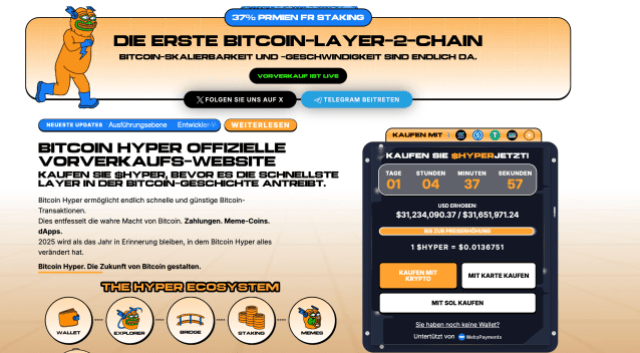
The narrative behind Bitcoin Hyper is closely linked to the community's desire to underpin Bitcoin's dominance with real utility, rather than relying solely on spot market price dynamics. The project is currently showing significant momentum, reflected in an above-average demand during its ongoing funding phase. A key driver for the growing interest is the integrated staking model, which currently promises an annual percentage yield (APY) of 38 percent.

Compared to the broad market average, this figure signals a strong attraction for investors seeking productive yield opportunities within the Bitcoin ecosystem. By combining technical scaling with economic incentives, Bitcoin Hyper distinguishes itself from purely speculative approaches and attempts to establish a sustainable infrastructure for the future Bitcoin network. Interested observers currently have the opportunity to benefit from planned price increases within the presale structure through early participation, which could lead to paper gains.

Go Directly to the Bitcoin Hyper Presale

Preguntas relacionadas

QWhat is the main reason for the current pressure on Bitcoin ETF investors according to the article?

AThe main reason is that Bitcoin's price has fallen significantly below the net cost basis of $82,405 and the gross cost basis of $83,655, meaning most institutional money entered the market at a higher price, putting investors in a loss position.

QWhat is the current aggregate unrealized loss for Bitcoin ETF holders as reported by Bloomberg Intelligence?

AThe current aggregate unrealized loss for Bitcoin ETF holders is approximately $7.31 billion.

QWhat potential role does the net cost basis of $82,400 play in a market recovery, as mentioned in the article?

AAnalysts are watching to see if the net cost basis of $82,400 will act as a major resistance level during a recovery, as many investors might try to close their positions at break-even to avoid losses.

QWhat new technological area is gaining focus as a potential catalyst for the next market cycle, independent of ETFs?

AThe segment of Bitcoin Layer-2 solutions is gaining focus as a potential catalyst, as they aim to expand the fundamental utility of Bitcoin, for example in decentralized finance (DeFi).

QWhat specific feature of the 'Bitcoin Hyper' project is highlighted as a major driver for investor interest?

AA major driver for interest in the 'Bitcoin Hyper' project is its integrated staking model, which currently offers a prospective annual yield (APY) of 38%.

Lecturas Relacionadas

380,000 Apps Exposed, 2,000+ Apps Leaked Secrets: AI Programming Turns 'Intranet' into Public Internet

Israeli cybersecurity firm RedAccess uncovered a severe data exposure trend linked to "vibe coding" or AI-powered software development tools. Their research found approximately 38,000 publicly accessible web applications built with platforms like Lovable, Base44, Netlify, and Replit. Of these, an estimated 2,000 apps exposed sensitive corporate and personal data, including medical records, financial information, internal strategic documents, and customer chat logs. In some cases, access even granted administrative privileges. The core issue stems from default privacy settings that make applications public by default, combined with a lack of built-in security controls (like authentication) in the AI-generated code. This allows employees without security expertise—"citizen developers"—to easily create and deploy applications that bypass standard corporate security reviews. The exposed apps, often indexed by search engines, are trivially discoverable. While some platform providers (Replit, Lovable, Wix/Base44) argue that security configuration is the user's responsibility and question the validity of some findings, security researchers confirm the widespread reality of such exposures. This pattern, also noted in prior studies, highlights a critical security gap as AI democratizes app creation, potentially leading to massive, unintentional data leaks.

marsbitHace 5 min(s)

380,000 Apps Exposed, 2,000+ Apps Leaked Secrets: AI Programming Turns 'Intranet' into Public Internet

marsbitHace 5 min(s)

Attracting Global Capital, Asia's New 'Super Cycle' Is Unfolding

Investors are turning to Asia as the next frontier for global equity growth, with a new "super cycle" unfolding across the region. Driven by the AI revolution, Asian markets, particularly South Korea, have seen significant rallies. According to Morgan Stanley analysis, the underlying drivers of Asia's industrial cycle are shifting from traditional sectors like real estate and manufacturing to massive investments in AI infrastructure, energy security and transition, and supply chain resilience. Fixed asset investment in Asia is projected to grow from around $11 trillion in 2025 to $16 trillion by 2030, with a 7% annual growth rate from 2026-2030. The AI wave is a primary catalyst, driving immense capital expenditure for chips, servers, data centers, and power systems. Asia is central to this hardware supply chain. In China, AI investment is focused on building a full-system domestic capability, with the local AI chip market potentially reaching $86 billion by 2030. Beyond AI, China's export story is expanding from EVs and batteries to robotics. The country already captures about half of new global industrial robot demand and over 90% of humanoid robot shipments. This growth phase mirrors the early stages of China's EV export boom. Simultaneously, energy security investments, spurred by AI's massive power needs, are rising, with China benefiting from its leadership in solar, batteries, and EVs. Regional defense spending is also increasing structurally, supporting demand for advanced manufacturing. The main beneficiaries are China, South Korea, and Japan, positioned in core supply chain areas. However, risks remain, including potential overcapacity, profit margin pressures from competition, persistent technological restrictions, geopolitical friction, and workforce displacement due to AI-driven automation. Market volatility is also expected to increase as investor expectations diverge on the realization of these capital investment and export themes.

marsbitHace 5 min(s)

Attracting Global Capital, Asia's New 'Super Cycle' Is Unfolding

marsbitHace 5 min(s)

Funding Weekly Report | 14 Public Funding Events, Kalshi Completes $10B New Funding Round at $220B Valuation Led by Coatue Management

Weekly Funding Roundup: 14 Deals and $10.49B+ in Total Funding, Led by Kalshi's $1B Round Last week (5.4-5.10) saw 14 notable funding events in the global blockchain ecosystem, raising over $10.49 billion in total. Key highlights include Kalshi, a prediction market platform, securing a $1 billion round led by Coatue Management, reaching a $22 billion valuation. The platform now boasts ~2 million MAUs and $178B in annualized trading volume. In DeFi, regulated on-chain reinsurer OnRe raised $5 million in Series A funding, and Bitcoin-backed credit protocol Saturn Credit completed a $2 million seed round. For Infrastructure & Tools, OpenTrade raised $17 million to expand its stablecoin yield infrastructure, and RWA platform Balcony secured $12.7 million to deploy its property settlement service in the US. Centralized Finance saw one deal: AI-driven trading platform Stockcoin.ai completed a seed round led by Amber Group. In the prediction market sector alongside Kalshi, AI-powered platform Elastics raised $2 million. Other notable deals include SC Ventures' strategic investment in crypto market maker GSR and Centrifuge securing a "seven-figure" investment from Coinbase to become a core RWA partner for Base. On the investor side, Haun Ventures raised a new $1 billion fund targeting crypto and AI, and Multi Investment raised ~$616 million to focus on blockchain and Web3 investments.

marsbitHace 1 hora(s)

Funding Weekly Report | 14 Public Funding Events, Kalshi Completes $10B New Funding Round at $220B Valuation Led by Coatue Management

marsbitHace 1 hora(s)

Trading

Spot
Futuros

Artículos destacados

Cómo comprar ONE

¡Bienvenido a HTX.com! Hemos hecho que comprar Harmony (ONE) sea simple y conveniente. Sigue nuestra guía paso a paso para iniciar tu viaje de criptos.Paso 1: crea tu cuenta HTXUtiliza tu correo electrónico o número de teléfono para registrarte y obtener una cuenta gratuita en HTX. Experimenta un proceso de registro sin complicaciones y desbloquea todas las funciones.Obtener mi cuentaPaso 2: ve a Comprar cripto y elige tu método de pagoTarjeta de crédito/débito: usa tu Visa o Mastercard para comprar Harmony (ONE) al instante.Saldo: utiliza fondos del saldo de tu cuenta HTX para tradear sin problemas.Terceros: hemos agregado métodos de pago populares como Google Pay y Apple Pay para mejorar la comodidad.P2P: tradear directamente con otros usuarios en HTX.Over-the-Counter (OTC): ofrecemos servicios personalizados y tipos de cambio competitivos para los traders.Paso 3: guarda tu Harmony (ONE)Después de comprar tu Harmony (ONE), guárdalo en tu cuenta HTX. Alternativamente, puedes enviarlo a otro lugar mediante transferencia blockchain o utilizarlo para tradear otras criptomonedas.Paso 4: tradear Harmony (ONE)Tradear fácilmente con Harmony (ONE) en HTX's mercado spot. Simplemente accede a tu cuenta, selecciona tu par de trading, ejecuta tus trades y monitorea en tiempo real. Ofrecemos una experiencia fácil de usar tanto para principiantes como para traders experimentados.

230 Vistas totalesPublicado en 2024.12.12Actualizado en 2025.03.21

Cómo comprar ONE

Discusiones

Bienvenido a la comunidad de HTX. Aquí puedes mantenerte informado sobre los últimos desarrollos de la plataforma y acceder a análisis profesionales del mercado. A continuación se presentan las opiniones de los usuarios sobre el precio de ONE (ONE).

活动图片













