Bitcoin Institutional Demand Overtakes BTC Mining Output – Here Are The Figures

bitcoinistPublicado a 2026-04-04Actualizado a 2026-04-04

Resumen

A recent report highlights a significant shift in the Bitcoin market: institutional demand for BTC is now substantially outpacing the supply of newly mined coins. Despite ongoing macroeconomic uncertainty, public companies acquired over 47,000 BTC in March alone—valued at approximately $3.14 billion—nearly doubling the previous month's accumulation. In contrast, only 13,950 BTC were mined during the same period, intensifying Bitcoin’s scarcity narrative. Leading the institutional charge is Michael Saylor’s MicroStrategy, which accounted for 44,377 of the net acquired BTC. This growing demand is further reflected in declining exchange balances, with BTC supply on exchanges dropping to a multi-year low of 14.6% by April 2026. A similar trend is observed in Ethereum, suggesting a broader institutional accumulation pattern. This supply-demand imbalance may serve as a catalyst for Bitcoin’s future price movement.

Bitcoin demand is taking a crucial turn in a market hampered by ongoing negative macroeconomic and political events across the globe. A recent report has outlined an increasing interest and demand for the leading cryptocurrency asset among large companies, which has now significantly exceeded those produced by miners in the market.

More Bitcoin Is Absorbed Than Being Mined

While price direction has been uncertain and unstable for the past few weeks, a growing imbalance is starting to take shape in the Bitcoin market. This imbalance focuses on institutions’ interests in BTC compared to new coins being mined.

On the X platform, a crypto investor known as AltCryptoGems has shared that institutional demand for BTC is rising at a substantial rate despite current unfavorable market conditions. Currently, public companies are scooping up more BTC faster than the rate at which miners are producing new coins.

As it continues to expand, this dynamic is strengthening the scarcity narrative of the flagship asset and reducing the amount of liquidity that is available. Such an imbalance could play a crucial role or act as a catalyst for the asset’s next price move. When large institutions accumulate, it is typically a clear sign of conviction in the asset’s long-term prospects.
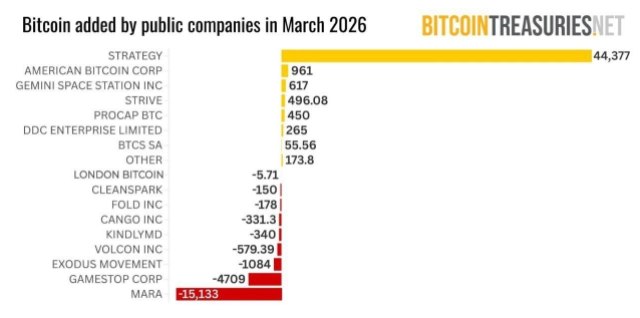
Source: Chart from AltCryptoGems on X

The recently concluded month of March saw a wave of accumulation from these big public firms. In the month alone, the expert revealed that these companies collectively added over 47,000 BTC valued at approximately $3.14 billion at current price levels, to their balance sheets. Leading the charge is Michael Saylor’s Strategy, amassing over 44,377 BTC out of the net acquisition.

When compared to the prior month, this is significantly higher, as it saw over 29,590 BTC being scooped up by public institutions. This shows that institutional interest and demand in BTC nearly doubled within a monthly period. As for Bitcoin mining, only 13,950 BTC were mined during the same period, indicating that demand is currently clouding new supply into the market.

BTC Exchange Balance Is Drying Up Pretty Fast

Despite persistent sideways price action and ongoing volatility, the underlying sentiment toward Bitcoin is turning quite bullish. Investors on cryptocurrency exchanges are steadily taking out their BTC from these platforms. Market expert Leon Waidmann reported that BTC balance on cryptocurrency exchanges is not sitting at its lowest level since 2018.

After a period of steady withdrawals, the total supply of BTC left on exchanges is only 14.6%. From 2019 to 2022, the balance dropped to the 16% to 18% range, and then gradually continued bleeding throughout 2022. Now, 8 years later, the percentage has dropped to 14.6% as of April 2026.

Ethereum, the second-largest cryptocurrency asset, has also witnessed a similar trend, with balances on exchanges now sitting at 11%, its lowest level in years. Both leading assets are at historic lows at the same time, making this period a crucial one for the market as it could notably shift sentiment.

BTC trading at $67,159 on the 1D chart | Source: BTCUSDT on Tradingview.com

Preguntas relacionadas

QAccording to the article, how much Bitcoin did public companies collectively add to their balance sheets in March, and what was its approximate value?

AIn March, public companies collectively added over 47,000 BTC to their balance sheets, valued at approximately $3.14 billion at current price levels.

QWhat does the article state is the significance of large institutions accumulating Bitcoin?

AWhen large institutions accumulate Bitcoin, it is typically a clear sign of conviction in the asset's long-term prospects and can act as a catalyst for its next price move.

QHow does the institutional demand for Bitcoin compare to the new supply from mining, as reported for March?

AInstitutional demand significantly exceeded mining output. While public companies acquired over 47,000 BTC, only 13,950 BTC were mined during the same period.

QWhat trend is reported regarding the balance of Bitcoin on cryptocurrency exchanges?

AThe balance of Bitcoin on cryptocurrency exchanges is at its lowest level since 2018, with only 14.6% of the total supply remaining on exchanges as of April 2026.

QWhich company was highlighted as the largest accumulator of Bitcoin in the recent wave of institutional buying?

AMichael Saylor's company, MicroStrategy, led the charge by amassing over 44,377 BTC out of the net acquisition.

Lecturas Relacionadas

You Bet on the News, the Pros Read the Rules: The True Cognitive Gap in Losing Money on Polymarket

The article explains that the key to profiting on Polymarket, a prediction market platform, lies not just predicting real-world events correctly, but in meticulously understanding the specific rules that govern how each market will be resolved. It illustrates this with examples, such as a market on Venezuela's 2026 leader, where the official rules defining "officially holds" the office overruled the intuitive answer of who was in practical control. Other examples include debates over the definition of a "token" or what constitutes an "agreement." The core argument is that a "reality vs. rules" gap creates pricing discrepancies that savvy traders ("车头" or "whales") exploit. The platform has a formal dispute resolution process managed by UMA token holders to settle ambiguous outcomes. This process involves proposal submission, a challenge window, a discussion period, and a final vote. However, the article highlights a critical flaw in this system compared to a traditional court: the lack of separation between the arbiters (UMA voters) and the interested parties (traders with financial stakes in the outcome). This conflict of interest undermines the discussion phase, leads to herd mentality, and results in opaque final decisions without explanatory rulings. Consequently, the system lacks a body of precedent, making it difficult for users to learn from past disputes. The ultimate takeaway is that success on Polymarket requires a lawyer-like scrutiny of the rules to identify and capitalize on the cognitive gap between how events appear and how they are contractually defined for settlement.

marsbitHace 27 min(s)

You Bet on the News, the Pros Read the Rules: The True Cognitive Gap in Losing Money on Polymarket

marsbitHace 27 min(s)

Will the Fed Still Cut Interest Rates? Tonight's Data Is Crucial

The core debate surrounding the Federal Reserve's potential interest rate cuts is intensifying amid geopolitical conflict and rebounding inflation. The key question is whether high energy prices will cause persistent inflation or weaken consumer demand enough to force the Fed to cut rates. Citigroup presents a bullish case for cuts, arguing that oil supply disruptions from the Strait of Hormuz are temporary and will not lead to lasting inflationary pressure. They point to receding bond yields and oil prices as evidence the market is pricing in a short-lived shock. Citi's data also shows tightening financial conditions, a stabilizing labor market, and healthy tax returns, supporting their view that the path to lower rates remains open. Conversely, Deutsche Bank offers a starkly contrasting, more hawkish outlook. They argue the Fed's current policy is already neutral and expect rates to remain unchanged indefinitely. Their view is based on stalled disinflation progress and a shift toward more hawkish rhetoric from key Fed officials like Waller, who cited risks from prolonged Middle East conflict and tariffs. Other officials, including Williams and Hammack, signaled rates would likely stay on hold for a "considerable time." The market pricing has shifted dramatically, now forecasting zero cuts in 2026. The imminent release of the March retail sales "control group" data is highlighted as a critical test. This metric, which excludes gas station sales, will reveal if high gasoline prices are eroding consumer spending in other areas. A weak reading could support the case for imminent rate cuts, while a strong one would bolster the argument for the Fed to hold steady. This data is pivotal for determining the near-term policy path.

marsbitHace 48 min(s)

Will the Fed Still Cut Interest Rates? Tonight's Data Is Crucial

marsbitHace 48 min(s)

Trading

Spot
Futuros
活动图片