Bitcoin Institutional Demand Overtakes BTC Mining Output – Here Are The Figures

bitcoinistPublicado a 2026-04-04Actualizado a 2026-04-04

Resumen

A recent report highlights a significant shift in the Bitcoin market: institutional demand for BTC is now substantially outpacing the supply of newly mined coins. Despite ongoing macroeconomic uncertainty, public companies acquired over 47,000 BTC in March alone—valued at approximately $3.14 billion—nearly doubling the previous month's accumulation. In contrast, only 13,950 BTC were mined during the same period, intensifying Bitcoin’s scarcity narrative. Leading the institutional charge is Michael Saylor’s MicroStrategy, which accounted for 44,377 of the net acquired BTC. This growing demand is further reflected in declining exchange balances, with BTC supply on exchanges dropping to a multi-year low of 14.6% by April 2026. A similar trend is observed in Ethereum, suggesting a broader institutional accumulation pattern. This supply-demand imbalance may serve as a catalyst for Bitcoin’s future price movement.

Bitcoin demand is taking a crucial turn in a market hampered by ongoing negative macroeconomic and political events across the globe. A recent report has outlined an increasing interest and demand for the leading cryptocurrency asset among large companies, which has now significantly exceeded those produced by miners in the market.

More Bitcoin Is Absorbed Than Being Mined

While price direction has been uncertain and unstable for the past few weeks, a growing imbalance is starting to take shape in the Bitcoin market. This imbalance focuses on institutions’ interests in BTC compared to new coins being mined.

On the X platform, a crypto investor known as AltCryptoGems has shared that institutional demand for BTC is rising at a substantial rate despite current unfavorable market conditions. Currently, public companies are scooping up more BTC faster than the rate at which miners are producing new coins.

As it continues to expand, this dynamic is strengthening the scarcity narrative of the flagship asset and reducing the amount of liquidity that is available. Such an imbalance could play a crucial role or act as a catalyst for the asset’s next price move. When large institutions accumulate, it is typically a clear sign of conviction in the asset’s long-term prospects.
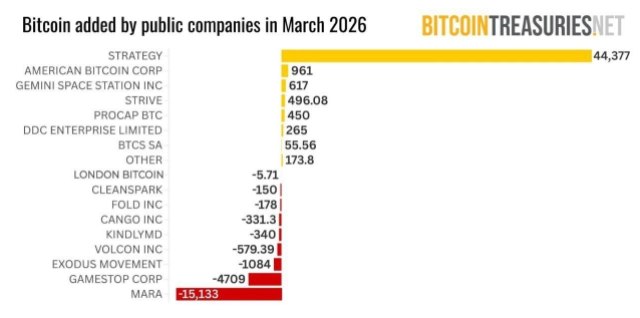
Source: Chart from AltCryptoGems on X

The recently concluded month of March saw a wave of accumulation from these big public firms. In the month alone, the expert revealed that these companies collectively added over 47,000 BTC valued at approximately $3.14 billion at current price levels, to their balance sheets. Leading the charge is Michael Saylor’s Strategy, amassing over 44,377 BTC out of the net acquisition.

When compared to the prior month, this is significantly higher, as it saw over 29,590 BTC being scooped up by public institutions. This shows that institutional interest and demand in BTC nearly doubled within a monthly period. As for Bitcoin mining, only 13,950 BTC were mined during the same period, indicating that demand is currently clouding new supply into the market.

BTC Exchange Balance Is Drying Up Pretty Fast

Despite persistent sideways price action and ongoing volatility, the underlying sentiment toward Bitcoin is turning quite bullish. Investors on cryptocurrency exchanges are steadily taking out their BTC from these platforms. Market expert Leon Waidmann reported that BTC balance on cryptocurrency exchanges is not sitting at its lowest level since 2018.

After a period of steady withdrawals, the total supply of BTC left on exchanges is only 14.6%. From 2019 to 2022, the balance dropped to the 16% to 18% range, and then gradually continued bleeding throughout 2022. Now, 8 years later, the percentage has dropped to 14.6% as of April 2026.

Ethereum, the second-largest cryptocurrency asset, has also witnessed a similar trend, with balances on exchanges now sitting at 11%, its lowest level in years. Both leading assets are at historic lows at the same time, making this period a crucial one for the market as it could notably shift sentiment.

BTC trading at $67,159 on the 1D chart | Source: BTCUSDT on Tradingview.com

Preguntas relacionadas

QAccording to the article, how much Bitcoin did public companies collectively add to their balance sheets in March, and what was its approximate value?

AIn March, public companies collectively added over 47,000 BTC to their balance sheets, valued at approximately $3.14 billion at current price levels.

QWhat does the article state is the significance of large institutions accumulating Bitcoin?

AWhen large institutions accumulate Bitcoin, it is typically a clear sign of conviction in the asset's long-term prospects and can act as a catalyst for its next price move.

QHow does the institutional demand for Bitcoin compare to the new supply from mining, as reported for March?

AInstitutional demand significantly exceeded mining output. While public companies acquired over 47,000 BTC, only 13,950 BTC were mined during the same period.

QWhat trend is reported regarding the balance of Bitcoin on cryptocurrency exchanges?

AThe balance of Bitcoin on cryptocurrency exchanges is at its lowest level since 2018, with only 14.6% of the total supply remaining on exchanges as of April 2026.

QWhich company was highlighted as the largest accumulator of Bitcoin in the recent wave of institutional buying?

AMichael Saylor's company, MicroStrategy, led the charge by amassing over 44,377 BTC out of the net acquisition.

Lecturas Relacionadas

Lowering Expectations for BTC's Next Bull Market

The author, Alex Xu, explains his decision to significantly reduce his Bitcoin holdings (from full to ~30% of his portfolio) during the current bull cycle, citing a lowered long-term outlook for BTC's price appreciation in the next cycle. He outlines six key reasons for this reduced expectation: 1. **Diminished Growth Drivers:** The narrative of exponential user adoption has largely played out with institutional ETF adoption. The next major growth phase—adoption by sovereign national reserves or central banks—seems unlikely in the near future. 2. **Personal Opportunity Cost:** More attractive investment opportunities have emerged in other assets, such as undervalued companies. 3. **Industry-Wide Contraction:** The broader crypto industry is struggling, with most Web3 business models (SocialFi, GameFi, DePIN) failing. This overall萧条 (depression) reduces the fundamental demand and consensus for Bitcoin. 4. **Strain on Major Buyer:** MicroStrategy, a major corporate buyer of BTC, faces rising financing expenses for its debt, which could slow its purchasing rate and create significant marginal pressure on the market. 5. **Increased Competition from Gold:** The emergence of "tokenized gold" has closed the functional gap (portability, divisibility) between physical gold and Bitcoin, offering a strong competitor in the non-sovereign store-of-value space. 6. **Security Budget Concerns:** The block reward halving continues to exacerbate the long-standing issue of funding Bitcoin's network security, with new fee source explorations like Ordinals and L2s largely failing. The author's decision to hold a significant (though reduced) position reflects a cautious, not bearish, outlook. He remains open to increasing his exposure if the fundamental reasons for his skepticism change or if new positive catalysts emerge.

marsbitHace 5 min(s)

Lowering Expectations for BTC's Next Bull Market

marsbitHace 5 min(s)

Can Iran 'Control' the Strait of Hormuz?

Iran has announced a comprehensive plan to assert control over the strategic Strait of Hormuz, a critical global oil shipping chokepoint. The proposed measures include requiring all vessels to obtain Iranian permission for passage, imposing fees for security, environmental protection, and navigation management—preferably paid in Iranian rials—and absolutely banning Israeli ships. Vessels from countries deemed hostile by Iran’s top security bodies may also be barred. Analysts suggest Iran’s motives are multifaceted: increasing pressure on the U.S. and Israel by leveraging control over oil transit to influence global prices and inflation; creating a new revenue stream, potentially exceeding $7.7 billion annually, to counter Western sanctions and support postwar reconstruction; and using transit permissions as bargaining chips in future negotiations, notably with the U.S. However, the plan faces significant practical and diplomatic challenges. Enforcing comprehensive interception and fee collection in the busy waterway, patrolled by international military forces, would be difficult. The U.S. has already countering with a blockade of Iranian ports and threats to intercept any ship paying fees, potentially strangling Iran’s oil exports and fee revenue. Broad international opposition, led by European and Gulf states, and legal controversies further complicate implementation. The proposal may ultimately serve more as a negotiating tactic than a feasible policy, with its execution remaining highly uncertain.

marsbitHace 1 hora(s)

Can Iran 'Control' the Strait of Hormuz?

marsbitHace 1 hora(s)

Trading

Spot
Futuros
活动图片





